Most B2B teams do not have a lead problem. They have a relevance problem. The right-fit buyer exists, the budget often exists, and the pain is real - but the message that reaches them is forgettable, mistimed, or copied from a template that twenty other vendors are also sending. That gap between a prospect being reachable and a prospect being reached well is where modern cold outreach lives.
Cold outreach is the deliberate practice of starting a business conversation with someone who has not asked to hear from you yet. Done well, it is targeted, researched, and respectful of the reader's time. Done poorly, it looks like noise. This guide walks through what cold outreach means in a B2B context, the channels available, how to pick prospects and messages that make sense, and how to shape a workflow your team can run every week without burning out your audience.
→ Explore SalesTarget.ai Email Outreach
What cold outreach actually means in B2B
Cold outreach is any first-touch, outbound communication you initiate with a prospect who has no existing relationship with your company. There is no prior inbound signal — no demo request, no download, no referral. You chose them.
That definition matters because it sets the bar. The prospect owes you nothing. They will decide within a few seconds whether to engage, ignore, or delete. The entire discipline of cold outreach is about earning that short window: picking the right person, writing in a way that respects their context, and giving them a clear, useful reason to reply.
In B2B specifically, cold outreach almost always targets a role rather than a random individual: a VP of operations at a fast-growing logistics company, a head of RevOps at a mid-market SaaS firm, a founder of a 15-person agency. The person matters, but the fit of the person's situation matters more.
Why cold outreach is still a core prospecting discipline
Inbound marketing is strong when it works, but it is not predictable at the account level. You cannot pick which 50 accounts will convert next quarter through content alone. Cold outreach gives sales teams a lever they can actually pull: identify the exact companies and buyers who should be customers, and start the conversation on purpose.
It also compresses the sales cycle for strategic accounts. Rather than waiting for a buyer to self-identify, you reach them at the point when their situation signals readiness — a new hire, a funding round, a product launch, a shift in regulation. The best cold outreach does not create demand out of nothing. It finds demand that is forming and shows up at the right moment.
If you want a dedicated system for the email side of this motion, the email outreach platform at SalesTarget.ai is built to handle the moving parts — AI-assisted sequences, personalization, automated follow-ups, inbox and reply management, and email validation workflows — so the operational load does not eat the strategy.
The cold outreach channels - and when each one earns its place
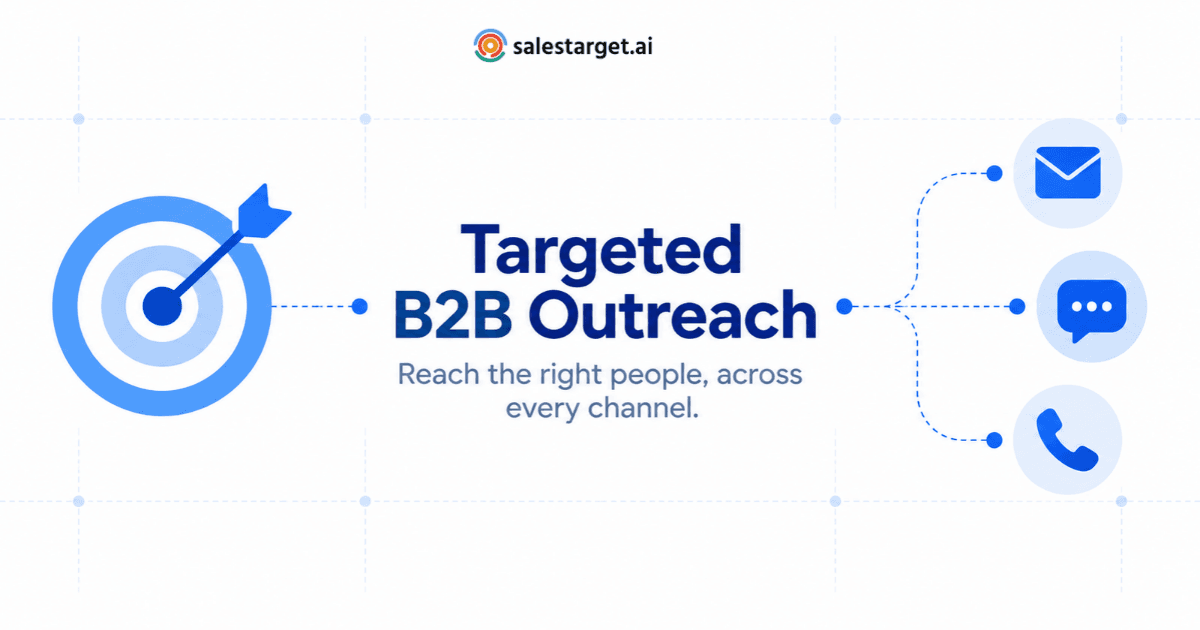
No single channel wins every scenario. The art is matching the channel to the buyer's habits and the message's weight.
Email is the backbone of most B2B cold outreach because it respects the reader's schedule, allows substance, and scales. It is the right default when you have a clear, specific point to make and a reason the prospect would want to see it. Email breaks down when it is used as a volume game disconnected from relevance — generic subject lines, no research, and sequences that keep arriving regardless of whether anyone replied.
LinkedIn and professional networks
LinkedIn works for warming up an account before an email, for referencing something specific the buyer posted, or for reaching people whose inboxes are filtered beyond repair. Connection requests with a one-line context note tend to perform better than long pitch messages. Treat LinkedIn as a conversation layer, not an email replacement.
Phone and voice
The cold call is not dead; it is just more selective. It works best for senior buyers, high-value accounts, or situations where a two-minute conversation can qualify in or out faster than a week of email ping-pong. Voicemail paired with a follow-up email ("just left you a voicemail about X") can meaningfully lift reply rates.
Direct mail and events
For target-account campaigns, physical mail, hand-written notes, or in-person event invitations can cut through when the digital channels are saturated. They are expensive per touch, so reserve them for accounts where the economics clearly justify the cost.
Choosing the right prospects before you write anything
The single biggest lever in cold outreach is who you decide to contact. A great message to the wrong person is worse than silence, because it burns a sender reputation and trains the buyer that your brand sends irrelevant mail.
Start by defining the account profile. Think in terms of industry, company size, business model, tech stack, growth stage, and the specific pain your product solves at that stage. Then layer the buyer profile on top: the role that owns the problem, the role that owns the budget, and the role that will be in the room when the decision is made. Often these are three different people.
Prioritization matters as much as selection. If 1,200 accounts fit your criteria, you cannot treat them identically. Rank them by signals — recent hiring, new product launches, funding events, visible pain, or clear use of a competing or adjacent tool — and let that ranking drive how much effort each tier gets.
Doing the research: finding a reason that is actually relevant
Research is the step most teams compress because it does not scale neatly. But a few minutes of context work changes the message entirely. You are looking for one specific, non-obvious thing: a signal that the problem you solve is probably on this person's mind right now.
That signal can come from almost anywhere: a job posting that implies a capacity gap, a podcast where the executive described a priority, a press release about a new market entry, a change in reporting structure. The point is not to prove you did homework. The point is to open the message with something that would only make sense to send to this particular person.
Writing a first message that respects the reader
A good cold message does three things in order: it earns attention, it offers something worth their time, and it makes the next step easy. The usual failure modes are: too much about you, too many asks, and no reason the reader should care today.
Keep the first message short. Reference the specific context you found. State the one thing you believe is true about their situation. Offer a small, concrete next step - a 15-minute conversation, a short teardown, a resource they can read on their own time. The exact mechanics of writing high-performing cold emails, including sequencing and testing, are covered in detail in the companion guide on cold email outreach strategy. For this article, the key point is that the message is a direct consequence of the research. If the research is thin, no clever structure will save it.
Coordinating channels without overwhelming the buyer
A multi-channel sequence is powerful when it feels like one coherent effort and brutal when it feels like three different people chasing someone. The simplest rule: every touch should either add new information or make it easier for the prospect to respond.
A workable pattern for a mid-tier account might be a researched email, a LinkedIn connection with a short note two days later, a second email that adds a specific resource, a brief voicemail if the account is high priority, and a final soft-close message. Each touch has a job. None of them are a reminder that the previous one existed.
Follow-ups that add new information instead of pressure
Most replies in cold outreach come from follow-ups, not first messages. But "following up" cannot mean "bumping this to the top of your inbox" repeatedly. Buyers tune that out.
Strong follow-ups introduce a new angle each time: a different pain point, a short customer example that mirrors the prospect's situation, a question that reframes the opportunity, or a lightweight asset that is genuinely useful whether or not they ever buy. Three or four well-constructed follow-ups usually outperform ten generic nudges, and they protect the sender's reputation.
Measuring cold outreach with metrics that mean something
Open rates can be misleading, especially with inbox providers inflating them. Reply rates are more honest. Positive reply rates - replies that lead to a next step - are more honest still. Beyond that, track meetings booked, qualified opportunities created, and pipeline sourced per sequence.
Deliverability indicators are also part of the measurement surface: bounce rate, spam complaints, and sender reputation. If deliverability is drifting, no amount of copy work will recover the campaign. Email validation, warm-up practices, and healthy sending volumes belong in the same dashboard as reply rate.
Common mistakes that quietly kill cold outreach performance
- Treating cold outreach as a volume problem instead of a relevance problem.
- Writing to a persona instead of a person - generic enough to fit anyone, specific enough to compel no one.
- Running the same sequence against every segment because changing it feels like extra work.
- Letting one SDR's voice define the entire company's outbound tone across accounts that need different registers.
- Measuring activity (emails sent, calls made) instead of outcomes (positive replies, meetings, pipeline).
- Ignoring the reply inbox. Every reply, even a negative one, is a data point and a human on the other end.
Building a repeatable cold outreach workflow
A workflow is what turns cold outreach from a scramble into a system. The pieces are familiar, but the discipline is in running them every week:
- Define and refresh your target account list on a set cadence.
- Capture buying signals and research notes in one place your team can see.
- Standardize the sequence structure, but keep the message layer flexible per segment.
- Automate the mechanical steps - sending, follow-ups, inbox routing, validation - so the human time goes into research and reply handling.
- Review results weekly against reply rate, meetings, and pipeline, not just send volume.
- Retire sequences that have stopped working and replace them, rather than letting fatigue degrade the brand.
Platforms built specifically for this motion, including cold email outreach software with AI-assisted sequence building, personalized messaging, automated follow-ups, Unibox-style inbox and reply management, and built-in email validation, exist to collapse the operational overhead so the team's time stays on the parts that cannot be automated: picking the right accounts and writing messages worth reading.
Cold outreach is not a trick, and it is not a volume game dressed up with new tooling. It is a discipline: pick the right people, show up with a reason that is clearly theirs, use the channel that fits, and follow up with new information rather than new pressure. The teams that treat it that way build pipeline their inbound funnel cannot replace, and they do it without burning the audience they will have to talk to again next quarter.