TL;DR
- List fatigue is not the same as list decay — it happens when the same accurate, verified contacts receive repeated outreach across campaigns until they mentally check out.
- The clearest signal: reply rates dropping on a list that is still technically clean. Data accuracy is not the problem. Exposure frequency is.
- Standard suppression window: 90 days minimum between outreach touches to the same contact, with re-engagement only if the angle or offer has meaningfully changed.
- The fix is not more personalization on the same list — it is introducing net-new contacts that have never been touched by your campaigns.
- List rotation and real-time prospect discovery are the only durable solutions to list fatigue at scale.
Your list is clean. Bounces are low. Deliverability looks healthy. But reply rates are falling with each campaign you run to the same contacts. So you tweak the subject line. Rewrite the first paragraph. Try a different sending window. Still falling. This is not a copywriting problem. It is not a deliverability problem. It is list fatigue — and most teams do not even know it has a name.
Here is what it is, how to spot it early, and the only way to fix it that actually works.
List Decay and List Fatigue: Two Different Problems, One Shared Symptom
These two problems are frequently conflated, and that conflation leads teams to apply the wrong fix. Understanding the distinction is the starting point for everything else.
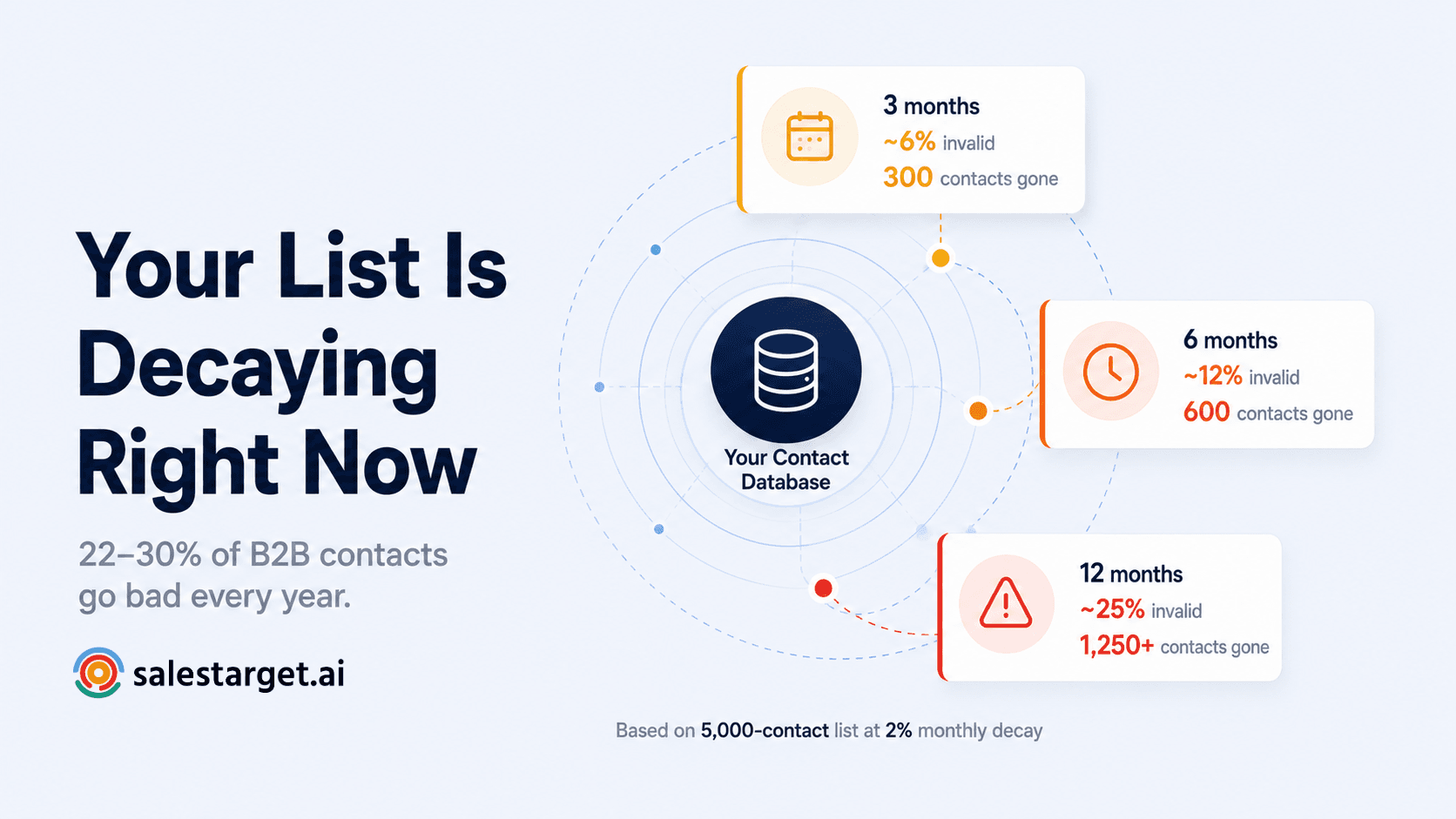
List decay is a data quality problem. It happens when contact information goes stale — people change jobs, companies merge, email addresses break. B2B data decays at roughly 2% per month, which means a 12-month-old list has lost meaningful accuracy before you even launch the campaign. The symptom is hard bounces, undeliverables, and contacts who no longer hold the job title you targeted.
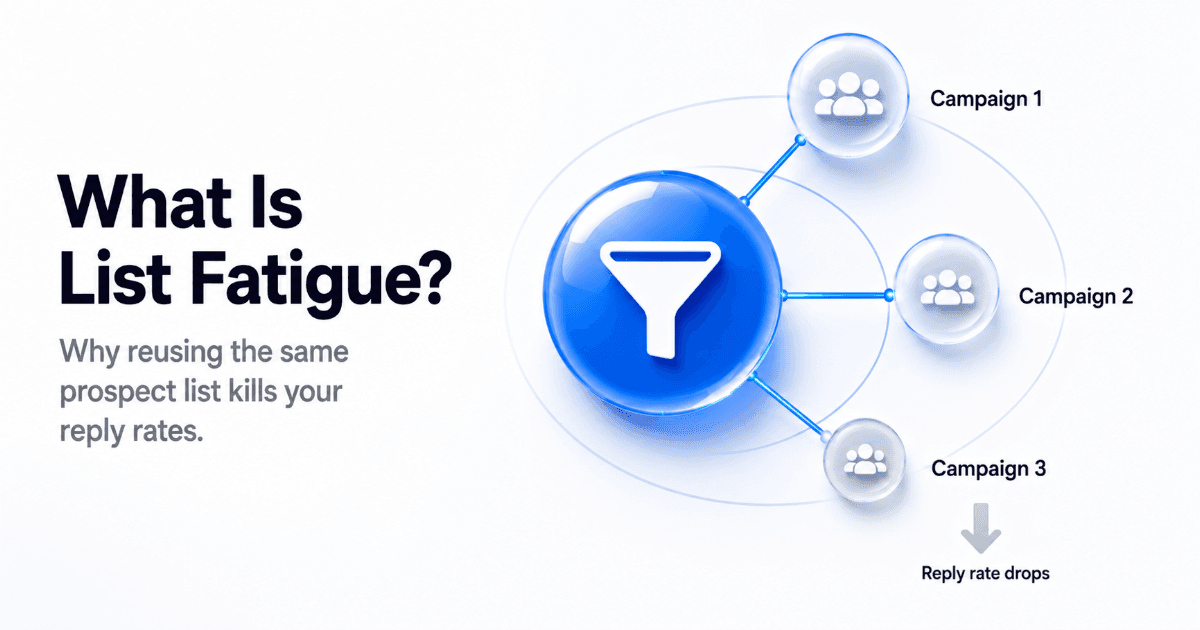
List fatigue is a human attention problem. It happens when the same people — perfectly valid email addresses, correct job titles, real contacts — receive your outreach so frequently across campaigns that they have learned to ignore you. The emails land. They are just never opened, or opened and immediately closed. The symptom is declining reply rates on a list that passes every technical health check.
| List Decay | List Fatigue | |
|---|---|---|
| Root cause | Data goes stale over time | Same contacts reached too frequently |
| Data still accurate? | No — emails bounce, roles have changed | Yes — list is technically clean |
| Primary symptom | Rising bounce rate and undeliverables | Declining reply rate, replies stay flat |
| The fix | Verify and re-enrich contact data | Introduce net-new contacts, rotate lists |
| Solved by email validation? | Yes | No — validation cannot fix familiarity |
This distinction matters because the standard fix for list decay — re-running email validation and data enrichment — does nothing to solve list fatigue. You can verify every address on a fatigued list, confirm every contact still works at the company, and your reply rate will still decline. Clean data is not the same as a fresh audience.
The Signs of List Fatigue (And Why They Get Misdiagnosed)
List fatigue is regularly misdiagnosed as a copy problem, a subject line problem, or a timing problem — because those are the variables most teams look at first when reply rates drop. Here are the signals that point to fatigue specifically.
Signal 1: Reply rates drop campaign-to-campaign on the same segment
If you run a campaign to a segment, pause, and then run another campaign to the same segment three weeks later — and your reply rate has dropped without any change to message quality or deliverability — that is fatigue, not copy. The same people saw your name in their inbox last month. They made a decision about it then. Running more campaigns does not undo that decision.
Signal 2: Open rates stay flat but reply rates fall
If contacts are still opening — they recognize the sender, curiosity still pulls them in — but replies have dropped significantly, that is a content-to-context mismatch driven by repeated exposure. They have already seen your pitch. Another version of the same pitch produces diminishing returns. A genuinely new angle to a genuinely new audience does not have this problem.
Signal 3: Unsubscribes and spam complaints increase without a deliverability change
Fatigue-driven unsubscribes are distinctly different from deliverability issues — they come from people who have received you multiple times, decided you are not relevant, and taken the explicit action to stop seeing you. An increase in opt-outs on a verified, clean list is a direct signal that you have reached these contacts too many times with too little variation in value.
How Much Exposure Is Too Much: Suppression Window Guidelines
There is no universally perfect suppression window — but there are well-established guidelines that most high-performance outbound teams converge on.
| Scenario | Recommended Suppression Window | Re-engage Only If |
|---|---|---|
| Contact completed a full sequence, no reply | 90 days minimum | Offer, angle, or trigger has materially changed |
| Contact opened but did not reply | 60 days | New relevant trigger or buying signal detected |
| Contact unsubscribed | Permanent suppression | Never — honor the opt-out |
| Contact replied negatively ("not interested") | 6 months minimum | Role or company context has visibly changed |
| Contact from a previously purchased list | Verify recency before first touch | Use only if list is less than 90 days old |
The 90-day rule is the working baseline because it gives enough time for a prospect's context to shift — a new initiative, a new budget cycle, a new pain point — which is the only legitimate reason to return to a contact who has already been through your sequence once without responding.
Building a Rotation System That Prevents Fatigue Before It Starts
The teams that never deal with list fatigue are not doing better personalization on the same list. They have a rotation system that ensures the audience seeing each campaign always contains a meaningful proportion of contacts who have never seen their outreach before.
The simple version of that system has three components.
The Three-Layer List Rotation Framework
LAYER 1 — ACTIVE POOL
Contacts currently inside an active sequence. This pool is fully suppressed from any other campaign until the sequence ends and the suppression window opens.
LAYER 2 — SUPPRESSION POOL
Contacts who completed a sequence and are in their suppression window (30–90 days depending on response type). No outreach. Monitor for buying signals that justify earlier re-engagement.
LAYER 3 — NET-NEW DISCOVERY POOL
Contacts identified through real-time prospecting who have never been touched by any campaign. This pool should be continuously fed with new prospects so every campaign can include a meaningful percentage of first-time contacts. Without this layer, fatigue is inevitable — you are just burning through a finite audience.
A practical target: every campaign should include at least 40–50% net-new contacts who have not previously appeared in any of your sequences. If your net-new percentage is consistently lower than that, your reply rates will trend downward regardless of how good the copy is.
How Real-Time Prospect Discovery Keeps Lists Permanently Fresh
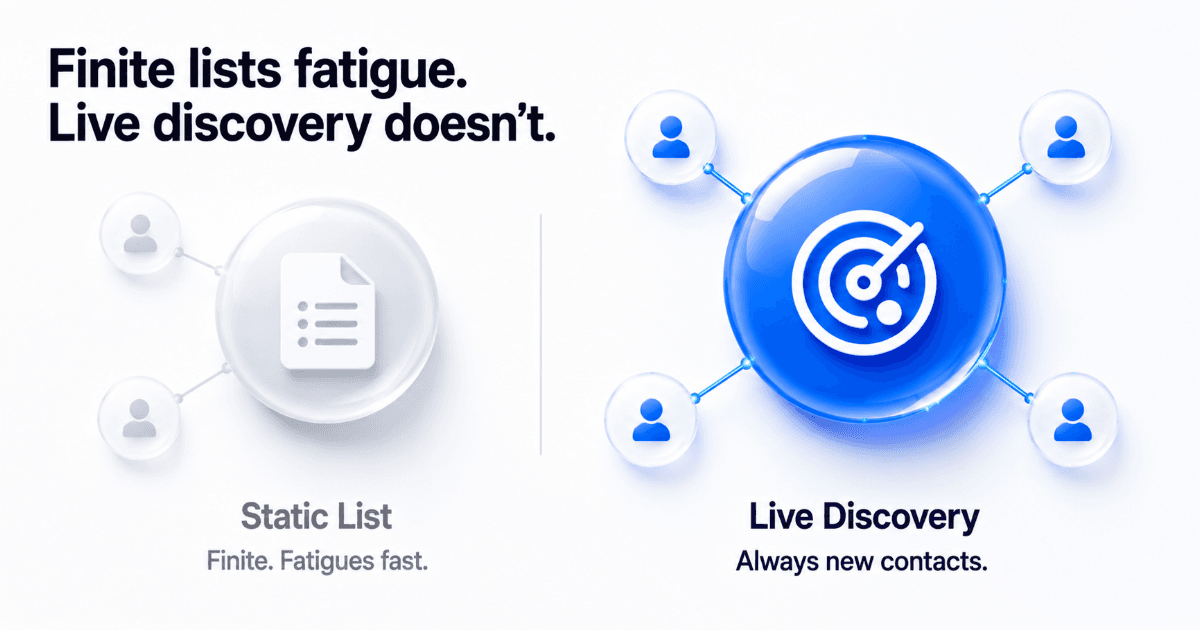
The structural fix for list fatigue is not better data hygiene on an existing list. It is a continuous supply of net-new prospects who match your ICP and who have never seen your outreach before. That requires moving from a static list model — download, upload, work through, repeat — to a live discovery model where the prospect pool refills itself based on real-world signals.
Static lists are inherently finite. You might add 1,000 contacts, run them through a sequence, suppress the non-responders, and find yourself six weeks later with 600 usable contacts remaining. Without a mechanism to continuously introduce genuinely new prospects into that pool, every subsequent campaign runs on a smaller, more fatigued audience.
A real-time signal discovery layer changes this dynamic. Instead of working from a fixed export, your prospect pool updates continuously — new contacts surfaced as they match your ICP criteria, trigger buying signals, or enter the market fresh. Hiring events, funding rounds, leadership changes, and tech stack shifts can all indicate a contact is newly relevant to your offer in a way that bypasses the familiarity problem entirely.
This is also why signal-triggered outreach has a structural reply rate advantage over static list outreach — it is not just that the message is more relevant. It is that the contact has never seen you before, which means there is no accumulated familiarity bias working against you before the email even opens.
The Three Responses to List Fatigue That Make It Worse
Rewriting the sequence instead of rotating the list
WHY IT FAILS
Better copy on a fatigued list will produce a temporary improvement at best. A prospect who has received your outreach three times and chosen not to reply has made a decision about you — not about your subject line. Sending a fourth version to the same person extends the fatigue window and risks tipping them into permanent opt-out territory.
Re-verifying a fatigued list and treating it as "fresh"
WHY IT FAILS
Email validation solves list decay — not list fatigue. Running a fatigued list through a data enrichment process confirms the emails are still valid. It does not reset the psychological familiarity those contacts have with your sender name. Treating a re-verified list as a first-touch list will produce first-campaign results — the wrong comparison entirely.
Shortening the suppression window to send more frequently
WHY IT FAILS
When reply rates fall, the temptation is to increase volume to compensate — more sends to the same contacts, shorter gaps between campaigns. This accelerates fatigue rather than reversing it. Each additional touch to a non-responsive contact deepens the pattern of ignoring your outreach and increases the probability of a spam complaint or unsubscribe that permanently removes that contact from your reachable pool.
Your list is not tired. You just need a bigger one.
Find net-new prospects matching your ICP every day — so every campaign has a first-touch audience, not a fatigued one.
✓ 50 credits ✓ 7-day trial ✓ No credit card required