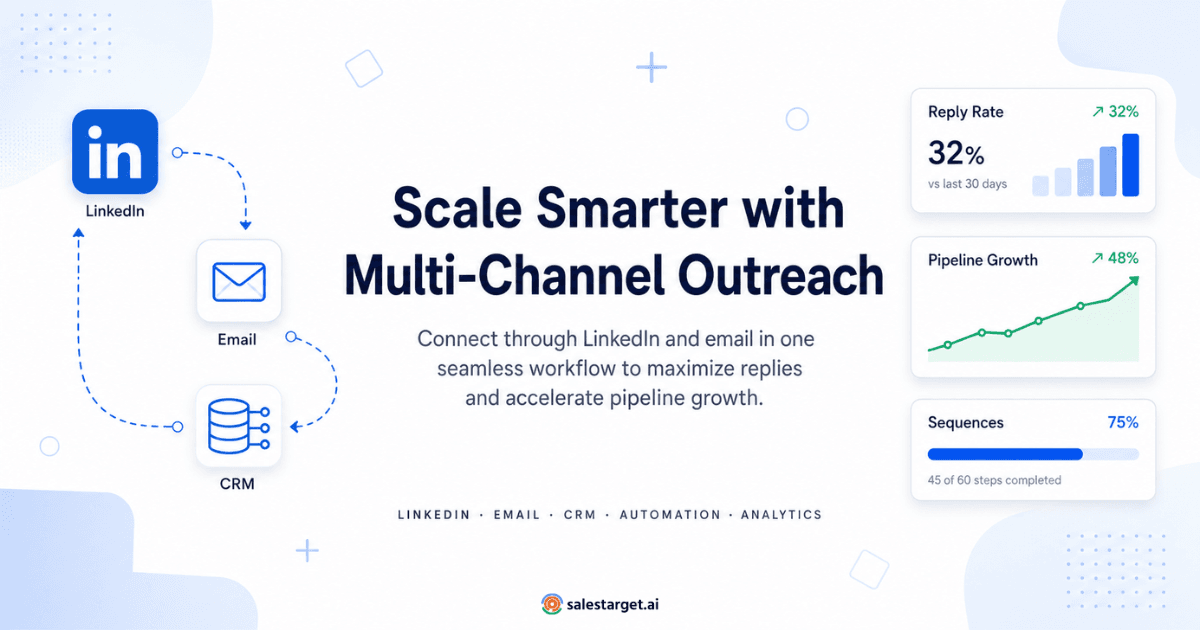
If your outbound motion still relies on a single channel, you're leaving pipeline on the table. The sales teams booking the most meetings in 2026 aren't just emailing harder or spamming LinkedIn connection requests—they're running coordinated multi-channel outreach that meets buyers where they actually spend time. And when you combine LinkedIn with email correctly, something interesting happens: your reply rates climb, your conversations get warmer, and your pipeline becomes far more predictable.
Multi-channel outreach is a sales strategy that uses two or more communication channels—typically LinkedIn and email - in a coordinated sequence to engage prospects. Sales teams combine these channels because buyers rarely respond to a single touchpoint. A synchronized cadence across LinkedIn and email creates multiple opportunities for recognition, builds familiarity faster, and significantly improves qualified meeting rates compared to single-channel campaigns.
Here's how this actually works in practice—and why the best revenue teams have already made the shift. Whether you're running a lean SDR team or managing a full outbound operation, a solid LinkedIn Outreach platform paired with smart email sequencing can transform how your team generates pipeline.
Why Multi-Channel Outreach Outperforms Single-Channel Prospecting?
Let's start with a reality check. Cold email reply rates have been sliding for years. According to research shared on the HubSpot Sales Blog, average cold email response rates now hover between 1–5% for most B2B teams. That's not a messaging problem alone—it's a channel saturation problem. Your prospects' inboxes are war zones, and most outbound emails never even get opened.
LinkedIn, on the other hand, offers something email can't: social proof and visibility before you ever send a message. When a prospect sees your profile view notification, engages with your content, and then receives a personalized connection request—you're no longer a stranger when your email lands the next morning.
This is the core advantage of multi-channel outreach. It's not about doubling the volume of touches. It's about creating a sequence of interactions across channels that builds recognition and trust. Buyers today toggle between platforms constantly—they check LinkedIn during their morning commute, process emails between meetings, and return to LinkedIn for industry content in the evening. A coordinated approach meets them in each context.
Here's what happens when you layer channels together: instead of one cold touchpoint, your prospect encounters your name three or four times before you ask for anything. That familiarity changes the dynamic entirely. You're not interrupting—you're showing up. And that difference is why multi-channel teams consistently book more qualified meetings than their single-channel counterparts.
The Ideal LinkedIn + Email Outbound Workflow
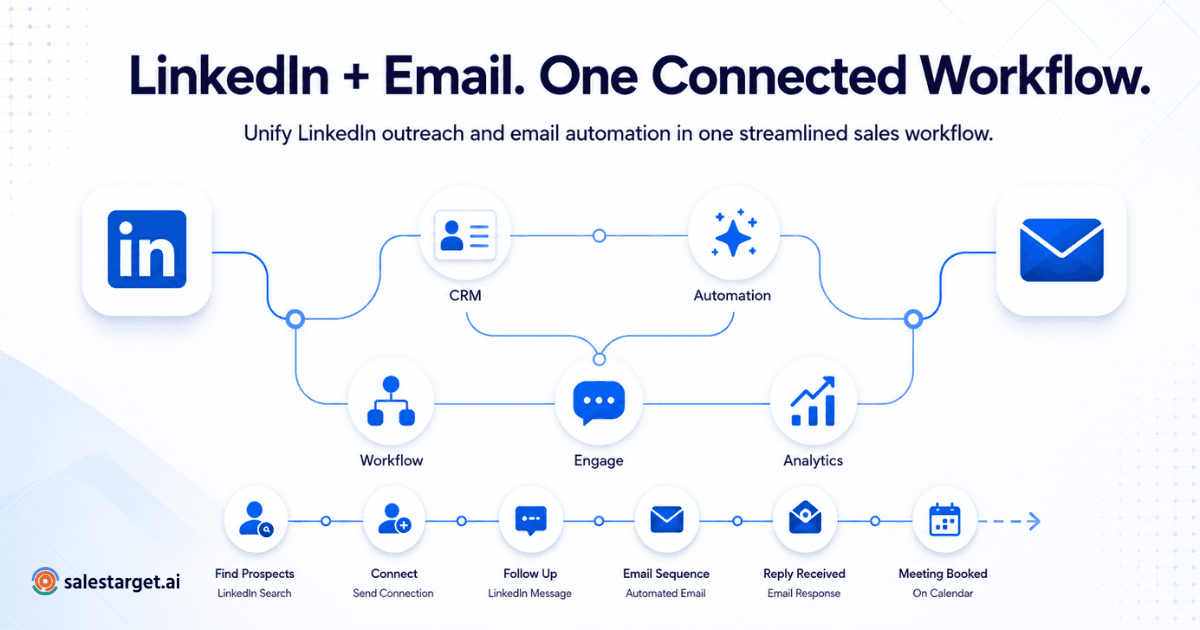
A strong multi-channel cadence isn't random. It follows a deliberate rhythm that balances persistence with respect for the buyer's time. Here's a framework that works well for most B2B sales teams:
Day 1: LinkedIn Profile View + Connection Request
Start by visiting the prospect's profile. This triggers a notification and plants your name in their awareness. Follow up within the same day with a personalized connection request. Skip the pitch entirely—reference something specific: a post they shared, a mutual connection, or a company announcement.
Day 2: Email 1 – The Warm Introduction
Now that you've made a LinkedIn touchpoint, send your first email. This should be short, relevant, and tailored to a specific pain point. Mention something that connects your outreach to their world—a trend in their industry, a challenge you've helped similar companies solve. Don't mention LinkedIn; let the familiarity work subconsciously.
Day 4: LinkedIn Engage – Comment or Like
Engage with one of their posts or shared articles on LinkedIn. This keeps your name visible without being intrusive. If they accepted your connection request, even better—now your engagement appears in their feed naturally.
Day 6: Email 2 – Value-First Follow-Up
Send a second email that leads with value. Share a relevant case study, a short insight, or a link to a resource that addresses the challenge you referenced earlier. This email should feel helpful, not salesy.
Day 8: LinkedIn DM – The Soft Ask
If they've accepted your connection, send a brief LinkedIn direct message. Reference the value you shared via email and ask a low-commitment question: "Would it be worth a 15-minute conversation to explore whether this applies to your team?"
Follow-up logic: If there's no response after Day 8, space your next touches 5–7 days apart. Alternate between channels, and always bring fresh context. After 4–5 total touchpoints with no engagement, move the prospect to a nurture sequence rather than continuing active outreach.
For teams in complex verticals, you can also explore a tailored multi-channel outreach cadence for financial services and healthcare that accounts for regulatory and relationship-driven selling dynamics.
How Multi-Channel AI Sales Automation Improves Efficiency?
Running a multi-channel cadence manually is possible but painful. Every rep would need to track which prospects are on which day, switch between platforms, and personalize every message from scratch. That's where multi-channel AI sales automation changes the game.
Modern automation platforms handle the sequencing automatically. They move prospects through your cadence across LinkedIn and email based on engagement signals, timing rules, and reply detection. But the real value isn't just sequencing—it's intelligence.
AI-driven tools now optimize send times based on when individual prospects are most likely to engage. They analyze subject line performance, suggest message variations, and flag prospects who are showing buying signals across channels. Some platforms can even adjust the cadence dynamically—accelerating follow-ups for warm prospects and slowing down for those who need more nurturing.
Engagement tracking across channels gives you a unified view of every interaction. Instead of guessing whether a prospect saw your email, you can see that they also viewed your LinkedIn profile twice this week. That behavioral data turns your outreach from guesswork into a precision operation.
The practical impact is significant. Reps spend less time on administrative tasks and more time on actual selling. Pipeline reporting becomes more accurate because every touchpoint is logged. And your team can run sophisticated multi-channel sequences that would be impossible to execute consistently by hand.
➡ Ready to build your own killer outbound motion? See how to combine LinkedIn and email for a killer outbound motion.
Where LinkedIn Outreach Automation Fits?
LinkedIn outreach automation is one of the most misunderstood pieces of the multi-channel puzzle. Done carelessly, it gets accounts flagged and damages your brand. Done thoughtfully, it becomes the engine that keeps your pipeline warm without consuming your team's entire day.
The right approach to LinkedIn automation focuses on safety first. That means respecting daily connection request limits, spacing out profile views to mimic natural behavior, and personalizing messages enough that they don't trigger spam filters. Good automation tools let you set these parameters and operate within LinkedIn's guidelines.
Where automation really shines is in the sequencing. Instead of manually tracking which prospects need a follow-up DM, automation handles the scheduling and triggers. If a prospect accepts your connection request, they automatically move to the next step in your sequence. If they don't respond after a set period, the system nudges through a different channel.
Personalization at scale is the other major benefit. AI-powered LinkedIn automation tools can pull data from a prospect's profile—their recent activity, job title changes, company news—and weave it into connection requests and messages. The result feels personal even when it's running across hundreds of prospects simultaneously.
According to insights from the LinkedIn Sales Blog, sellers who engage with prospects' content before reaching out see notably higher acceptance rates on connection requests. Automation makes this engagement step scalable without sacrificing authenticity.
Omnichannel Outreach vs Multi-Channel Outreach
Sales leaders often use "omnichannel outreach" and "multi-channel outreach" interchangeably, but there's a meaningful distinction worth understanding:
| Feature | Multi-Channel Outreach | Omnichannel Outreach |
|---|---|---|
| Personalization | Per-channel messaging tailored to context | Unified messaging that adapts across all touchpoints |
| Coordination | Sequenced touchpoints across channels | Fully synchronized experience with shared context |
| Customer Journey | Linear progression through defined steps | Fluid, buyer-led journey across any channel |
| Best For | Outbound prospecting and SDR workflows | Full-cycle sales and customer success motions |
| Complexity | Moderate – manageable with automation | High – requires deep platform integration |
For most outbound sales teams, multi-channel outreach is the practical starting point. Omnichannel outreach requires tighter integration across your entire tech stack and is better suited for post-sale or enterprise account management motions. Start with multi-channel, and layer in omnichannel capabilities as your processes mature.
Common Mistakes Sales Teams Make
Even teams that adopt a multi-channel approach stumble when they overlook the details. Here are the pitfalls that kill outbound performance:
- Sending identical messages across channels. If your LinkedIn DM reads like a copy of your email, the prospect notices. Each channel needs its own voice and angle.
- Ignoring timing gaps. Sending a LinkedIn request and an email within the same hour feels aggressive. Spacing matters—it creates the impression of organic familiarity.
- Surface-level personalization. Inserting {{first_name}} and {{company}} isn't personalization. Reference something specific to the prospect's situation, role, or recent activity.
- No CRM sync. If your outreach data doesn't flow into your CRM, you lose visibility into what's working and reps end up duplicating efforts.
- No reply tracking. Without tracking replies across both email and LinkedIn, prospects fall through the cracks. You need a unified view of engagement.
- Too many follow-ups. There's a fine line between persistent and annoying. After 4–5 touchpoints with no engagement, shift to a nurture approach.
For a deeper look at reply strategies across both channels, check out the LinkedIn and email B2B reply playbook for tested frameworks that improve response rates.
How SalesTarget Helps Teams Execute Better Multi-Channel Outreach?
Building a reliable multi-channel outreach engine requires tools that connect the dots. SalesTarget was designed for exactly this challenge—bringing LinkedIn and email workflows together in a way that's practical for revenue teams of all sizes.
The platform handles LinkedIn automation with built-in safety controls that keep your accounts compliant. Email sequencing runs in parallel, synchronized to your multi-channel cadence so prospects experience a coherent series of touchpoints rather than disconnected messages. CRM integration ensures every interaction—LinkedIn views, connection acceptances, email opens, replies—flows into your pipeline records automatically.
What makes this especially useful for sales managers and RevOps leaders is the analytics layer. You get clear visibility into which sequences are driving conversations, which channels are contributing most at each stage, and where prospects are dropping off. AI-powered personalization suggestions help reps craft better messages without starting from a blank page every time.
It's not about replacing the human element in selling - it's about removing the operational friction that slows teams down.
Industry Observation: Based on observed B2B outbound campaign patterns across SaaS organizations, coordinated LinkedIn and email outreach can improve qualified conversation rates by 25–40% compared to single-channel campaigns. This is an industry observation based on aggregated outbound performance trends, not a verified benchmark from a single study.
The days of relying on email alone to build outbound pipeline are behind us. Buyers are spread across channels, and your outreach needs to reflect that reality. Combining LinkedIn and email in a coordinated, well-timed cadence isn't just a nice-to-have—it's the foundation of every high-performing outbound motion in 2026.
Consistency beats volume. Personalization beats templates. And automation—when applied thoughtfully—beats the manual grind that burns out sales teams. Start with the workflow framework in this article, measure what works, and iterate. The teams that treat multi-channel outreach as a system, not a tactic, are the ones filling their pipeline quarter after quarter.