The AI Copilot for B2B Sales Your Team Actually Needs
Selling in B2B has never been more complex. Buyers are harder to reach, sales cycles are longer, and reps are drowning in admin work that has nothing to do with actually selling. Meanwhile, quota pressure keeps climbing.
The teams winning right now aren't necessarily the ones with the biggest headcounts or the flashiest pitch decks. They're the ones using an AI copilot for B2B sales to work smarter at every stage of the pipeline—prospecting, outreach, follow-up, and forecasting.
This isn't about replacing salespeople. It's about giving them a co-pilot that handles the grunt work so they can focus on what moves deals forward.
What Is an AI Copilot for B2B Sales?
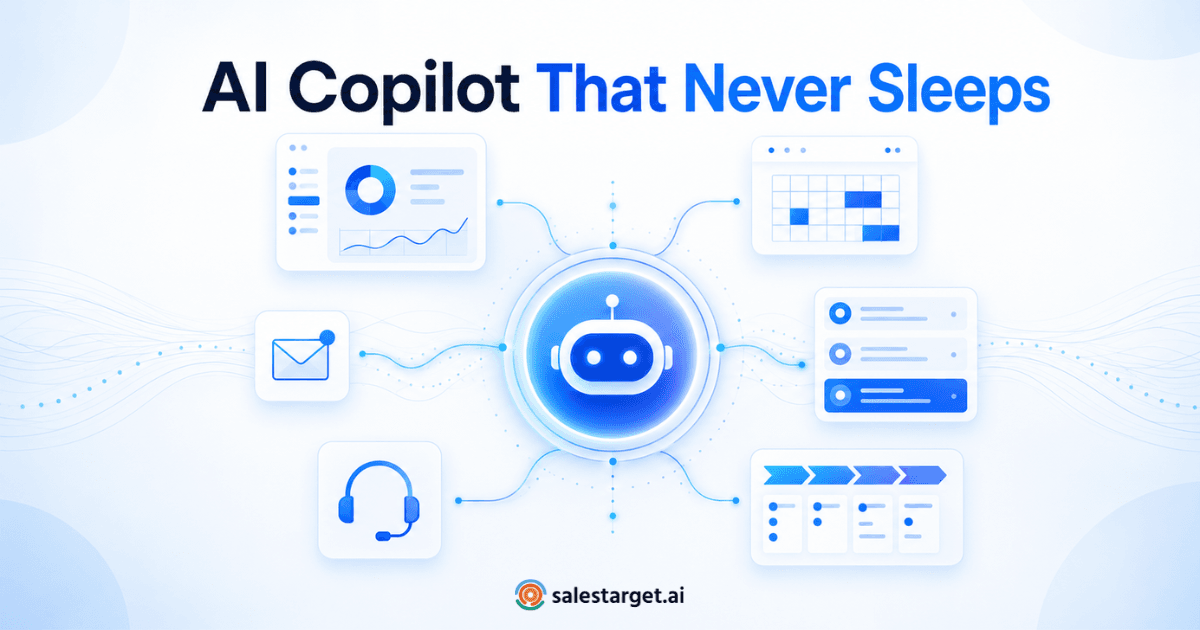
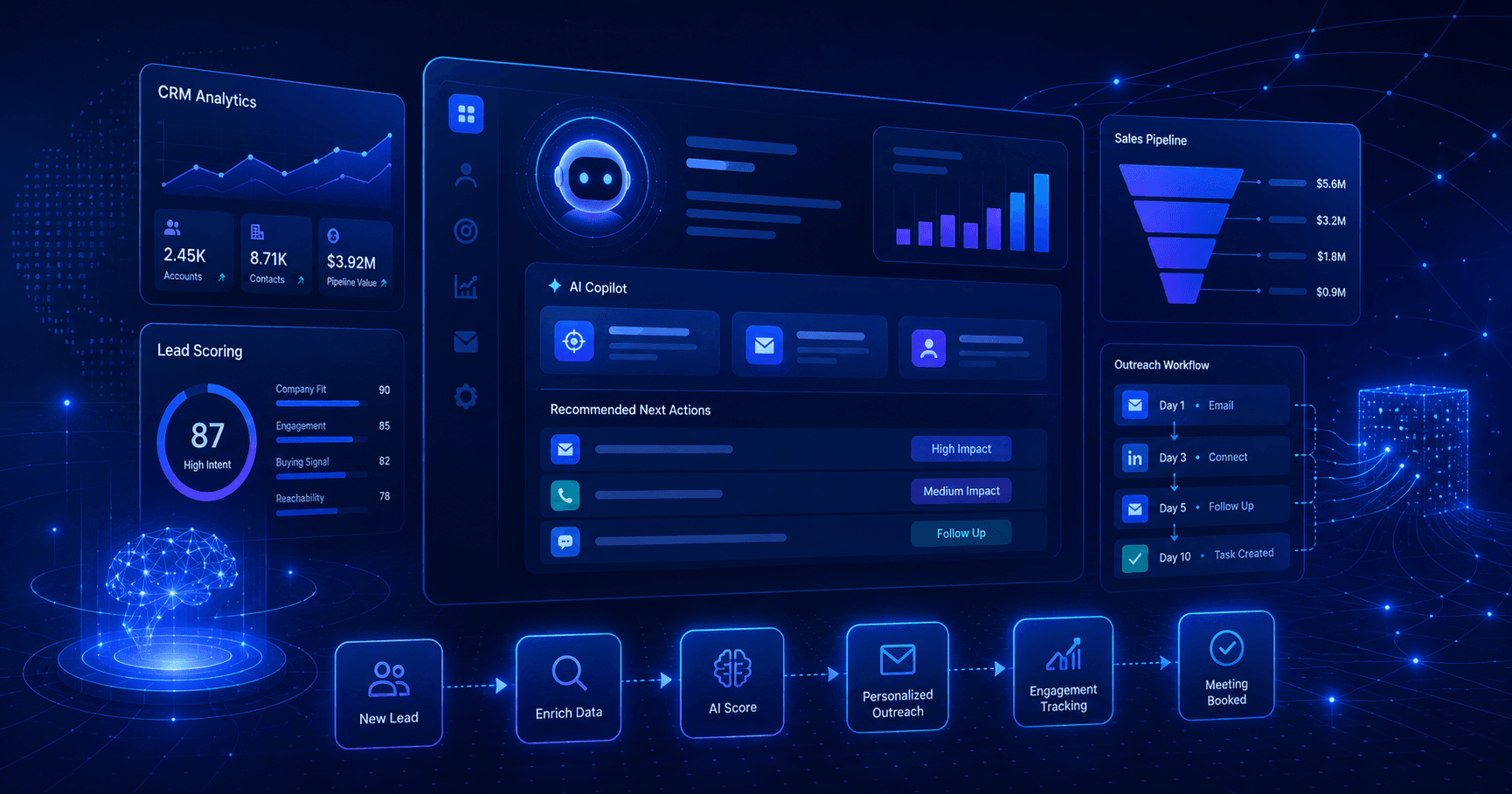
An AI copilot for B2B sales is an intelligent layer that sits alongside your existing sales workflow. It ingests data from your CRM, email activity, LinkedIn signals, and intent data—then gives reps and managers actionable guidance in real time.
Unlike basic sales tools that automate isolated tasks, an AI copilot connects the dots. It tells a rep who to contact, when to contact them, what to say, and why that account is worth pursuing right now. Think of it as CRM intelligence meets outreach automation, layered with contextual AI reasoning.
Why Traditional Sales Workflows Slow Teams Down
Most B2B sales teams have a workflow problem, not a talent problem. Reps spend hours each week logging activities, updating fields, researching accounts, and piecing together outreach from scratch. By the time they get to actual selling, the prime outreach windows have passed and high-intent leads have gone cold.
Traditional automation tools don't fully solve this. Sequencing tools send emails on a schedule—but they don't tell you which leads are actually ready to buy. CRMs store data—but they rarely surface what that data means for today's priorities.
If this sounds familiar, the real issue isn't productivity—it's workflow design (read more here). AI copilots address this at the structural level.
How AI Copilots Improve Prospecting and Outreach
Prospecting is where most sales teams bleed time. An AI copilot for sales teams compresses this dramatically. Here's what that looks like in practice:
- Account Research: The AI surfaces relevant context—recent funding rounds, hiring trends, tech stack changes, job postings—and ties it to your ICP.
- Personalized Messaging: The AI drafts outreach that pulls in account-specific signals. Not generic templates. Actual context-aware copy grounded in real data.
- Send-Time Optimization: AI identifies when a specific contact is most likely to engage based on historical response patterns, reducing noise in crowded inboxes.
The output isn't just faster outreach. It's better outreach—the kind that earns replies because it's relevant.
AI-Powered Lead Prioritization and CRM Intelligence
One of the biggest levers an AI sales assistant pulls is lead prioritization. AI copilots score leads dynamically using a combination of:
- Behavioral signals (email opens, site visits, content engagement)
- Firmographic fit (company size, industry, revenue, growth stage)
- Intent data (third-party buying signals from platforms like G2, Bombora)
- CRM history (prior interactions, deal stage velocity, past objections)
This CRM intelligence means reps start every day with a ranked list of who to call and why—not a random queue from an outdated sequence. For RevOps teams, forecast accuracy improves significantly as a result.
Benefits of AI Copilot for Sales Teams
For SDRs
Less time on research, more time on conversations. Higher reply rates from better-personalized outreach. Clearer daily priorities instead of decision fatigue.
For Account Executives
Faster ramp on new accounts with AI-generated briefings. Better follow-up timing based on engagement signals. More context walking into calls.
For Sales Managers
Real-time visibility into rep activity and pipeline health. AI-generated coaching prompts based on deal behavior. Forecasts grounded in actual signal—not wishful thinking.
For RevOps
Cleaner data inputs, automated activity logging, and workflow consistency across the team. Less time spent chasing reps for CRM updates.
How Sales Automation AI Reduces Manual Work
The average B2B sales rep spends roughly 30% of their week on non-selling tasks. Sales automation AI attacks this directly.
Activity logging? Automated. After a call, the AI captures notes, updates the CRM record, and logs the next action—without the rep touching a single field.
Follow-up sequencing? The AI monitors engagement and triggers the right follow-up based on behavior, not a fixed time delay. If a prospect opens an email three times in a day, the AI flags it for immediate action.
Meeting prep? The AI compiles a pre-call brief covering account history, recent news, a stakeholder map, and suggested talking points. Collectively, this gives a rep back 8–10 hours per week—time that goes directly into pipeline-building activities.
AI Sales Assistant vs. Traditional Automation Tools
Traditional sales automation tools—sequencers, dialers, email schedulers—operate on fixed rules. They execute what you tell them to. They don't learn, adapt, or recommend.
An AI sales assistant is a reasoning layer that processes inputs, identifies patterns, and makes recommendations. It improves with data—surfacing insights a rule-based tool would miss entirely, like noticing that a previously cold account just hired a VP of Sales who worked at your top customer.
Teams using AI sales assistants that find leads, write outreach, and guide next actions (read the full breakdown here) consistently outperform teams relying on static sequences. The sequencer sends emails. The AI copilot tells you which emails to send, to whom, when, and what to say—and learns from what works.
Real-World Use Cases for B2B Sales AI
SaaS Outbound Team
A 10-person SDR team using AI-powered lead prioritization cuts prospecting time by 40% and improves connect rates because reps are working the highest-intent accounts first—not just the freshest import.
RevOps Forecasting
A RevOps leader integrates AI copilot signals into the CRM, giving the sales manager a live heat map of which deals are actually progressing and which are stalling—weeks before a missed quarter.
Enterprise AE Ramp
A new AE uses AI-generated account briefings to get up to speed on a 50-account territory in 5 days instead of 5 weeks. First call is informed. First proposal is relevant.
Multi-threaded Outreach
An AI copilot identifies three stakeholders at a target account, drafts personalized messages for each based on role and background, and sequences them in a coordinated campaign—something that would take a rep hours to do manually.
What to Look for in an AI Copilot Platform
Not all AI copilot platforms deliver equal value. When evaluating options, prioritize:
- CRM integration depth: Does it read from and write to your CRM in real time, or operate in a silo?
- Outreach personalization quality: Does AI-generated copy actually sound human, or does it feel templated?
- Lead scoring transparency: Can reps see why a lead is prioritized, or is it a black box?
- Workflow fit: Does it work with how your team already operates, or does it require a full process overhaul?
- Analytics and coaching: Does it give managers insight into what's working—and what isn't?
The Future of AI in B2B Sales
The trajectory is clear: AI won't be a bolt-on feature in B2B sales—it'll be the operating system. Teams that integrate AI copilots now will build compounding advantages in data quality, outreach effectiveness, and rep productivity.
The next generation of B2B sales AI will move beyond assistance into autonomous action—handling first-touch outreach, scheduling meetings, and surfacing deal risks before they become losses. For sales leaders who think of AI as a future investment, the gap is already forming between teams that use it and those that don't.
The companies winning in B2B sales right now have one thing in common: they're not trying to outwork the market—they're out-intelligencing it.
An AI copilot for B2B sales isn't a luxury for well-funded enterprise teams. It's becoming the baseline for any outbound motion that wants to stay competitive. The data is there, the tools exist, and the gap between teams using AI and those that aren't is widening every quarter.
If your team is ready to stop losing hours to manual work and start focusing on what actually closes deals, explore what SalesTarget.ai Copilot can do for your pipeline.