AI Is Killing Manual Prospecting — Is Your Sales Team Ready?
Most SDR teams aren't failing because they lack hustle. They're failing because their workflow was never designed for the speed, personalization, and volume that modern B2B outbound demands.
The average sales rep still spends roughly 70% of their time on non-selling tasks — research, writing emails, logging activity, sorting through lead lists — according to Salesforce's State of Sales report. That leaves barely two to three productive hours a day for what actually moves revenue: real conversations with real buyers.
That's not a motivation gap. That's a structural one.
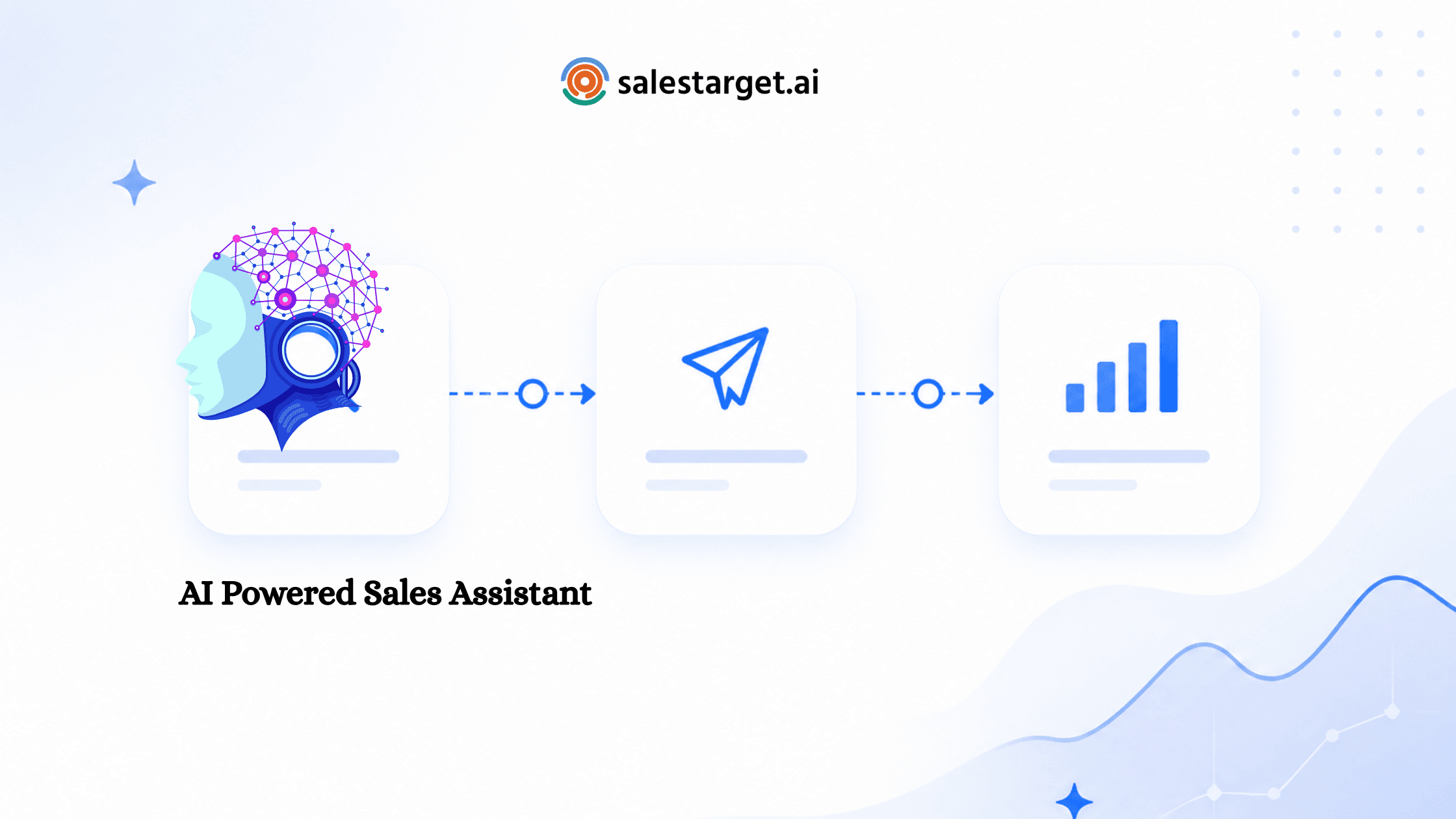
And it's precisely the gap that an AI powered sales assistant is built to close.
Why Traditional Outbound Is No Longer Enough
Cold outreach was already competitive. Now it's overrun.
Inboxes are noisier. Buyers are more skeptical. Generic templates that once scraped by with mediocre open rates now land in spam or get deleted on sight. Meanwhile, platforms have made it easier than ever to send at scale — but sending more of the same hasn't fixed the deeper problem: the outreach still has to be relevant, timely, and worth reading.
What's broken isn't effort. It's the manual assembly line sitting between "I have a target account" and "I have a qualified conversation."
Traditional outbound requires a rep to:
- Research the account manually
- Build a contact list from a separate tool
- Write a sequence from scratch
- A/B test variations manually
- Track replies across multiple inboxes
- Log everything into a CRM
Each step is a friction point. Each friction point is time not spent selling. And across a full SDR team, those friction points compound into an enormous, silent revenue leak.
What an AI Powered Sales Assistant Actually Does ?
Definition: An AI powered sales assistant is software that automates, personalizes, and optimizes the sales development workflow — from prospecting and outreach to campaign analysis — using artificial intelligence to reduce manual effort and increase the precision of every touchpoint.
That's a clean definition, but the practical impact is more nuanced.
The best AI sales assistants don't just automate tasks. They create an intelligent layer over the entire outbound workflow, making every decision — which leads to target, what to write, when to follow up, which campaigns to scale — faster and more data-informed than any human team operating manually.
According to Gartner, by 2027, 95% of seller research workflows will begin with AI, up from less than 20% in 2024. That's not a marginal shift. It's a structural transformation of how sales teams operate.
A Workflow-Based Look at What Changes
It helps to map this against a typical sales development workflow, because that's where the difference becomes tangible.
Lead Discovery
Instead of a rep spending hours filtering LinkedIn or a third-party database, an AI prospecting assistant takes a description of the ideal customer profile and builds a curated, enriched lead list — complete with firmographic, technographic, and intent data. The rep didn't research. The AI did.
SalesTarget.ai Copilot does exactly this: describe your ideal customer in plain language, and it returns enriched lead lists drawn from a database of 840M+ profiles and 4,000+ data signals — including real-time intent markers showing who's actively in-market right now.
Campaign Creation
Writing a multi-step cold email sequence used to mean an hour of work minimum — drafting, editing, thinking through variations, figuring out follow-up timing. An AI email assistant for sales can generate complete sequences, personalize messages by industry and persona, and suggest A/B variants, all in minutes.
This matters because personalization is no longer optional. HubSpot's research shows 73% of sales professionals report that AI has significantly improved team productivity, and much of that gain comes from eliminating the time cost of manually personalizing outreach at scale.
Performance Analysis
Most SDR teams run campaigns and then make educated guesses about what's working. An AI sales copilot shifts this entirely: it reviews campaign results in real time, identifies top-performing sequences, ranks strategies by revenue impact, and surfaces specific improvement recommendations — not just data, but direction.
AI Sales Assistant vs. Manual Prospecting: The Honest Comparison
This is where the business case becomes difficult to ignore.
Manual prospecting is time-intensive, inconsistent, and dependent on individual rep skill. An SDR who's great at writing might struggle with targeting precision. One who's great at identifying accounts might produce templated, forgettable copy.
An AI powered sales assistant levels the execution floor. It doesn't replace the rep's judgment — it handles the execution layer so judgment can be applied where it actually matters: in the conversation.
McKinsey reports that AI sales tools can increase leads by up to 50% and cut operational costs by as much as 60% by automating prospect qualification and follow-up. Meanwhile, Salesforce data shows that sales teams using AI are 83% more likely to see revenue growth compared to teams that don't use it at all.
The comparison isn't really "AI vs. manual." It's "AI-assisted team vs. fully manual team" — and the performance gap between those two groups is widening every quarter.
Personalization at Scale: From Aspiration to Execution
Here's the tension every sales team faces: buyers want personalized outreach, but personalization at scale is, traditionally, an oxymoron. You either personalize for a small list or blast a large one.
AI breaks that constraint.
A capable AI SDR assistant can personalize outreach based on each prospect's industry, job function, company size, and contextual signals — without requiring a rep to manually research every contact. The output isn't a single templated email with a first name swapped in. It's messaging that reflects what actually matters to that type of buyer.
SalesTarget.ai Copilot personalizes outreach messages based on each prospect's profile and context — adapting tone, emphasis, and structure across different industries and personas. Combined with a Spintax Generator that creates natural email variation to maintain deliverability, and built-in inbox warmup and rotation, the platform treats deliverability and personalization as a unified problem rather than separate ones.
Signal-Based Outreach: The Next Frontier of AI Sales Automation
Sending to a list is table stakes. Sending to the right people at the right moment is what separates good AI sales automation from genuinely effective outbound.
Intent signals — behavioral data suggesting a company or contact is actively researching a problem your product solves — dramatically improve response rates. A prospect who visited your competitor's pricing page last week is a fundamentally different conversation than one who hasn't engaged with your category at all.
SalesTarget.ai's intelligence engine surfaces real-time intent signals alongside firmographic and technographic data, giving sales teams the ability to prioritize outreach around who's actually in-market — not just who fits the ICP on paper.
This is the shift from spray-and-pray to signal-and-sequence. And it's one of the clearest illustrations of why AI for sales teams isn't just about efficiency — it's about strategic precision.
Real-World Use Cases Across Sales Contexts
- For SDR teams at B2B SaaS companies: AI handles research and sequence creation, freeing reps to run more conversations and focus on qualification.
- For founders doing early-stage outbound: Instead of spending nights manually building lead lists and writing cold emails, founders can describe their ICP and let the AI draft and launch campaigns — while they focus on product and customers.
- For growth-stage agencies: Managing outbound for multiple clients without expanding headcount requires automation that adapts to different verticals and personas. An AI outbound sales assistant makes multi-client campaign management scalable without sacrificing quality.
- For enterprise sales teams: AI copilots that prioritize leads, forecast opportunities, and recommend next steps keep large, complex pipelines moving — reducing the risk of high-value deals going cold due to poor follow-up timing.
The Future of AI-Assisted Sales Execution
The current wave of AI sales tools is impressive. The next wave will be autonomous.
Gartner has identified agentic AI — systems that plan, decide, and execute without requiring constant human input — as a major evolution beyond today's generative tools. In a sales context, that means AI systems that not only write sequences, but decide when to follow up, adjust messaging based on real-time reply data, re-route cold leads back into nurture flows, and escalate warm leads to human reps automatically.
LinkedIn's research found that sellers using AI for research already save 1.5 hours per week, while Bain concludes that AI could effectively double active selling time by eliminating routine tasks. As these systems mature, that number will grow — and the gap between AI-assisted teams and manual teams will become harder to close retroactively.
The trajectory is clear: the question for sales leaders isn't whether to adopt AI workflow tools. It's which workflow to build now that remains competitive as the tools improve.
Conclusion: Workflow Is the Competitive Edge
The best salespeople aren't going to be replaced by AI. But they are going to be outpaced by salespeople who use AI well.
An AI powered sales assistant doesn't make a mediocre strategy great — it makes a solid strategy scalable. It removes the execution bottlenecks that turn good target lists into missed opportunities. It brings personalization, timing, and analysis into a single connected workflow instead of scattering them across five different tools.
Platforms like SalesTarget.ai Copilot are built around this idea from the ground up: one AI teammate that helps you prospect, write, analyze, and optimize — without switching between tools or stitching together disconnected systems. The result isn't just efficiency. It's a more focused, better-informed, and consistently executing sales team.
And in an environment where 78% of sales leaders already worry their companies are falling behind on AI adoption, the teams that build smart workflows today will be the ones with durable pipeline advantages tomorrow.