TL;DR
- Recruiting firms run two outbound pipelines simultaneously — candidate sourcing and client acquisition — and most are managing them manually across disconnected tools.
- LinkedIn-first sequencing wins for passive candidate outreach. Email-first sequencing wins for hiring manager and client acquisition.
- Hiring signals — a company posting new roles, expanding headcount, or entering a new market — are actionable triggers for both pipelines at the same time.
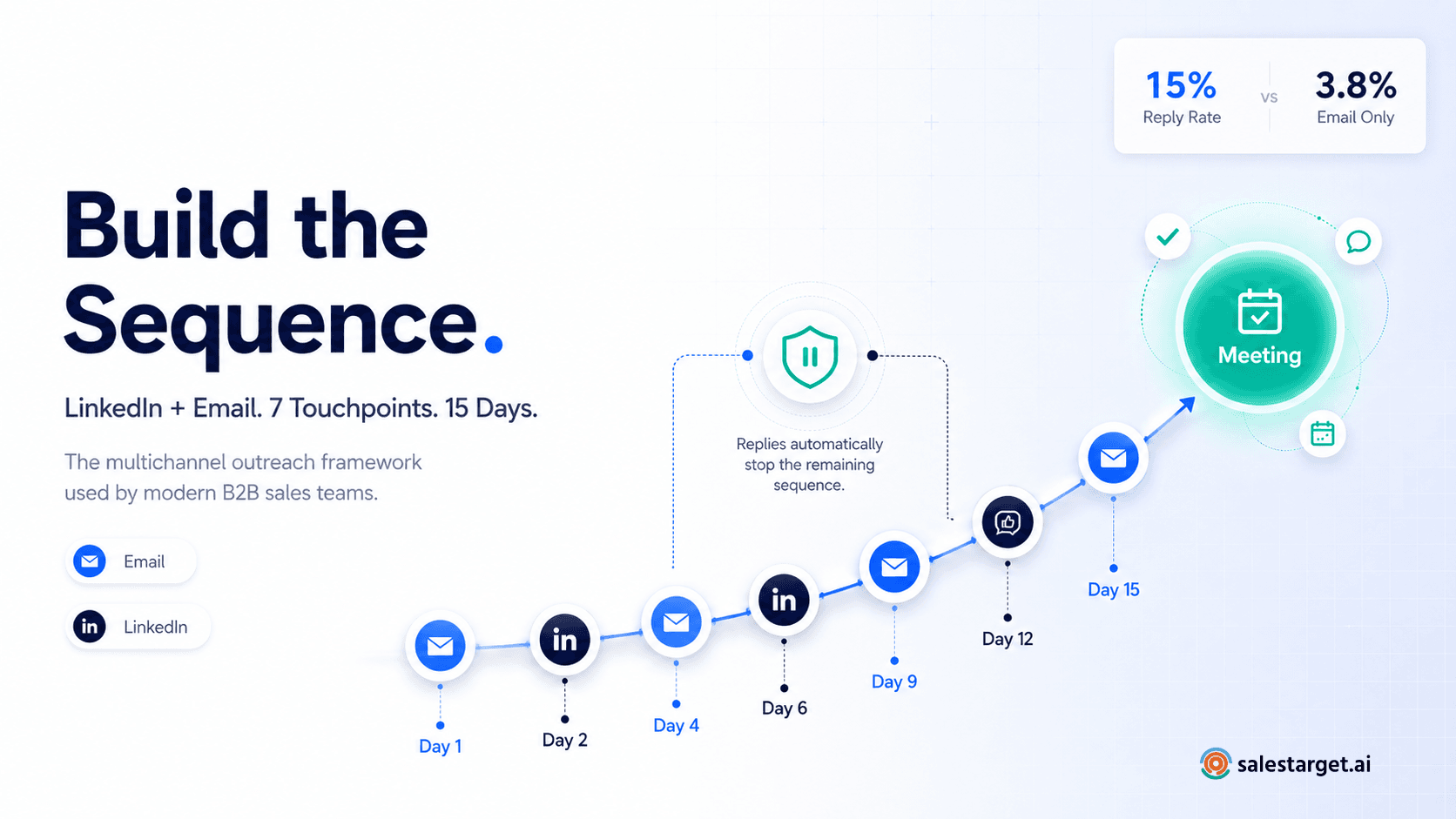
- The firms filling roles fastest in 2026 are running coordinated multichannel outreach sequences, not individual LinkedIn DMs or one-off email blasts.
- SalesTarget supports both pipelines in a single platform — with LinkedIn automation, email outreach, real-time signal discovery, and a shared team inbox built in.
The average time-to-fill for a specialist role sits above 40 days. For most staffing firms, that gap isn't a sourcing problem — it's a sequencing problem. Candidates are on LinkedIn. Hiring managers respond to email. But almost no recruiting team has a coordinated system that works both channels at once, for both sides of the desk, at scale.
This guide breaks down exactly how to build that system.
Why Recruiting Firms Need Multichannel Outreach Differently Than Sales Teams
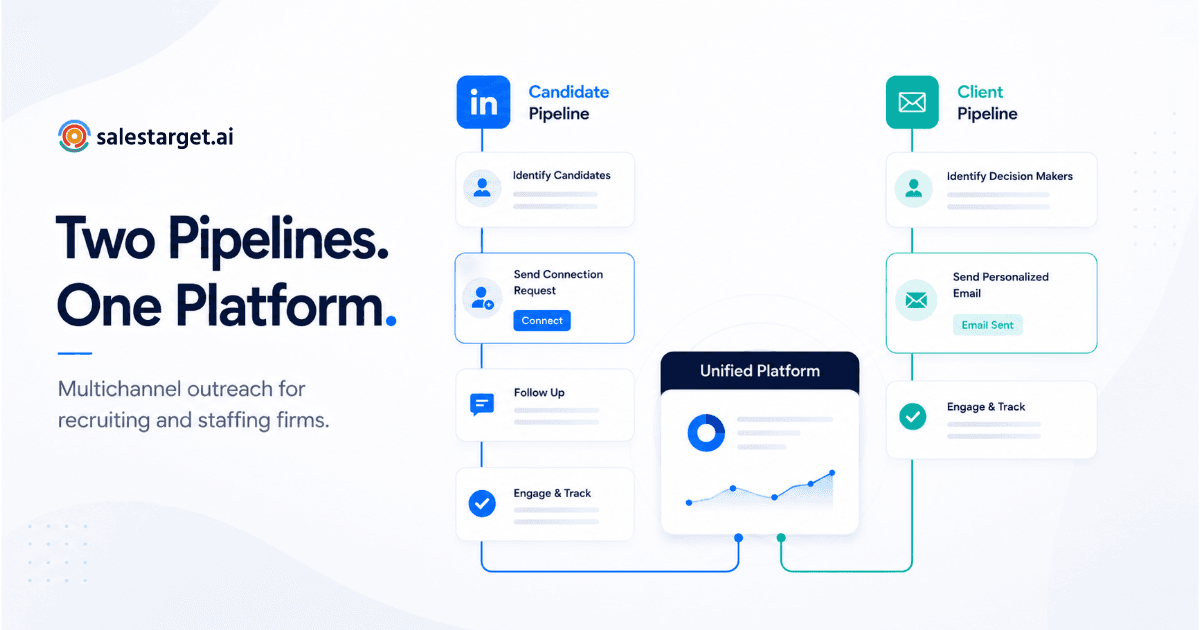
A B2B sales team runs one outbound pipeline. They prospect buyers, nurture them, and close deals. A recruiting firm runs two outbound pipelines at the same time — and the two pipelines have completely different audience psychology, channel preferences, and sequencing logic.
Candidates — especially passive ones — live on LinkedIn. They're not checking their work email for unsolicited outreach from agencies they've never heard of. A cold email to a software engineer who isn't actively looking lands in a folder they'll never open. A LinkedIn connection request with a sharp one-line message about a role that fits their career trajectory? That gets a reply.
Hiring managers and procurement leads at client companies are the opposite. They're buried in LinkedIn noise — connection requests from a dozen agencies a week. Email cuts through. A well-timed cold email with a specific subject line, a clear value proposition, and a single ask outperforms a LinkedIn connection request to a VP of Engineering by a significant margin.
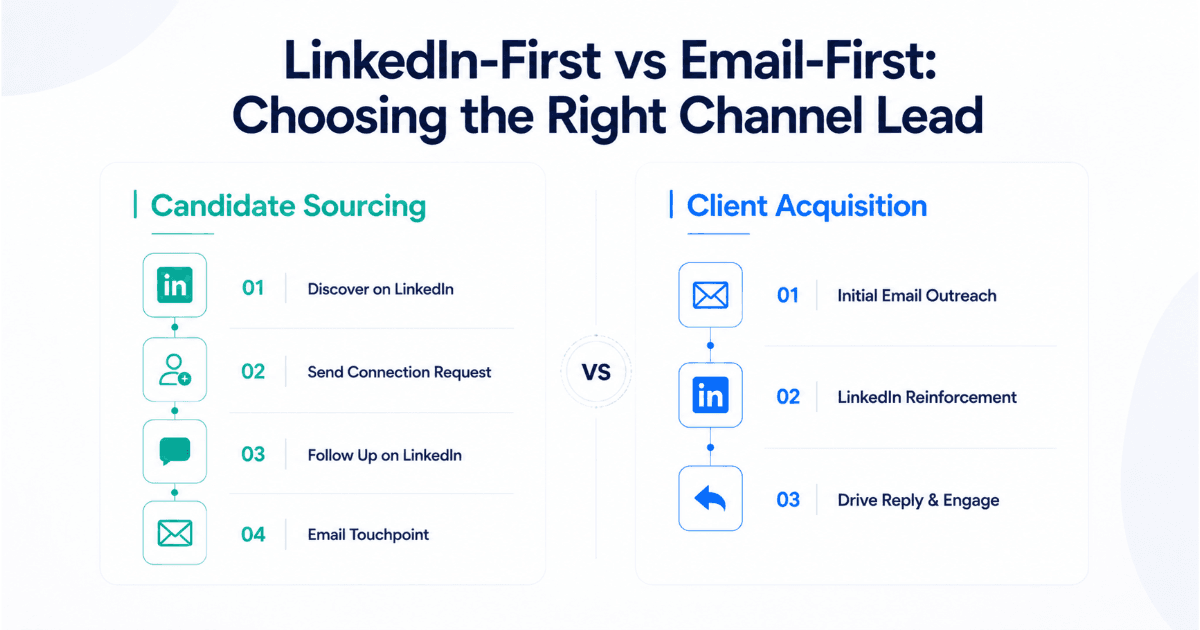
So the channel strategy for a recruiting firm isn't just "use LinkedIn and email." It's about knowing which pipeline leads with which channel — and then building sequences that layer the second channel in at the right moment.
The Two Pipelines: Candidate Sourcing vs Client Acquisition
Before you build sequences, you need to be clear on what each pipeline is actually doing — because the goal, the message, and the timing logic are fundamentally different.
Pipeline 1: Candidate Sourcing
The objective is to build a warm bench of qualified candidates before a specific role opens — not just to fill the current req. High-volume, relationship-first, reputation-sensitive. One bad outreach message circulates fast in tight professional communities. Every touchpoint needs to feel personal, relevant, and respectful of where that candidate is in their career.
Pipeline 2: Client Acquisition
The objective is to convert hiring managers and HR leaders into retained or contingency clients. The conversation is commercial — it's about placement guarantees, time-to-fill benchmarks, cost-per-hire, and access to talent pools the client can't reach on their own. This is a classic B2B sales motion with a longer decision cycle and multiple stakeholders.
| Dimension | Candidate Pipeline | Client Pipeline |
|---|---|---|
| Primary channel | LinkedIn-first | Email-first |
| Tone | Career-focused, personal | Commercial, ROI-led |
| Decision cycle | Days to weeks | Weeks to months |
| Volume | High | Targeted |
| Success metric | Qualified intros booked | Discovery calls, signed agreements |
| Signal trigger | Career activity, job change, profile update | Company hiring spike, headcount growth |
LinkedIn-First Strategy for Candidate Sourcing
Passive candidates are not browsing job boards. They are on LinkedIn, building their professional brand, engaging with content, and quietly watching the market. Your outreach needs to meet them there — and the sequence logic needs to feel like a conversation, not a campaign.
With LinkedIn outreach automation, recruiters can run structured, personalized candidate sequences at scale without losing the human feel that makes candidates respond.
The Candidate Sourcing Sequence
| Step | Channel | Action | Timing |
|---|---|---|---|
| 1 | Profile view (passive signal) | Day 1 | |
| 2 | Connection request — short, role-specific note | Day 2 | |
| 3 | Follow-up message if connected — add context on role | Day 4 | |
| 4 | Soft follow-up if no LinkedIn reply — brief, low-pressure | Day 8 | |
| 5 | Final touchpoint — keep door open for future roles | Day 14 |
Personalization is the only lever that matters here
Key insight
Passive candidates have zero tolerance for generic outreach. Reference something specific — their current role, a recent career move, a technology they're known for. AI LinkedIn personalization lets you inject candidate-specific variables into every connection message and follow-up at scale, so each sequence reads like it was written for that person alone.
Email-First Strategy for Client Acquisition
Hiring managers are decision-makers with budget pressure. They care about one thing: getting the right person into a role as fast as possible, with as little internal effort as possible. Your outreach needs to lead with that value — and email is where that conversation starts.
A well-structured email outreach sequence for client acquisition runs three to five touches before adding LinkedIn as a reinforcement channel, not the other way around.
The Client Acquisition Sequence
| Step | Channel | Message focus | Timing |
|---|---|---|---|
| 1 | Lead with the problem — time-to-fill, specialist scarcity | Day 1 | |
| 2 | Social proof — placement track record, vertical specialization | Day 3 | |
| 3 | Connection request — reference the email, keep it brief | Day 5 | |
| 4 | Specific ask — 15-minute intro call, single CTA | Day 8 | |
| 5 | Final breakup email — low-pressure, leave the door open | Day 14 |
This is where multichannel outreach gives staffing firms a structural edge. Instead of managing LinkedIn and email as separate manual workflows, the entire sequence runs in one place — triggered, tracked, and optimized from a single campaign view.
Using Hiring Signals as Intelligence for Both Pipelines
The best time to contact a hiring manager is when their company just posted three new senior roles. The best time to reach a candidate is when they've updated their LinkedIn profile or changed their job title in the last 30 days. Both of these are signals — and both should be triggering outreach automatically, not after a manual search.
Real-time signal discovery changes the economics of recruiting outreach entirely. Instead of blasting a cold list built six months ago, you're reaching out to companies with live hiring intent and candidates showing active career movement — at the exact moment they're most likely to respond.
📊 Signals that matter for recruiting outreach
- Company hiring spike — a client prospect just posted 5+ open roles in 30 days. High-intent signal for client acquisition outreach.
- Funding announcement — Series A/B/C companies scale headcount fast. Window to reach hiring managers before competitors do.
- Candidate job change — a placed candidate just moved roles. Reconnect, collect a referral, rebuild the relationship.
- Profile update / skills added — passive candidate signaling readiness to move. Highest-intent trigger for sourcing outreach.
- Leadership change — new VP of Engineering, new CHRO. New leaders often replace or restructure teams within 90 days.
Real-Time Signal Discovery in SalesTarget surfaces these triggers automatically, so recruiters can act on them the same day — not a week later when a competitor has already booked the call.
How Multi-Recruiter Teams Run This at Scale
A solo recruiter running multichannel sequences is powerful. A team of five recruiters running coordinated campaigns across both pipelines — without stepping on each other's outreach — is a completely different competitive position.
The operational challenge for recruiting teams isn't finding people to contact. It's coordination: making sure Recruiter A isn't reaching the same candidate that Recruiter B enrolled in a sequence last week, and that the client pipeline is consistent in message and timing regardless of which team member owns the account.
Team Workflow Principles for Recruiting Firms
| Challenge | What it costs you | How to solve it |
|---|---|---|
| Duplicate outreach to same candidate | Reputation damage | Shared CRM with enrollment status visible to all recruiters |
| Inconsistent client messaging across team | Brand credibility | Shared sequence templates with locked core messaging |
| Replies falling through the cracks | Lost placements | Unified inbox — all replies from all channels in one view |
| No visibility into team performance | Uneven output | Campaign-level analytics broken down by recruiter |
SalesTarget's Unibox consolidates every reply — LinkedIn messages, email responses, follow-up threads — into a single team inbox, so no warm candidate or interested hiring manager gets missed because it landed in a personal LinkedIn DM that no one else could see.
Real Metrics: What Good Looks Like for Recruiting Outreach in 2026
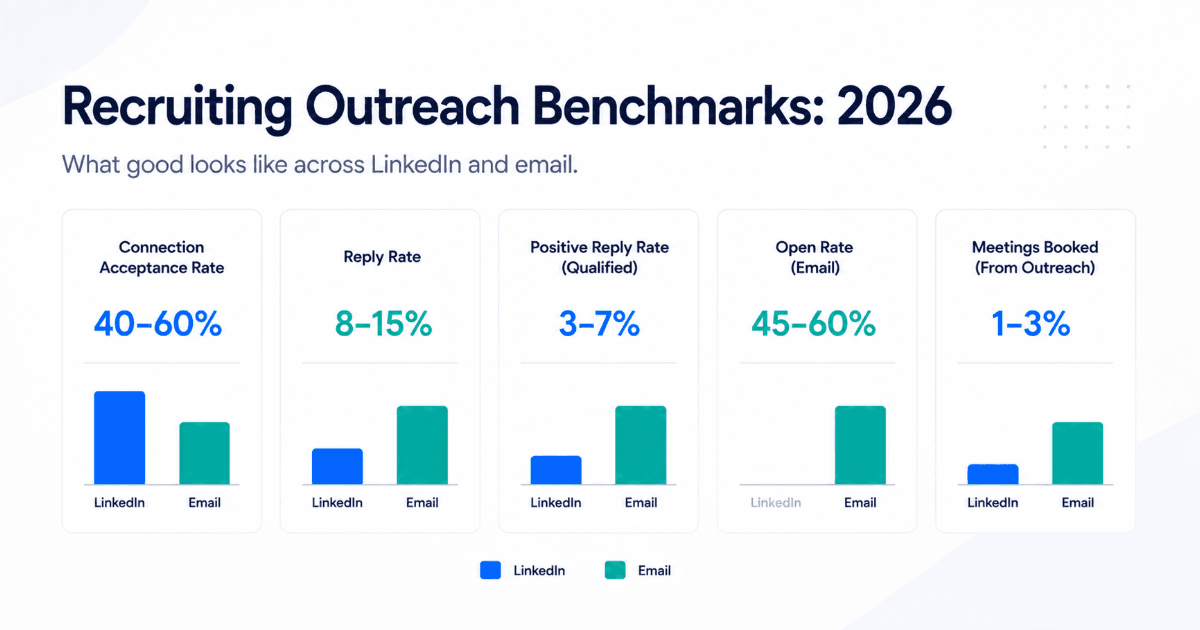
Benchmarks vary by vertical and seniority level, but coordinated multichannel sequences consistently outperform single-channel outreach by a material margin. Research from outbound sales platforms shows that multichannel sequences — combining LinkedIn and email — produce reply rates 2–3x higher than email alone for professional services outreach.
📊 Recruiting outreach benchmarks to aim for
- LinkedIn connection acceptance rate: 30–45% for well-targeted, personalized requests to passive candidates
- LinkedIn message reply rate (post-connect): 15–25% with a specific, relevant opening message
- Cold email open rate (client acquisition): 45–60% with strong subject lines and verified contacts
- Cold email reply rate (client acquisition): 8–15% with a 4–5 touch sequence and a clear single CTA
- Multichannel sequence vs single-channel: 2–3x higher qualified intro rate when both LinkedIn and email are coordinated
5 Multichannel Outreach Mistakes Recruiting Firms Make
Mistake 1: Using the same sequence for candidates and clients
Why it fails
The audience psychology is completely different. A message optimized to attract a passive mid-level engineer will not convert a VP of HR into a client. Build separate sequences for each pipeline with separate messaging frameworks, separate channel orders, and separate CTAs.
Mistake 2: Starting with LinkedIn for client acquisition
Why it fails
Hiring managers receive a high volume of unsolicited LinkedIn connection requests from agencies. You become noise. Email lets you lead with a specific, value-forward message that demonstrates you understand their hiring challenges before they've even accepted a connection. LinkedIn then reinforces a conversation that's already started.
Mistake 3: Sending to unverified contact data
Why it fails
B2B contact data decays fast. Sending campaigns to stale email addresses drives up your bounce rate, damages sender reputation, and eventually lands your domain on a blocklist. Verify every email before it enters a live sequence. SalesTarget's email validator runs real-time checks on every address so you only send to deliverable contacts.
Mistake 4: Ignoring hiring signals and sourcing from static lists
Why it fails
A list built three months ago has no idea which companies are actively hiring today and which candidates have just updated their profile signaling readiness. Signal-blind outreach wastes contact volume on low-intent prospects and misses the high-intent triggers that would convert immediately. Use real-time signal discovery to lead every campaign with intent data.
Mistake 5: Running team campaigns without a shared inbox
Why it fails
When five recruiters are running campaigns across LinkedIn and email simultaneously, replies will scatter across personal inboxes and LinkedIn message threads. A candidate who replied positively on a Friday afternoon should not be waiting until Monday because the recruiter was offline. A unified reply management system ensures every warm lead gets a response within hours, not days.
Run both pipelines from one platform.
SalesTarget gives recruiting and staffing firms LinkedIn automation, email sequences, signal-based prospecting, and a shared team inbox — built for high-velocity, dual-pipeline outreach.
✓ 50 credits ✓ 7-day trial ✓ No credit card required
Frequently Asked Questions

See It In Action: Book Your Free Demo
Get a personalized walkthrough and see how it works for your team.
Book My Demo →