Sales reps hate bad data. There is nothing more frustrating than spending thirty minutes researching a prospect, writing the perfect cold email, and watching it bounce because the contact left the company six months ago. Bad data wastes selling time, destroys domain reputation, and creates friction between marketing and sales teams.
High-performing outbound teams do not rely on manual Google searches or outdated purchased lists. They use B2B data providers to feed their pipeline with accurate, verified contact information. The difference between missing quota and exceeding it often comes down to the quality of the phone numbers and email addresses your team dials every day.
This guide breaks down exactly how B2B data providers work, the specific types of data they offer, and how supplying your team with verified business data directly increases your meeting booked rate.
What Are B2B Data Providers and Why Do Sales Teams Use Them?
B2B data providers are companies that aggregate, verify, and sell business contact information and firmographic data to sales and marketing teams. Think of them as massive, constantly updated directories of every professional and business entity your team might want to sell to.
Sales teams use them because manual prospecting scales poorly. If a sales development representative (SDR) has to hunt down an email address using free tools or social media scraping, they might find 10 leads a day. With a B2B data provider, that same rep can build a list of 500 highly targeted, verified prospects in ten minutes.
These platforms provide the fuel for modern sales prospecting. Without a reliable source of accurate B2B data, your expensive outreach sequencers and CRMs sit idle. The database is the foundation of the entire outbound motion.
Why Sales Teams Struggle to Find Accurate B2B Data for Lead Generation
Data decays incredibly fast. Professionals change jobs, companies get acquired, and phone numbers change constantly. Industry estimates suggest that B2B data degrades at a rate of 30% per year. If you buy a static list of 1,000 contacts in January, 300 of those records will be useless by December.
Salesforce data confirms that reps spend hours every week managing bad data and manual CRM entries. When teams try to build their own lists using cheap scrapers or manual research, they encounter three massive hurdles: incomplete profiles (missing phone numbers), unverified emails (causing high bounce rates), and outdated firmographics (targeting companies that no longer fit their ideal customer profile).
Free or cheap data is a trap. Sending emails to invalid addresses alerts spam filters, which can result in your entire company domain getting blacklisted. The cost of bad data is not just wasted rep time; it is the destruction of your primary communication channel.
How B2B Data Providers Help Businesses Find Better Leads?
Access to Accurate and Verified Business Data
The primary value of a B2B data provider is accuracy. The best platforms do not just scrape the web once and forget about it. They run continuous verification checks on the emails and phone numbers in their database.
When an SDR pulls a list of 100 leads from a premium provider, they know those emails will actually reach an inbox. This direct access bypasses gatekeepers and generic "info@" company addresses, putting the rep in direct contact with the buyer.
Better Audience Targeting with Firmographic and Demographic Insights
Selling software to a 5-person startup requires a different approach than selling to a 500-person enterprise. B2B data providers allow teams to slice audiences using deep firmographic filters.
You can filter by company size, annual revenue, industry, geographic location, and even the specific software technologies a company currently uses. Demographic filters allow you to target specific job titles, seniority levels, and departments, guaranteeing your message reaches the exact person holding the budget.
Identifying Decision-Makers for Faster Outreach
Navigating corporate hierarchies manually wastes days. A strong B2B prospect database maps out the organizational structure of target accounts.
Instead of calling a front desk to ask who handles IT purchasing, reps can search the provider for the "Director of IT Infrastructure" at a specific account and get their direct dial instantly. Identifying the decision-maker before outreach shrinks the sales cycle drastically.
Enriching Lead Data for Personalized Sales Campaigns
Data enrichment takes a partial lead record—like an email address captured from a webinar sign-up—and fills in the missing pieces. The provider matches that email against its database and appends the prospect's job title, LinkedIn profile, company size, and phone number.
McKinsey highlights that top-performing sales organizations use deep personalization to achieve major productivity gains. Enriched data gives reps the context they need to write highly personalized messages that actually get replies, rather than sending generic spam.
Improving Lead Qualification and Conversion Rates
Sales teams waste massive amounts of time talking to unqualified buyers. If a lead does not have the budget or authority to buy, the rep is wasting their breath.
By using strict filtering criteria within a B2B data provider, teams ensure that only highly qualified leads enter the pipeline. When the pipeline is full of exact-match prospects, the conversion rate from initial meeting to closed-won deal naturally increases.
Supporting Sales Teams with Real-Time Data Updates
Timing is everything in sales. B2B data providers offer real-time updates and alerts on target accounts. If a key prospect changes jobs, or if a target company raises a new round of funding, the system alerts the rep.
Reaching out to a prospect the week they start a new role as a decision-maker is one of the highest-converting tactics in outbound sales. Real-time data makes this timing possible.
Integrating Lead Data with CRM and Sales Tools
Data sitting in a separate app is useless. Top B2B data providers integrate directly with your CRM and outreach sequencers. Reps can build a list in the database and push it directly into their outreach tool with a single click, completely eliminating manual CSV exports and formatting errors.
What Types of Data Do B2B Data Providers Offer?
Business contact data including emails, roles, companies, and industries
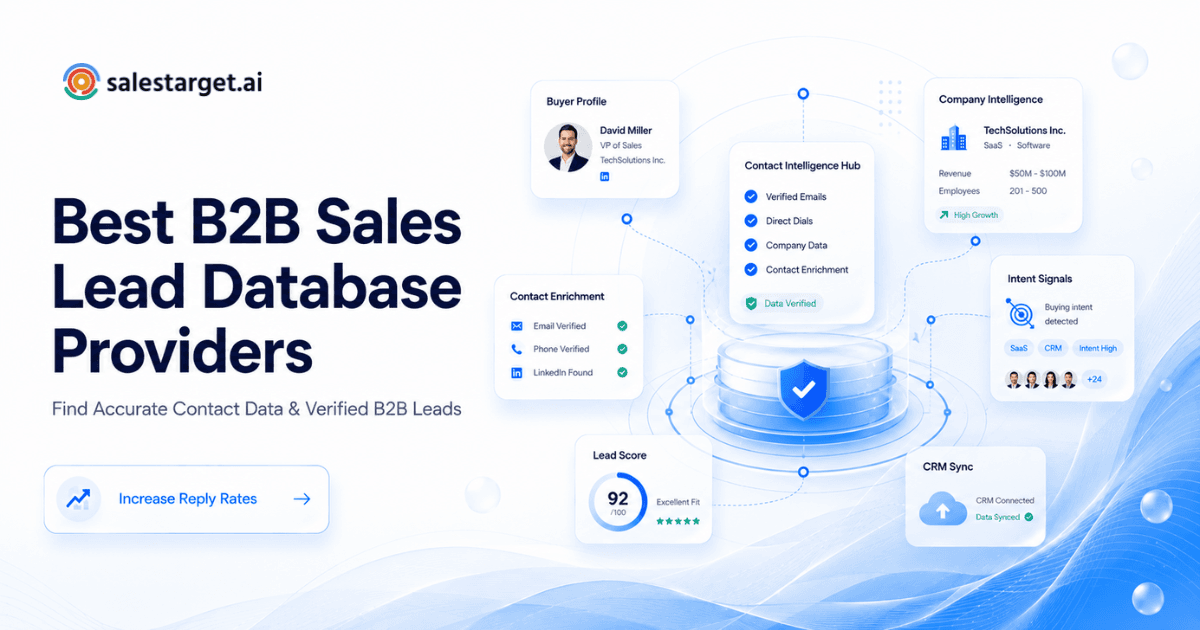
This is the baseline requirement. It includes the prospect's first and last name, their current job title, their verified professional email address, and direct dial phone numbers. It also includes company-level data: industry classification, employee headcount, and location.
B2B email databases for targeted email outreach campaigns
Providers maintain massive repositories of B2B email addresses specifically structured for cold outreach. These databases are regularly cleaned to remove spam traps, catch-all addresses, and dormant accounts, protecting the sender's domain reputation during high-volume campaigns.
Intent signals and firmographic data for account-based marketing (ABM)
Intent data shows you who is actively researching your solution category right now. Providers track content consumption across the web to flag companies showing high buying intent. Combining intent signals with firmographic data allows teams to run highly precise Account-Based Marketing (ABM) campaigns, reaching out just as the prospect begins looking for a solution.
How to Choose a B2B Data Provider for Your Sales Team?
Data accuracy, verification methods, and database freshness
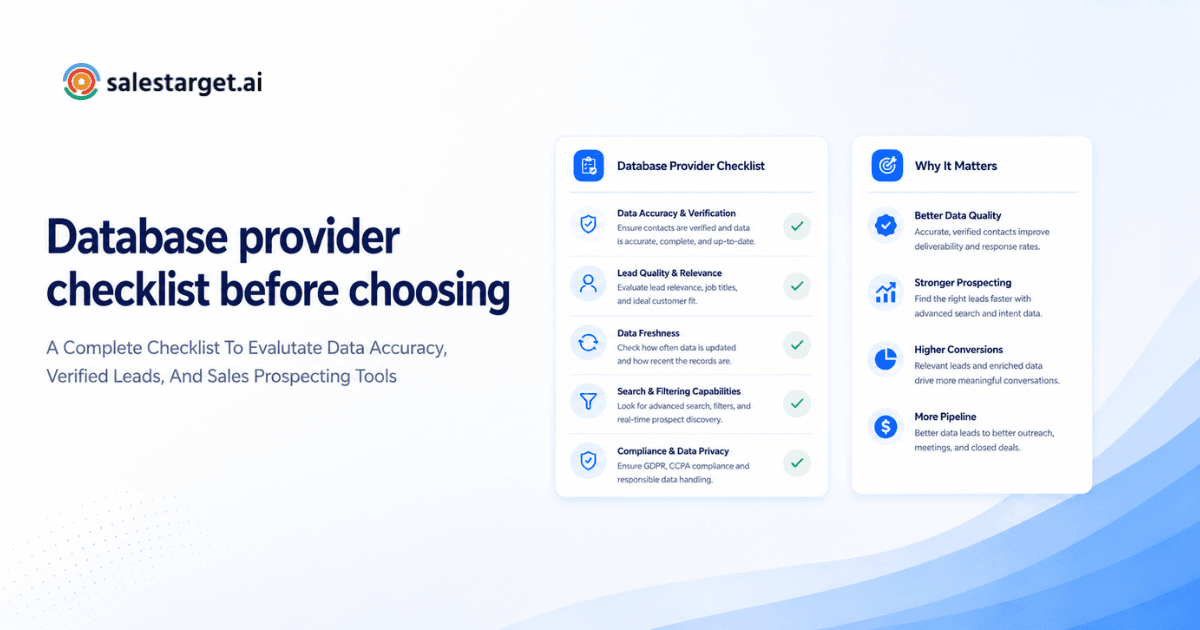
Do not trust providers who claim "100% accuracy" without explaining how they verify it. Ask the vendor how often they refresh their data. Do they verify emails in real-time before export, or do they rely on historical data? A smaller, highly accurate database is vastly superior to a massive database filled with dead contacts.
Coverage, filtering options, and lead targeting features
Evaluate the provider's coverage in your specific industry and target region. If you sell exclusively to European manufacturing companies, a database heavily skewed toward US tech startups will not help you. Test the filtering options during your trial to find verified B2B leads that match your exact Ideal Customer Profile.
CRM data integration and workflow compatibility
The provider must fit seamlessly into your existing workflow. If reps have to use complex workarounds to move data from the provider into your CRM, they simply will not use the tool. Look for native integrations or, better yet, platforms that combine the database and the CRM into a single workspace.
How SalesTarget.ai Helps Teams Find, Verify, and Convert B2B Leads?
Find prospects faster with AI-powered lead data and enrichment
SalesTarget.ai includes the Lead Explorer, a built-in prospecting engine offering access to 840M+ verified professional profiles and 146M+ business entities. Instead of clicking through endless dropdown menus, reps can search in plain English or stack filters like intent topics, tech stack, and company revenue. One-click enrichment instantly unlocks verified professional emails, personal emails, and mobile numbers. You get the data you need exactly when you find the prospect, without relying on stale, pre-scraped lists.
Verify contacts before outreach with email validation checks
Protecting your domain is critical. SalesTarget.ai includes a built-in Email Validator that runs MX and SMTP checks in real-time. It identifies disposable emails and risk-scores contacts before they ever enter your sequence. You do not need to pay for a separate validation service; the platform ensures your emails land in the primary inbox, reducing bounces and keeping your domain off blacklists.
Run email and LinkedIn outreach from one sales platform
Once you find and verify the lead, SalesTarget.ai pushes them straight into action. The platform runs automated email and LinkedIn sequences in one coordinated flow. You can trigger connection requests, direct messages, and email follow-ups based on prospect behavior. By keeping the data and the outreach in the same platform, you eliminate the need to export CSV files to a third-party sequencer.
Manage conversations and follow-ups inside a built-in CRM
Fragmented tools cause dropped leads. SalesTarget.ai features a lightweight, built-in CRM designed specifically for outbound teams. Campaign leads land in the pipeline automatically. Every email sent and call made is logged to the lead timeline. The native AI dialer captures call notes for you, saving reps hours of manual entry. When a prospect replies, the system instantly generates a follow-up task, ensuring no opportunity is missed.
Why Choose SalesTarget.ai for B2B Lead Generation?
Building a tech stack piece by piece is expensive and operationally fragile. Teams often buy Apollo for data, Instantly for email, a separate LinkedIn tool, and Salesforce to hold the records. This creates data silos and forces reps to manage integrations instead of managing deals.
SalesTarget.ai's Lead Explorer solves this by putting everything on one bill and in one workspace. You get the deep B2B database, the multichannel outreach, the email validation, and the CRM in a single platform. Gartner reports that AI will soon handle the majority of initial SDR tasks; SalesTarget.ai makes this a reality today. The AI Copilot generates personalized sequences, flags at-risk deals, and lets reps query the CRM in plain language. Users report 3.2X faster deal cycles and save approximately 6 hours per rep per week.
Getting Started With B2B Data for Your Sales Team
Running a pilot program with your SDR or sales team
Do not roll out a new data provider to a fifty-person team on day one. Select two or three of your best SDRs to run a two-week pilot. Have them build lists mirroring their current targets and track the bounce rates and reply rates compared to your old process. Hard data from a small pilot proves the ROI before a full rollout.
Setting up data enrichment in your CRM
If you use an external CRM, configure the data provider to automatically enrich inbound records. When a prospect requests a demo on your website with just their email address, the data provider should instantly append their title, company size, and phone number in the CRM, giving the rep full context before the first call.
Measuring the impact on your sales cycle
Track the metrics that actually matter. Do not just measure how many leads the team exported. Measure the reduction in email bounce rates, the increase in meetings booked per rep, and the shortening of the overall sales cycle. Better data should directly correlate with faster, higher-converting deals.
Final Thoughts
A sales team is only as effective as the data it relies on. If your reps are calling dead numbers and emailing invalid addresses, your revenue will stagnate regardless of how talented the sellers are.
B2B data providers fix the root cause of empty pipelines by delivering accurate, verified, and highly targeted prospects directly to your team. However, simply buying data is no longer enough. The highest-performing teams integrate that data seamlessly with their outreach tools and CRM to create a frictionless outbound machine.
SalesTarget.ai offers this exact seamless experience. It provides the best sales acceleration software by combining a massive B2B prospect database, email validation, multichannel sequencing, and a native CRM into one powerful platform. Stop paying for fragmented tools and start booking more meetings.