Your reps just burned through a fresh list of 5,000 contacts. Half the emails bounced. A quarter went to people who changed jobs six months ago. The LinkedIn messages landed on profiles that haven't logged in since 2024. That list cost money, time, and a chunk of your sender reputation you won't get back easily.
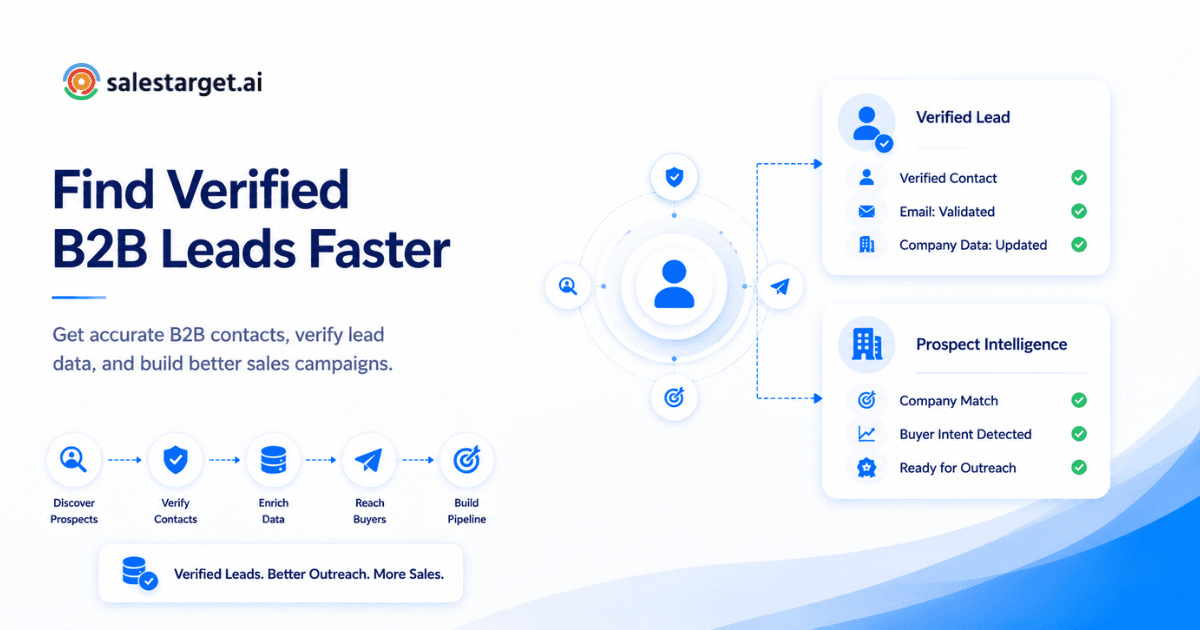
Here is the short answer: to find verified B2B leads, you need a data-driven process that combines targeted search, real-time verification, and buying-signal enrichment before a single message goes out. That means sourcing contacts from a reliable B2B data provider, validating emails at the point of enrichment (not weeks or months later), and filtering by intent so your outreach hits people who are actually in a buying window. The rest of this guide breaks down exactly how to do that, step by step.
How Can Sales Teams Find Verified B2B Leads Without Wasting Outreach Efforts?
Most outreach waste happens before the first email is sent. It starts with the list.
Sales teams lose up to 500 hours per year chasing bad contact data, including disconnected numbers, outdated emails, and contacts who left their companies months ago (Salesforce State of Sales Report). That is not a minor inefficiency. It is a structural problem that compounds across every campaign.
The fix is straightforward in concept but rarely executed well. You need to verify leads at the moment you find them, not after you import them into your sequencer. You need to filter by real buying signals, not just job titles. And you need a B2B contact database that decays slower than the industry average of 2.1% per month.
Teams that get this right see measurably different results. Clean, verified data drives up to 66% higher conversion rates and a 20% lift in campaign response rates compared to teams working off unverified lists.
What Does "Verified" Mean for B2B Leads?
A verified B2B lead is a contact record where the email address, phone number, job title, and company association have been confirmed as accurate and current at the time of outreach. Verification is not a one-time event. It is a status that expires.
Too many teams treat verification as a checkbox. They buy a list that was "verified" at some unknown date in the past and assume it is still good. But B2B contact databases decay at 22.5% to 30% per year (HubSpot Sales Trends Report). That means if your list is six months old, roughly 15% of your contacts have already gone stale. If you bought it a year ago, you are working with a list where nearly one in three records could be wrong.
Real verification means checking MX records, running SMTP validation, flagging disposable email domains, and scoring risk at the individual contact level. It means doing this right before you send, not right after you scrape.
What Makes a B2B Lead Verified and Ready for Sales Outreach?
The difference between collected leads and sales-ready B2B sales leads
A collected lead is just a name, an email, and maybe a company. It came from a scrape, a purchased list, a webinar registration, or a LinkedIn export. It exists in your spreadsheet. That is all you know about it.
A sales-ready B2B lead has been cross-referenced against current company records, validated for email deliverability, confirmed for job title accuracy, and matched against at least one buying signal that suggests timing. The gap between these two is where most outbound campaigns fail.
Here is something most articles skip: the freshness of verification matters more than the method. A lead verified 90 days ago using the best SMTP checks in the world is still less reliable than a lead verified today using a basic MX lookup. Recency beats sophistication every time.
Key data points that define a verified B2B lead
A fully verified B2B lead should include:
- Validated professional email with MX/SMTP confirmation and risk scoring
- Current job title and seniority level matched against the company's latest org data
- Direct phone or mobile number that maps to the individual, not a company switchboard
- Company firmographics including size, revenue range, industry, and location
- At least one intent or timing signal such as recent funding, hiring activity, technology adoption, or active research on topics related to your solution
Missing any of these does not make the lead useless. But each missing data point adds friction to your outreach and reduces your reply rate. The more detailed your data is, the better you can tailor your message. This also helps you avoid reaching out to people who are unlikely to become customers.
How lead verification checks improve contact accuracy
Lead verification is a multi-step technical process. At minimum, it should include:
- MX record validation confirming the domain accepts mail
- SMTP handshake testing checking whether the specific mailbox exists
- Disposable email detection filtering out temporary or throwaway addresses
- Role-based address filtering eliminates generic email accounts such as info@ or sales@, allowing you to focus on reaching specific individuals rather than shared inboxes.
- Risk scoring assigning a deliverability confidence level to each contact
The non-obvious point here: running verification in bulk on a static list is not enough. The highest-performing teams run verification at two points in the workflow. First, at the moment of enrichment, when the lead is pulled from a database. Second, right before campaign launch, to catch any decay that happened during the staging period. If your staging window is longer than two weeks, that second pass is not optional.
Where Do Businesses Get Reliable B2B Leads for Sales Campaigns?
Using a B2B data provider for updated company and contact information
The most efficient way to find verified B2B leads is through a B2B data provider that maintains a continuously updated database. The key differentiator between providers is not the size of their database. It is how recently their records were verified and how they handle decay.
Ask any provider two questions before signing. First, when was this contact last verified? Second, is verification happening at the time I pull the lead, or was it done at ingest? The answer tells you everything about the quality you are actually getting.
Building a targeted B2B contact database based on buyer profiles
A high-quality B2B contact database is not a giant spreadsheet of everyone in your industry. It is a filtered, segmented list built around your specific buyer profiles.
Start with your closed-won deals from the last 12 months. Pull out the patterns: what industries, company sizes, job titles, and seniority levels appear most often? Those patterns become your search filters. Layer on department-level targeting and geographic focus to narrow the list further.
The mistake most teams make is building too broad. A list of 50,000 "marketing directors" is not a strategy. A list of 800 marketing directors at mid-market SaaS companies in North America who recently adopted a competitor's technology and are showing intent signals around your category is a strategy.
Combining company data, job roles, and buying signals for better targeting
Buying signals are the most underused filter in B2B prospecting. Most teams filter by job title and company size and stop there. But intent data, such as active research on specific topics, recent funding rounds, leadership changes, and hiring patterns, tells you when a company is likely in a buying window.
Combining firmographic filters (industry, size, revenue) with contact-level filters (title, seniority, department) and timing signals (intent topics, business events) creates a three-dimensional targeting model. This is where your hit rate jumps from single digits to something worth scaling.
How to Find Verified B2B Leads Using a Data-Driven Process
Step 1: Define your target companies and decision-makers
Build your ideal customer profile around the attributes of your best existing customers. Define the company-level criteria (industry, headcount, revenue, geography, tech stack) and the contact-level criteria (title, seniority, department, decision-making authority). Write these down as search filters, not as vague descriptions.
Step 2: Search for relevant prospects with accurate business data
Use a B2B lead generation tool with both firmographic and people-level search capabilities. The best tools let you search using natural language or stacked filters across industry, role, seniority, department, company size, revenue, location, and technology.
SalesTarget.ai's Lead Explorer searches across 840M+ verified professional profiles and 146M+ business entities. You can type a plain-English audience description or stack filters including Bombora Intent Topics and business events like funding rounds, hiring spikes, and leadership changes, with a 30 to 90 day lookback window.
Step 3: Verify emails and remove risky contacts
Run every contact through email validation before adding it to any outreach sequence. This step catches invalid addresses, disposable emails, and high-risk contacts that would spike your bounce rate.
The target is to keep your bounce rate below 2%. Anything above 5% causes measurable damage to your sender reputation and inbox placement rates. Teams that skip this step often find out the hard way when their domain gets flagged and deliverability tanks across all campaigns, not just the one with the bad list.
Step 4: Organize leads based on sales priority and outreach goals
Not every verified lead should get the same outreach cadence. Segment your list by priority. Leads showing active intent signals and matching your ideal profile go into your highest-touch sequence. Leads that match on firmographics but lack intent signals go into a nurture track.
This prioritization step is where most teams leave value on the table. A flat list treated equally produces mediocre results across the board. A tiered list with different cadences and messaging produces higher reply rates on your best prospects and keeps your volume up on the rest.
How Verified B2B Leads Improve Email and LinkedIn Sales Campaigns
Reduce email bounces with validated contact information
Email bounces are not just a deliverability problem. They are a compounding problem. Every bounce chips away at your sender score, which affects inbox placement for every future email from that domain. A campaign with 8% bounces does not just lose 8% of its audience. It degrades the performance of your next five campaigns.
Validating contacts before sending keeps bounce rates under the 2% safe threshold and protects your sender reputation over time. If you are running email outreach at scale, this is non-negotiable.
Improve personalization with detailed prospect insights
Verified leads with complete data (job title, seniority, company context, recent activity) give you the raw material to write messages that feel relevant. A cold email that references a prospect's recent funding round or a specific technology in their stack gets a fundamentally different reception than one that opens with "I noticed your company..."
The depth of your data directly determines the ceiling of your personalization. Generic data produces generic outreach. Detailed, verified data produces messages that land.
Increase sales team productivity with cleaner prospect lists
When reps work from verified lists, they spend less time researching, less time cleaning data, and less time following up on dead leads. Salesforce reports that reps spend only 28% to 40% of their time on actual selling activities. Cleaner data pushes that number up by removing the manual research and data cleanup that eats into selling hours.
What Should You Look for in B2B Lead Generation Tools?
Lead databases with accurate and frequently updated records
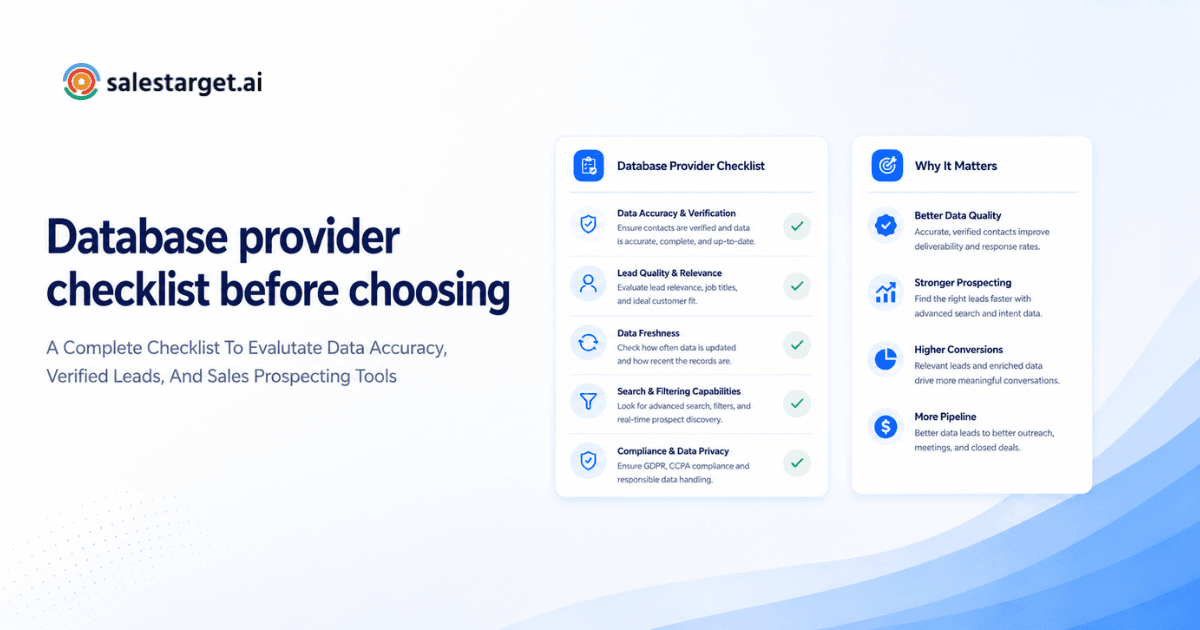
The minimum standard is a database that verifies records at the point of access, not just at the point of initial collection. Ask how often records are refreshed and what the verification methodology looks like. A database provider checklist can help you compare options on the criteria that actually matter.
Built-in lead verification and enrichment features
The best B2B lead generation tools combine search, enrichment, and verification in a single workflow. If you have to export a list from one tool, upload it to a verification service, download the cleaned list, and then import it into your outreach platform, you are losing time and introducing data-quality risk at every handoff.
Look for tools where enrichment and verification happen in the same action. One-click enrichment that delivers a verified professional email, personal email, phone, and mobile saves reps hours of manual work per week.
Tools that connect prospecting with sales outreach workflows
B2B prospecting tools that sit in isolation from your outreach stack create unnecessary friction. When your lead data, email sequencing, LinkedIn automation, and CRM live in separate systems, you spend time stitching workflows together instead of selling.
The most effective setup is a platform where you can find a lead, verify and enrich it, push it directly into a multichannel sequence, and track the deal from first touch to close, all without switching tabs. That is the gap SalesTarget.ai fills by combining lead data, email outreach, LinkedIn automation, email validation, and a built-in CRM in one workspace.
Why Choose SalesTarget.ai
Find verified prospects with AI-powered lead search and enrichment
SalesTarget.ai's Lead Explorer gives sales teams access to 840M+ verified professional profiles across 50+ data sources. Enrichment happens at the moment you find the lead. Contacts are verified at the point of enrichment, not whenever the data was first scraped. One-click enrichment delivers verified professional email, personal email, phone, and mobile for each contact.
Access B2B contact data with Lead Explorer and intent signals
Lead Explorer includes 4,000+ intent and buyer signals powered by Bombora Intent Topics. You can filter by business events like funding rounds, hiring spikes, leadership changes, and industry awards with a 30 to 90 day lookback. This lets you target companies that are actively in a buying window, not just companies that match a firmographic profile.
Run email and LinkedIn outreach after finding the right buyers
Once you find and verify your leads, you can push them directly into email sequences or LinkedIn outreach without leaving the platform. Email outreach includes unlimited inboxes with AI warm-up, intelligent inbox rotation, and SPF/DKIM/DMARC checks. LinkedIn automation handles connection requests, DMs, follow-ups, and engagement actions with AI personalization adapted to each profile.
Keep campaigns clean with email validation and deliverability checks
SalesTarget.ai's built-in Email Validator runs MX/SMTP checks, disposable-email detection, and risk scoring before any email leaves your inbox. 90% of emails are validated before sending, keeping bounce rates well below the 2% safety threshold.
Manage leads from first contact to deal tracking with built-in CRM
Campaign leads land automatically in SalesTarget.ai's built-in CRM. Every email and call is logged to the lead timeline. Follow-up tasks are created automatically. Teams using the CRM report 3.2X faster deal cycles and about 6 hours saved per rep per week, time that goes back into actual selling.
What Sales Teams Miss When They Focus Only on Lead Quantity
Why a large lead list does not always create more opportunities
A list of 10,000 unverified contacts will produce fewer meetings than a list of 2,000 verified, intent-matched prospects. Volume feels productive. It fills up your CRM and makes your pipeline metrics look healthy on the surface. But volume without verification just increases the noise your reps have to sort through before finding a real conversation.
The math is simple. If your unverified list converts at 0.5% and your verified list converts at 2.5%, you need 5X the volume from the unverified list to match the output. And that 5X volume comes with 5X the bounces, 5X the spam complaints, and 5X the damage to your sender reputation.
How inaccurate data affects sales conversations and pipeline growth
Bad data does not just cause bounces. It warps your pipeline visibility. Deals that are based on outdated contact information stall silently. Reps follow up with people who left the company. Forecasts include opportunities that were dead before they started. CRM data quality degrades, and your reporting loses accuracy.
According to Gartner, 72% of sellers feel overwhelmed by their tech stacks, and teams running on fragmented, low-quality data are 45% less likely to hit quota (Gartner Sales Technology Research). The root cause is often upstream. Garbage data in means garbage pipeline out.
Why connecting lead generation with outreach improves results
When lead generation and outreach live in separate systems, data degrades between the handoff. You export a list Tuesday, clean it Wednesday, upload it Thursday, and by Friday some of those contacts have already changed. Every gap in the workflow is a window for decay.
Connecting prospecting directly to outreach inside one platform, where a lead goes from discovery to verification to sequence in a single session, closes those gaps. That is how B2B data accuracy improves sales outreach in practice, not in theory.
Build Better Sales Campaigns With Verified B2B Leads
Every outbound campaign starts with a list. The quality of that list determines whether your reps spend the next month having real sales conversations or chasing dead contacts.
Finding verified B2B leads is not about getting more names. It is about getting the right names, verified at the right time, enriched with the right signals, and fed directly into the right outreach channels. That process, done well, is the single highest-leverage improvement a sales team can make to their outbound results.
SalesTarget.ai brings every step of that process into one platform. Find your buyers with Lead Explorer. Verify and enrich them in the same click. Push them into email and LinkedIn sequences. Track every deal in a built-in CRM. No stitching tools together. No data decay between handoffs. One workspace, from first lead to closed deal.