TL;DR
- Group-based LinkedIn campaigns are posting some of the strongest first-message reply rates of any outreach format in 2026
- The winning sequence is join → engage → THEN connect — never join → pitch
- Cold DMs and InMail keep losing ground to context-rich, community-warmed outreach
- Spammy group posting gets you muted, reported, or removed — the reputation risk is real
- Once a group connection replies, move them into a structured, personalized sequence instead of manual one-off follow-ups
Every LinkedIn growth hack from 2023 stopped working around the same time. Connection acceptance rates dropped, InMail turned into background noise, and "Hi {{firstName}}, noticed we're both in sales" became an instant ignore. The reps still booking meetings quietly went back to something LinkedIn built over a decade ago and everyone forgot about: Groups.
Why LinkedIn Groups Are Making a Comeback in 2026
Cold outbound on LinkedIn has hit a ceiling. Prospects have seen the same connection-request template a hundred times, and LinkedIn's own spam detection has gotten aggressive about flagging accounts that blast generic invites at volume. At the same time, the platform's algorithm now weights engagement signals — comments, reactions, shared group activity — more heavily than a stranger's cold click.
Groups sidestep both problems. When you and a prospect are both members of the same industry group, you already share context before a single message goes out. Research from LinkedIn automation platforms tracking 2026 campaign performance shows group-based campaigns post some of the strongest first-message reply rates of any outreach format, consistently outperforming standard cold connection sequences — largely because the relationship starts with a shared interest instead of a stranger's ask.
This isn't a new feature. Groups have existed on LinkedIn since the platform's early years. What's changed is that reps burned out on cold DMs are rediscovering a channel that was sitting there the whole time, underused because it doesn't scale the way a connection-request script does. That's exactly why it still works.
Picture two reps targeting the same buyer persona. The first sends 200 connection requests a week from a script, gets flagged for review twice, and books one call. The second joins four active groups in their prospect's niche, spends three weeks actually reading and commenting, then sends fifteen connection requests referencing real conversations. The second rep books more meetings with a fraction of the volume — not because the tactic is flashy, but because every single ask lands on someone who already recognizes the name.
There's also a trust dynamic that's easy to underestimate. A buyer scrolling their feed sees hundreds of company pitches a day. A comment thread inside a group they chose to join feels different — it's a space they opted into, made up of peers they've decided are worth listening to. Showing up there with something genuinely useful, before you've asked for anything, borrows credibility no cold message can buy.
It also solves a math problem reps are quietly running into. Connection request limits haven't gone up, and neither has patience for another templated pitch. When the number of cold asks you can send stays capped, the only lever left is making each one count more — and nothing raises the odds of a reply like the recipient already recognizing your name from somewhere real.
Finding the Right Groups for Your ICP
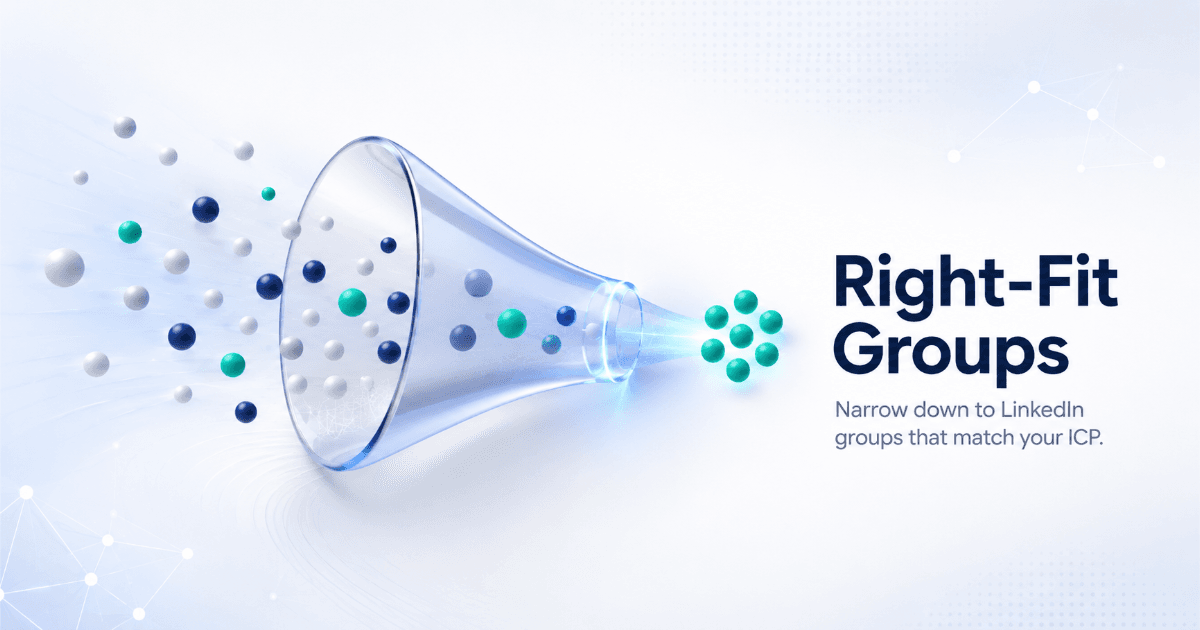
Not every group is worth your time. Search LinkedIn Groups using the same terms you'd use to define your ideal customer — job function, industry, niche technology, or region — and skip anything with fewer than a few thousand members or no posts in the last two weeks. A group with 40,000 members and no activity since last year is a graveyard, not an audience.
What to search for
Start narrow, not broad. "Sales Leaders" returns a bloated group of every job title imaginable. "B2B SaaS Revenue Operations" or "Fintech Compliance Professionals" returns a group where the people posting are almost certainly your buyer. Layer in geography or seniority terms if your ICP is regional or executive-heavy — a smaller, sharper group beats a massive generic one every time.
Red flags that mean skip it
Three signals almost always mean a group isn't worth your time: the most recent post is weeks old, the top posts in the feed are all recruiters or event promoters rather than the buyer persona you're after, and comment counts sit at zero across the board. None of that means the group is dead in name — it means nobody's actually reading it, which is the only thing that matters here.
If you've already documented your ICP inside a tool like SalesTarget's ICP Builder, don't start your group search from scratch — turn each firmographic filter you've already defined (industry, company size, seniority) into a group search term. It turns a guessing game into a shortlist in about ten minutes, and you walk in already knowing exactly who you're looking for in the member list.
The Engagement-First Group Strategy
This is the part most reps skip, and it's the part that actually makes group prospecting work. Joining the right group means nothing if you go straight to selling — the sequence matters more than the group itself:
| Step | What to do |
|---|---|
| 1. Go quiet first | Join and read for 1–2 weeks before posting or commenting on anything |
| 2. Comment with substance | Leave real, specific comments on 3–5 posts before you publish anything yourself |
| 3. Post once, no pitch | Share one genuinely useful post — no demo link, no product mention |
| 4. Track who engages back | That short list is your warm list — not the entire group roster |
| 5. Connect with context | Reference the specific post or comment thread in your connection request |
| 6. Move into a sequence | Once they accept, bring the conversation into a structured 1:1 sequence |
Notice what's missing: there's no step where you pitch inside the group. The entire point of this sequence is that by the time you send a connection request, the prospect already recognizes your name from a real conversation — not a sales script.
"Real" comments are specific enough that they couldn't be copy-pasted onto a different post. Instead of "Great insights, thanks for sharing," add a number from your own experience, disagree respectfully with one point, or ask a question the original poster would actually want to answer. That's the difference between a comment that gets noticed and one that reads as filler.
There's no fixed clock on this — some groups move fast enough to compress the timeline to a week or two, others take a month before you've built enough visibility to send a connection request that actually lands. Watch engagement, not the calendar. The moment someone replies to one of your comments or reacts to your post, that's your signal to move to step five.
Where Group Prospecting Goes Wrong
Groups can build trust fast, or torch it just as fast. Here's what gets reps muted, reported, or quietly removed by a moderator:
Pitching on day one
Mistake
Joining a group and posting a product link in the first week reads as exactly what it is — an ad. Most moderators remove it before anyone sees it.
Generic "Great post!" comments
Mistake
Low-effort comments left across dozens of posts are visible to everyone in the thread. Prospects notice the pattern faster than you'd think, and it kills credibility instead of building it.
Joining 50 groups, engaging in none
Mistake
Group prospecting doesn't scale by volume the way a connection-request script does. Three or four active groups you genuinely participate in beat fifty you silently joined.
Pitching in the comments instead of the DM
Mistake
Even a soft pitch left publicly in a comment thread embarrasses the prospect in front of peers. Any sales conversation belongs in a private message, after the connection is made.
Treating every member as a lead
Mistake
Not everyone in the group matches your ICP, and connecting with all 3,000 members regardless of fit turns a warm channel into spray-and-pray with extra steps. Stay selective — the whole advantage disappears at volume.
Group-Warmed Outreach vs. Cold DMs
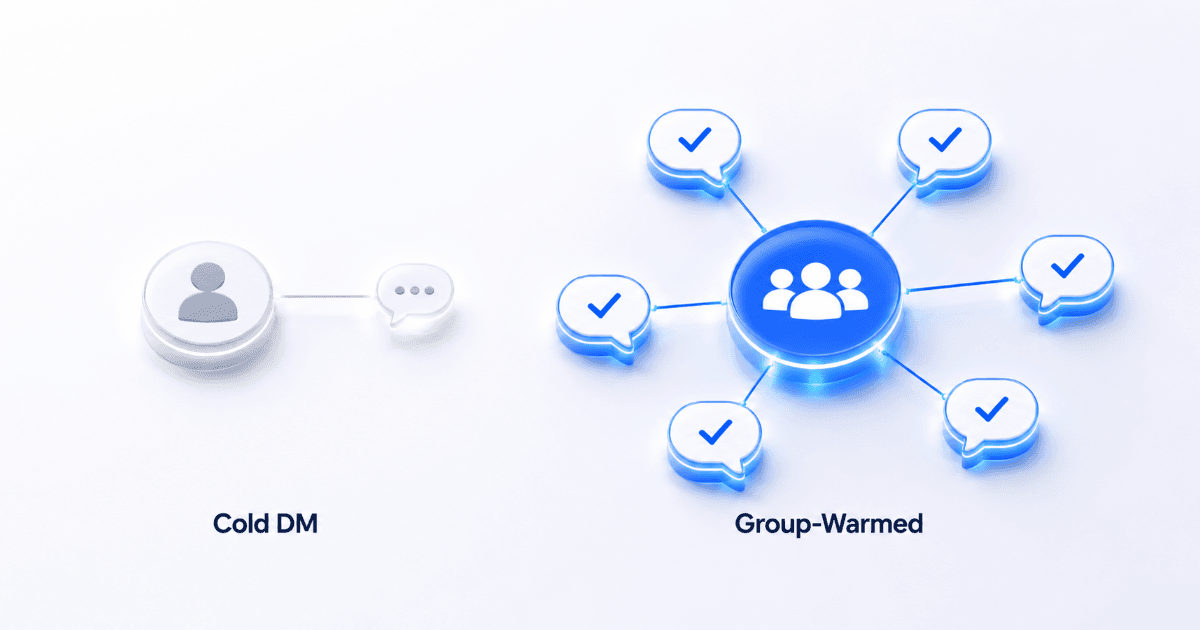
Take the same target account list and split it between two reps for a month. Rep A works it the traditional way: a daily batch of cold connection requests, a generic opener, and a follow-up sequence if there's no response. Rep B works four relevant groups instead — commenting through week one, posting once in week two, then sending a short list of highly targeted connection requests in week three, each referencing a specific thread.
By the end of the month, Rep A has sent far more requests and started far fewer real conversations. Rep B sent a fraction of the volume and is already scheduling calls, because every person they messaged had already seen their name attached to something useful. Same account list, same time window, completely different outcome — and it comes down to context, not effort.
Put the two approaches side by side and the gap is obvious:
| Dimension | Cold DM | Group-Warmed |
|---|---|---|
| First-message context | None — a stranger's ask | Shared group, real prior interaction |
| Reply-rate tier | Tier 2 — moderate | Tier 1 — strong |
| Time to first reply | Slower, more ignored requests | Faster — recognition already exists |
| Account risk | Higher at scale | Lower — no mass invites needed |
📊 The reply-rate gap, by the numbers
- Group and event-based campaigns post some of the strongest first-message reply rates tracked across LinkedIn outreach platforms in 2026 — research from these platforms shows they outperform standard cold connection sequences by tapping into shared interests before the ask
- Standard cold outbound on LinkedIn keeps producing single-digit first-message reply rates across most industries, per the same 2026 data
How This Fits Into Your Outreach Stack
Group prospecting stays a manual, human step — and that's the point. The moment you automate comments and posts inside a group, you lose the exact thing that made the approach work: a real person actually engaging. Reading, commenting, and posting genuinely inside a group isn't a task to hand off.
Where automation earns its place is right after the handoff. Once a group-warmed connection accepts your request and you're ready to open the conversation, that's the moment to bring in a real system instead of a manual follow-up you might forget by Friday. SalesTarget's AI LinkedIn Personalization can help you open with a message that keeps the group context alive — referencing the specific post or thread that started the relationship — instead of resetting to a generic template.
From there, the rest of your LinkedIn outreach sequence — follow-ups, human-like send timing, and safe daily limits — runs the way any warm connection would, just with a head start most cold sequences never get. The idea is a clean division of labor: the human part of the job (reading a room, contributing something real, deciding who's worth connecting with) stays with you, and the repetitive part of the job (timing follow-ups, keeping pacing safe, not letting a warm reply go cold) gets handed to a system built for it.
Concretely, that means smart scheduling to send the follow-up at a time the recipient is actually likely to see it, built-in safety guardrails so pacing stays within what LinkedIn tolerates, and a message that opens by referencing the group thread instead of resetting the relationship to zero. None of that replaces the manual work of showing up in the group — it just makes sure that work doesn't go to waste the moment someone finally replies.
None of this makes Groups a shortcut. It takes more patience upfront than firing off two hundred connection requests before lunch. But the reps getting real replies in 2026 aren't the ones optimizing for volume anymore — they're the ones showing up in the right rooms, saying something worth responding to, and letting that do the work a cold script never could.
Turn Group Conversations Into Pipeline.
Move warmed-up LinkedIn connections into personalized, safely-paced sequences with SalesTarget.
✓ 50 credits ✓ 7-day trial ✓ No credit card required