Your reps spend four hours a day digging through LinkedIn, hunting email addresses, and cross-referencing company databases. Half the emails they send bounce. The other half land in spam. And when a contact does reply, it's often someone who left the company six months ago. The problem isn't that good leads don't exist. The problem is that finding them and trusting the data burns time and cash at scale.
The best lead generation companies solve this by bundling verified contact data, real-time enrichment, and multichannel outreach into a single platform. Instead of stitching together five separate tools, you get one unified workspace where you find a buyer, validate their email, run coordinated email and LinkedIn campaigns, and track the deal all in one place. This guide walks you through the top providers, how they stack up, and how to pick the right one for your team.
Why Sales Teams Struggle to Find Accurate B2B Contacts
Three things go wrong when buying B2B contact data. First, the database is stale. A contact list might have been accurate three months ago, but job changes happen constantly. According to recent Gartner research, B2B contact data degrades by 3% each month due to job transitions, role changes, and company churn. Second, verification is loose. Many providers claim 95% accuracy, but that often means "we tried to validate the email format," not "we tested it with SMTP checks before you sent to it." Third, even if you get good data, you still need a separate tool for outreach, another for email validation, and a third for CRM tracking. That stack multiplies your subscription costs and creates manual data entry.
Sales teams end up choosing between quantity over quality (buying massive lists that bounce) or spending weeks manually researching each lead (which doesn't scale). Neither works at the volume modern outbound demands.
What Makes a Lead Generation Company Reliable?
Contact Accuracy and Data Refresh Frequency
Real accuracy means more than a big database. It means contacts are verified within the last 30 to 90 days and updated continuously as job changes happen. Ask providers how often they refresh their data and how they detect when someone moves jobs. The best platforms use a mix of automated signals (LinkedIn scraping, email bounces, hiring announcements) and manual research to keep records current.
Email, Phone, Company, and Buyer-Intent Coverage
A useful lead database includes professional email, personal email, direct phone, mobile, company size, revenue, industry, tech stack, job title, department, and seniority. But the real differentiator is intent data. Can the platform show you which accounts are actively hiring, raising funding, or installing your competitor's software? Intent signals cut cold outreach from a guessing game to a targeting game.
Built-In Email Verification and Contact Data Enrichment
Enrichment that happens after you find a lead is too late. The best platforms enrich contacts in real time as you search, so you know the email is valid before you add it to a sequence. MX checks, SMTP validation, and disposable-email detection should be automatic, not a separate step.
Search Filters for Finding Qualified B2B Leads
You need to search by more than job title and company size. Look for platforms that let you filter by tech stack, hiring velocity, funding stage, revenue growth, and location. Advanced filters mean fewer manual false positives and less time wasted on disqualified accounts.
Data Privacy, Compliance, and Opt-Out Handling
GDPR, CCPA, and CASL aren't optional. Any platform you use must maintain explicit audit trails of data sources, respect opt-outs, and support compliance workflows. Sending cold outreach to opted-out contacts can cost you thousands in fines.
Integrations with Outreach Tools and CRM Systems
You shouldn't have to export and re-import leads between systems. The best platforms sync directly with your CRM, email automation tool, and sales engagement platform. That means enriched leads land straight in your outreach workflow with zero manual steps.
How We Compared the Best B2B Lead Generation Companies
Size and Quality of the B2B Contact Database
Bigger is not always better. We evaluated the total number of verified contacts (professional profiles), the depth of data per contact (email, phone, company info, intent signals), and the geographic and industry spread. A platform with 500 million mediocre contacts is less useful than one with 200 million that are actively maintained and enriched.
Verified Email Lead Accuracy
We looked at verification methods: whether platforms use SMTP checks, MX record validation, and real-time email validation at the point of enrichment. We also checked whether they publish their accuracy rates and allow beta testing on sample lists.
Prospecting Filters and Intent Signals
We assessed search capabilities: how granular you can get with business filters (industry, revenue, tech stack, hiring velocity), people filters (role, seniority, department, location), and whether platforms offer real-time intent signals (job changes, funding, tech adoptions, buying signals).
Email and LinkedIn Outreach Features
We reviewed automation depth: can you build multi-step sequences, personalize at scale, and run coordinated email and LinkedIn campaigns in one workflow? We looked at deliverability protections (warm-up, inbox rotation, DKIM/SPF/DMARC checks) and reply management (unified inbox, lead scoring, intent classification).
CRM, Workflow, and Reporting Tools
Do leads automatically land in the CRM? Are calls logged and notes captured? Can you build custom reports on campaign performance, pipeline, and revenue metrics? A good platform logs activity automatically so your team focuses on sales, not data entry.
Pricing, Credit Limits, and Total Software Cost
We looked at the real cost per usable lead, not headline pricing. This includes credit consumption for searches, enrichment, verification, outreach sends, and CRM usage. Many platforms appear cheap until you scale; we flagged those trade-offs.
Best Lead Generation Companies with Verified B2B Contacts
SalesTarget.ai — Best All-in-One Platform for Prospecting, Verification, Outreach, and CRM
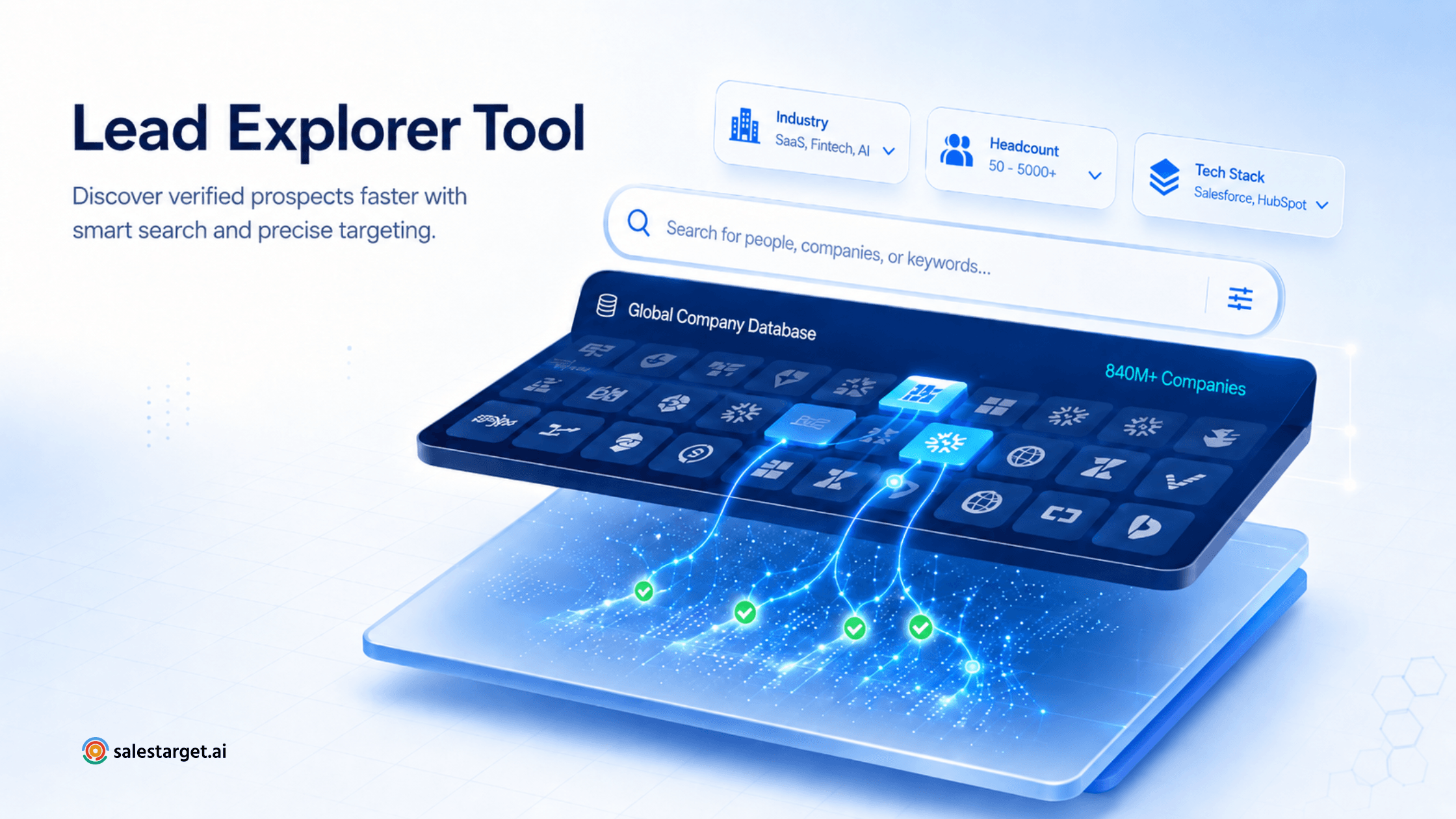
SalesTarget.ai bundles lead data, email validation, multichannel outreach, and CRM into one platform. Its Lead Explorer taps 840M+ verified professional profiles, 4,000+ intent signals, and 50+ data sources, with enrichment happening in real time at the moment you search. Emails are validated with MX and SMTP checks before you send them. Email Outreach builds multi-step sequences with AI, auto warm-up, and Unibox unified inbox for reply management. LinkedIn Outreach automates connections, DMs, and follow-ups with AI personalization and timezone-aware scheduling. The built-in CRM captures every email, call, and reply on the lead timeline, with 3.2X faster deal cycles and 91% follow-up completion reported by users. AI Copilot generates campaigns in seconds and flags at-risk deals. One subscription replaces data, email, LinkedIn, validation, and CRM tools. Best for teams that want to move fast without juggling five platforms.
Apollo.io — Best for Contact Data and Email Sequencing
Apollo combines a large B2B database (200M+ contacts) with email engagement and basic CRM. Its strength is contact quantity and email deliverability. Weakness: no native LinkedIn automation, no built-in contact verification beyond basic email checks, and reply management requires a separate tool. Pricing scales quickly at volume. Suited for teams that have a separate CRM and want to layer in email outreach.
ZoomInfo — Best for Large Sales and Revenue Teams
ZoomInfo is enterprise-grade B2B data with intent signals and account-based marketing (ABM) features. Its database is comprehensive and compliance-first. Downside: it's built for large teams with complex sales cycles and comes with enterprise pricing. Setup takes weeks. Not practical for startups or lean teams. Best if you already have Salesforce and a six-figure annual budget.
Cognism — Best for Compliant Global B2B Contact Data
Cognism focuses on GDPR-compliant data with strong European coverage. Its contacts are sourced transparently and updated frequently. The platform includes email search, phone verification, and company enrichment. Missing: no native outreach tools (you bring your own email platform), no intent signals beyond basic hiring data, and pricing is per-search, which gets expensive at scale. Good for teams that need European data and have existing outreach stacks.
UpLead — Best for Real-Time Email Verification
UpLead specializes in real-time email validation and lead verification. You can upload lists or search for contacts, and UpLead runs SMTP checks and deliverability scoring on each record. Its API integrates with most CRMs and email platforms. Limitation: it's a verification tool, not a full prospecting platform. You still need a separate database tool to find leads. Best for teams that already have lead lists but need to validate quality before sending.
Lusha — Best for Simple Contact Lookup and Enrichment
Lusha offers straightforward B2B contact search with enrichment: email, phone, company info, and LinkedIn profiles. It's easy to use and has a free tier to test. Downside: the database is smaller than competitors (50M+ contacts), and intent data is limited. No outreach or CRM features built in. Best for smaller teams or those doing occasional research; not built for high-volume outbound campaigns.
RocketReach — Best for Finding Professional Contact Details
RocketReach specializes in finding email and phone for specific people and companies. Search is simple: enter a name or company, get contact details in seconds. Its database covers executives and decision-makers well. Limitation: minimal intent data, no outreach features, and the search-by-search model gets expensive if you need hundreds of leads. Good for one-off lookups; not for building large-scale outbound campaigns.
Lead411 — Best for Direct Dials and Sales Triggers
Lead411 focuses on decision-maker data, direct phone numbers, and sales triggers (hiring, funding, tech stack changes). Its phone data is particularly strong. Weakness: smaller database than Apollo or ZoomInfo, no email validation built in, and no outreach or CRM tools. Best for phone-first outreach teams or those supplementing another platform with better direct dial data.
Seamless.AI — Best for AI-Assisted Contact Discovery
Seamless.ai uses AI to find B2B contacts by company and role. Its AI learns from your replies to improve targeting over time. The platform includes email, phone, company data, and intent signals. Missing: no native email outreach or CRM (you integrate with external tools), limited GDPR compliance documentation, and verification methods are less transparent than competitors. Good for teams that want AI-driven prospecting but have their own outreach and CRM stacks.
Belkins — Best for Managed Lead Generation Services
Belkins is less a platform and more a service. You define your target audience, and Belkins researchers find and verify leads, delivering them as a CSV or CRM sync. You don't do the searching yourself. Strength: hands-off for busy teams. Weakness: slower turnaround, less flexible filtering, higher per-lead cost, and no self-serve control. Best for agencies or in-house teams that want to outsource prospecting entirely.
Lead Generation Companies Comparison Table
Contact Database Size and Data Coverage
SalesTarget.ai: 840M+ profiles, 146M+ businesses, 4,000+ intent signals. Apollo: 200M+ contacts. ZoomInfo: 180M+ business contacts, intent data. Cognism: 120M+ contacts, strong European coverage. Lusha: 50M+ contacts. RocketReach: 600M+ profiles (emphasis on executives). Seamless.AI: 500M+ contacts. Lead411: 30M+ contacts, strong phone data.
Email Verification and Phone Data
SalesTarget.ai: Real-time MX/SMTP checks at enrichment, 99% verified data reported. Apollo: Email syntax checks, limited real-time verification. UpLead: Full SMTP verification, email scoring. ZoomInfo: SMTP checks, some real-time. Cognism: Limited email verification. Lead411: Strong direct dial coverage. Seamless.AI: Basic email checks.
Outreach Channels and Sequence Tools
SalesTarget.ai: Email + LinkedIn automation, multi-step sequences, AI personalization, warm-up, unified inbox. Apollo: Email sequences, limited personalization, requires external tool for LinkedIn. Instantly, Smartlead, Lemlist: Email-focused, strong for cold email, no LinkedIn or CRM. Others: Mostly no native outreach tools; you bring your own.
CRM and Workflow Features
SalesTarget.ai: Built-in lightweight CRM, automatic lead capture, call logging, task creation, activity tracking. Apollo: Basic CRM, limited automation. ZoomInfo: Works with Salesforce, no standalone CRM. Others: None; require external CRM integration.
Best Use Case and Target Team Size
SalesTarget.ai: All-in-one for SDRs, AEs, founders, and agencies wanting one platform. Apollo: Mid-market teams with existing CRMs. ZoomInfo: Enterprise sales teams. Cognism: Global teams needing GDPR-first data. UpLead: Teams that already have leads but need verification. Lead411: Phone-first outreach. Belkins: Agencies and teams outsourcing prospecting.
Pricing Model and Software Stack Cost
SalesTarget.ai: Per-user or pay-as-you-go; replaces 4 to 5 tools, lower total cost of ownership. Apollo: Per-user plus credits; scales with volume. ZoomInfo: Enterprise custom pricing, six figures. Cognism: Per-search model. UpLead: Per-search, $0.10 to $0.50 per email validated. Lead411: Monthly or per-lead. Seamless.AI: Per-user or per-lead.
Which Companies Provide Verified B2B Contacts?
Platforms with Real-Time Email Validation
Real-time validation means checking the email at the moment you enrich it, not days or weeks earlier. SalesTarget.ai, UpLead, and ZoomInfo run SMTP checks and MX record validation in real time. Most others validate during initial data ingestion, which means old data stays old. Real-time is critical because even a contact verified three months ago might have been laid off or changed roles since then.
Providers That Verify Mobile and Direct-Dial Numbers
Mobile and direct-dial numbers are harder to verify than emails. Lead411 and ZoomInfo have invested in phone verification networks. SalesTarget.ai includes phone data from multiple sources and flags uncertain entries. Others often include phone numbers but don't validate them. If phone outreach is part of your mix, check whether the platform actually verifies these numbers or just republishes what they found.
Companies That Combine Contact Data with Buyer-Intent Signals
Intent data is the real differentiator. Instead of just reaching out cold, you target accounts that are actively buying. SalesTarget.ai pulls intent from Bombora (hiring spikes, leadership changes, awards, funding), job posting velocity, tech stack changes, and 4,000+ other signals. Apollo includes some intent but not as deeply. ZoomInfo's intent module is sold separately. Most smaller platforms don't offer intent at all.
Questions to Ask About Data Sources and Refresh Cycles
Ask how providers source data: LinkedIn scraping, public records, API partnerships, third-party resellers? Are sources disclosed transparently, or do they keep it vague? How often is each contact record updated? If they say "continuously," ask for specifics: daily, weekly, monthly? What triggers an update: a new email bounce, a LinkedIn job change, or something else? The best platforms can show you when and why a record was last refreshed.
Which B2B Database Provider Has the Most Accurate Data?
Why Database Size Does Not Equal Contact Accuracy
A platform with 900 million contacts is worthless if 70% are stale or duplicate. Size is noise without quality. A smaller database of 500 million actively maintained, verified contacts beats a bloated 1 billion where half haven't been touched in a year. Look at refresh frequency, deduplication methods, and how the platform measures accuracy, not just the headline number.
How Providers Calculate Verified Contact Rates
Beware of vague "95% accuracy" claims. Ask how they measure it: Do they send test emails and count how many don't bounce? Do they allow beta testing on your own contact lists? Do they check SMTP in real time or just run an offline format check? The most transparent platforms publish their methodology and let you test before buying. SalesTarget.ai reports 99% verified contact data and backs it with SMTP checks at enrichment.
How to Test a Data Provider with a Sample Contact List
Before committing, request a sample of 100 to 500 contacts in your target industry and region. Upload that list to the provider's platform and run an email deliverability test. Track bounces and reply rates over two weeks. A bounce rate above 15% is a red flag. Also check for duplicates, incomplete records, and typos in names or company info. This small test often reveals data quality issues that headline claims hide.
Metrics to Track During a Database Accuracy Test
Monitor these during a pilot: hard bounce rate (aim for under 10%), soft bounce rate (under 5%), reply rate (baseline), unsubscribe rate (you shouldn't see many from fresh prospects), spam complaint rate (under 0.5%), and invalid data rate (incomplete email, bad formatting). Compare these against the platform's claimed accuracy. A gap of more than 5 percentage points suggests their accuracy claims are inflated.
Best Lead Generation Companies by Business Need
Best Option for B2B SaaS Companies
SaaS companies need to find and target buyers across multiple company sizes and personas fast. SalesTarget.ai is built for this: search by tech stack (who uses Salesforce, HubSpot, etc.), department (sales, marketing, ops), job changes, and hiring velocity. Run coordinated email and LinkedIn outreach to build pipeline. Track meetings and closed deals in the built-in CRM. All in one platform.
Best Option for Sales and Lead Generation Agencies
Agencies need to run outbound for multiple clients, each with different targeting requirements. A unified platform saves time and reduces data silos. Multi-user access, client segmentation, and centralized reporting are critical. Learn how lead generation agencies use multichannel outreach to scale client results.
Best Option for Start-ups and Founder-Led Sales
Founders need everything in one place without a huge budget. A platform that combines free prospecting searches, email outreach, and a lightweight CRM beats paying five separate tools. SalesTarget.ai includes a free AI Copilot for campaign generation and lead research, reducing the need to hire an SDR immediately.
Best Option for Global Prospecting
If you sell across multiple regions and languages, you need a provider with deep coverage in those countries. Cognism is strong for Europe (GDPR-first). SalesTarget.ai covers 150+ countries and supports multiple languages. ZoomInfo is best for North America. Lusha has solid Asia-Pacific coverage. Check the provider's coverage map for your specific regions before signing.
Best Option for Enterprise Sales Teams
Enterprise requires account-based marketing (ABM) workflows, deep CRM integration, custom reporting, and compliance auditing. ZoomInfo and SalesTarget.ai both scale to enterprise. ZoomInfo is more traditional and integrates tightly with Salesforce. SalesTarget.ai is faster to implement and includes ABM-style intent filtering built in.
Best Option for Multichannel Outbound Sales
If you reach out via email and LinkedIn (and ideally phone), you need a platform that orchestrates all three in one workflow. SalesTarget.ai is built for this. Other platforms focus on one channel. See how startups coordinate email and LinkedIn outreach to accelerate reply rates.
How Do Lead Generation Companies Verify Contact Data?
Email Syntax, Domain, MX, and SMTP Checks
The first level is format: does the email look right (name@domain.com)? Does the domain exist? The second level is MX records: can mail actually be delivered to that domain? The third level is SMTP: connect to the mail server and ask if that specific inbox exists. Real-time SMTP checks at enrichment are gold standard. Most platforms only do the first two levels during batch processing.
Phone Verification and Direct-Dial Matching
Phone verification is harder than email. Providers cross-reference phone numbers against telecom records, LinkedIn, and company websites to confirm they belong to the person listed. Direct-dial matching means the number is tied to a specific person, not just the company main line. Lead411 and ZoomInfo do this well. Others often include phone numbers without verification.
Contact Data Enrichment from Multiple Sources
The best platforms don't rely on a single source. They pull data from LinkedIn, job boards, company websites, third-party APIs, news, SEC filings, and public databases. If a data point exists in multiple sources, confidence goes up. If it conflicts, the platform flags it. SalesTarget.ai pulls from 50+ sources to triangulate accuracy and catch outdated records.
Job-Change Tracking and Database Refresh Methods
Continuous refresh catches job moves before you send to an old email. Platforms monitor LinkedIn, job boards, hiring announcements, and email bounces to detect changes. When someone leaves a company, their corporate email often becomes invalid within weeks. SalesTarget.ai updates records within 30 to 90 days of a detected change. Ask providers for their refresh speed before signing.
Why Catch-All Emails Still Need Extra Checks
A catch-all email domain (e.g., hello@company.com, sales@company.com) accepts mail to any address, making it impossible to know if a specific person got your email. It also inflates bounce rates because many of those mailboxes are never checked. Platforms that flag catch-all addresses are honest about data limits. Those that hide it are setting you up for surprises. SalesTarget.ai flags catch-all domains so you know the verification risk upfront.
How to Choose a B2B Lead Generation Company?
Define Your Target Market and Contact Requirements
Before evaluating platforms, write down your ideal customer profile: industry, company size, location, revenue, department, job title, seniority, and any buying signals (hiring, funding, tech stack). This clarity helps you assess whether a platform's database covers your specifics. A platform great for startups might be weak in enterprise. One strong in tech might miss nonprofits.
Match the Platform to Your Outbound Channels
If you only do email, UpLead or Instantly work. If you need email plus LinkedIn coordination, SalesTarget.ai or Apollo fit better. If phone is primary, Lead411. Picking a tool that doesn't match your channels wastes money and creates workflow friction.
Review Data Coverage in Your Main Countries and Industries
Download a sample list from the platform in your target industry and region. Are the records complete? Do they include accurate titles, company sizes, and phone numbers? High sample quality predicts high full-database quality.
Compare Verification Methods and Accuracy Claims
Not all "verified" means the same thing. Get specifics: Do they use SMTP? Real-time or batch? How old is the verification? Any money-back guarantee for bounces above a certain threshold?
Test Search Results with a Small Sample Campaign
Run a pilot with 100 to 500 prospects from the platform. Send one email and track opens, clicks, and replies over one week. A 25% to 35% open rate and 2% to 5% reply rate is solid for cold email. Below that, the data quality or your targeting is off.
Calculate the Full Cost per Usable Lead
Don't just look at per-user pricing. Add credits spent on searches, enrichment, verification, and outreach. Then divide by the number of leads that actually reply or convert. This shows you the real cost per result, not per click.
Why Choose SalesTarget.ai?
Find and Enrich Buyers Through Lead Explorer
Lead Explorer combines search, enrichment, and verification in one step. Type in plain English (e.g., "VP Sales at SaaS companies in California using HubSpot") or stack business and people filters. Results include verified email, phone, LinkedIn profile, company info, and intent signals. Enrichment happens in real time, so you know the email is valid before you send.
Access 840M+ Profiles and 4,000+ Intent Signals
SalesTarget.ai's database spans 840 million verified professionals and 146 million business entities. Intent data includes job changes, hiring velocity, funding rounds, tech stack shifts, and buying signals from Bombora. This means you're not just finding decision-makers; you're finding ones actively buying.
Use Contact Data Reported as 99% Verified by SalesTarget.ai
SalesTarget.ai reports 99% verified contact data. This is backed by real-time MX and SMTP checks at the point of enrichment, not old data that degrades over time. You know email validity before you build a sequence.
Validate Emails with MX and SMTP Checks Before Outreach
Email Validator runs full SMTP verification on every contact. This catches invalid, dead, and catch-all addresses before they hit your outreach. Result: bounce rates under 10%, better sender reputation, and improved inbox placement.
Run Email and LinkedIn Sequences in One Workflow
Build multichannel sequences that mix email and LinkedIn touches. Email Outreach auto-builds multi-step sequences with AI, handles warm-up, and rotates inboxes to protect reputation. LinkedIn Outreach personalizes connection requests, DMs, and follow-ups with timezone-aware scheduling and safety safeguards. Both channels run as one coordinated flow so context carries from email to LinkedIn.
Manage Replies Through the Unibox Unified Inbox
Every reply from email or LinkedIn lands in Unibox, sorted by intent (Interested, Follow-Up, Not a Fit). Automatically assign leads to team members, flag hot prospects, and see which campaigns drive the most qualified replies. No more digging through five inboxes.
Track Leads, Calls, Notes, and Deals in the Built-In CRM
Leads from your campaigns land automatically in the CRM. Every email, reply, and call is logged to the lead timeline. When a lead replies or a meeting ends, tasks are auto-created for follow-up. Call notes are captured by the built-in AI dialer, so reps never write them manually. Result: 3.2X faster deal cycles and 91% follow-up completion, according to user data.
Use the Free AI Copilot for Prospecting and Campaign Work
The AI Copilot is free inside the platform. Chat to find leads, generate full personalized sequences in seconds, track which campaigns drive revenue, or query your CRM in plain language. It knows your workspace data and can pull your website content to keep replies on-brand. Reps focus on relationships; the AI handles grunt work.
Replace Separate Data, Outreach, Validation, and CRM Subscriptions
Instead of paying for Apollo (data) + Instantly (email) + HubSpot (CRM) + UpLead (validation), one SalesTarget.ai subscription gives you all four in one bill, all integrated, all sharing the same data. Faster implementation, simpler training, and lower total cost.
How to Build a Verified B2B Lead Generation Workflow?
Set Your Ideal Customer Profile and Buying Signals
Start by defining the exact personas, companies, industries, and behaviors you target. What size company? What revenue? What job titles? What's the buying signal that makes someone fair game (hiring, funding, tech adoption, job change)? Write this down. It's your filter for all downstream decisions.
Find Target Accounts and Decision-Makers
Use Lead Explorer or a similar search tool to pull lists of target accounts and the people in them who match your ICP. Use intent filters to surface accounts actively buying. If available, use lookalike models to find similar accounts outside your initial list.
Enrich Contacts with Email, Phone, and Company Data
As you find leads, enrich them with complete contact data and company info (industry, size, revenue, tech stack, hiring velocity). Real-time enrichment at search time is faster and cleaner than batch enrichment later.
Validate Email Addresses Before Adding Them to a Sequence
Run SMTP validation on every email before it goes into outreach. Catch bounce-risk and dead addresses upfront. This single step cuts bounces by 40% to 50% and improves sender reputation.
Run Coordinated Email and LinkedIn Outreach
Build one sequence that mixes email and LinkedIn touches. Start with a warm LinkedIn connection request. Follow with an email 24 hours later. Run LinkedIn DMs on day 3. Layer in a second email on day 7. The multichannel approach lifts reply rates by 30% to 50% over single-channel alone.
Route Replies and Qualified Leads Into the CRM
As campaigns run, replies land in your unified inbox. Classify them by intent and route qualified leads to closers or to a follow-up queue. Use deal stage to track progress through your pipeline.
Review Bounce Rate, Reply Rate, Meetings, and Deal Progress
Track metrics weekly: bounce rate (aim for under 10%), reply rate (target 2% to 5% cold), meeting rate (1% to 2% of sends), and pipeline velocity (days to close, deal size, win rate). Use these to iterate on targeting, copy, and follow-up timing.
Common Mistakes When Buying Verified Business Leads
Choosing a Provider Based Only on Database Size
A billion contacts are worthless if half are stale or duplicate. A provider with a smaller, actively maintained database delivers better results. Quality beats quantity every time.
Buying Static Contact Lists with No Refresh Process
Purchasing a one-time export of 10,000 contacts is a trap. Those contacts degrade at 3% per month. Within a year, 30% are outdated. Subscribe to platforms that continuously refresh data, not one-time downloads.
Ignoring Email Verification Before Sending Campaigns
Skipping validation to save credits is false economy. A 20% bounce rate kills your sender reputation and lands you on blacklists. Validation costs $0.05 to $0.15 per email but saves ten times that in recovery and resend time.
Paying for Duplicate or Incomplete Records
Some platforms charge per contact even if duplicates exist in your export. Ask about deduplication. Also avoid providers that list email but leave phone and company data blank. Incomplete records are low-value clutter.
Using Data Without Checking Regional Compliance Rules
GDPR in Europe, CASL in Canada, CCPA in California, and other local laws restrict cold outreach. Use data only if the provider can confirm compliant sourcing and has audit trails. Non-compliance can cost thousands in fines.
Measuring Contact Volume Instead of Usable Lead Quality
Don't measure success by how many contacts you pulled. Measure by reply rate, meeting rate, and deal rate. A 100-contact list that gets 5% replies is better than a 10,000-contact list that gets 0.5% replies. Focus on conversion, not volume.
Questions to Ask Before Signing a Contract
How Frequently Is the Contact Database Updated?
Ask for specifics: Is it daily, weekly, monthly? What triggers an update? Will I see job-change detection and company churn within 30 to 90 days? Slow refresh means old data stays old.
What Counts as a Verified Email or Phone Number?
Get their verification definition in writing. Do they use SMTP? MX checks? Real-time validation? How old is the verification? Don't accept vague claims like "verified by a team of researchers." Insist on technical verification methods.
Can We Test Data Accuracy Before Buying?
Ask for a free trial or sample data in your target industry and region. Run a small campaign and track bounce and reply rates. Most reputable platforms offer this. If they won't, that's a red flag.
Are Credits Refunded for Invalid Contact Records?
A good provider will offer a guarantee: if bounce rate exceeds X%, you get credits back or a refund. This puts the accuracy risk on them, where it belongs. Avoid platforms that don't stand behind their data.
Which Countries, Industries, and Job Roles Have the Strongest Coverage?
Ask for a breakdown. A platform might have deep coverage in tech and North America but be weak in Australia or healthcare. Make sure their strengths match your target markets.
Does the Platform Support Email, LinkedIn, and CRM Workflows?
If you use multiple channels, make sure the platform integrates all of them or at least doesn't fight your existing tools. Integration friction slows adoption and wastes money.
What Is the Cost per Verified and Usable Contact?
Don't just ask for per-user pricing. Calculate the true cost: search + enrichment + verification + outreach + CRM divided by usable leads. This shows you the real financial impact.
Choose the Right Lead Generation Company for Reliable B2B Contacts
Accurate B2B contact data and verified emails are the foundation of outbound sales. Without them, your reps waste time on dead-end research, emails bounce, and reply rates tank. The right lead generation company doesn't just give you contacts; it verifies them in real time, keeps them fresh, and integrates with your outreach and CRM so no step falls through the cracks.
SalesTarget.ai stands out because it bundles everything: search, enrichment, verification, email outreach, LinkedIn automation, and CRM into one unified platform. Instead of stitching point tools together and manually moving data between systems, you find a lead, validate it, send it outreach, and track the deal, all without leaving one dashboard. The 99% verified contact data, 840M+ profile database, and real-time SMTP checks mean you hit the ground running. The AI Copilot handles sequence generation, and the built-in CRM captures every touchpoint automatically.
For teams tired of managing five subscriptions and manually copying data between systems, SalesTarget.ai cuts setup time from weeks to days and cuts total software cost by consolidating tools. If speed, simplicity, and accuracy matter to your outbound strategy, start your free trial with SalesTarget.ai today and see the difference a unified platform makes.