Picking the best database provider quietly shapes an entire revenue engine. Get it right, and your SDRs spend their mornings calling qualified accounts. Get it wrong, and you burn sales time chasing dead numbers, marketing budget on bounced sends, and pipeline opportunities that were never real. After running vendor evaluations for dozens of GTM teams, I've noticed most buyers rush this call — they compare logos and record counts instead of what actually matters. Here's the framework I use with clients.
Why Choosing the Right Database Provider Matters?
Your database sits under everything: outbound cadences, ABM lists, lifecycle campaigns, territory planning, forecasting. When the underlying data is stale, every downstream motion inherits the flaw. A 22% bounce rate isn't a deliverability problem — it's a data problem wearing a deliverability mask.
The cost isn't only wasted sends. It's SDRs pitching contacts who left nine months ago, marketing misfiring on old titles, and leadership forecasting off accounts the CRM never learned had closed a round.
What Makes a Great B2B Database Provider?
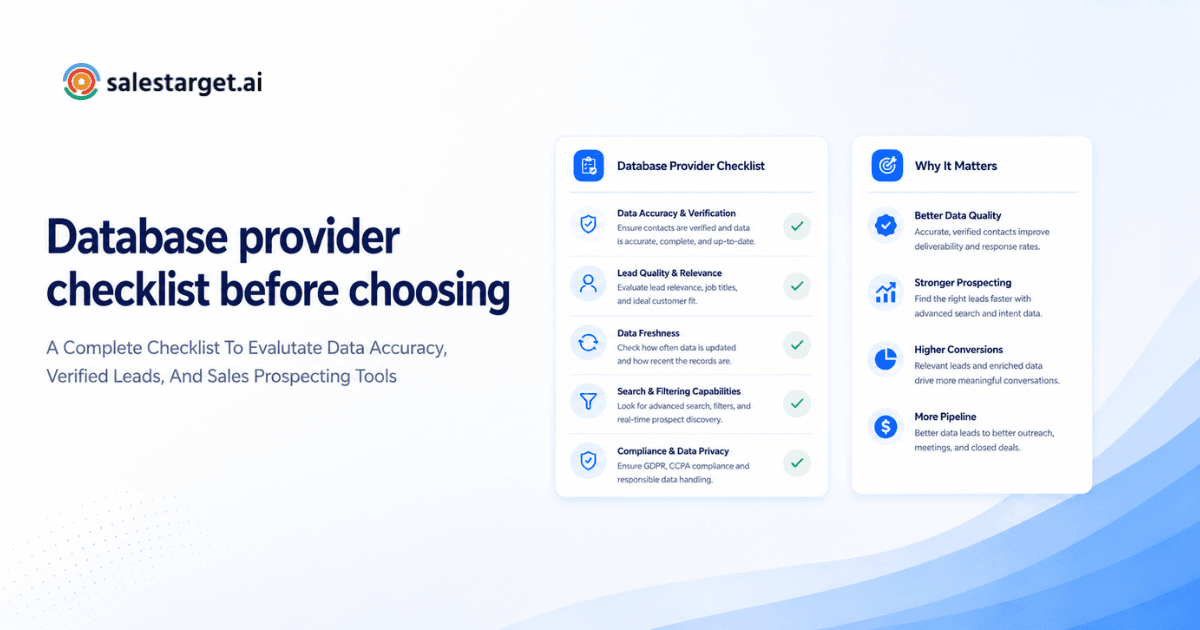
The top B2B data providers share a handful of traits — and record volume is rarely one of them. Look for:
- Accuracy verified through multi-source cross-referencing, not a single scrape.
- Freshness with defined refresh cycles, not vague "regularly updated" language.
- Compliance with GDPR, CCPA, CAN-SPAM, and regional sourcing standards.
- Integrations into Salesforce, HubSpot, and outreach tools without CSV gymnastics.
- Intent signals tied to real behavioral data rather than surface-level firmographics.
- Enrichment that fills gaps in your existing CRM instead of creating duplicates.
- Scalability so the platform grows with your ICP expansion, not against it.
The gap between B2B list providers that check all these boxes and ones that check three is enormous — and it usually doesn't show up in a demo.
Framework for Evaluating B2B Database Providers
Use these criteria as your prospect database evaluation checklist. Rate each vendor honestly.
Data Quality
Ask for a sample export against your actual ICP. Not a curated demo — a raw pull of 500 contacts in your target segment. Verify emails through your own tools and phone-verify a random 25. What the sample shows in five minutes beats any pitch deck.
Coverage
Coverage is not "how many total contacts." It's how many contacts within your ICP. A provider with 200M records but weak APAC mid-market data is worse for you than one with 40M records concentrated where you sell.
Verification Process
Ask exactly how each contact is verified. SMTP ping? Human research? Community-sourced? Providers that can't explain this clearly are usually reselling scraped data.
Data Refresh Frequency
Data refresh frequency is the metric buyers most often ignore. B2B contact databases decay roughly 2–3% per month as people change roles. A provider refreshing quarterly is showing you contacts that were correct 90 days ago. Ask about the cadence for emails, phones, and job changes separately — they're rarely refreshed at the same interval. This is also why data enrichment latency matters more than most teams realize.
Intent Signals
If a vendor sells intent, ask which source powers it (Bombora, G2, first-party web, or proprietary), how topics map to your keywords, and what the false-positive rate looks like in practice.
Ease of Integration
Native CRM sync, bidirectional field mapping, dedupe logic, and enrichment triggers should be out of the box. If the answer involves Zapier and a spreadsheet, keep looking.
Pricing Transparency
Per-credit, per-seat, per-export, or unlimited? Overage charges? Contract-year commitments? Any pricing model that requires a whiteboard to understand is designed to benefit the vendor.
Customer Support
Named CSM? Response SLA? Onboarding included? Small detail, big impact when data breaks before quarter-end.
Compliance
Where does the data come from? Is opt-out honored across regions? Do they carry a DPA you can share with legal without rewriting it?
Database Vendor Checklist
A quick reference for questions that surface real vendor differences:
| Evaluation Criteria | Why It Matters | Questions to Ask Vendors |
|---|---|---|
| Data accuracy | Drives deliverability, connect rates, and rep trust | "Can you share a 500-record sample from my exact ICP?" |
| Coverage depth | A large database is useless if it's thin in your segment | "How many verified contacts in [region + industry + role]?" |
| Refresh frequency | Contacts decay fast; stale data burns cadences | "How often are emails, phones, and job changes refreshed?" |
| Verification method | Reveals whether data is researched or scraped | "Walk me through how a single record is verified." |
| Integrations | Determines time-to-value and workflow friction | "Do you offer native, bidirectional CRM sync?" |
| Intent data | Signals whether outreach is well-timed | "What's the source and false-positive rate?" |
| Pricing model | Predictable spend vs. surprise overage charges | "Show me a real invoice from a customer my size." |
| Compliance | Protects the business legally and reputationally | "Can I see your DPA and sourcing documentation?" |
Data Accuracy Comparison
When running a data accuracy comparison, focus on four categories:
- Verified emails — bounce rate on a 500-record sample tested through your own ESP.
- Phone numbers — connect rate and mobile vs. HQ split for direct dials.
- Company information — accuracy of headcount, funding, tech stack, and revenue bands.
- Buying signals — how tightly intent, funding, and hiring signals correlate to real opportunities.
Don't take vendor-published stats at face value. Every provider has a slide claiming 95% accuracy. Your own bounce test is worth more than any benchmark deck.
Common Mistakes Buyers Make
A few patterns show up in nearly every evaluation I've run:
- Buying on contact volume alone. A 300M-record database that's 40% stale is a liability.
- Ignoring refresh frequency. Data ages regardless of how carefully it was sourced.
- Underweighting enrichment quality. Fields matter as much as records.
- Skipping CRM integration testing. A rough sync creates duplicate hell for years.
- Chasing the lowest price. Cheap data usually means high SDR churn — that math never works out.
The Database Evaluation Scorecard
Score each vendor out of 100 across six weighted categories. This is the scorecard I use with clients:
| Category | Weight | What "10/10" Looks Like |
|---|---|---|
| Accuracy | 25 | Sample test shows under 5% bounce rate |
| Coverage | 20 | Deep in your specific ICP (region, industry, role) |
| Freshness | 15 | Monthly or faster refresh with clear job-change tracking |
| Compliance | 10 | Full GDPR/CCPA support and a clean, shareable DPA |
| Integrations | 15 | Native, bidirectional CRM sync with dedupe logic |
| Cost Efficiency | 15 | Predictable pricing, no surprise overages |
Below 70? Don't advance them to procurement. Above 85 is a genuine contender. This scorecard consistently outperforms gut-feel vendor comparisons and has saved teams from six-figure regret.
An Industry Benchmark Worth Knowing
Operational benchmark: based on common RevOps benchmarking across mid-market B2B teams, sales reps often spend 20–30% of prospecting time validating inaccurate contact information before outreach begins. That's roughly one full day per SDR per week lost to cleanup — an operational tax most B2B data quality benchmarks ignore. Salesforce research on the state of sales echoes this across enterprise teams, and HBR's work on data quality shows how few organizations meet even basic standards.
How Lead Explorer Helps Build Better Prospect Lists
Lead Explorer for B2B prospecting is built around the same evaluation logic. It offers verified business contacts, granular filters for company discovery (industry, headcount, funding stage, tech stack, geography), and enrichment fields that plug into most CRMs. RevOps and SDR teams can move from ICP definition to a clean outbound list without stitching three tools together. For pipeline-building context, this complete B2B lead generation playbook pairs well with it.
Before committing to any multi-year contract, run a real ICP sample through the scorecard above. The right vendor should hold up under a 500-record test, not a 20-minute demo.
The best database provider isn't the one with the biggest number on the homepage — it's the one whose data holds up in your ICP, your CRM, and your workflow. Use the scorecard, run the sample test, ask the uncomfortable pricing questions. That discipline separates teams with clean pipeline from teams stuck cleaning their own data.