TL;DR
- Full automation is a trust liability — Gartner predicts that by 2030, 75% of B2B buyers will prefer sales experiences that prioritize human interaction over AI.
- Four signals should always escalate to a human: a positive reply, a pricing question, a technical objection, and any explicit request to talk to a person.
- Let the AI own the high-volume, low-stakes work — research, first-touch personalization, follow-up timing, scheduling, and CRM hygiene.
- Good escalation logic is about thresholds, not timers — it's defined by intent and stakes, not by how long the AI has been running.
- The handoff itself is where trust is won or lost: pass full context, never make the buyer repeat themselves, and never let a hot reply sit in a queue.
Every AI sales tool on the market promises full automation. Almost none will tell you when the machine should get out of the way. That silence is a problem — because the fastest way to lose a deal isn't a slow reply, it's an AI confidently handling a moment that needed a human.
Why Full Automation Backfires: The Trust Problem
Here's the uncomfortable truth most AI sales vendors skip: buyers can tell, and increasingly, they want a person. Gartner predicts that by 2030, 75% of B2B buyers will prefer sales experiences that prioritize human interaction over AI — a reversal after years of rising demand for rep-free, self-serve buying. AI still wins the early, information-gathering stages. But as the stakes rise, the absence of a human starts to cost you.
The mechanism is trust. Forrester's 2025 research found that 20% of buyers felt less confident in a decision after using generative AI — often because they hit unreliable or inaccurate information — and among procurement professionals that figure climbs to 28%. When your AI keeps talking past the moment a buyer needed reassurance, it doesn't read as efficient. It reads as evasive. The "uncanny valley" of a too-automated sales experience quietly pushes serious buyers away right when they're closest to a decision.
This is why "set it and forget it" automation leaks pipeline. The AI that never hands off will eventually mishandle a pricing negotiation, flatten a real objection into a templated reply, or keep nurturing someone who just asked to speak with a human. Each of those is a small, invisible leak — a deal that cools because the experience felt automated at exactly the wrong moment. Gartner's data points to the fix: 69% of B2B buyers prefer to validate AI-generated insights with a sales rep. The goal was never less AI. It's an AI that knows its lane — and knows when to step out of it.
📊 What the research says about trust
- 75% of B2B buyers will prefer sales experiences that prioritize human interaction over AI by 2030 — Gartner
- 69% of buyers prefer to validate AI-generated insights with a sales rep — Gartner
- 20% of buyers felt less confident after using generative AI — 28% among procurement — Forrester
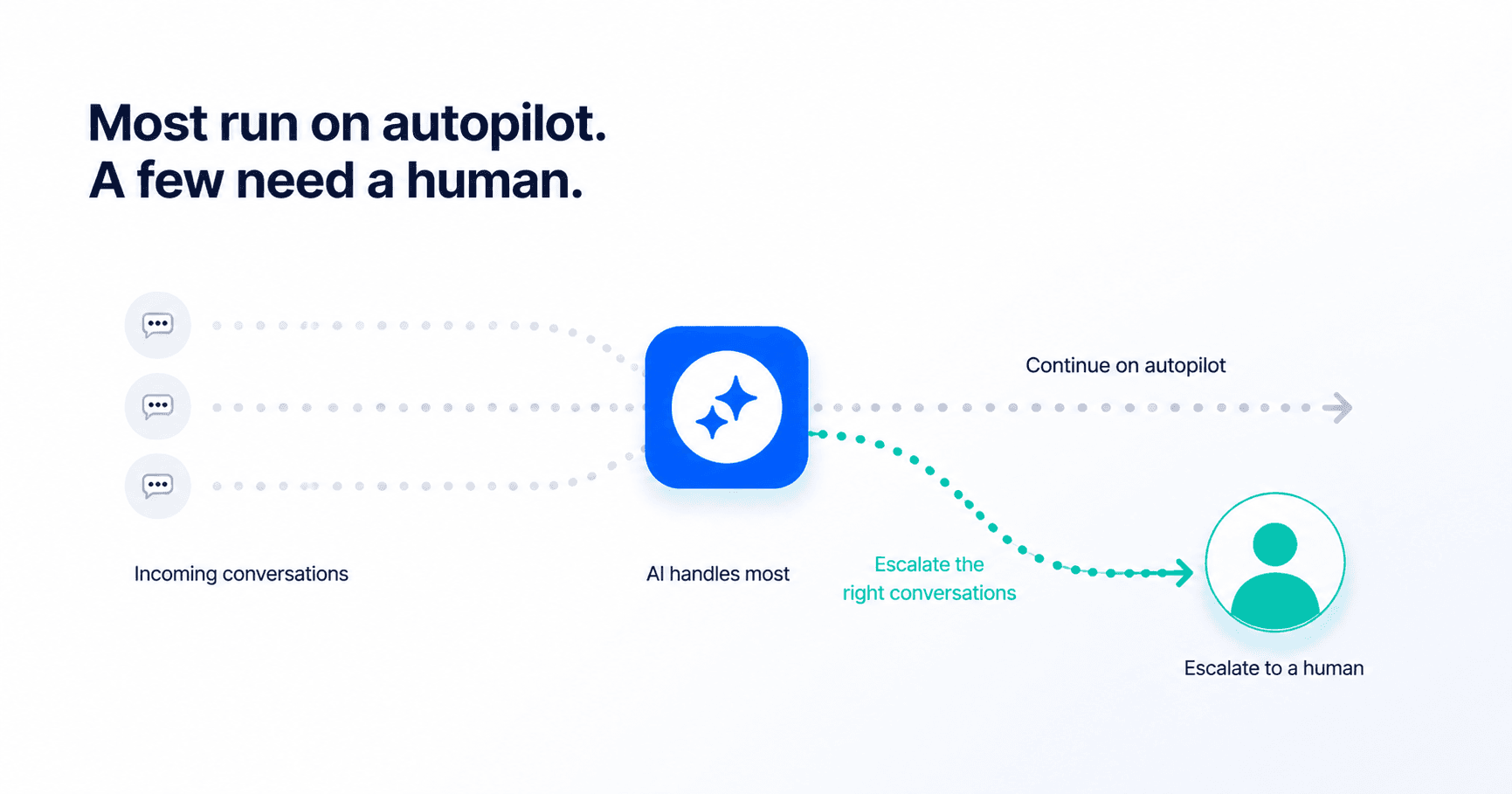
The 4 Triggers That Should Always Escalate to a Human
If you build only one rule into your AI sales assistant, build this: certain signals end the AI's turn and start a human's. These four are non-negotiable. When any of them fires, the conversation should route to a rep — fast, and with the full thread attached.
1. A positive or buying-intent reply
The moment a prospect replies with interest — "tell me more," "we're evaluating this now," "what would this look like for us" — the AI's job is done. This is the most expensive moment to automate. Gartner found buyers were 32 percentage points more likely to say a human rep made them feel confident in a purchase decision than generative AI did. A warm reply met with another scheduled message is a wasted opening. Hand it to a rep while the intent is still hot — ideally within minutes, not at the next step in the cadence.
2. A pricing or commercial question
Pricing is negotiation, and negotiation is human. The instant a buyer asks "how much," "what's the cost for our team size," or "can you do better on that," escalate. An AI quoting numbers can anchor a deal in the wrong place, miss a discount you would have offered, or commit to terms you can't honor. Commercial questions also signal genuine intent, which makes them doubly worth a person's attention. Let the AI surface the question and the context around it; let a human own the answer.
3. A technical objection or complex question
When a buyer raises a specific objection — a security requirement, an integration question, a "how does this handle our edge case" — they aren't looking for a confident-sounding paragraph. They're looking for a correct answer they can trust. This is exactly where an AI's plausible-but-wrong reply does the most damage: a single inaccurate response on a technical point can quietly erode credibility for the rest of the cycle. Escalate complex or high-stakes questions to someone who can answer precisely and stand behind the answer.
4. An explicit request to talk to a human
This one should be obvious, and yet it's the most commonly ignored. If a buyer says "can I talk to someone," "is this a bot," or "I'd rather speak to a person," the only acceptable response is a fast handoff. Making them ask twice — or worse, looping them back into automated replies — is the quickest way to torch trust. Honor the request immediately and without friction.
Notice the pattern: every trigger is a moment where intent or stakes cross a threshold. That's the dividing line — not a timer, not a message count.
What Your AI Copilot Should Handle on Its Own
Escalation only works if the AI is genuinely useful the other 90% of the time. The point isn't to make the machine timid — it's to aim its speed at the work that doesn't need a human in the room. Done right, your reps never touch the repetitive grind and spend their judgment only where it actually moves a deal.
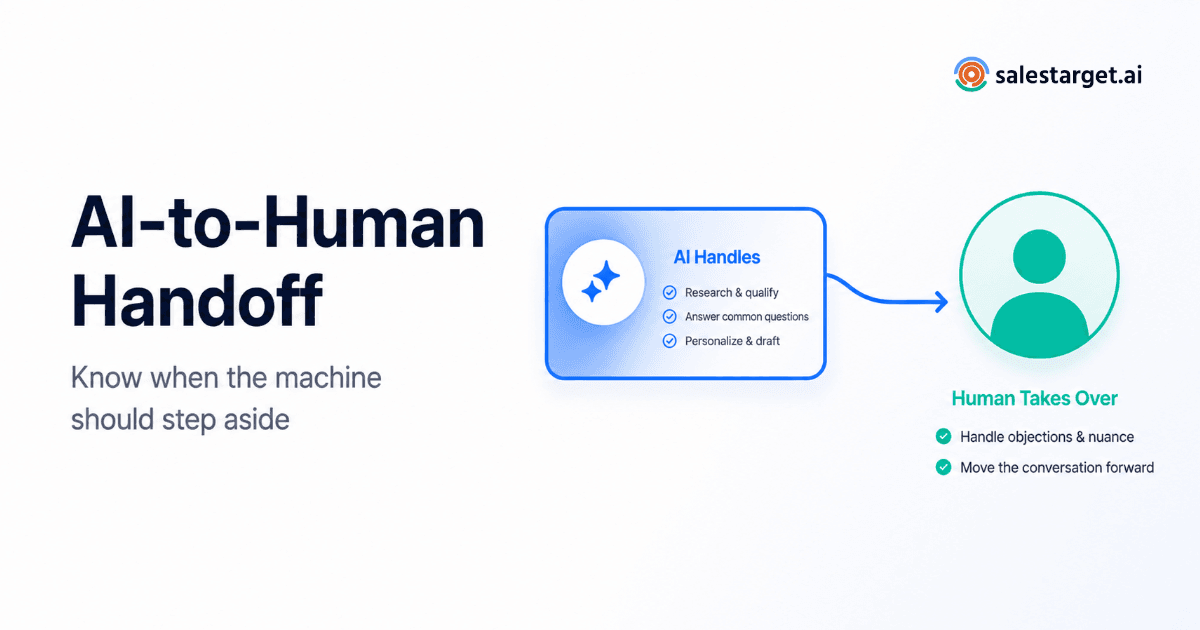
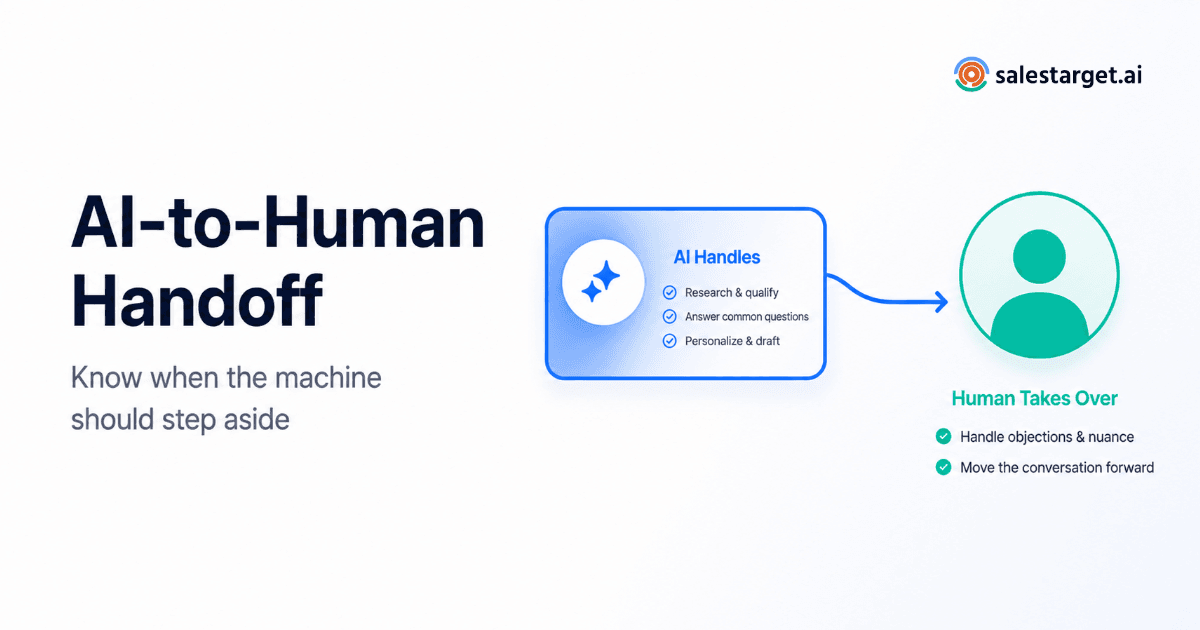
Let the AI own the high-volume, low-stakes layer: account and prospect research, first-touch personalization at scale, follow-up timing and cadence, meeting scheduling, data enrichment, and CRM hygiene. This is precisely where analysts agree AI is strongest — fast, tireless, and consistent across thousands of touches. A good AI sales assistant should also do the watching: monitoring every reply and signal so the right conversations get flagged for a human at the right moment, instead of slipping past unnoticed.
Here's the practical split most high-performing teams land on:
| Moment | AI handles autonomously | Escalate to a human |
|---|---|---|
| Account research & list-building | Yes | — |
| First-touch personalization | Yes | — |
| Follow-up timing & scheduling | Yes | — |
| Data enrichment & CRM updates | Yes | — |
| Positive / buying-intent reply | Flag only | Yes |
| Pricing / commercial question | Surface context | Yes |
| Technical objection | Acknowledge, route | Yes |
| "Can I talk to a person?" | Hand off instantly | Yes |
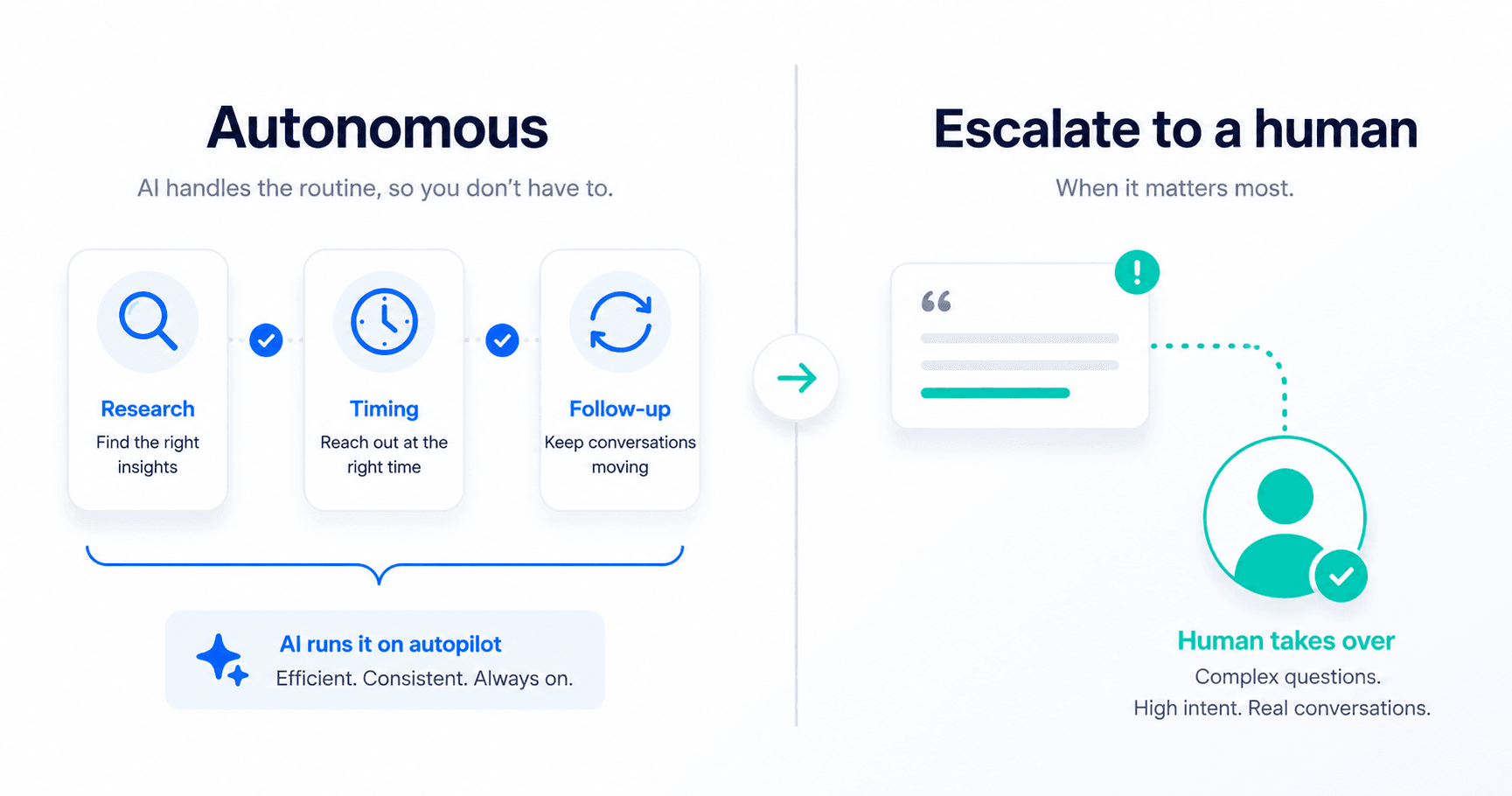
The dividing line is simple: if the moment needs judgment, empathy, or a commitment, it needs a human. Everything else, let the AI carry — at a volume and consistency no rep could match.
Building the Escalation Logic in Practice
Knowing the triggers is one thing; wiring them into a system that holds up under real pipeline volume is another. Here's how to build escalation logic that works:
- Define your triggers as explicit rules. Write down the exact signals that escalate — buying-intent language, pricing questions, objections, "talk to a human." Vague instructions like "escalate when it seems important" fall apart at scale. Make them concrete enough that the AI can detect them and you can audit them later.
- Set the threshold by intent and stakes, not by time. Don't escalate on a timer or a message count. Escalate when intent or risk crosses a line. A cold prospect can stay in automation for weeks; a single hot reply should escalate in minutes.
- Route with full context. The handoff should carry the entire thread, the prospect's profile, and the reason the AI escalated — straight into the rep's workflow. The buyer should never have to repeat themselves. Logging every touch in your CRM is what keeps that context portable.
- Make the handoff fast. A buying-intent reply that sits in a queue for a day is a lost deal. Assign an owner the moment a trigger fires and alert them immediately. Speed at the handoff is the whole game.
- Keep a consistent voice through the transition. The handoff shouldn't feel like a gear-grinding switch from bot to person. Match the tone, reference what was already said, and let the rep pick up the thread naturally so the buyer barely notices the seam.
- Review escalations and tune the rules. Audit what got escalated and what didn't. Too many false escalations and your reps drown; too few and buyers slip through. Treat the trigger list as something you refine over time, not set once and forget.
How SalesTarget Copilot Handles the Handoff
This is the philosophy behind SalesTarget Copilot: automate the grind, escalate the judgment. It runs the high-volume work — finding prospects, personalizing outreach, timing follow-ups — and watches every reply for the signals that mean a human should step in.
When a buying-intent reply, a pricing question, an objection, or a direct request for a person shows up, Copilot flags it and routes the conversation to the right rep with the full thread attached — so the handoff feels seamless to the buyer instead of like hitting a wall. New to it? You can see how the free AI sales assistant works and where the human takes over.
Because the handoff lands inside the same workspace your team already sells from, nothing falls through the cracks: the context, the history, and the next step all stay connected. That's the difference between an AI that tries to replace your reps and an AI sales copilot that makes them faster on exactly the moments that decide deals.
Escalation Mistakes That Erode Trust
Automating the hot reply
The expensive miss
Meeting a buying-intent reply with another automated message is the costliest mistake on this list. The moment a prospect leans in is the moment a human should too. Every scheduled step that fires instead of a rep is a cooling deal.
Letting the AI negotiate
Off the rails
An AI improvising on price can anchor low, miss a discount, or promise terms you can't deliver. Pricing and commercial questions are signals of intent and moments of commitment — both belong to a person.
The cold, robotic handoff
Trust killer
Bouncing a buyer from a chatty assistant to a generic "a rep will contact you," with no context carried over, makes them feel processed. If they have to repeat themselves, you've already lost ground.
Escalating everything
The other failure
Over-escalation is just as damaging as under-escalation. If reps get pinged for every cold reply, they tune out and miss the real ones. Tight, intent-based triggers keep the signal clean.
Let AI run the grind. Keep humans on the moments that close.
SalesTarget Copilot automates outreach and follow-up, then hands off to your reps the instant intent gets real.
✓ 50 credits ✓ 7-day trial ✓ No credit card required