The Real Cost of a Fragmented Sales Stack
The average B2B sales rep spends less than 30% of their working week actually selling. The rest disappears into prospecting tabs, copy-pasting contact data, writing cold email variations, chasing CRM updates, and trying to figure out why last month's sequences underperformed. According to McKinsey, sales teams that still rely on manual, siloed processes are leaving measurable productivity and revenue on the table — and the gap between AI-enabled teams and traditional ones is widening every quarter.
This is not a workflow problem. It is an architecture problem.
Tools like Apollo, Instantly, Lemlist, and Smartlead each solve a narrow part of the equation well. But stitching them together creates its own overhead: data doesn't sync cleanly, context gets lost between platforms, and reps end up doing coordination work instead of selling work. The promise of AI in B2B sales was never about adding another point solution — it was about building an intelligent layer that connects the dots.
That is precisely what a modern AI copilot is designed to do.
What Is an AI Copilot, Actually?
The term "AI copilot" is increasingly used across software categories, but in a B2B sales context, it has a specific meaning. An AI sales copilot is a conversational, context-aware assistant embedded directly into a sales workflow that can prospect, write, analyze, and recommend — without requiring a rep to switch tools or manually trigger each step.
Think of it less like a chatbot and more like an experienced SDR sitting alongside your team: someone who already knows your ICP, can pull a targeted lead list in seconds, draft a personalized multi-step email sequence for a specific industry or persona, and then tell you which campaigns are actually driving pipeline — and which ones to cut.
The distinction between an AI copilot and a standard automation tool is critical. Automation executes predefined rules. An AI copilot interprets intent, generates outputs, surfaces insights, and adapts to context. It doesn't just do what you program; it helps you figure out what to do next.
From Point Tools to Intelligent Workflows: The Shift Underway
Gartner has identified AI-augmented selling as one of the most significant operational shifts in B2B go-to-market strategies over the next three years. The underlying driver is not the AI itself — it is the consolidation of fragmented workflows into a single, intelligent operating layer.
The fragmentation problem runs deep. Most outbound teams have separate tools for lead sourcing, email sequencing, inbox warming, CRM management, LinkedIn outreach, and performance analytics. Each has its own login, its own data model, its own reporting logic. According to HubSpot's State of Sales research, reps at companies with high tool fragmentation spend significantly more time on administrative tasks and less time on revenue-generating activity.
AI copilots address this at the architectural level. Instead of integrating tools, a well-designed AI copilot eliminates the need for several of them — by embedding prospecting, outreach creation, multi-channel execution, CRM tracking, and performance analysis into a single conversational interface.
For SDRs, this means less context-switching and more focused selling time. For founders running lean outbound without a dedicated sales team, it means being able to build a real pipeline without hiring. For RevOps professionals, it means cleaner data, fewer integration points to maintain, and a more reliable view of what is actually working.
What Modern AI Copilots Can Do: A Practical Breakdown ?
Lead Discovery and Smart Prospecting
Effective AI prospecting is not about access to a large database. It is about the ability to translate an ICP description into precise, actionable lead lists — fast. Modern AI copilot software allows sales teams to describe their ideal buyer in plain language and receive curated lead lists enriched with relevant business data, without manually configuring complex filters across separate platforms.
This matters because prospecting velocity directly affects pipeline volume. The faster a rep can move from ICP to verified, targeted contact, the more time they spend on conversations that convert.
AI-Powered Campaign Creation
The quality of cold outreach has always been the variable most correlated with reply rates, according to multiple studies analyzing cold email performance at scale. AI sales copilots now close the gap between knowing what good copy looks like and being able to produce it consistently — for every prospect, across every industry vertical.
Modern AI copilots can generate complete multi-step email sequences, personalized by role, industry, and company size, with built-in A/B variations — in under a minute. This is a fundamental shift from templated outreach toward genuinely adaptive messaging, which research consistently shows drives higher engagement and more qualified replies.
Sales Personalization at Scale
Personalization has long been the gap between what B2B sales teams aspire to and what they actually execute. Manually writing tailored emails for hundreds of prospects is not operationally realistic. AI copilots make contextual personalization default, not exceptional — each message built around the prospect's role, their likely pain points, and the industry context they operate in.
This is meaningfully different from simple variable insertion. Personalization at the AI copilot level means the tone, the angle, the specific value proposition, and the call to action all adapt to the audience — not just the name in the subject line.
Multi-Channel Outreach Coordination
LinkedIn has become an indispensable channel for B2B outreach, and sales teams that operate across email and LinkedIn simultaneously see higher response rates than those relying on a single channel. According to LinkedIn's own research, multi-touch, multi-channel sequences generate significantly stronger engagement than email-only campaigns.
AI copilots that support coordinated multi-channel workflows — where email sequences and LinkedIn outreach run in parallel from a single interface — eliminate the operational friction of managing separate tools and keep prospect context intact across touchpoints.
Revenue Analytics and Performance Intelligence
One of the most underused capabilities in most sales toolstacks is performance analytics. Teams pull open rate and reply rate data, but rarely use it to make structural changes to their sequences. AI copilots change this by surfacing actionable recommendations — not just metrics, but specific guidance on which campaigns are driving pipeline, where deals are stalling, and what to scale or cut.
This shifts performance review from a retrospective exercise into a continuous feedback loop embedded in the daily workflow.
CRM and Pipeline Management
CRM adoption among sales reps has historically been inconsistent, largely because updating it requires manual effort that interrupts selling momentum. AI copilots that integrate directly with a built-in CRM allow reps to query deals, log activity, and manage follow-up tasks through natural language — no menu-clicking, no form-filling. Every touchpoint flows into a centralized pipeline view automatically, giving sales leaders real-time visibility without the usual administrative overhead.
What Makes an AI Sales Copilot Worth Evaluating?
Before adopting any AI copilot software, sales leaders and RevOps teams should pressure-test against a clear framework:
- Is the data foundation reliable? Lead quality upstream determines outreach quality downstream. Any AI copilot worth using should be built on a verified, regularly updated contact database — not scraped or unvalidated lists that inflate bounce rates and damage sender reputation.
- Does it consolidate or just add to your stack? An AI copilot that requires five other tools to function is not a copilot — it is a workflow layer with API dependencies. The value of a true AI copilot is in replacing fragmentation, not layering on top of it.
- How fast can a rep go from ICP to live campaign? Time-to-launch is a practical test of how genuinely integrated the platform is. If it takes hours of setup to get a campaign running, the efficiency gains are theoretical.
- Does it surface recommendations or just reports? Data without guidance adds cognitive load. Copilot-level intelligence means the system tells you what to do next, not just what happened.
- Is personalization structural or cosmetic? First-name tokens are not personalization. Evaluate whether the AI adapts message structure, framing, and value proposition based on prospect context.
How SalesTarget.ai Copilot Fits Into This Framework ?
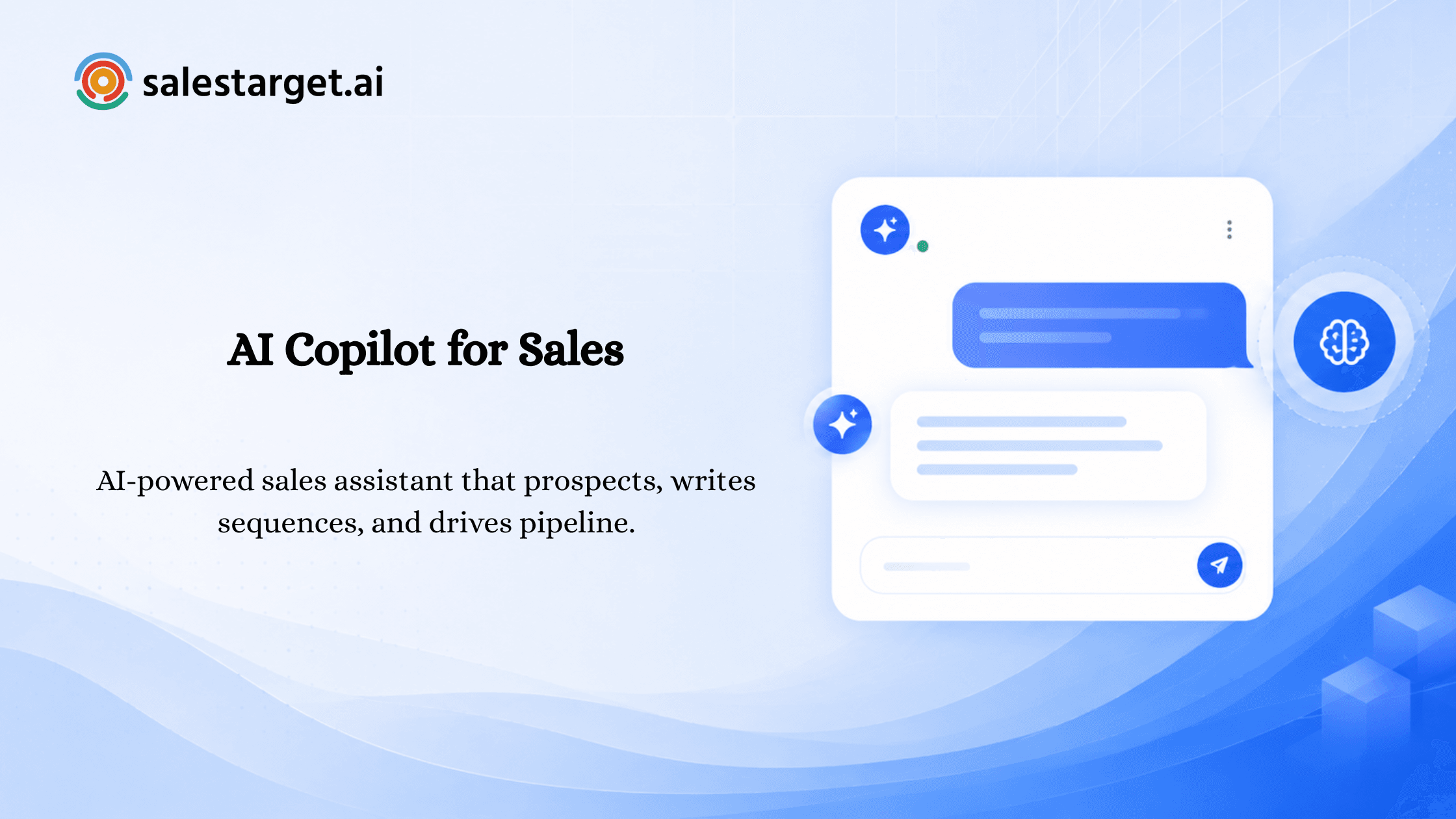
SalesTarget.ai Copilot is designed around a straightforward premise: describe your buyer, launch your campaign, and follow what's working — without leaving a single screen.
The Copilot operates as a conversational AI-powered sales assistant embedded inside the SalesTarget.ai platform. Through a chat-based interface, users can search across 840M+ verified profiles using plain-language ICP descriptions, generate multi-step email sequences personalized for specific industries and personas, create and save targeted lead lists, and track deal progress and tasks — all without switching tools.
What distinguishes the Copilot's approach to personalization is the structural depth. Sequences are built around the prospect's industry, role, and company size — not assembled from generic templates with variable fields dropped in. A/B variations are built into the sequence generation process, enabling teams to test and iterate without additional setup work.
For performance intelligence, Copilot reads campaign results and surfaces specific recommendations: which campaigns are driving pipeline ranked by revenue impact, where deals are at risk, and what actions to prioritize next. This moves analytics from a dashboard you review periodically into an active feedback loop within the daily workflow.
The platform also connects Copilot directly to CRM deal tracking, task management, and multi-channel outreach — including LinkedIn automation — within a unified interface. For SDRs, this means less time on research and administrative tasks. For founders building outbound without a full sales team, it means being able to run a structured pipeline from zero to booked calls without operational complexity.
Deliverability infrastructure — inbox warm-up, inbox rotation, email validation, and spintax generation — sits alongside Copilot's outreach capabilities, ensuring that the sequences Copilot writes actually reach inboxes rather than disappearing into spam folders.
The Business Outcomes That Actually Matter
- Prospecting time reduction. Research from Salesforce indicates that high-performing sales teams are significantly more likely to use AI tools to automate prospecting and research tasks. Faster ICP-to-lead turnaround means more pipeline built per rep per week.
- Reply rate improvement. Personalization quality and multi-channel coordination are the two variables most strongly correlated with cold outreach reply rates. AI copilots that address both structurally produce measurable lifts in response rates.
- Pipeline visibility. When CRM updates happen automatically through integrated workflows rather than manual entry, pipeline data is more accurate — supporting better forecasting and faster identification of at-risk deals.
- Ramp time for new reps. SDRs using AI copilot software reach productivity faster because the system handles the knowledge-intensive parts of prospecting and copy creation, allowing new reps to focus on conversations rather than building workflows from scratch.
The Future of AI-Assisted Selling
The evolution of AI copilots in B2B sales is not complete. The next phase will likely involve deeper real-time intent signal integration, more adaptive personalization informed by prospect behavior, and tighter feedback loops between outreach performance and sequence optimization.
What is already clear, though, is that the teams gaining the most ground are not those with the largest headcount or the most tools — they are those with the most coherent, AI-integrated workflow. The competitive advantage in outbound sales is shifting from effort to intelligence.
For SDRs, founders, outbound agencies, and RevOps professionals evaluating where to invest next, the question is no longer whether to adopt an AI copilot. It is which one removes the most friction, surfaces the most useful intelligence, and actually helps close deals faster.
Start With Your AI Copilot
SalesTarget.ai Copilot is free to try — no credit card required, and no onboarding marathon. Describe your buyer, let Copilot build the list and write the campaign, and start following what works.