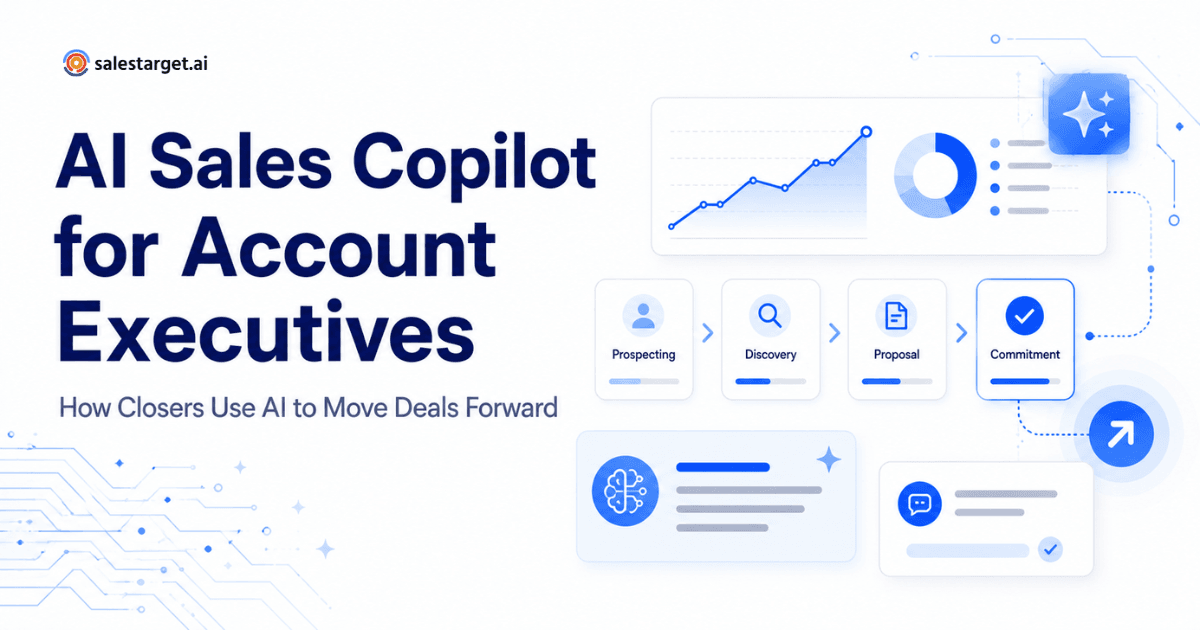
Account Executives don't need more activity. They need sharper context, better deal intelligence, and fewer hours lost to administrative work. That's where an AI Powered Sales Assistant changes the equation — not by automating outreach at scale, but by helping closers understand what's actually happening inside their pipeline.
SDRs and AEs both benefit from AI, but the problems they solve with it are fundamentally different. SDRs use AI to prospect faster. AEs use it to prepare more thoroughly, track deal momentum, spot risks earlier, and make every conversation count. This article breaks down how AEs can use an AI sales copilot to close more effectively — without surrendering the judgment that makes a great closer great.
Why AEs Need AI Differently Than SDRs
SDRs operate in a volume-driven workflow. Their core metrics — emails sent, calls made, meetings booked — reward activity. AI helps SDRs prospect faster, personalize outreach at scale, and qualify leads more efficiently.
AEs live inside deals. Their work centers on opportunity strategy, stakeholder management, deal progression, objection handling, forecasting, and revenue. When an AE opens the CRM on Monday morning, the question isn't "Who should I email today?" It's "Which of my 15 opportunities actually has momentum, where am I exposed, and what do I need to prepare before my 2 pm call?"
An SDR might handle dozens of prospects at an early stage. An AE manages fewer, higher-value opportunities, each with multiple stakeholders, varying timelines, and layers of context that need to be understood — not simply tracked.
According to Salesforce's State of Sales report, sales reps spend 70% of their time on non-selling tasks, including administrative work, meeting preparation, and CRM updates (Salesforce, 2024). For AEs, that drain is especially costly — every hour spent on admin is an hour not spent understanding an account, preparing for a negotiation, or advancing a deal past a stall.
AI Sales Copilot vs. Traditional Sales Automation
Traditional sales automation was built for sequences: if a lead does X, send Y. That model works for top-of-funnel SDR workflows. It doesn't map well to mid- and late-stage deal management, where every opportunity has a unique shape.
An AI sales copilot works differently. Instead of running a fixed playbook, it surfaces contextual intelligence — reading across CRM data, past interactions, company signals, and stakeholder activity to give AEs a live picture of their deals.
For a deeper look at how this works in practice, see AI Sales Copilot: How It Works and Use Cases.
Think of it as the difference between a template and a briefing. A sequence tool sends a pre-written email three days after a demo. A copilot tells you that your champion hasn't responded in eight days, the CFO just joined the evaluation thread, and a competitor was mentioned in the most recent internal meeting note. One is automation. The other is intelligence.
How an AI Powered Sales Assistant Helps Account Executives
Account Research and Enrichment
When an AE inherits an opportunity after an SDR books a meeting, the real work begins. The AE needs to understand the company's org structure, recent news, technology stack, competitive landscape, and the pain points that drove initial interest.
An AI-powered sales workflow handles this in seconds. Instead of spending 20 minutes toggling between LinkedIn, the company website, news feeds, and the CRM, the AE gets a consolidated account brief with the information that matters most for the upcoming conversation.
Deal Preparation and Context
Before a discovery call or follow-up meeting, AEs need to review every prior touchpoint. An AI sales assistant can summarize previous calls, highlight unanswered questions, flag gaps in qualification — such as missing stakeholders or unconfirmed budget — and recommend specific talking points.
Consider a scenario where an AE has a proposal out with a mid-market prospect. The champion is engaged, but the economic buyer hasn't been involved. A copilot surfaces that risk before the AE walks into a status call assuming everything is on track.
Personalized Follow-Up Emails
After a complex discovery call, writing a strong follow-up email takes more effort than most people realize. The AE needs to reference specific points discussed, restate commitments, and move the conversation forward with a clear next step.
An AI assistant can draft a follow-up email that pulls context directly from the call, personalizes the message to the prospect's situation, and suggests a concrete next step. The AE reviews, adjusts tone, and sends — cutting the task from 15 minutes to three without sacrificing quality.
Opportunity Prioritization and Risk Detection
An AE with 12 active deals can't give each one equal attention every day. An AI copilot helps prioritize by analyzing deal velocity, engagement signals, time since last contact, and next-step status across the pipeline.
It also flags stalled deals that aren't obvious from a CRM view alone. A deal might look healthy because the close date hasn't passed and the stage hasn't changed — but if there's been no buyer activity in three weeks and no confirmed next meeting, that's a deal at risk. AI surfaces these patterns so AEs act before momentum disappears.
Where AI Helps AEs Close Better — Not Just Faster
The goal for AEs isn't speed for its own sake. It's precision. AI helps closers perform better by making sure they walk into every conversation prepared, follow up with genuine relevance, and catch problems before they become lost deals.
For AEs focused on improving deal execution over time, AI Sales Coaching for Better Deal Execution offers additional practical guidance.
Sales managers benefit too. When an AI-assisted workflow surfaces deal health insights — stalled opportunities, missing stakeholders, inconsistent forecasting — managers can coach with specifics instead of relying on gut instinct during pipeline reviews.
A Gartner survey of 1,026 B2B sellers found that reps who effectively partner with AI tools are 3.7 times more likely to meet quota (Gartner, 2024). For Account Executives, that edge comes from preparation quality and deal awareness — not outreach quantity.
The AE Productivity Reallocation Framework
Original Analysis — If an AE spends 70% of their time on non-selling tasks (per Salesforce data) and AI reduces research and admin time by even 30%, that reclaims roughly 8.4 hours per 40-hour workweek — time that can be reinvested directly into deal conversations and pipeline advancement. This reallocation matters more for AEs than SDRs because each AE hour on an active opportunity carries significantly higher revenue potential than an incremental prospecting touch.
How AEs Can Use AI Without Losing the Human Element
An AI Powered Sales Assistant doesn't replace the instincts that make a great AE effective. It handles the research, surfaces the signals, and prepares the context. The AE decides what to do with it.
Negotiation nuance, stakeholder politics, reading a room, adapting to a buyer's emotional state — those remain firmly human skills. AI is poor at knowing when to push and when to pause. But it's excellent at making sure you never walk into a meeting unprepared.
The best AEs will treat AI the way experienced pilots treat autopilot: use it to handle the routine so your focus stays where it creates the most value — building trust and guiding complex decisions.
Practical Takeaways
- Start with pre-call preparation and deal briefings — they reduce admin time immediately and have the highest visible impact.
- Use AI to audit your pipeline weekly — flag any deal with no confirmed next step or no buyer activity in the last 14 days.
- Let AI draft follow-up emails after calls, but always personalize the final version with your own observations.
- Don't use AI to avoid understanding your accounts. Use it to understand them more deeply and more quickly.
AEs who close well don't need more automation layered onto their workflow. They need smarter context and fewer distractions. An AI sales copilot built for the deal cycle - not just the prospecting cycle - gives closers the edge they actually need: more time and better information for the work that wins revenue.
Turn Every AE Into a Better Closer With AI
SalesTarget.ai's AI Copilot helps Account Executives spend less time digging through information and more time advancing real opportunities. Get consolidated account briefs, AI-drafted follow-up emails, deal risk alerts, and pipeline prioritization — all inside your workflow.