Most B2B sales teams lose deals not because of bad products or weak pricing but because information falls through the cracks during the handoff from SDR to AE. A qualified lead moves from one rep to another, and somewhere between Slack threads, half-filled CRM fields, and verbal summaries, the buyer's context disappears. The right sales lead management software prevents that by creating a single, structured record that travels with the deal.
What is the best way to handle an SDR-to-AE handoff without losing deal context?
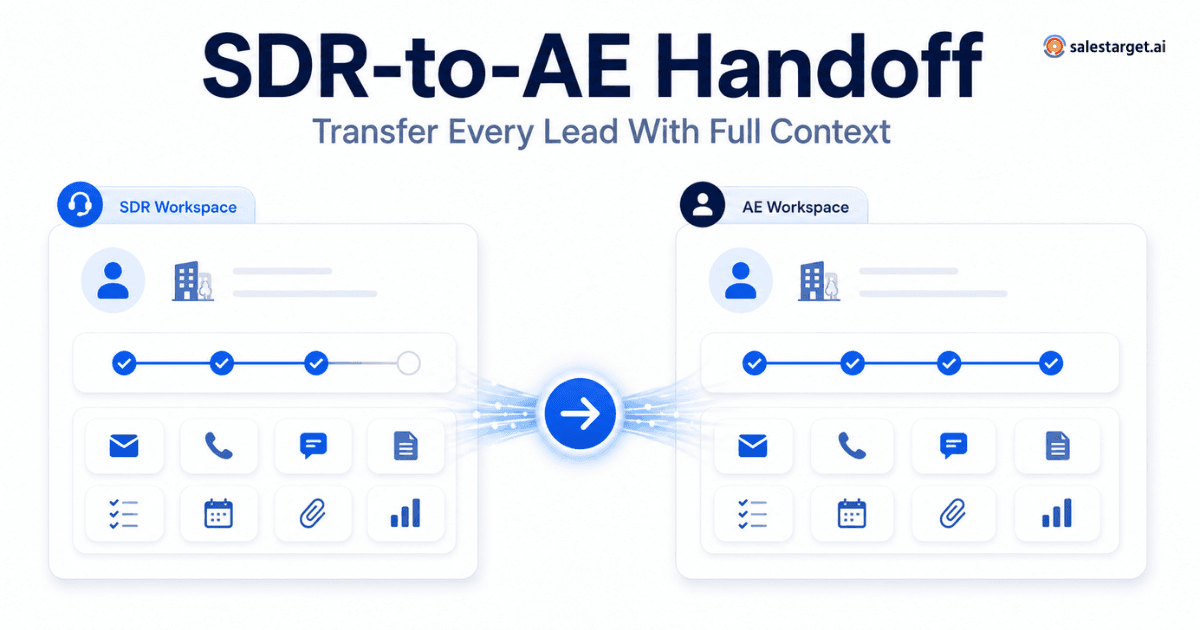
A reliable SDR-to-AE handoff requires standardized qualification data, a complete activity history, documented buyer context, clear next steps, defined ownership, and a shared CRM record. Teams that rely on Slack messages, spreadsheets, or memory will consistently lose context. The handoff should happen inside your CRM so that every conversation, objection, and next step is visible to the AE before their first call.
This article breaks down why handoffs fail, what information should transfer, and seven best practices that sales teams can implement this quarter.
Why SDR-to-AE Handoffs Break Down ?
An SDR-to-AE handoff is the moment a sales development rep transfers a qualified lead to an account executive for deeper discovery and closing. It sounds simple. In practice, it is one of the most fragile points in any B2B sales pipeline.
Here is what typically goes wrong:
- Missing qualification information. The SDR logs a company name and maybe a phone number but skips budget, timeline, and decision-maker details. The AE walks into a call blind.
- Repeated discovery questions. The buyer already told the SDR about their pain points. When the AE asks the same questions again, trust drops immediately.
- Poor activity visibility. Call notes sit in one tool, emails in another, and LinkedIn messages in a third. Nobody has the full picture.
- Unclear next steps. The SDR told the prospect "someone will follow up" but never set a specific meeting or action.
- Lost buyer intent signals. The prospect mentioned a contract renewal deadline or a competitor evaluation. If that is not recorded, the AE misses the urgency.
- Deals handed over too early or too late. Without clear qualification criteria, SDRs either pass leads before they are ready or hold them too long. Teams using CRM workflows for SDRs and AEs with distinct stage definitions can reduce this problem significantly.
According to a Salesforce State of Sales report, high-performing sales teams are 1.5 times more likely to base forecasts on data-driven insights rather than intuition. The handoff is where that discipline either starts or falls apart.
What a High-Quality SDR-to-AE Handoff Should Contain ?
Before an AE picks up a deal, they should have access to a structured handoff record. Think of it as a briefing document, not a sticky note. Here is the minimum:
- ICP fit and account-level data. Does this company match your ideal customer profile by size, industry, and tech stack?
- Buyer role and decision-making position. Is this person an end user, an evaluator, a budget holder, or the final decision maker?
- Business pain. What specific problem prompted this person to take a call?
- Current solution and gaps. What are they using today, and where does it fail them?
- Trigger event. A new funding round, leadership change, contract expiration, or competitive threat.
- Budget and commercial context. Even a range or a "no budget defined yet" is useful.
- Timeline. When are they planning to make a decision?
- Stakeholders. Who else needs to be involved?
- Objections raised. Price concerns, internal resistance, integration worries.
- Complete conversation history. Every email, call recording, and chat message.
- Agreed next step. A booked meeting, a sent proposal, or a specific follow-up date.
A practical example: an SDR qualifies a VP of Operations at a 200-person logistics company. The VP mentioned their current CRM cannot track deal stages across regions, and they need a solution before Q4 planning. The SDR books a demo with the AE and records the trigger (Q4 deadline), the pain (no regional pipeline visibility), the stakeholder (CFO must approve), and an objection (concerns about migration from their legacy system). That is a handoff an AE can work with.
7 Best Practices for a Better SDR-to-AE Handoff
1. Standardize the Handoff Fields
Create a required field checklist that every SDR must complete before transferring a deal. If the fields are optional, they will be skipped. Build them directly into your lead management software so the system blocks a stage change until the essentials are filled in. Required fields should include: buyer role, pain, trigger, timeline, next step, and objection notes.
2. Make the CRM the Single Source of Truth
If your SDRs log notes in spreadsheets, Slack, or personal notebooks, the AE will never see them. Everything must live in one place. A B2B CRM software platform that both SDRs and AEs use daily eliminates the "where did that note go?" problem. When choosing deal tracking software, prioritize tools that surface the full activity timeline on a single deal page, so an AE can scan every touchpoint in under two minutes.
3. Capture Buyer Context, Not Just Data Points
Fields like "Budget: $50K" and "Timeline: Q3" are useful, but they are not context. Context sounds like: "The VP mentioned their board is pushing for a new vendor before the September board meeting, and they are comparing us against two competitors who demo'd last month." Train SDRs to write one or two sentences of qualitative context alongside every structured field. This is what separates a warm handoff from a cold one.
4. Define Qualification and Handoff Criteria
When should an SDR hand off a lead? Define it explicitly. Most teams use a framework like BANT (Budget, Authority, Need, Timeline) or MEDDIC, but the specifics matter less than consistency. Write down the criteria, train the team, and enforce them in your sales management software. If a deal does not meet the threshold, it stays with the SDR. A HubSpot study found that sales reps spend roughly 21% of their day on data entry. Clear criteria reduce wasted effort on both sides of the handoff.
5. Give the AE a Clear Next Action
Every handoff should include a booked meeting or a documented next step. "The prospect is interested" is not a next step. "Demo scheduled for Thursday at 2 PM; the prospect wants to see the reporting dashboard and will bring their ops lead" is a next step. AEs should never have to chase a prospect just to figure out what was promised.
6. Preserve the Complete Activity Timeline
Call recordings, email threads, LinkedIn messages, form submissions. All of it matters. Modern sales pipeline management software should automatically capture and display these interactions on the deal record. Platforms like AI-powered CRM tools for sales teams can log activities without manual input, reducing the risk that a rep forgets to save a critical note.
This is where a tool like SalesTarget.ai's CRM adds real value. It centralizes deal information, provides shared visibility for both SDRs and AEs, and maintains a complete activity history on every record. Instead of chasing context across tabs, the AE opens one deal page and sees everything: calls, emails, notes, pipeline stage, and next steps. The result is a handoff that feels seamless to the buyer and efficient for the team.
7. Measure Handoff Quality and Downstream Conversion
You cannot improve what you do not measure. Track metrics like handoff-to-opportunity conversion rate, time from handoff to first AE meeting, and deal velocity after handoff. If AEs consistently report incomplete information, the process needs tightening.
Original Framework: Handoff Completeness Score
Handoff Completeness Score = (Completed Required Handoff Fields ÷ Total Required Handoff Fields) × 100
This is an illustrative operational benchmark, not an industry statistic. Define 10 to 12 required fields (buyer role, pain, trigger, timeline, next step, objection notes, ICP fit, stakeholders, conversation summary, current solution, budget context, and handoff reason). If an SDR completes 8 out of 12 fields, the Handoff Completeness Score is 67%. Teams should aim for a minimum score of 85% before allowing a stage change. Track this score weekly. When completeness drops, handoff quality drops, and pipeline leakage increases. Use your sales lead management software to automate this calculation by flagging incomplete records before they move to the AE stage.
Note: This framework is illustrative. Adjust the required fields and threshold to match your team's qualification process.
Build a Handoff Process That Protects Your Pipeline
A broken handoff does not just frustrate your AEs. It frustrates your buyers, inflates your sales cycle, and quietly kills deals that should have closed. The fix is not more meetings between SDRs and AEs. It is a structured process backed by a CRM that captures, organizes, and surfaces every detail at the moment it matters.
Start by auditing your current handoff. Calculate your Handoff Completeness Score. Identify the fields that are consistently missing. Then put a system in place so those gaps stop recurring.
If you want to understand where your pipeline is leaking and how handoff quality affects downstream conversion, see how your sales pipeline is really performing.