Getting in front of the right prospect at the right time still starts with one thing: a working phone number. But sourcing accurate, current contact numbers — especially at scale — has always been one of the more stubborn friction points in B2B sales. That's where AI phone number lookup comes in.
Rather than relying on static databases or manual research, AI-powered lookup tools continuously cross-reference signals from multiple data sources to surface, verify, and enrich contact information in near real time. For sales development representatives, lead generation teams, and revenue operations professionals, that shift has meaningful practical implications.
This guide explains how AI phone number lookup works, why it has become a core part of modern B2B prospecting, and what to consider when evaluating a tool for your team.
Looking to put AI-powered contact discovery into practice?
SalesTarget.ai's Lead Explorer lets you search, identify, and research B2B prospects - including phone and contact data - in one place.
Explore Lead Explorer →
What Is AI Phone Number Lookup?
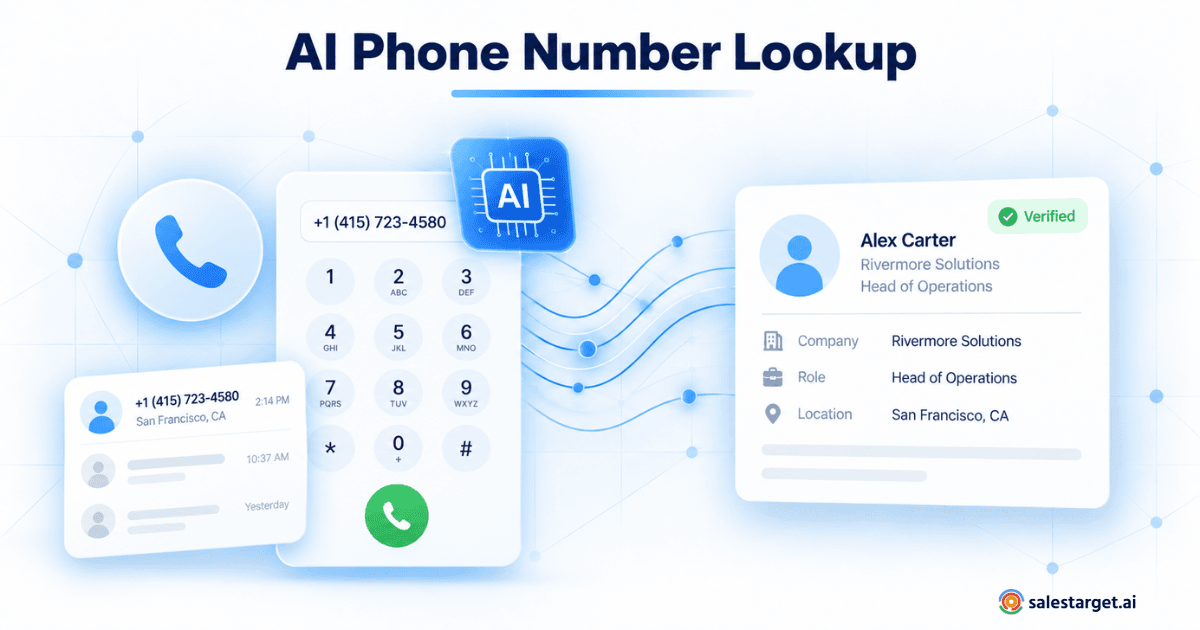
AI phone number lookup is the process of using artificial intelligence — including machine learning models, natural language processing, and automated data aggregation — to find, identify, or verify phone numbers associated with specific individuals or businesses.
Unlike basic reverse-lookup services that check a single static directory, an AI-powered lookup system continuously ingests and reconciles data from a wide range of publicly available and aggregated sources. It then applies pattern recognition and entity matching to return a result that's more accurate, more current, and often richer in context than what a traditional lookup could produce.
In a B2B setting, this typically means looking up a direct-dial number, mobile number, or main business line for a specific decision-maker at a target company — rather than a generic switchboard.
How AI-Powered Phone Number Lookup Works
The mechanics behind AI phone number lookup vary by platform, but most modern tools follow a broadly similar approach:
- Data aggregation: The system pulls from multiple sources — professional network data, public business directories, company websites, regulatory filings, and aggregated contact databases — and consolidates what it finds about a given person or organization.
- Entity resolution: AI models identify whether multiple records across different sources refer to the same individual. This is more complex than it sounds: a "John Smith" at "Acme Corp" may appear differently across ten different data sources, and the system must determine which records are duplicates and which represent different people.
- Freshness scoring: Rather than treating all data equally, AI-driven systems often weight signals by recency and reliability. A phone number sourced from a recently updated professional profile carries more confidence than one pulled from a three-year-old database entry.
- Verification and validation: Some platforms integrate real-time validation checks — such as carrier lookup or format verification — to flag numbers that are disconnected, reassigned, or format-invalid before they reach a sales rep.
- Continuous learning: Machine learning models can improve over time as the system accumulates signal about which data sources and patterns produce the most accurate results.
Traditional Phone Lookup vs. AI-Enhanced Lookup
Traditional phone lookup typically meant querying a single directory or database — a one-to-one lookup with limited freshness and no intelligent reconciliation. Results were often outdated, incomplete, or limited to residential lines.
AI-enhanced lookup approaches the problem differently. Instead of a single source, it triangulates across many. Instead of a binary found/not-found result, it returns a confidence-weighted output. And instead of a static snapshot, it aims to reflect data that's been updated as recently as possible.
The practical difference for a sales team: fewer wasted calls, higher connect rates, and less time spent manually verifying contact data before outreach begins.
Why Businesses Use AI Phone Lookup for B2B Prospecting
B2B contact data decays faster than most teams expect. People change roles, companies restructure, and phone numbers get reassigned. Studies across the data industry consistently suggest that a meaningful portion of B2B contact records become inaccurate within twelve months — which is why the freshness and verification logic in AI-driven tools matters so much.
For sales and marketing teams, the downstream effects of poor contact data are tangible: calls that go nowhere, dial attempts logged against the wrong person, CRM records that steadily drift out of sync with reality. AI phone lookup addresses the underlying data quality problem rather than just surfacing more numbers to work through.
Beyond accuracy, there's a workflow efficiency argument. Manually researching a prospect's direct dial through LinkedIn, company websites, and phone directories might take five to fifteen minutes per contact. At scale, that time adds up quickly. An AI lookup tool that returns a verified number in seconds changes the economics of outbound prospecting.
Key Use Cases for Sales Teams and SDRs
AI phone number lookup has practical applications across several stages of the sales development process:
- Outbound prospecting: SDRs building call lists can use AI lookup to append direct-dial or mobile numbers to a target account list, reducing dependence on generic reception numbers.
- Account-based sales: When working a named account, sales reps often need to reach multiple stakeholders across a buying committee. AI lookup can help surface contact numbers for each relevant decision-maker within a single organization.
- Lead enrichment: Inbound leads often arrive with incomplete contact data — a name and email but no phone number. AI phone lookup can fill that gap before a sales rep attempts follow-up.
- CRM hygiene: Revenue operations teams use phone lookup tools to validate and refresh existing contact records, reducing the data decay problem that affects CRM accuracy over time.
- Recruiting and talent sourcing: Beyond sales, people operations teams use similar AI contact lookup capabilities to find direct contact information for passive candidates.
What to Look for in an AI Phone Number Lookup Tool
Not all AI phone lookup tools are built the same. When evaluating options for your team, the following factors are worth examining closely.
If you're comparing platforms, it's worth reviewing an independent breakdown of the best phone number lookup tools to understand how different solutions approach data sourcing, coverage, and verification.
- Data coverage and depth: Does the tool cover the markets and industries your team targets? B2B coverage varies significantly between platforms, especially for mid-market and SMB segments versus enterprise contacts.
- Accuracy and confidence scoring: Look for tools that return a confidence indicator alongside results, so your team can prioritize higher-confidence numbers in their outreach sequencing.
- Verification capabilities: Real-time phone number validation — checking whether a number is active, whether it's a mobile or landline, and whether it can receive calls — adds a meaningful quality layer beyond raw data retrieval.
- Freshness and update frequency: Ask vendors how frequently their underlying data is refreshed. A tool pulling from datasets that are updated monthly will generally outperform one relying on annual snapshots.
- Integration with your existing stack: A phone lookup tool that connects natively to your CRM, sales engagement platform, or prospecting workflow creates less friction than one that requires manual export/import steps.
- Compliance and data handling: Understand where data is sourced and how the vendor handles regulatory considerations. This is particularly relevant for teams operating across multiple jurisdictions with different privacy frameworks.
Accuracy, Verification, and Privacy Considerations
AI phone number lookup tools are only as useful as the data they return — and that means accuracy isn't just a feature, it's the foundation. A tool that surfaces a high volume of numbers but with poor accuracy wastes more time than it saves, because your team still has to verify results manually before dialing.
Verification is a distinct step from lookup. Lookup retrieves a number; verification checks whether that number is currently valid, active, and correctly associated with the intended contact. The best AI phone lookup tools bundle both functions, surfacing not just a number but an indication of how reliable that number is likely to be.
On the privacy side, responsible use matters. AI phone lookup tools that aggregate data from public and aggregated sources operate within specific legal frameworks that vary by country and use case. For B2B outreach, legitimate interest provisions under frameworks like GDPR and the contextual expectations of business-to-business communication generally create a clearer path than consumer-facing use cases — but it's always worth understanding the applicable rules in your markets.
When evaluating a vendor, ask directly about their data sourcing practices, their opt-out and suppression mechanisms, and whether they maintain do-not-contact list compliance. These aren't just compliance checkboxes — they reflect the quality and ethics of the underlying data infrastructure.
How AI Phone Lookup Fits into a Broader Sales Intelligence Workflow
Phone number lookup is rarely the starting point of a prospecting workflow — it's usually one layer in a broader research and enrichment process. Understanding where it fits helps teams use it more effectively.
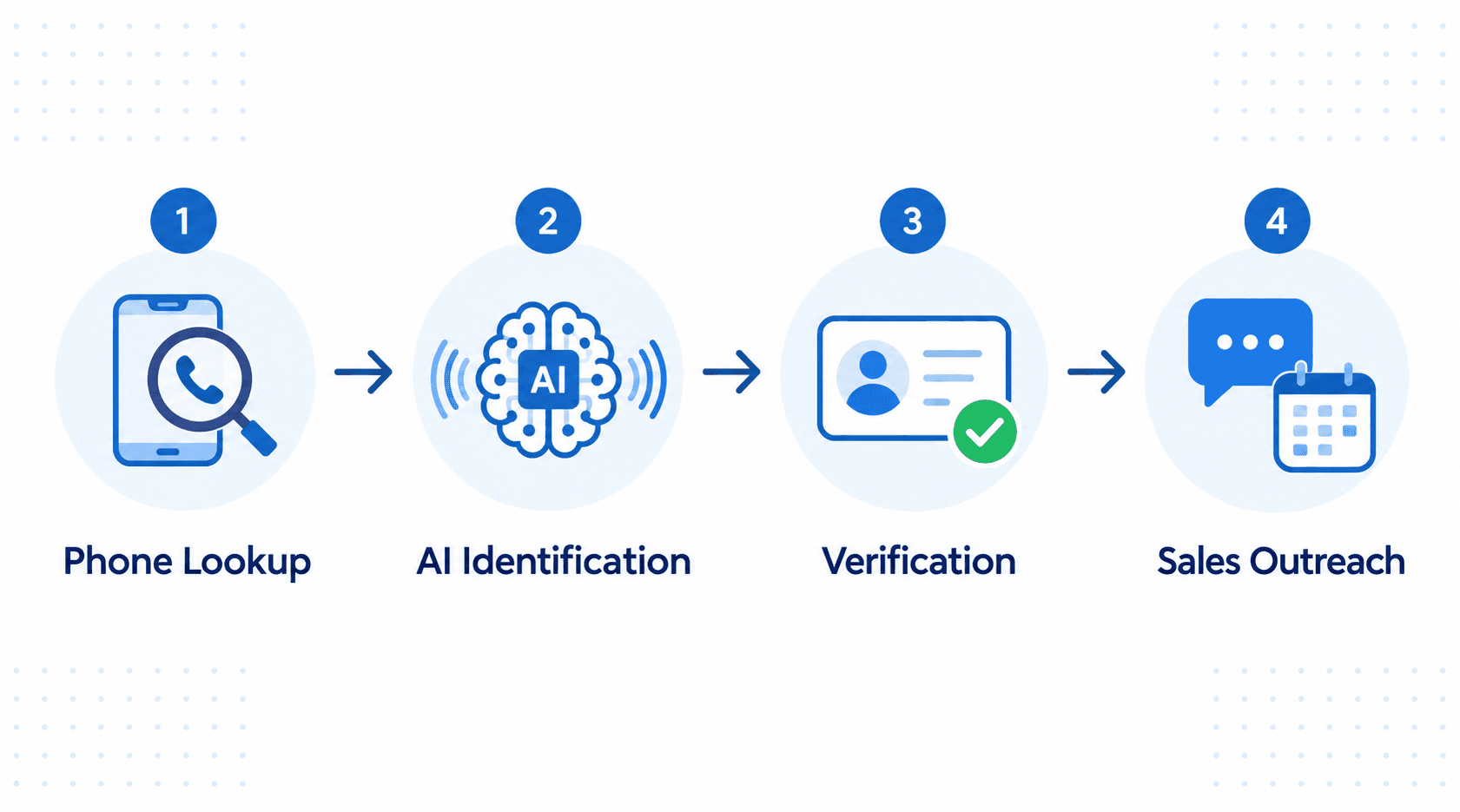
A typical B2B prospecting workflow might look like this:
- Account selection: The team identifies target companies based on firmographic and technographic criteria — industry, company size, tech stack, growth signals.
- Contact identification: Within target accounts, the team identifies the relevant personas — the decision-makers and influencers who would be involved in a buying decision.
- Contact enrichment: For each identified contact, the team enriches their data with email, phone, job title, company data, and any available intent or engagement signals.
- Verification: Before contacts enter outreach sequences, phone numbers and emails are validated to reduce bounce rates and incorrect dial attempts.
- Outreach execution: Verified contacts are loaded into the sales engagement platform, and reps begin multi-channel outreach — phone, email, and social.
AI phone number lookup primarily supports steps three and four of that workflow — enrichment and verification. But because those steps sit at the top of the outreach funnel, improving their accuracy has a compounding effect on everything downstream: connect rates, conversation quality, and ultimately pipeline generated.
Some sales intelligence platforms integrate lookup, enrichment, and verification into a single interface, reducing the friction of moving between multiple tools.
How SalesTarget.ai Supports Prospect Research and Contact Discovery
SalesTarget.ai is built for B2B sales teams that need to research and identify prospects efficiently. The platform's Lead Explorer brings together firmographic data, contact discovery, and prospect research in one interface — designed for SDRs, account executives, and sales operations teams who need to move quickly without sacrificing data quality.
Rather than managing a patchwork of separate tools for account research, contact lookup, and CRM enrichment, SalesTarget.ai provides a unified starting point for prospect discovery. Users can search by company, role, or territory to surface relevant contacts — including available phone and contact data — and move directly into their outreach workflow.
If your team is evaluating how AI-powered contact research could fit into your prospecting process, the Lead Explorer is worth exploring as a starting point.