Most cold email campaigns fail quietly. Low open rates. Ignored follow-ups. A reply rate that sits between 1% and 3% if you're lucky. Sales teams keep sending the same templated sequences because that's what the tool makes easy — not because it works.
The problem isn't email as a channel. Email still drives more B2B pipeline than most other outbound channels combined. The problem is how the outreach is done: generic messages, manual copy-paste personalisation, and no intelligence behind the timing or targeting.
AI email outreach for sales changes the equation. It doesn't just automate the sending — it adds contextual personalisation, smart sequencing, and real-time optimisation that traditional tools simply can't deliver. The result is higher reply rates, shorter sales cycles, and less manual work for your team.
The Challenges With Traditional Email Outreach
Manual cold email workflows were built for a world where sending 50 emails a day was high-volume. That world doesn't exist anymore. Today's outbound teams are managing hundreds of prospects simultaneously — and the old approach breaks down fast.
Here's where traditional outreach consistently falls short:
- Templates that feel like templates. Prospects can spot a mail-merged email in seconds. Generic openers and copy-paste value props don't build trust — they signal that you haven't done your homework.
- No intelligent follow-up logic. Most tools send follow-ups on a fixed timer regardless of prospect behaviour. If someone opens an email three times, that's a buying signal. A fixed-cadence tool treats it the same as a bounce.
- Personalisation that doesn't scale. Adding a prospect's first name and company name isn't personalisation. True personalisation — referencing recent news, job changes, or specific pain points — takes time. Without AI, it doesn't scale past a handful of accounts per day.
- Disconnected from pipeline. Most standalone outreach tools live outside the CRM. That means reps switch between tools, data gets out of sync, and there's no unified view of where a prospect is in the sales process.
The numbers tell the same story. According to Salesforce, only 27% of salespeople believe traditional outreach tools help them hit quota effectively. And McKinsey reports that personalised outreach generates 2–3x higher response rates than generic campaigns — yet only a fraction of teams do it at scale.
How AI Transforms Email Outreach
AI doesn't just speed up what you were already doing. It changes what's possible.
The core difference: traditional email tools execute instructions. AI tools make decisions — and improve those decisions based on results.
Contextual Personalisation at Scale
AI-powered platforms analyse prospect data — job titles, company size, industry, recent funding rounds, hiring signals — and generate email copy that speaks to each recipient's specific context. Not mail merge. Actual relevance. Research by Experian found that personalised emails deliver 6x higher transaction rates, and HubSpot data shows they improve click-through rates by an average of 14% and conversions by 10%.
Intelligent Sequencing and Timing
AI analyses engagement signals — opens, clicks, reply intent — and adjusts follow-up cadence accordingly. If a prospect opens your email on a Tuesday morning but doesn't reply, the system can schedule a follow-up for the same day and time the following week. Timing optimisation alone can lift reply rates by 20–30%, according to data from Outreach.io's 2024 sales engagement benchmarks.
Continuous Optimisation
Traditional A/B testing takes weeks and requires a large enough sample to be statistically significant. AI systems optimise in real time — adjusting subject lines, send times, and messaging based on what's working across your entire pipeline. This is the difference between running experiments and running a learning system.
Key Features to Look for in AI Email Outreach Tools
Not all platforms marketed as 'AI-powered' actually use AI in meaningful ways. These are the capabilities that separate genuine AI sales engagement tools from tools with a thin AI veneer:
- AI-generated email copy — personalised based on prospect data, not just name/company tokens
- Behaviour-triggered sequences — follow-ups that respond to opens, clicks, and reply intent
- Native CRM integration — outreach data flows directly into the pipeline, no manual sync
- Deliverability management — domain warm-up, sending limits, and spam score monitoring built in
- Multi-channel coordination — email sequencing coordinated with LinkedIn and call tasks
- Real-time analytics — open rates, reply rates, and conversion metrics by sequence, step, and rep
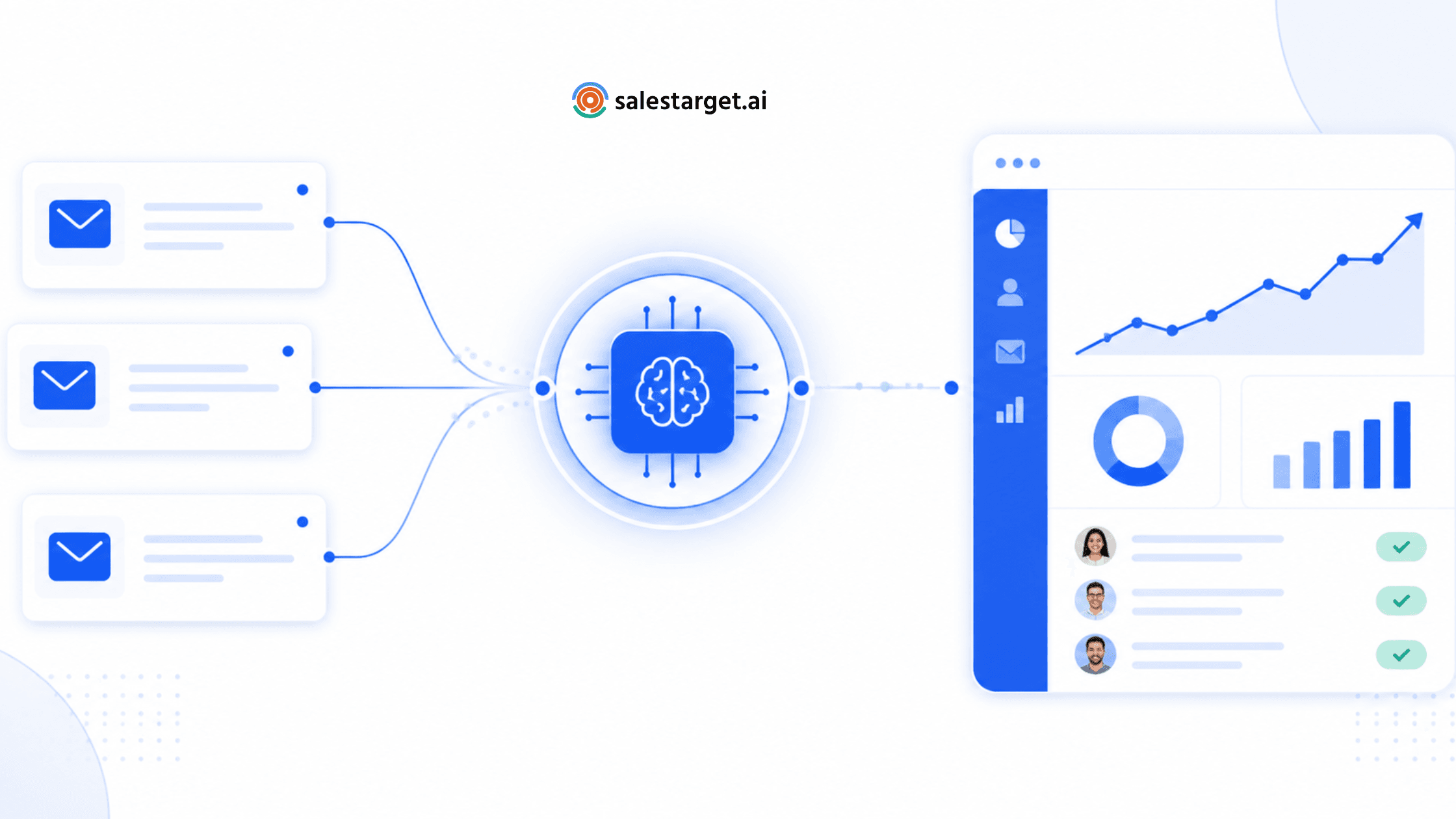
SalesTarget.ai's Email Outreach product is built with these capabilities native to the platform — not bolted on through integrations. Because outreach and CRM are in the same system, every reply, click, and conversion automatically updates the prospect record and deal stage.
How to Set Up AI Email Outreach: A Step-by-Step Guide
Getting from zero to a running AI outreach campaign takes less time than most teams expect. Here's the process:
-
Define your ICP and segment your list
AI personalisation is only as good as the data you feed it. Start by defining your ideal customer profile — industry, company size, role, geography. Segment your list by those parameters before writing a single word of copy.
-
Set up your sending infrastructure
Warm up your sending domain before launching campaigns. A cold domain sending 300 emails per day on day one will land in spam. Use SalesTarget.ai's built-in deliverability tools to warm domains gradually over 2–4 weeks.
-
Build your sequence structure
A high-performing sequence typically has 4–6 steps over 14–21 days. Step 1: Value-led cold email. Step 2: Follow-up adding social proof or a case study. Step 3: Different angle or challenge framing. Steps 4–6: Short, direct check-ins. Map the logic before writing copy.
-
Use AI to generate and personalise copy
Feed SalesTarget.ai's AI the prospect data and your value proposition. Let it generate personalised first lines, subject line variants, and body copy tailored to each segment. Review and edit — the AI creates a strong foundation, your expertise shapes the final message.
-
Configure behaviour-based triggers
Set rules for how the sequence responds to prospect behaviour. If a prospect opens step 1 three times without replying, trigger a modified follow-up. If they click a link, route them to a high-priority task for manual outreach. These triggers are what separate automated cold email outreach from intelligent outreach.
-
Launch, monitor, and optimise
Launch your campaign and monitor reply rates, open rates, and bounce rates in the first 48 hours. Use sequence-level analytics to identify which steps and subject lines are performing — then adjust. Campaigns that are actively optimised in the first two weeks outperform set-and-forget campaigns by a significant margin.
Real Use Cases: How Teams Are Using AI Email Outreach
SDR Workflow Automation
SDRs using AI email outreach automation can manage 3–4x more active prospects without sacrificing personalisation quality. Instead of spending 2 hours a day on manual research and copy, they focus on replies, call prep, and pipeline movement. The outreach runs in the background. The conversations come to them.
Lead Nurture Campaigns
Not every prospect is ready to buy today. AI-powered nurture sequences keep your brand present with relevant, timed content — without requiring a rep to manually follow up every two weeks. When a prospect's behaviour signals buying intent, the system escalates them automatically to active outreach.
Outbound Campaign Management
Growth teams running outbound campaigns across multiple ICPs can use AI to manage separate sequences, personalised by segment, with unified analytics across all campaigns. This connects directly to the sales pipeline — so when a campaign generates a reply, it flows into the CRM deal stage immediately. (For more on structuring your pipeline to match your outreach process, see our guide: How to Set Up a Sales Pipeline That Actually Reflects How Your Team Sells.)
Best Practices to Improve Email Reply Rates
Technology does the heavy lifting — but these fundamentals determine whether your campaigns convert:
- Keep subject lines under 7 words. Analysis of over 40 million emails by Yesware found that shorter subject lines consistently outperform longer ones.
- Lead with relevance, not features. Your first line should make the prospect think 'this person understands my situation' — not 'this is a sales pitch.'
- One CTA per email. Ask for one specific thing. A 15-minute call, a reply, a reaction. Multiple CTAs reduce conversion.
- Test send time by segment. Decision-makers in finance open email at different times than heads of engineering. Segment your send timing accordingly.
- Treat reply rates as a leading indicator, not a vanity metric. A 2% reply rate from well-qualified prospects is worth more than an 8% reply rate from a poorly-targeted list.
- Keep sequences short and direct. Research from TOPO (now Gartner) suggests that the highest reply rates come from sequences of 4–6 steps — not the 12-step sequences many teams run.
Cold email doesn't have a deliverability problem. It has a relevance problem. Generic sequences going to generic lists will always produce generic results.
AI email outreach for sales solves the core issue: it makes personalisation scalable, makes sequences intelligent, and connects outreach data directly to the pipeline — so nothing falls through the cracks between a positive reply and a closed deal.
The teams winning with outbound today aren't sending more emails. They're sending smarter ones — and following up with precision. AI makes that possible at a scale no manual process can match.
Ready to see what AI-powered outreach looks like inside a native CRM? Explore SalesTarget.ai Email Outreach