Most B2B sales teams do not have a prospecting problem. They have a coordination problem.
A rep finds a promising account in one tool, enriches it in a second, writes a sequence in a third, logs the reply in a fourth, and then forgets to follow up because the task sits in a fifth. The lead was never bad. The handoffs were.
A b2b sales engagement platform is designed to remove those handoffs. It brings prospect discovery, lead qualification, personalized communication, follow-up sequencing, and activity tracking onto one timeline so a rep can move from "this looks like a fit" to "we have a meeting booked" without exporting a CSV in the middle.
This guide walks through the engagement workflow stage by stage, explains how it differs from adjacent categories like sales intelligence and CRM, and shows what to look for when evaluating a platform against the way your team actually sells.
What a B2B Sales Engagement Platform Actually Does
A B2B sales engagement platform is the operational layer that sits between your prospect data and your buyer. Its job is to orchestrate the touches — emails, LinkedIn messages, calls, tasks — that move a lead through the top and middle of the funnel, while keeping every interaction logged against the right record.
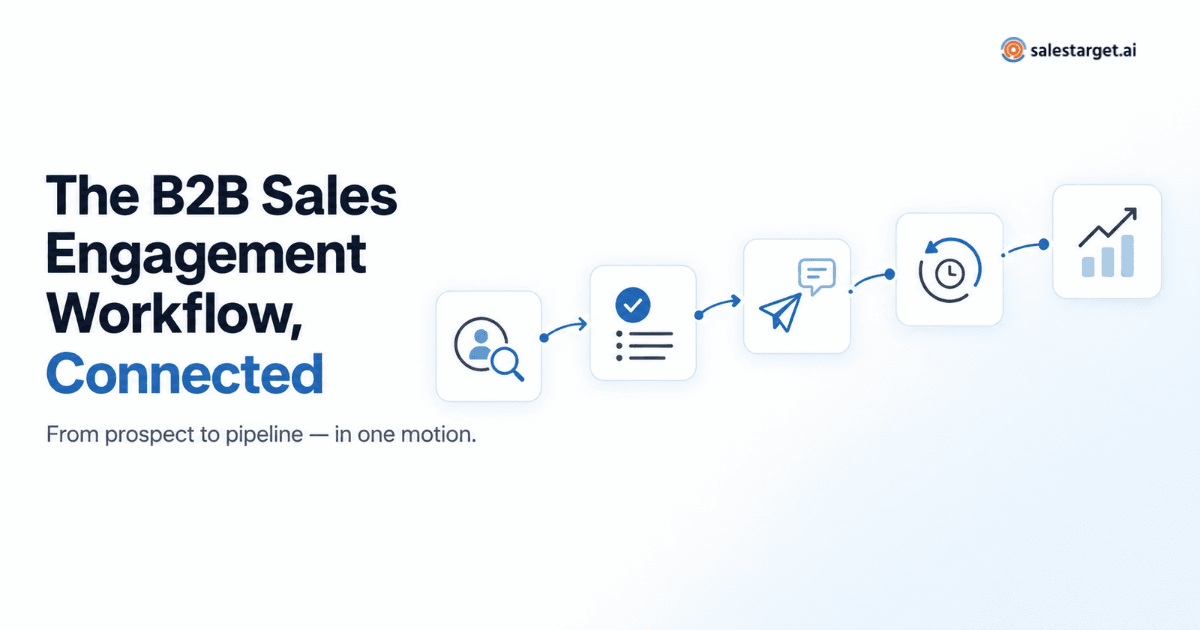
In practical terms, that means five things working together:
- A way to find or import the right prospects.
- A way to qualify them before they enter a sequence.
- A way to send personalized, multichannel outreach.
- A way to time and automate follow-ups.
- A way to see and review every touch across the team.
What makes it a platform, rather than a collection of features, is that the five stages share one data layer. A reply on LinkedIn can pause the email sequence. A new title detected on a contact can retrigger qualification. A no-show on a booked meeting can route the lead into a nurture track. The workflow is continuous, not stitched.
For teams building out the first stage — finding the right B2B prospects — SalesTarget.ai's B2B lead discovery and prospect qualification (Lead Explorer) gives reps searchable access to 840M+ B2B profiles and 146M+ businesses, with more than 4,000 intent signals and ICP-building tools to narrow a market into a working prospect list. That list then feeds the rest of the engagement workflow.
Sales Engagement vs. Sales Intelligence vs. CRM vs. Sales Automation
These terms get used interchangeably in marketing copy, which makes platform selection harder than it needs to be. Each category solves a different problem.
Sales intelligence
Sales intelligence platforms are about what you know before you reach out. They provide verified contact data, firmographic and technographic filters, buyer intent signals, and enrichment. They answer: "Who should we be talking to, and what is going on at their company right now?"
Sales engagement
Sales engagement platforms are about the touches themselves. They sequence emails, schedule LinkedIn messages, trigger calls, and coordinate follow-ups across channels. They answer: "How do we reach the people we have decided to pursue, in a way that is personal and consistent?"
CRM
A CRM is the system of record for deals and relationships. It stores accounts, contacts, opportunities, pipeline stages, and historical activity. It answers: "What is the state of every deal, and who owns it?"
Sales automation
Sales automation is the connective tissue — the rules, triggers, and workflows that fire actions when conditions are met (auto-enrich when a lead comes in, auto-assign when territory matches, auto-task when a reply arrives). It is a feature set that appears inside every category above, not a standalone category.
Why this matters: a strong engagement workflow usually needs all four. Teams get burned when they buy an engagement tool expecting it to also serve as their intelligence source, or buy intelligence software and discover there is no built-in way to actually run a sequence against it. Choosing a connected platform that spans the full workflow is one way to avoid the gap; integrating best-of-breed tools is another, as long as the data layer stays clean.
For a deeper look at the data-and-signals layer that feeds engagement work, see our guide to sales intelligence platforms for B2B sales teams.
The Five Stages of a Modern B2B Sales Engagement Workflow
The clearest way to evaluate a b2b sales engagement platform is to walk a lead through it, stage by stage, and ask what breaks at each handoff. Here is the workflow most high-performing teams end up with.
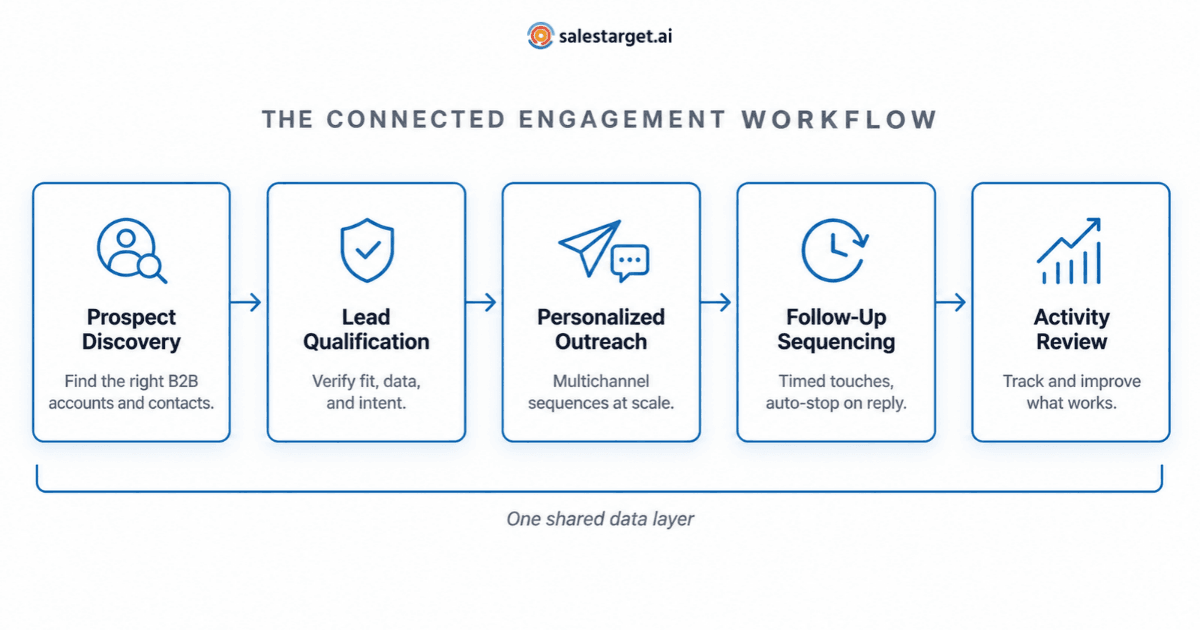
Stage 1: Prospect Discovery
Everything downstream depends on who enters the funnel. A sequence sent to the wrong title at the wrong company will not become a meeting, no matter how well written.
At this stage, a platform should let a rep:
- Search a verified B2B contact and company database by role, seniority, department, headcount, revenue, geography, and industry.
- Layer firmographic filters with technographic ones (what the company uses) and intent signals (what the company is researching).
- Save searches as reusable ICP definitions rather than rebuilding them weekly.
- Push qualified matches directly into the next stage without a CSV export.
A practical example: a rep selling to mid-market fintech security teams defines an ICP once — 200 to 2,000 employees, financial services, with a specific SIEM in the stack — and saves it. Every Monday, the saved search returns net-new accounts that match. The rep is spending time on outreach, not on list-building.
Stage 2: Lead Qualification
A long prospect list is not a qualified pipeline. Before anything enters a sequence, each lead needs a quick check:
- Does the contact information look current (recent title, active email, verified phone)?
- Does the company show any buying signals — hiring, funding, leadership change, intent topic research?
- Does the lead meet the fit criteria beyond the surface filters that pulled them in?
Qualification is where enrichment and verification earn their keep. Enrichment fills in missing fields; verification confirms the ones you have still work. Doing both at the moment a lead is pulled, rather than batching them later, prevents the slow bleed of bounces and bad numbers that erodes sender reputation and rep morale.
When fit and intent are weighed together, the output is a ranked list, not a filtered one. A ranked list tells a rep where to start on Monday morning.
Stage 3: Personalized Outreach
This is the stage most buyers imagine when they picture a sales engagement platform — and the one most prone to misuse. The temptation is to automate every touch and send at maximum volume. The result is a predictable drop in reply rates.
A better model: automation handles the structure (timing, channel order, step gating), while content stays specific to the recipient. Modern platforms support this by:
- Letting reps build sequences that mix email, LinkedIn, and phone steps in whatever order fits the segment.
- Allowing dynamic fields that pull from enriched data (company detail, recent news, title context) into the message.
- Supporting AI-assisted drafting that uses the prospect's own context, not a generic template.
- Running inbox warm-up and sending throttles automatically to protect deliverability.
A sequence that opens with a short email referencing a specific detail — a recent funding round, a job posting, a product change — tends to earn a reply where a generic opener does not. The platform's job is to make that level of relevance fast enough that it is actually feasible across a full book.
Stage 4: Follow-Up Sequencing
Most meetings are booked on the fourth, fifth, or sixth touch. Teams that stop at touch two leave pipeline on the table. Teams that keep sending without rules annoy the prospects they were trying to reach.
A good follow-up engine does several things at once:
- Spaces touches at intervals that respect the channel (LinkedIn moves faster than email; phone is used sparingly).
- Stops the sequence when the prospect replies, opts out, or books a meeting — automatically, on every channel.
- Branches based on behavior (opened but did not reply, clicked the link, visited the pricing page).
- Hands off to a different motion when the lead goes quiet, so the record does not just stall in a sequence slot forever.
The platform's role here is state management. Without it, a rep ends up tracking "who got what, when, and did they respond" in a spreadsheet, which is where follow-up discipline goes to die.
Stage 5: Sales Activity Tracking and Review
The engagement workflow does not end at the first reply. Every email sent, link clicked, call made, LinkedIn message delivered, and meeting booked becomes activity data. That data powers three decisions:
- Which sequences are earning replies, and which should be rewritten.
- Which reps are hitting the activity levels that correlate with pipeline, and which need coaching.
- Which segments are responding, and which should be deprioritized.
A connected platform logs this automatically. A fragmented stack requires reps to manually update the CRM — a step that gets skipped under pressure, which means the activity data in the CRM is incomplete, which means the review is based on a sample. One of the strongest arguments for a connected engagement platform is simply that it makes activity data trustworthy.
How to Evaluate a B2B Sales Engagement Platform Against Your Workflow
Rather than scoring platforms against a generic feature list, map each candidate against the five stages above and ask the specific questions your team will actually run into.
Prospect discovery capability
- How large and how current is the underlying B2B database?
- Can reps combine role, firmographic, technographic, and intent filters in one search?
- Are ICPs reusable and shareable across the team?
Qualification and data quality
- Is enrichment done at the moment of selection, or in batches?
- Is every contact classified before it enters a sequence (verified, catch-all, risky, invalid)?
- How does the platform signal which accounts are actively in-market?
Multichannel outreach
- Can a sequence natively combine email, LinkedIn, and phone steps?
- Does personalization scale through dynamic fields and AI drafting, or does it require per-prospect manual edits?
- Are deliverability safeguards (warm-up, sending caps, domain health) built in or bolted on?
Follow-up logic
- How are branching rules configured? Can a non-technical rep set them up?
- Does a reply on one channel pause the sequence on all channels?
- What happens when a sequence ends without a response?
Activity tracking and reporting
- Is every touch logged automatically to the contact and account record?
- Can leaders see per-rep activity, per-sequence performance, and per-segment response in one view?
- Does the activity timeline stay intact when a lead moves between reps or motions?
Common Adoption Mistakes (And How to Avoid Them)
Most platforms fail inside sales teams for operational reasons, not technical ones. The patterns repeat.
Treating the platform as a sending tool
Teams that use only the sequence feature and ignore qualification, enrichment, and tracking end up with a glorified mail merge. The payoff from a sales engagement platform scales with how much of the workflow you actually route through it.
Running too many sequences at once
A sequence per segment is helpful. A sequence per rep is manageable. A sequence per rep per week is unmaintainable — nobody can tell what is working, and winning patterns never get consolidated. Start with a small number of well-maintained sequences and iterate.
Ignoring the handoff to CRM
A reply is not the end of the engagement workflow; it is the beginning of a deal cycle. If replies do not flow cleanly into the pipeline with context, the AE picks up a cold conversation. A platform that shares the data layer with the CRM (or ships a built-in CRM) avoids this handoff tax.
Over-automating the opener
AI drafting is a tool for scale, not a substitute for judgment. Teams that review the first message in a sequence and leave the follow-ups more automated tend to outperform teams that automate every touch equally.
Skipping the review loop
Activity data is only useful if someone looks at it. A weekly 30-minute review of top-performing sequences and bottom-performing ones catches patterns faster than any dashboard alert.
Best Practices for Running the Workflow Well
- Define the ICP once, then reuse it. Every ad-hoc list is a chance for drift.
- Verify before you send. Catch-all and unverified addresses damage sender reputation faster than any content choice.
- Keep sequences short and sharp. Three to six well-timed touches outperform ten shallow ones in most B2B segments.
- Match channel to context. LinkedIn fits warm-ish openings; email fits detailed pitches; phone fits a reply that stalled.
- Review weekly. Sequences decay. What worked in Q2 may be noise in Q4.
- Keep the data layer clean. One source of truth, enriched continuously, is worth more than three partially synced ones.
Choosing a B2B Sales Engagement Platform That Matches Your Motion
The job of a b2b sales engagement platform is not to automate selling. It is to remove the friction between the moments when a rep is actually selling — the research tax, the data-entry tax, the handoff tax — so that more of a week ends up in front of a buyer.
The platforms that do this well share a trait: they treat prospect discovery, qualification, outreach, follow-up, and activity tracking as five parts of one motion, running on one data layer. The ones that struggle treat them as five separate features bolted together.
When evaluating a platform, walk a hypothetical lead through all five stages and ask where the handoffs happen. The fewer handoffs — the fewer exports, re-imports, re-keyings, and reconciliations — the more time your team spends on the conversation that actually moves a deal.