TL;DR
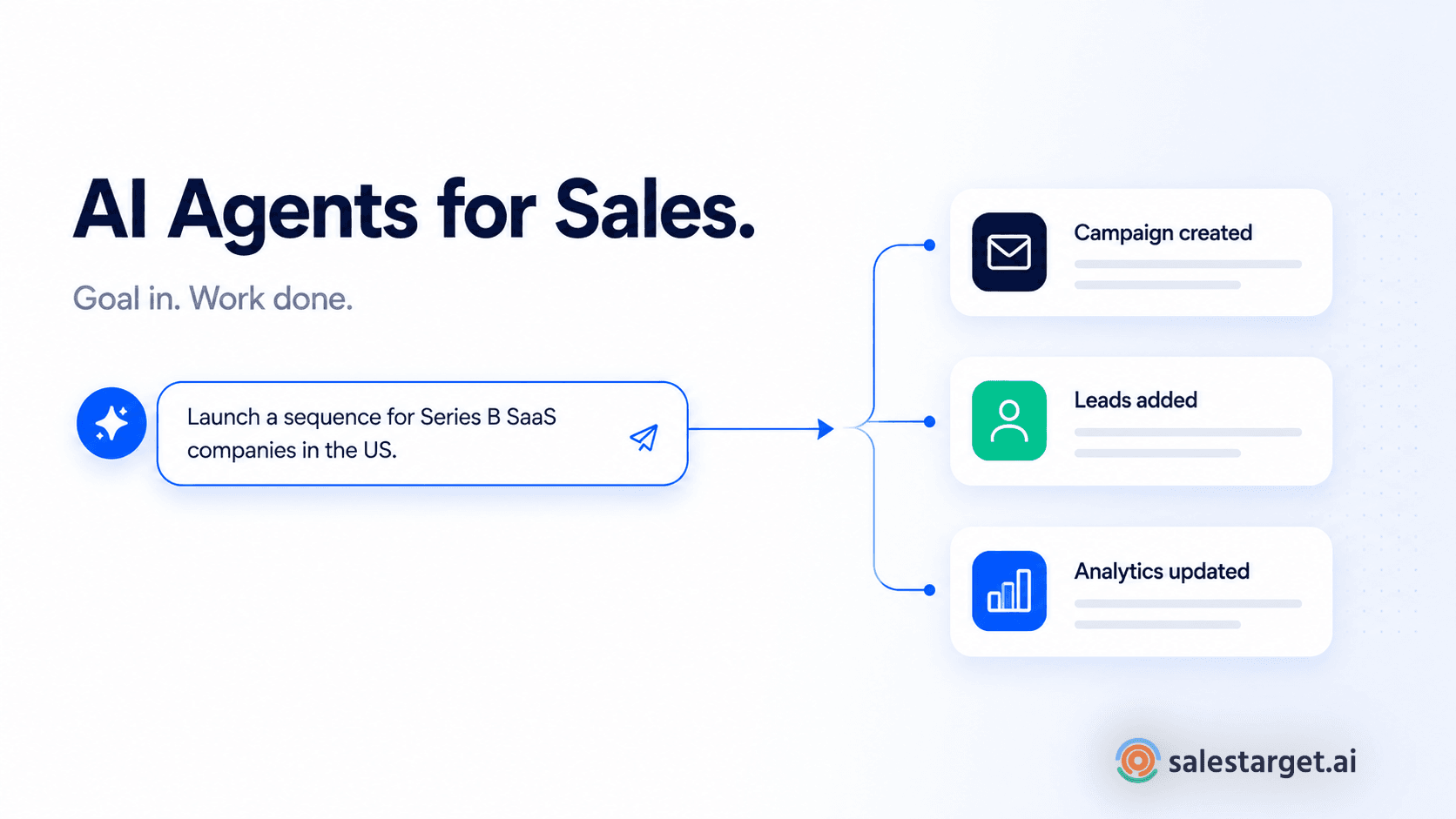
- An AI agent for sales is not a chatbot and not a simple automation tool — it is a system that takes a goal in plain language and executes the work end-to-end across your outreach stack
- The difference between an AI agent and a traditional sales automation tool: automation follows a fixed sequence you design in advance; an AI agent interprets your intent and decides how to execute
- B2B sales teams using AI agents for outreach report handling 10–20x the activity volume of manual teams — without proportional headcount increases
- The highest-value tasks for AI agents in sales: campaign creation, lead search and list building, sequence management, CRM task handling, and campaign analytics — the work that consumes 60% of a rep's day without generating pipeline
- AI agents do not replace human judgment — they eliminate the operational drag that prevents reps from using it
- SalesTarget's Copilot is a chat-based AI agent built into the platform — tell it what you want to accomplish, and it executes across campaigns, leads, CRM, and analytics without switching tabs
Most Sales Automation Tools Are Sophisticated to Set Up and Primitive to Use
The average B2B sales rep spends 61% of their time on work that is not selling — researching accounts, building lists, creating campaigns, logging CRM activity, writing follow-up sequences, and pulling analytics reports. Sales automation tools were supposed to fix this. Instead, most of them added a new job: learning and maintaining the automation itself.
Sequence builders require you to design every branch in advance. CRM automations break when a field is missing. Campaign tools need manual campaign setup for every new audience segment. The rep is no longer doing the work manually — they are managing the system that does it, which is a different kind of overhead and not obviously better.
AI agents for sales are a different category. Not because they are smarter software, but because they change the fundamental interaction model. Instead of you configuring what the system should do, you tell the system what you want to achieve and it figures out how to do it.
That distinction sounds subtle. In practice it changes everything about how outreach work gets done.
What an AI Agent for Sales Actually Is
The term gets used loosely enough that it has started to lose meaning. Here is a precise definition that holds up to scrutiny.
An AI agent for sales is a software system that takes a goal expressed in natural language, breaks it into the required component tasks, executes those tasks across the relevant tools and data sources, and returns a result — without requiring the user to specify each step in advance.
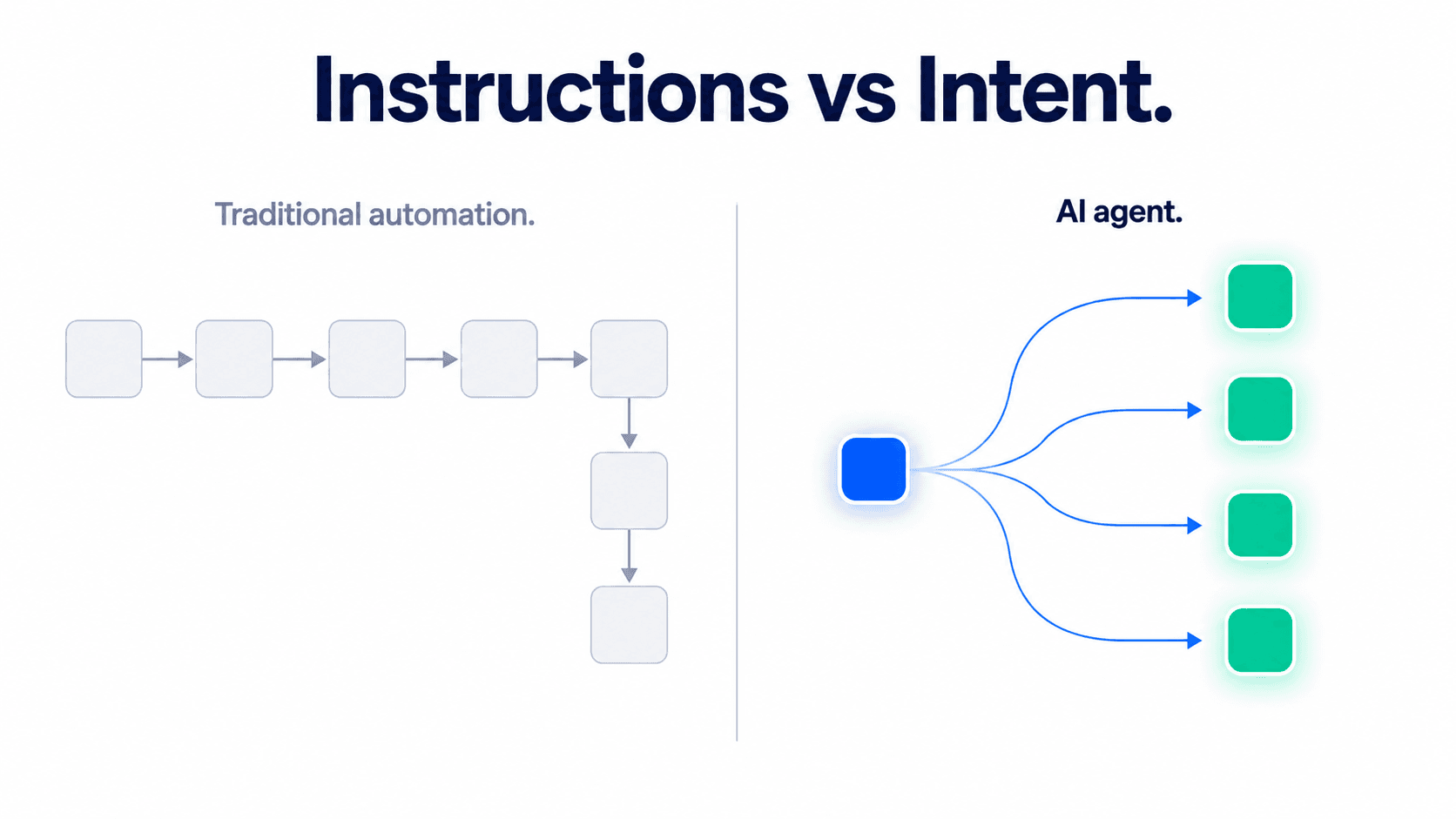
The operative word is goal. Traditional automation takes instructions: "send this email to this list on this schedule." An AI agent takes intent: "find me 50 SaaS companies in the APAC region that are hiring SDRs and create a campaign targeting their VP of Sales." The system resolves what that means operationally and executes it.
AI Agent vs Traditional Sales Automation: The Real Difference
This distinction is worth being precise about because most of what is marketed as an "AI agent" in 2026 is actually traditional automation with a natural language interface bolted on. The difference matters for how you evaluate tools and what you can realistically expect.
| Dimension | Traditional sales automation | AI agent for sales |
|---|---|---|
| Input | Explicit instructions — you define every step | A goal — you describe what you want to achieve |
| Flexibility | Rigid — breaks when conditions change | Adaptive — interprets intent and adjusts execution |
| Setup time | High — requires workflow design, field mapping, testing | Low — conversational prompt replaces configuration UI |
| Who can use it | Requires technical or ops expertise to configure | Any rep who can describe what they need |
| Maintenance | High — someone owns the automation and fixes breaks | Low — no static workflow to maintain |
| Output | Executes the defined process | Achieves the stated goal — process is determined by the agent |
| Human role | System designer and maintainer | Goal-setter and judgment layer |
The practical implication: a traditional automation tool makes an experienced ops person more productive. An AI agent makes every rep on the team more productive — regardless of their technical background.
What Tasks AI Agents Actually Handle in B2B Sales
The honest answer to what AI agents can do in 2026 is more specific and more useful than the broad claims most vendors make. Here are the task categories where AI agents for sales deliver consistent, measurable value — and where human judgment still owns the work.
Tasks AI agents handle well
Campaign and sequence operations
Creating campaigns by name and goal, updating email sequence steps, attaching lead lists to campaigns, retrieving campaign performance data. Work that previously required navigating multiple UI screens now happens in a single conversational instruction.
Lead search and list management
Searching and filtering leads by ICP parameters, creating named lists, adding leads to lists, fetching available lists for campaign use. The rep describes who they want to reach; the agent builds the list.
CRM task and pipeline management
Querying and filtering deals, meetings, and tasks. Creating, updating, and assigning tasks. Surfacing what needs attention without the rep having to navigate the CRM manually to find it.
Analytics and performance reporting
Weekly campaign analytics including activity line charts, stat cards, and top performers. Best-performing campaign identification using weighted scoring across the past 30 days. The rep asks what is working; the agent surfaces the answer.
Tasks that still require human judgment
Live discovery calls and objection handling — the conversation once a prospect replies requires a human who can read tone, adapt in real time, and build genuine rapport.
Strategic account decisions — which accounts to prioritize for enterprise deals, how to navigate multi-stakeholder buying committees, when to escalate from email to phone.
Message quality review — AI agents generate and execute; a human should review high-stakes outreach before it sends, particularly for named accounts or senior buyer personas.
How a Chat-Based AI Agent Works in Practice
The most accessible form of AI agent for sales in 2026 is chat-based — you interact with it the way you would interact with a knowledgeable colleague who has access to your entire sales stack. You describe what you need, it executes, and it reports back what it did.
This interaction model removes the configuration layer entirely. There is no workflow builder to learn, no field mapping to maintain, no trigger logic to design. The rep's input is plain language. The agent's output is completed work inside the platform.
Here is what a realistic working session looks like using SalesTarget's Copilot:
💬 A working session with an AI sales agent
Rep instruction
"Search for SaaS companies in the US with 50–200 employees that are hiring SDRs and create a list called Q3-SDR-Hiring-Targets."
Agent executes
Runs the lead search with the specified filters → creates the named list → confirms how many leads were added and the list ID for campaign use.
Rep instruction
"Create a campaign called SDR-Hiring-Outreach and attach the Q3-SDR-Hiring-Targets list to it."
Agent executes
Creates the campaign → attaches the list → confirms campaign is ready for sequence setup.
Rep instruction
"Show me my best performing campaign in the last 30 days and the weekly analytics for it."
Agent executes
Runs weighted scoring across all campaigns for the past 30 days → surfaces the top performer → pulls weekly activity line chart and stat cards for that campaign.
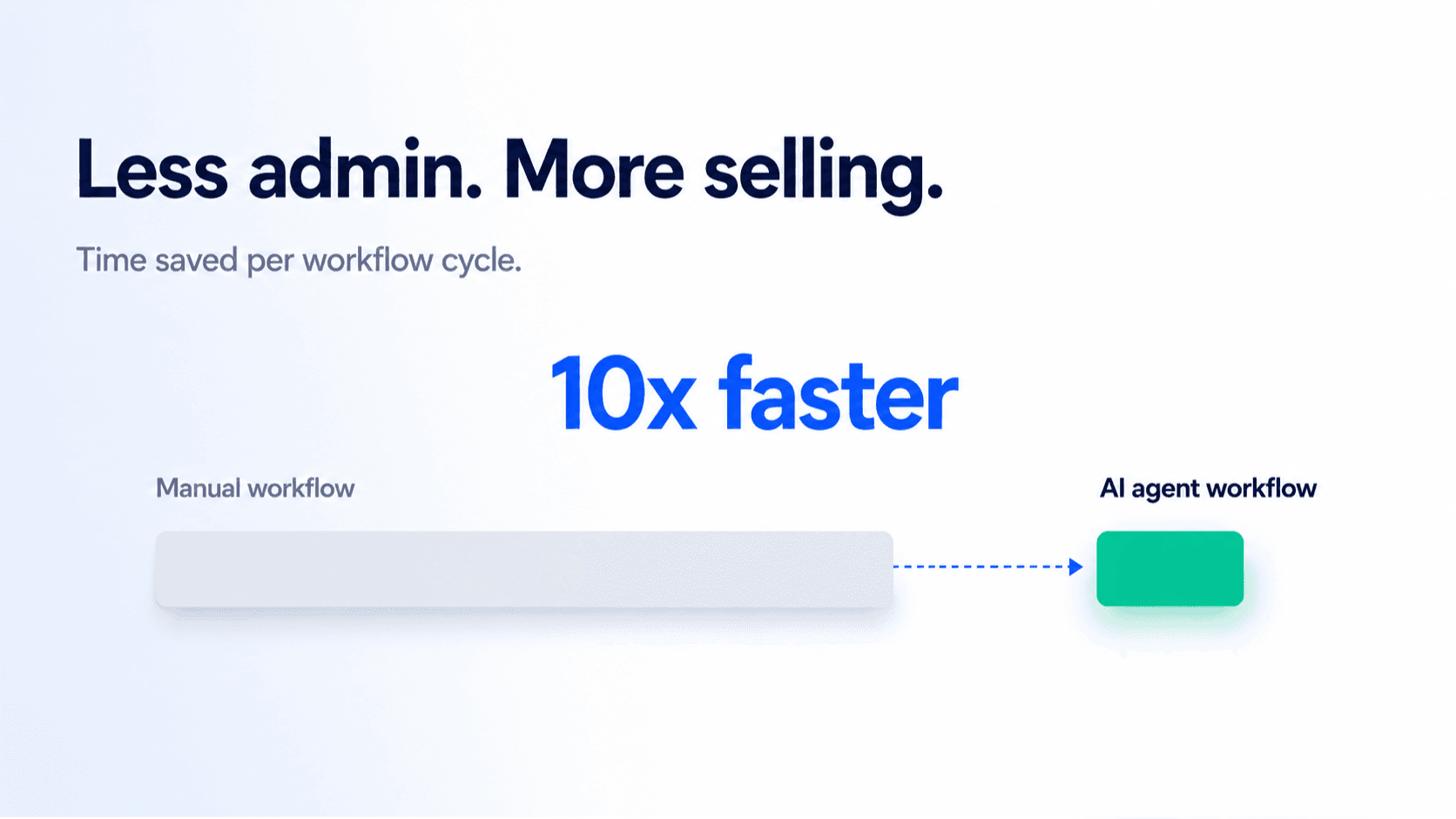
What took 25–40 minutes of manual platform navigation — searching leads, building lists, creating campaigns, pulling reports — is completed in a few conversational exchanges. The rep's time moves from administration to the output: reviewing results, refining targeting, and handling replies.
Why Most AI Agent Implementations Fail in the First 90 Days
Treating it as a replacement rather than an accelerator
Teams that hand the entire outreach workflow to an AI agent and remove human review fail consistently. The agent handles execution. A human still needs to set the strategy, review message quality for high-value accounts, and manage replies. The teams that succeed define clear boundaries: what the agent owns, what the rep owns, and what requires sign-off before sending.
Starting with a vague ICP
An AI agent amplifies your targeting. If your ICP definition is vague — "B2B companies that could benefit from our product" — the agent will find a large, noisy list that produces low reply rates at high volume. The quality of the output is directly proportional to the specificity of the input. Define ICP filters (industry, company size, job title, tech stack, hiring signals) before asking the agent to build lists.
Not using analytics to close the loop
Most teams set up AI agent-driven campaigns and then evaluate results the same way they evaluated manual campaigns — by opening a dashboard once a week. AI agents can surface campaign analytics, identify top performers, and flag underperforming sequences on demand. Teams that query their agent for performance data regularly and refine based on it consistently outperform teams that run campaigns and wait.
Ignoring the CRM task layer
The most underused capability in most AI agent implementations is CRM task management. Reps continue logging activity manually and checking their task queue manually — despite the agent being capable of querying deals, surfacing overdue tasks, creating follow-up reminders, and flagging stalled pipeline. The teams that instruct their agent to manage the CRM task layer as well as the outreach layer see the largest productivity gains.
How to Build Your First AI Agent Workflow in B2B Sales
The fastest path to results with an AI agent is to start with one high-volume, high-repetition workflow and prove the model before expanding. Here is the sequence that works consistently for B2B outbound teams starting with cold email outreach:
| Step | What you do | What the agent does | Time saved |
|---|---|---|---|
| 1. Define ICP | Write down your target company profile — industry, size, job title, signals | Nothing yet — this is your input, not the agent's | — |
| 2. Build the list | Instruct the agent: "Search for [ICP description] and create a list called [name]" | Runs filtered lead search, creates the named list, confirms count | 45–90 min → 2 min |
| 3. Create campaign | Instruct the agent: "Create a campaign called [name] and attach the [list name] list" | Creates campaign, attaches list, confirms ready for sequence setup | 15 min → 1 min |
| 4. Set sequence | Review and approve sequence steps — human judgment on message quality | Updates sequence steps on instruction, manages timing and follow-up logic | 20 min → 5 min |
| 5. Monitor and optimise | Ask the agent: "Show me weekly analytics and best performing campaign this month" | Surfaces activity charts, stat cards, top performer with weighted scoring | 30 min → 2 min |
| 6. Manage pipeline | Ask the agent: "Show me open deals and overdue tasks" | Queries CRM deals, meetings, and tasks — surfaces what needs attention | 20 min → 1 min |
Run this workflow for one campaign first. Measure the time saved and the output quality. Once you trust the model, expand: more campaigns, more lists, more frequent analytics queries. The workflow compounds — each campaign cycle is faster than the last because the agent handles the setup and reporting overhead while the rep focuses on what the data says to do next.
What to Look for When Evaluating AI Agents for Sales
The market in 2026 is noisy. Here are the four things that actually separate an AI agent worth using from a chatbot with a sequence tool attached:
📋 AI agent evaluation checklist
- Native platform integration — the agent should execute inside your outreach and CRM stack, not require you to copy-paste outputs between tools. An agent that lives outside your platform adds a handoff problem, not solves one.
- Breadth of executable tasks — can it handle the full workflow (lead search, list building, campaign creation, sequence management, CRM tasks, analytics) or only one part of it? Narrow agents solve narrow problems.
- Conversational interface quality — does it understand natural language instructions accurately, or does it require precise syntax? A good agent handles ambiguous instructions gracefully and asks for clarification when needed.
- Analytics depth — can it surface campaign performance data on demand, identify top performers, and give you actionable insight — or does it only execute tasks and leave analysis to you?
The Teams That Win in 2026 Are Not Working Harder
The productivity gap between AI-assisted and manual outbound teams is not closing — it is widening. Teams using AI sales automation in 2026 are not smarter than the teams they are outperforming. They have simply stopped asking their best people to do work that software can do faster and without error.
An AI agent for sales does not change your strategy or write your best emails or close your most complex deals. It eliminates the administrative layer that was consuming 60% of your team's time and preventing them from doing those things in the first place.
That is not a minor efficiency gain. It is a structural advantage that compounds every week the other team is still building lists manually.
Tell SalesTarget's Copilot what you want. It handles the rest.
Search leads, build lists, create campaigns, manage tasks, and pull analytics — all in plain language.
✓ 50 credits ✓ 7-day trial ✓ No credit card required
Frequently Asked Questions

See It In Action: Book Your Free Demo
Get a personalized walkthrough and see how it works for your team.
Book My Demo →