TL;DR
- Technographic data is information about the technology stack a company currently uses — software, tools, and platforms running their business right now
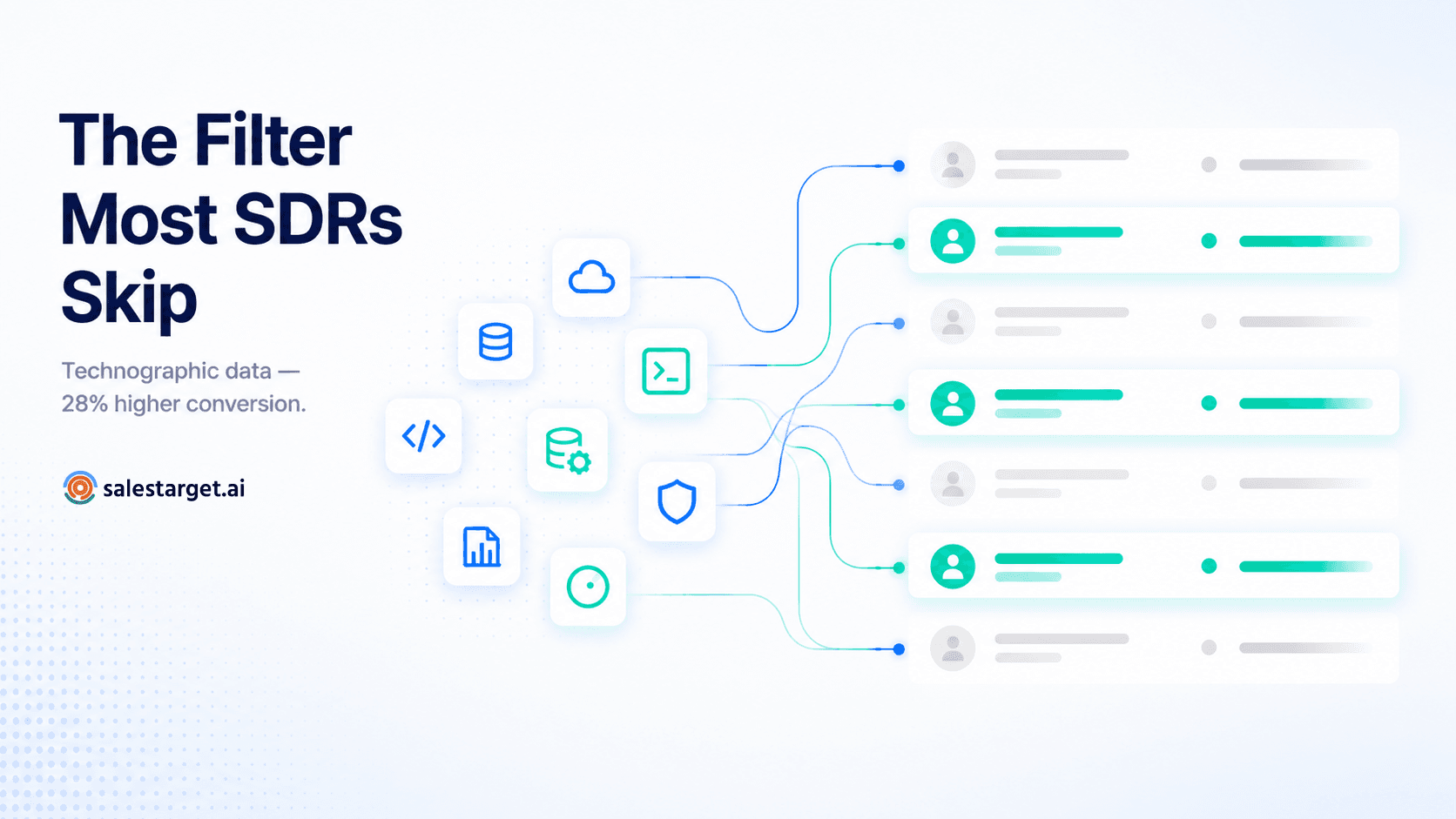
- Teams using technographic targeting see 28% higher conversion rates and are 50% more likely to exceed revenue goals — but most SDR teams skip this filter entirely
- Over 60% of B2B software purchases are replacements — technographic data tells you exactly who is running what you displace
- The pipeline cost of skipping it: lists that include companies with incompatible infrastructure, competitor-locked accounts, and no operational gap for your product
- Three use cases that drive immediate ROI: competitive displacement, integration selling, and ICP refinement from closed-won tech stack patterns
- SalesTarget.ai's Tech Stack filter searches 840M+ profiles by specific tool or category — applied in one click alongside firmographic criteria, before enrichment credits are spent
Most SDR Teams Are Filtering by the Wrong Things
The average B2B organisation now runs over 100 software applications, and mid-sized companies average 255 apps across their full stack (Productiv research 2026). Every one of those tools is a signal — about budget priority, operational maturity, integration fit, and competitive situation. Most SDR teams ignore all of it.
Instead they filter by industry and headcount. Maybe geography. Sometimes revenue range. They build a list that looks right on a spreadsheet and launch a sequence. Then they wonder why conversion rates are sitting at 2–5% when they should be 10–15%.
The missing filter is technographic. And the reason most SDR teams skip it is not that they don't understand the value — it is that it feels complex, unfamiliar, and like something enterprise RevOps teams do, not something a lean outbound team can implement in a morning. That perception is wrong. And it is costing them pipeline every week.
📊 The technographic data performance gap
- 28% higher conversion rates — technographic targeting vs firmographic-only — Prospeo / Landbase 2026
- 50% more likely to exceed revenue goals — organisations using technographic data — Landbase benchmark 2025
- 27% shorter sales cycles — when tech stack filtering pre-qualifies accounts — Prospeo / TechnologyChecker 2026
- 20% increase in sales — businesses using technographic data to inform strategy — Forrester research
- Over 60% of B2B software purchases are replacements — not first-time buys — Gartner 2024
What Technographic Data Is (The Brief Version)
Technographic data is structured intelligence about the software, hardware, and digital tools a company currently uses to run its business. It is the tech layer of a company's profile — sitting alongside firmographic data (who they are) and intent data (what they're researching) to give you a complete picture of whether a prospect is a realistic buyer, an integration opportunity, or a competitive displacement target.
For a deeper technical explanation, see our full technographic data guide. This piece is about why most SDR teams skip the filter — and what it costs them.
| Data type | What it tells you | Used for |
|---|---|---|
| Firmographic | Industry, company size, revenue, headcount, geography | Defining who is in your addressable market |
| Technographic | Current software tools and platforms in use | Qualifying which companies can adopt your product — and which already run a competitor |
| Intent (Bombora) | Active research behaviour — what topics they're researching now | Timing outreach to companies in an active buying window |
Why Most SDR Teams Skip It — And Why That Reasoning Is Flawed
In conversations with outbound sales teams, the same reasons come up for why technographic filtering gets skipped. None hold up under examination.
"We don't know which tools to filter for" — Pull your last 20 best customers and look at what tools they use. The patterns across CRM, marketing automation, and sales engagement are your technographic ICP. If 70% of your best customers run HubSpot, start filtering for HubSpot. The filter set writes itself from your own data.
"It takes too long to set up" — In SalesTarget.ai's Lead Explorer, applying a tech stack filter takes the same time as adding an industry filter — one click, one search field. It runs in the same filter panel as firmographic criteria. No separate platform, no manual cross-referencing.
"We're not sure the data is accurate" — Accuracy varies by collection method and refresh cadence. The question to ask any data provider: how do you collect it and how often do you update it? Pixel-based detection alone only catches front-end marketing tools. The most reliable technographic data combines multiple collection methods refreshed frequently.
"We'll add it later" — This is the most expensive reasoning of all. Every week without technographic filtering is a week of sequences going to companies with incompatible infrastructure, competitor-locked accounts, or no gap to fill. The 28% higher conversion rate is not a future benefit — it is a present cost of not using it.
The Exact Pipeline Cost of Skipping Tech Stack Filtering
Without technographic filtering, a prospect list built on firmographic criteria alone will typically contain three categories of accounts that should never have made the list.
| Account category | Why they're on the list | Technographic filter that removes them |
|---|---|---|
| Wrong infrastructure | Matches industry, size, geography — but tech stack is incompatible with your product | Inclusion: must run [compatible tool or category] |
| Competitor locked-in | Matches ICP on paper — already running your direct competitor | Exclusion: does NOT run [competitor tool] |
| No operational gap | Looks like your best customers — already has a tool doing what you do | Exclusion: does NOT run [adjacent category] |
| Displacement target ✓ | Runs competitor — actively in your segment | Inclusion: runs [competitor] — this is who you want |
| Integration opportunity ✓ | Runs compatible tool — your product extends their stack | Inclusion: runs [integration partner tool] — this is who you want |
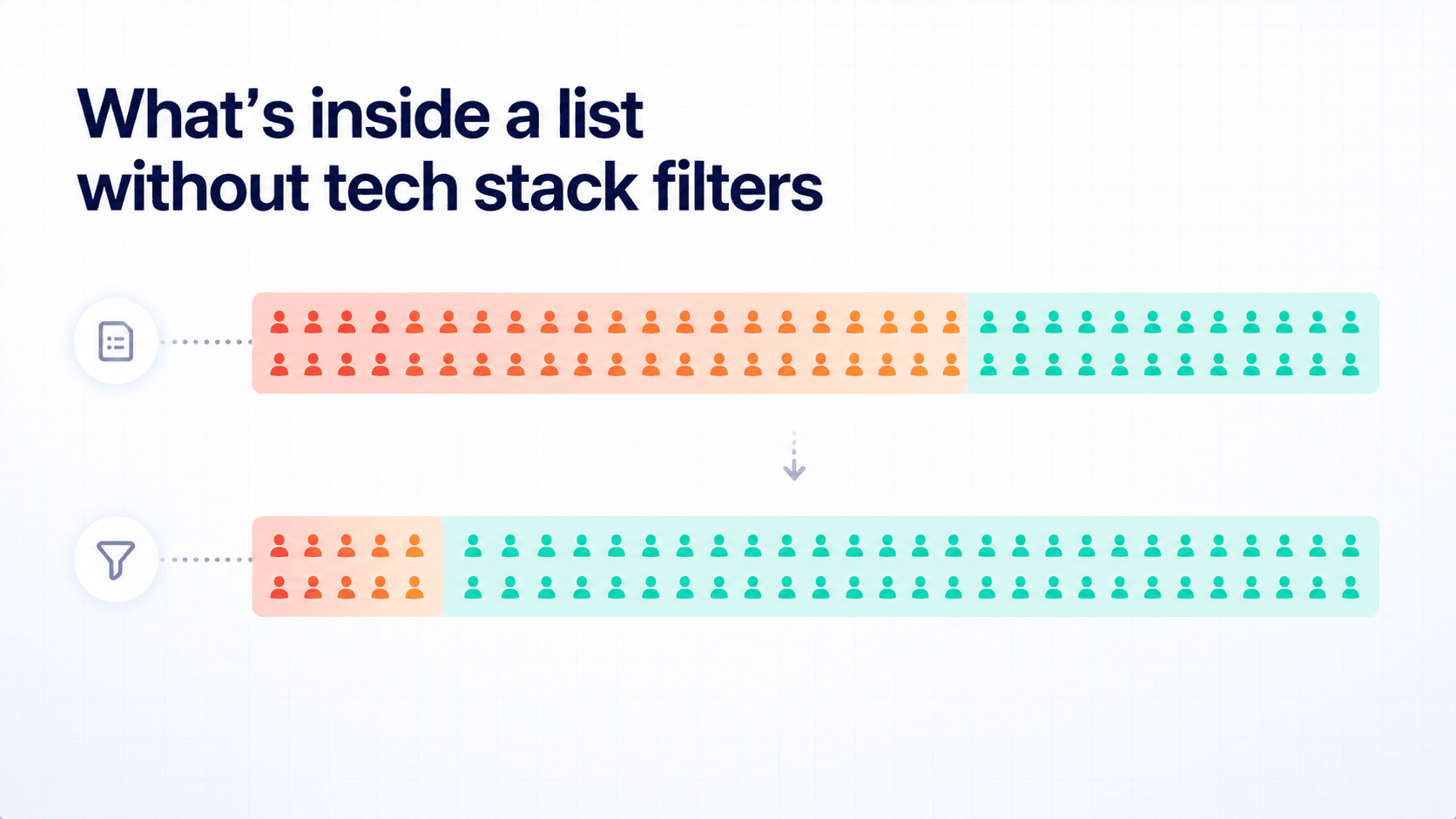
A 2,000-contact list built without technographic filters will typically include 30–40% of accounts in the first three categories. At an average of $100 in rep time and credit cost per enriched contact, that is $60,000–$80,000 in wasted prospecting effort per list.
Three Use Cases That Drive Immediate ROI From Tech Stack Filtering
1. Competitive displacement — Over 60% of B2B software purchases are replacements (Gartner 2024). Without technographic data, you have no way to know who is running the competitor's product at scale. With it, you can build an entire outbound motion targeting every company in your ICP that runs a specific competitor — and write outreach that speaks directly to the migration pain points you know exist at that tool's user base.
2. Integration selling — If your product integrates with Salesforce, HubSpot, or any other major platform, companies running those tools are your warmest prospects — because you're extending what they already have rather than asking them to replace it. Shorter sales cycles, fewer procurement objections, easier internal champions. Filter for your integration partner's tool before building any list, and your sequence opens with a fact rather than a pitch.
3. ICP refinement from closed-won patterns — Your best existing customers have technographic patterns. Analyse their stacks. If 70%+ of your highest-retention customers share two or three technology combinations, those combinations become a technographic ICP filter. Teams that add two or three technographic filters to their existing ICP criteria consistently cut unqualified pipeline by 30–40% while maintaining conversion volume.
How SalesTarget.ai's Tech Stack Filter Works in Practice
SalesTarget.ai's Tech Stack filter inside Lead Explorer makes technographic filtering as simple as any other search dimension. No separate data platform. No API integration. No export-and-match workflow.
- Search by specific tool: Type 'Salesforce', 'HubSpot', 'Marketo', 'Outreach', or any named product. Returns companies confirmed to be currently running that tool across 840M+ profiles.
- Search by technology category: Don't know the specific tool? Search by category — 'CRM', 'marketing automation', 'sales engagement platform'. Returns companies with any tool in that category.
- Exclusion filters: Add NOT filters to remove companies running a competitor's tool, or companies already running something that fills the same operational gap. Applied before the search runs.
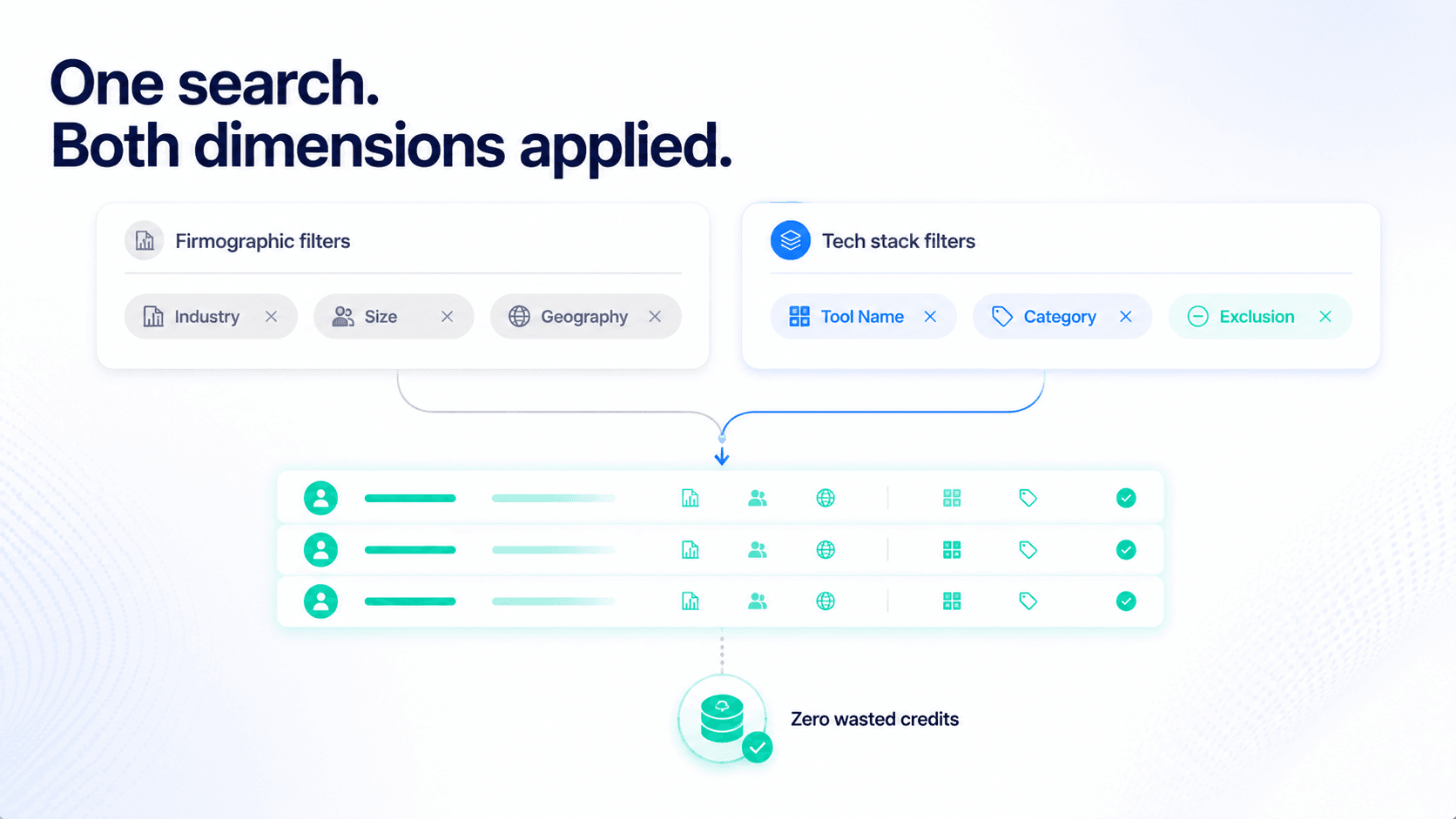
- Stack combinations: Layer multiple tech filters — 'runs HubSpot' AND 'does not run a sales engagement platform' — to identify exact gap-in-stack patterns.
- Applied alongside firmographic criteria: Tech stack filters sit in the same filter panel as industry, company size, and role. All dimensions run simultaneously in a single search.
🎯 Technographic + intent: the highest-precision combination
Technographic data tells you the angle. Intent data tells you the timing. A company running a competitor's CRM tool and showing a Bombora intent surge on 'CRM software' is not just a displacement opportunity — it is one that is actively researching alternatives right now. Forrester research identifies the combination of technology stack intelligence and intent data as the highest-ROI targeting approach in B2B sales. Both are available inside SalesTarget.ai — Bombora intent is included in every plan, and the ICP Builder applies both alongside firmographic criteria in a single search.
Conclusion: The Filter That Changes What Your List Is Made Of
Most SDR teams optimise the wrong variables. They test subject lines, iterate on personalisation, and A/B test CTAs — while the underlying list contains 30–40% of accounts that should never have been there. Better messaging to the wrong company still produces a no.
Technographic filtering fixes the list before the sequence starts. It removes companies with incompatible infrastructure, competitor-locked accounts, and those with no gap to fill — and surfaces the displacement targets, integration opportunities, and ICP-refined accounts that actually convert.
The 28% higher conversion rate is not a copy improvement. It is a targeting improvement. And in SalesTarget.ai, applying it takes the same time as setting an industry filter.
Filter by tech stack. Stop pitching the wrong companies.
SalesTarget.ai's Tech Stack filter searches 840M+ profiles by specific tool or category — before you spend a single enrichment credit.
50 credits · 7-day free trial · No credit card required