TL;DR
- Signal-based selling is a B2B sales methodology that uses observable company events — funding rounds, hiring spikes, leadership changes, tech adoption, and intent surges — to identify prospects entering a buying window before they contact a vendor
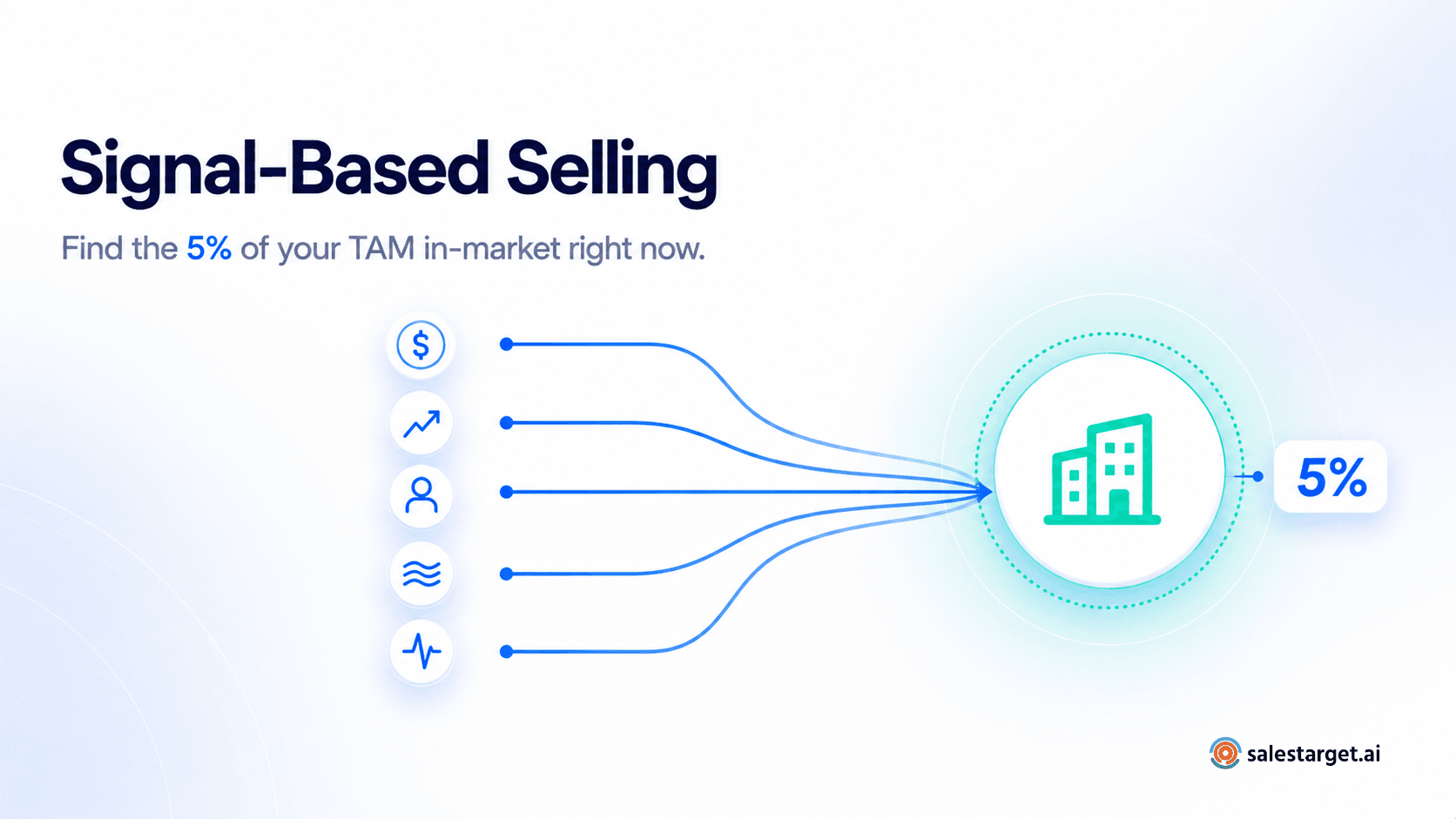
- Only 5% of your TAM is in-market at any given time (Gartner). Signal-based outbound is how you find that 5% — and get on the shortlist before formal evaluation begins
- 85% of B2B purchases go to a vendor already on the day-one shortlist. The pre-contact favourite wins ~80% of deals. Signals get you on that list first
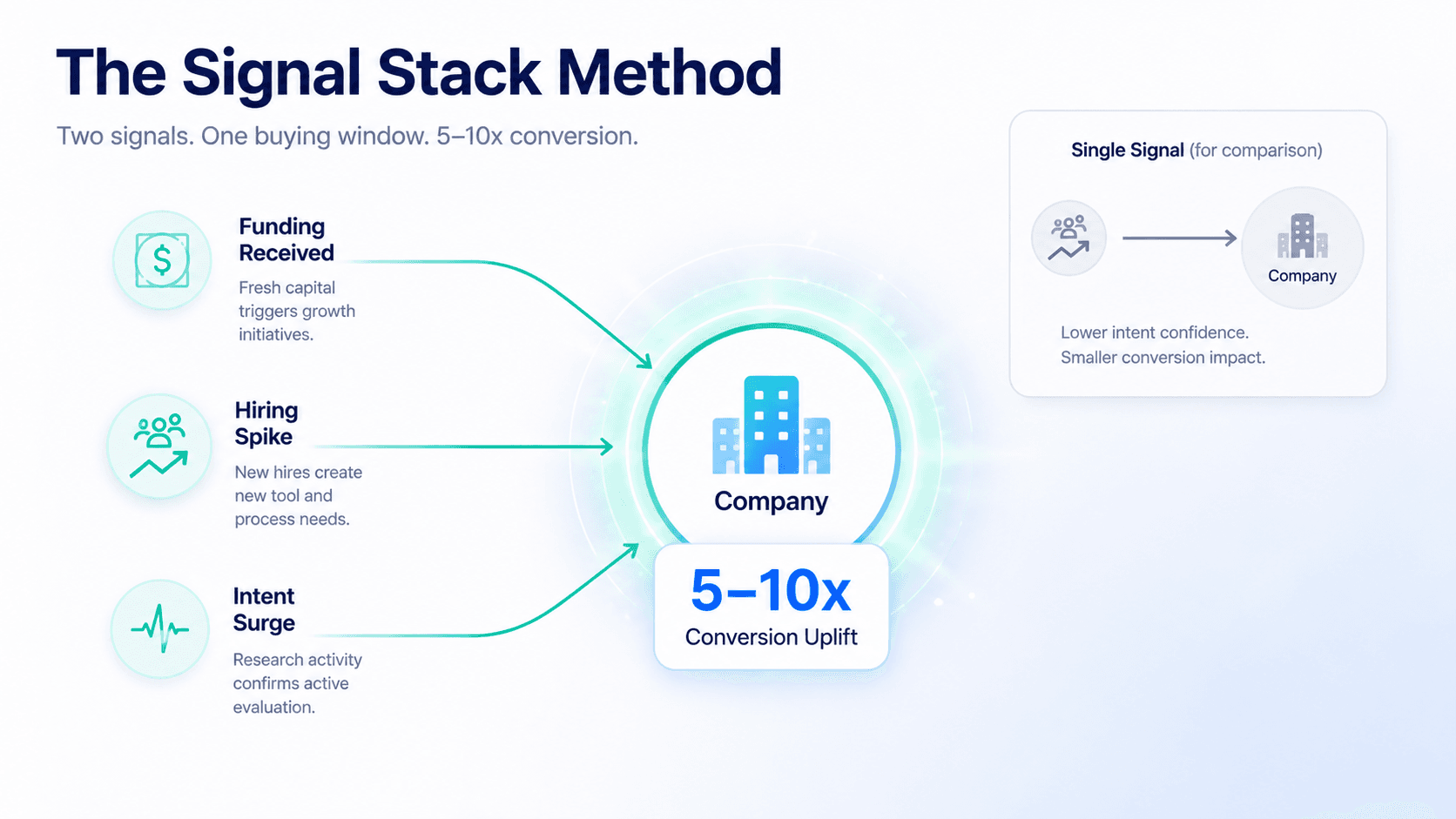
- Introducing the Signal Stack Method: combining 2+ signals on the same account converts at 5–10x the rate of single-signal or cold outreach
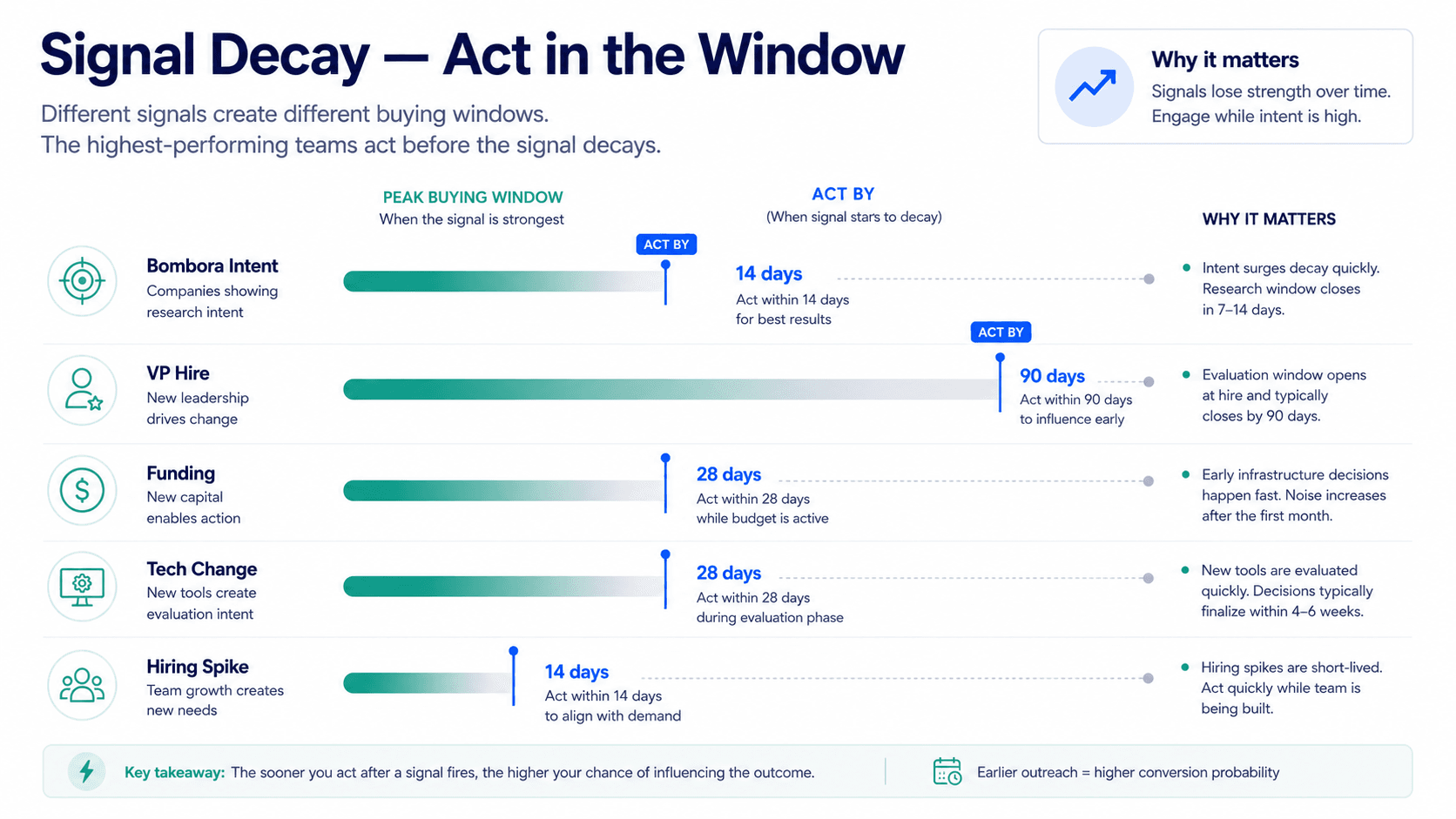
- Signal decay is real — funding window: 2–4 weeks. New VP hire: 30–90 days. Intent surge: 7–14 days. Speed to action is half the methodology
- SalesTarget.ai's Real-Time Signal Discovery surfaces all five signal types inside Lead Explorer — applied as filters before the search runs, no manual monitoring required
Only 5% of Your TAM Is Ready to Buy Right Now
At any given moment, only about 5% of your total addressable market is actively in a buying window (Gartner research). The other 95% will not engage meaningfully with outbound no matter how good the copy is, how relevant the personalisation is, or how many follow-ups are sent. They are simply not in the market yet.
This is not a pessimistic stat — it is the most clarifying insight in B2B outbound. If you could reliably identify that 5%, your conversion rates would be 5–10x what they are from cold outreach to the full TAM. The companies winning B2B outbound in 2026 are not sending more. They are sending to the right 5% at the right moment.
That is what signal-based selling is. It is the methodology of detecting, prioritising, and acting on observable company events — buying signals — that indicate a prospect is entering a purchasing window. Not tomorrow. Not in three months. Right now.
📊 Why the shortlist is the only race that matters
- 5% of TAM: only this fraction is actively in-market at any given moment — Gartner research
- 85% of B2B purchases go to a vendor already on the buyer's day-one shortlist — Corporate Visions (Reachly 2026)
- 80% win rate for the pre-contact favourite — the vendor on the shortlist before formal evaluation begins
- 99% of B2B purchases are triggered by a specific organisational change — Gartner. Detect the trigger, get on the shortlist first
- 70% of the purchase journey completed before buyers contact a vendor — 6sense 2025. The shortlist forms before the demo form is filled
What Is Signal-Based Selling?
Signal-based selling is a B2B sales methodology that uses observable company events — buying signals — to identify prospects entering a purchasing window, and prioritises outreach to those accounts based on the strength and recency of the signals detected. It replaces spray-and-pray outreach to the full ICP list with a precision model: outreach to the ICP accounts showing evidence that a purchase decision is forming right now.
The key word is observable. A buying signal is not inferred from psychological profiling or website behaviour guesswork. It is a real-world event that happened: a company raised funding, hired a new VP of Sales, posted 20 SDR openings in three weeks, or started showing Bombora intent surges on topics relevant to your product. These events are detectable, time-stamped, and have proven correlations with purchasing behaviour.
| Signal type | What it indicates | Correlation with purchase behaviour |
|---|---|---|
| Funding round | New budget, growth targets, infrastructure to build | 3–5x more likely to purchase within 12 months — Origami 2026 |
| Hiring spike | Active investment in a team you sell into | +38% correlation with buying behaviour — Reachly 1M purchase analysis |
| Leadership change | New exec re-evaluates existing tools within 90 days | Evaluation window opens at hire, closes at 90 days — Salesmotion 2026 |
| Tech adoption / content change | Partnership, expansion, or new tool adoption | +46% correlation for AI tool adoption — highest single signal — Reachly 2026 |
| Bombora intent surge | Actively researching topics relevant to your category | 7–14 day active research window — highest urgency, shortest window |
Introducing the Signal Stack Method
The Signal Stack Method is a framework for combining two or more buying signals on the same account within a short time window to identify a buying window score — a composite indicator that a prospect is not just signal-positive, but actively in motion toward a purchase decision.
A single signal is a prompt to pay attention. Two signals converging on the same ICP-fit account is a Tier 1 priority. Stacked signals convert at 5–10x the rate of single signals or cold outreach (Reachly / Autobound analysis 2026). The highest-converting signal pair in 2026: recent funding combined with a new VP of Sales hire — 4–6x cold baseline conversion.
📶 Growth Stack
Signals: Funding round (Series A–C) + hiring spike (Sales/RevOps) + Bombora intent surge
Conversion uplift: 5–8x cold baseline — highest-converting for sales infrastructure products
Window: Act within 2–4 weeks of funding. Intent surge decays in 7–14 days — prioritise immediately if both present
Outreach angle: "Most Series B teams rethink their prospecting infrastructure in the first 60 days post-raise — especially when scaling the SDR team. Is that on your radar at [Company]?"
📶 Leadership Stack
Signals: New VP of Sales / CRO hire + Bombora intent surge on relevant topics
Conversion uplift: 4–6x cold baseline — new exec actively researching during evaluation window
Window: Opens at hire announcement. Closes at 90 days. If intent surge also present — contact within 48 hours
Outreach angle: "Most new VPs re-evaluate their outreach stack in the first 60 days — even when broadly happy with what's there, they want to know if there's something better. Is that a conversation worth having?"
📶 Tech Displacement Stack
Signals: Running competitor tool + Bombora intent surge on your product category
Conversion uplift: 3–5x cold baseline — in active research mode while running the tool you displace
Window: Bombora intent: 7–14 days. Act immediately. Highest-urgency stack for displacement outreach
Outreach angle: "Your team is currently running [competitor] — a lot of teams at your stage are finding [specific pain point] at scale. Is that something you're actively evaluating solutions for?"
📶 Expansion Stack
Signals: Website content change (new market / partnership) + hiring spike in affected region or function
Conversion uplift: 3–4x cold baseline — new operational needs, active team building to execute
Window: Content change: 2–4 weeks. Hiring spike: 1–2 weeks. Both present = act within 48 hours
Outreach angle: "The [Company]/[Partner] announcement signals a [market] push — most teams at this stage find outbound infrastructure becomes the bottleneck in weeks 3–6 of an expansion. Is that something you're planning for?"
Signal Decay: Why Speed Is Half the Methodology
Signal decay is the rate at which a buying signal loses its predictive value over time. A funding round is most actionable in the first 2–4 weeks — before the team has made infrastructure decisions and before every other vendor has sent their congratulatory sequence. The same signal at week 8 is less valuable because the purchasing windows have either opened or closed.
| Signal type | Peak window | Decay point | Speed required |
|---|---|---|---|
| Bombora intent surge | Days 1–14 | Day 14–21: research window closes | Within 72 hours |
| Hiring spike | Weeks 1–2 | Month 2+: team built, needs resolved | Within 1 week |
| Funding round | Weeks 1–4 | Week 8+: early decisions made | Within 48 hours for 4x conversion |
| New VP hire | Days 1–30 (evaluation open) | Day 90: stack evaluation concluded | Within 1 week of hire |
| Website / content change | Weeks 1–3 post-publish | Week 4+: pivot moves to execution | Within 2 weeks |
How SalesTarget.ai's Real-Time Signal Discovery Works
SalesTarget.ai's Real-Time Signal Discovery surfaces all five signal types inside Lead Explorer — applied as filters before the search runs, so every result is a pre-qualified, signal-positive account. No separate signal monitoring tool. No alert email to parse. No manual cross-referencing.
- Funding signals: Last funding round date, round type, round value, total funding, investors — for public and private companies. Filter by funding stage, recency, and round size.
- Hiring signals: Workforce trends and hiring patterns — surface companies scaling specific departments within your ICP. Combine with role-level filters to find companies hiring into the exact function you sell into.
- Leadership signals: Professional profile data including job title history, seniority level, and recent role changes — identify new C-suite, VP, and Director hires within target companies.
- Website / content signals: Company website content changes including change description, change implication, and date — surfaces partnership announcements, market expansions, and strategic pivots.
- Bombora intent surges: Included in every SalesTarget.ai plan — surfaces companies actively researching relevant topics across 5,000+ B2B publisher sites. The highest-urgency, shortest-window signal available.
All five signal types apply alongside ICP filters (industry, company size, job title, tech stack) in the same search. The result: a list of accounts that are not just ICP-fit but ICP-fit and in an active buying window right now. Signal Discovery feeds directly into intent-based lead scoring — so the highest-signal accounts automatically surface at the top of your list.
🎯 Signal Stack in practice: SaaS company example
Scenario: You sell sales engagement software to B2B SaaS companies. You set the following stack in Lead Explorer:
- ICP filter: SaaS, 50–500 employees, $5M–$50M revenue, US-based
- Signal 1: Raised Series A or Series B in the last 30 days
- Signal 2: Hiring 5+ SDR/BDR roles in the last 3 weeks
- Signal 3: Bombora intent surge on 'sales engagement platform' or 'cold email outreach'
Result: SaaS companies that recently raised, are actively scaling their SDR team, and are researching sales engagement platforms right now. Every account has a buying window open. This is not a cold list — it is an in-market account list.
Expected conversion vs cold: 5–8x — three-signal Growth Stack at peak window
Conclusion: The 5% Is Findable. The Method Is Here.
The 5% of your TAM that is in-market right now is not hidden. They are raising funding. They are hiring into the teams you sell to. They are replacing the tool you displace. They are researching your category on Bombora's publisher network. The signals are there. The question is whether your outbound motion is built to detect and act on them before your competitors do.
The Signal Stack Method gives you the framework: combine signals, prioritise by decay window, act within the conversion peak. SalesTarget.ai's Real-Time Signal Discovery gives you the infrastructure: all five signal types, applied alongside ICP filters, returning Tier 1 in-market accounts in a single search.
Stop outreaching to the 95%. Start finding the 5%.
Get real-time buyer signals — before your competitors do.
SalesTarget.ai's Real-Time Signal Discovery surfaces funding rounds, hiring spikes, leadership changes, and intent surges — all in one search.
50 credits · 7-day free trial · No credit card required