TL;DR
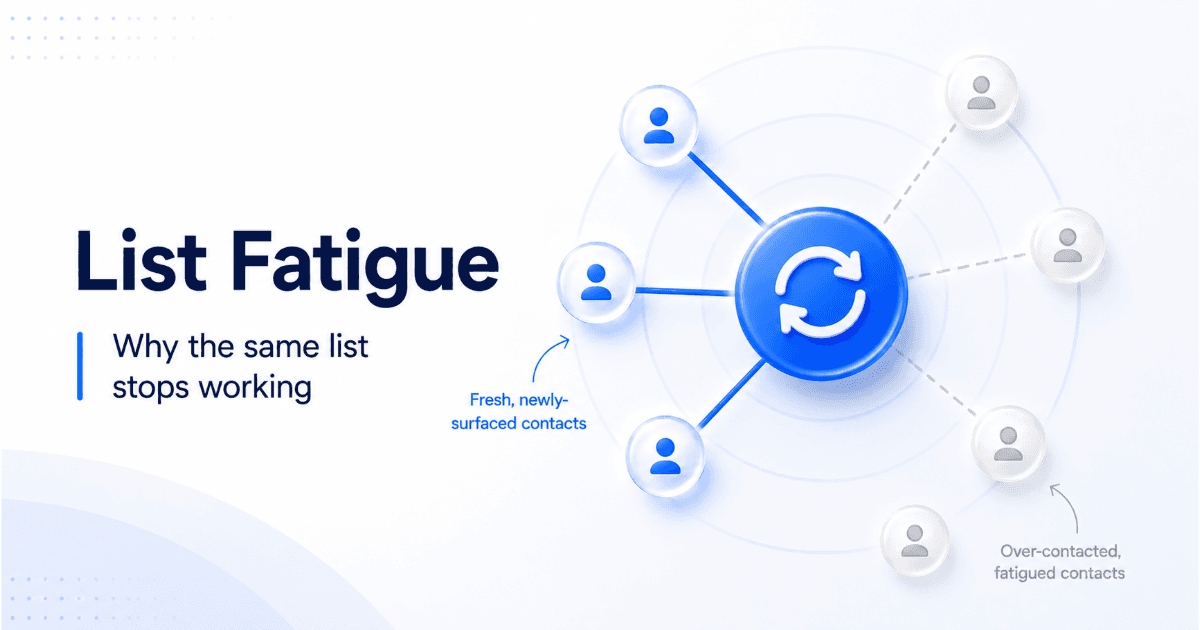
- List fatigue is different from list decay — decay is data going stale, fatigue is the same real, accurate humans getting repeatedly targeted until they stop responding.
- A list can be 100% accurate and verified and still underperform badly if it's the fourth or fifth campaign hitting the same names.
- The clearest sign of fatigue: reply rates decline on a list you've already confirmed is accurate — the data isn't the problem, the repetition is.
- The fix is structural — rotation and suppression logic, plus a genuinely new source of prospects — not better copywriting on the same names.
Your list passed verification. Every email is deliverable, every job title is current, every phone number connects. And your reply rate still dropped by half compared to last quarter. If your first instinct is to re-check the data, you're looking in the wrong place — the data is fine. What's tired is the audience.
List Decay vs. List Fatigue: Two Different Problems
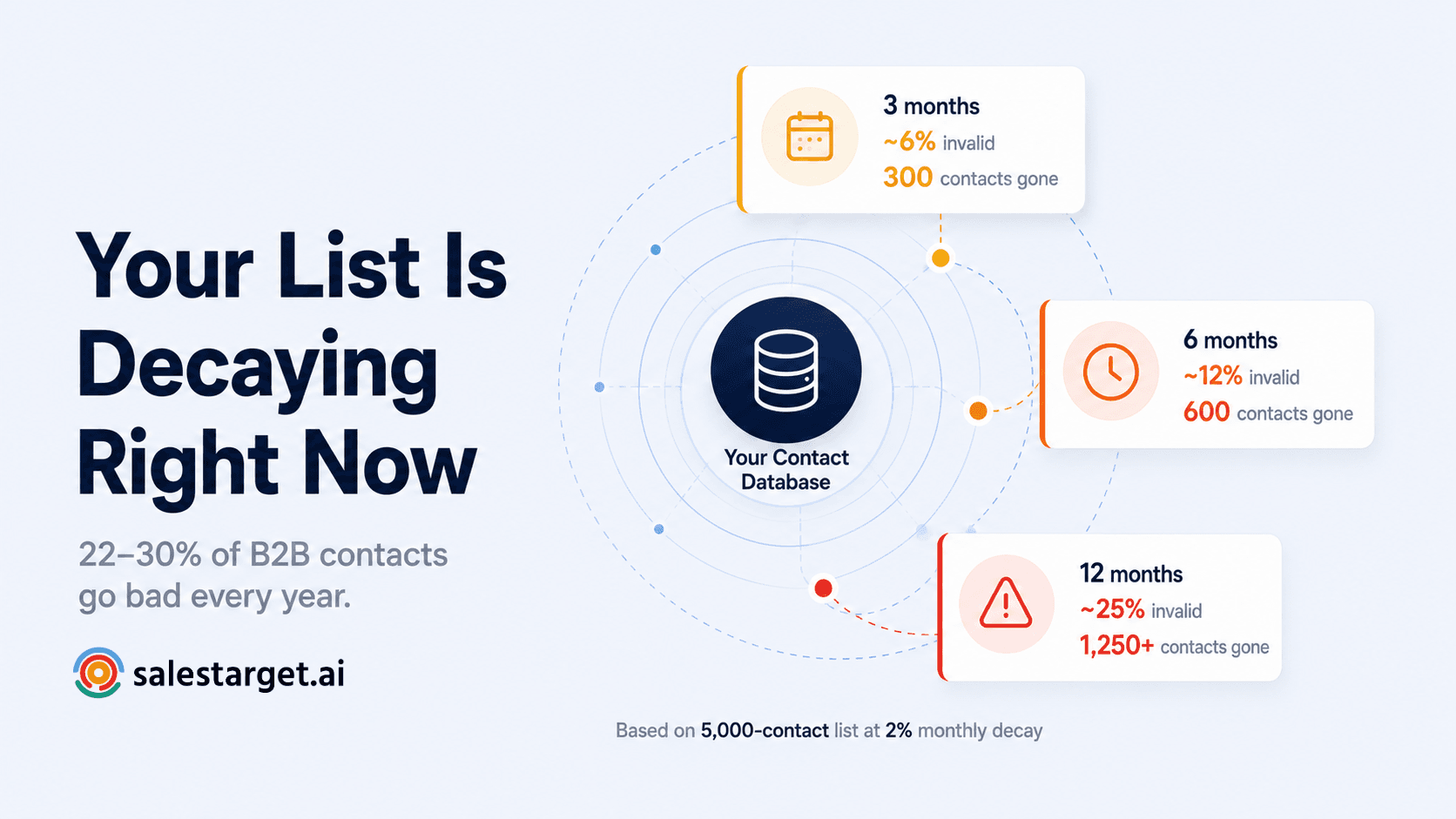
These two terms get used almost interchangeably, but they describe entirely different failure modes. List decay is a data-accuracy problem: contacts change jobs, companies get acquired, phone numbers get reassigned, and the record you have on file stops matching reality. The fix for decay is re-verification — refresh the data, and the problem goes away.
List fatigue is a completely different problem, and re-verifying the data does nothing to fix it. Fatigue happens when the underlying contact information is perfectly accurate — right person, right title, right company, right email — but that same real human has already received three, four, or five outreach attempts from your team (or from your competitors running similar plays) in the recent past. The record isn't stale. The audience is worn out.
The Signs of List Fatigue
The clearest diagnostic signal is this: your reply rate is declining on a list you've already confirmed is accurate. If you ran a verification pass and bounce rates are low, deliverability checks out, and job titles are current — but replies are still down — the data isn't your bottleneck. A few other patterns tend to show up alongside it:
- The same segment of your ICP consistently underperforms newer segments, even when messaging and targeting logic are identical
- Reply rates decline specifically on contacts that have appeared in more than one previous campaign, versus contacts appearing for the first time
- Unsubscribe or "stop contacting me" requests cluster around a narrow set of accounts you've worked repeatedly rather than being evenly distributed across your list
- Cold outreach to a segment underperforms even when the same segment converts well through inbound or referral channels — the problem isn't ICP fit, it's exposure
How Much Exposure Is Too Much
There isn't a single universally published number for exactly how many touches or how many days before a contact should be suppressed — and treating any specific figure as a hard rule would be overstating what the data actually supports. What is well established, including from cold email infrastructure research, is the underlying mechanism: repeated exposure without a meaningfully new angle degrades engagement, and providers increasingly weight engagement quality — not just volume — when deciding how a sender's messages get treated going forward.
The practical framework that follows from this: treat suppression as a function of how much has genuinely changed since the last touch, not a fixed calendar window. If nothing new has happened at the account — no new signal, no new stakeholder, no new angle — re-contacting the same person inside the same quarter is close to guaranteed fatigue. If a real trigger event has occurred (a new hire, a funding round, a product launch), that resets the clock in a meaningful way, because the contact is now being reached about something genuinely different, not the same pitch repeated.
Building a Rotation System to Avoid Fatigue
| Step | What to do |
|---|---|
| 1 | Tag every contact with the date and campaign of their last outreach touch — not just whether they replied, but when they were last contacted at all |
| 2 | Build a suppression rule that blocks re-enrollment into a new campaign unless a genuinely new trigger (signal, role change, funding event) has occurred since the last touch |
| 3 | Split your prospecting pipeline into two lanes — a "fresh" lane sourced from new signals and newly matched ICP accounts, and a "re-engagement" lane reserved specifically for contacts with a new, real reason to be re-approached |
| 4 | Review reply rate by "times previously contacted" as a segment, not just by campaign — this surfaces fatigue patterns that a single-campaign report will hide |
Mistakes That Accelerate List Fatigue
Re-verifying instead of rotating
When reply rates drop, the instinct is to re-run email validation on the same list. If the data was already accurate, this fixes nothing — it confirms the list is clean while leaving the actual problem, repeated exposure, untouched.
Treating every campaign as a clean slate
Without cross-campaign suppression tracking, a contact who received your last three sequences looks identical to someone hearing from you for the first time. The system has no memory, so it keeps re-serving the same tired names into new campaigns.
Confusing a bigger list with a fresher one
Buying or pulling a larger static list doesn't solve fatigue if it's the same static universe of companies your ICP always matches. A genuinely fresh pool requires new accounts entering "in-market" status, not just a wider net over the same pond.
Keeping Lists Fresh With Real-Time Discovery
The most direct structural fix for fatigue isn't a smarter suppression rule on your existing list — it's a pipeline that keeps introducing accounts your team hasn't already worked. Real-Time Signal Discovery surfaces accounts based on business events — funding rounds, hiring spikes, leadership changes — within a 30 to 90 day lookback window, combined with your ICP filters. Because the surfaced accounts shift as new signals fire, the pool your team is working isn't a static list you keep re-dialing; it's continuously repopulated by whichever accounts are currently showing a real reason to be relevant, which is a fundamentally different mechanism than reusing the same static universe of companies.
Paired with Smart Prospect Search to narrow each new signal-surfaced batch to ICP-fit contacts before enrichment, the practical effect is a rotation system built into how leads are sourced in the first place, rather than something your team has to engineer manually on top of a static export.
Stop Re-Verifying. Start Rotating.
If your reply rate is falling on a list you've already confirmed is accurate, the fix isn't another verification pass — it's suppression logic and a genuinely new source of prospects. List decay and list fatigue require opposite remedies, and treating fatigue like a data problem just wastes a cycle confirming what you already knew: the list was fine. It was just tired.
Stop reusing the same tired list.
Get a continuously refreshed pool of signal-surfaced, ICP-fit prospects.
✓ 50 credits ✓ 7-day trial ✓ No credit card required