TL;DR
- Published cold email reply rate benchmarks range from 1–5% to 3.8% depending on the source — both are "realistic," neither is a fixed target.
- LinkedIn consistently outperforms cold email for initial contact, with InMail/DM engagement reported between 10–25% across sources.
- Cold calling recovered from roughly 2% to 6.7%+ once teams paired it with precision targeting and signal-based sequencing.
- Reliable reply-rate benchmarks segmented by industry are not consistently published anywhere — treat industry variance as a qualitative factor, not a lookup table.
"Is a 4% reply rate good?" is one of the most common questions a sales manager asks after a rough quarter — and one of the hardest to answer honestly. The truth is that published benchmarks disagree with each other by a factor of two or three, depending on who ran the study, what industries they sampled, and how they defined "reply." Instead of picking one number and pretending it's gospel, this piece lays out what's actually been published, where sources agree, where they diverge, and how to read your own numbers against that range instead of a single myth-sized target.
Why Benchmarks Vary So Much (And How to Use Them Correctly)
Every published outreach benchmark comes from a different sample: different industries, different company sizes, different definitions of "reply" (some count auto-replies and out-of-office bounces as engagement, some don't), and different time windows. That's why you'll see cold email reply rates reported anywhere from under 2% to nearly 4% depending on the source — both figures are real, they're just measuring somewhat different populations.
The right way to use any published benchmark is as a range, not a target. If your number falls within the reported range for your channel, you're performing in line with the broader market — the more useful question becomes whether your own historical trend is improving, not whether you match someone else's exact figure.
Reply Rate by Channel: Email, LinkedIn, InMail, Phone
Here's where the two most detailed available benchmark sources — Salesmotion's 2026 outreach playbook and Fundraise Insider's 2026 channel playbook — land on each major channel. Both are cited below with their original attribution rather than averaged into a single artificial number.
| Channel | Reported range | Source |
|---|---|---|
| Cold email (average) | 1–5%, down from ~7% two years prior | Salesmotion 2026 playbook |
| Cold email (average) | 3.8% | Fundraise Insider 2026 playbook |
| Cold email (top-quartile, signal-anchored) | 15–25% | Salesmotion 2026 playbook |
| LinkedIn InMail / DM | 10–25% response range | Salesmotion 2026 playbook |
| LinkedIn DM engagement | 10.3% (vs. 5.1% for cold email) | Fundraise Insider 2026 playbook |
| LinkedIn connection request (personalized note) | 27–30%+ acceptance | Both sources agree closely |
| Cold call-to-meeting (general) | 2–2.5% | Both sources agree closely |
| Cold call-to-meeting (precision-targeted, signal-based) | 6.7–15% | Both sources agree closely |
The pattern that holds across both sources, even where the exact figures differ: LinkedIn consistently outperforms cold email for initial contact, and the single biggest lever for any channel isn't the channel itself — it's whether outreach is anchored to a real, timely signal versus sent as a generic template. Signal-anchored email and signal-based calling both show 3–6x improvement over generic versions of the same channel.
This is the section where most consolidated benchmark posts quietly make numbers up, so it's worth being direct: there isn't a reliably published, industry-segmented reply rate table — not one that holds up across SaaS, healthcare, financial services, and manufacturing with real sample sizes behind each cell. What is well-supported is the set of structural factors that reliably shift reply rates within any channel, industry by industry:
| Industry factor | Typical directional effect |
|---|---|
| Buying committee size (e.g., healthcare, financial services) | Lowers reply rate per individual touch; more stakeholders to reach before any one replies |
| Compliance/regulatory sensitivity (financial services, healthcare) | Slower response cycles; buyers are more cautious about engaging outside approved vendor processes |
| Buyer digital fluency (SaaS, tech) | Higher familiarity with LinkedIn/email outreach norms tends to normalize response behavior |
| Deal cycle length (manufacturing, enterprise industrial) | Longer evaluation windows can mean lower immediate reply rates but higher signal-to-meeting conversion once engaged |
If your team operates in one of these more complex-buying-committee industries, the right adjustment isn't to expect a lower "acceptable" reply rate in the abstract — it's to weight your own historical baseline by industry and track your trend against that, rather than importing a SaaS-sector benchmark into a healthcare or financial services program.
What "Good" Multichannel Performance Looks Like Combined
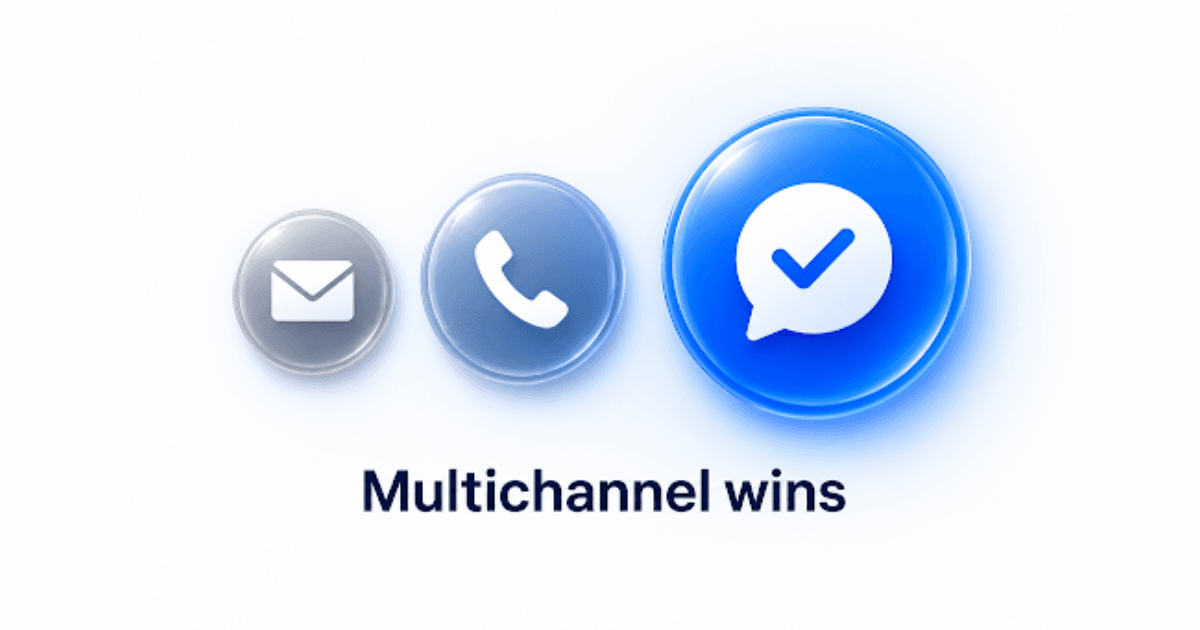
Individual channel numbers matter less than what happens when channels are sequenced together. On this, the two sources actually diverge in magnitude but agree in direction:
Multichannel outperforms single-channel — by how much depends who you ask
Reported lift
Salesmotion reports 40% higher engagement and 31% lower cost-per-lead for omnichannel sequences versus single-channel. Fundraise Insider reports a considerably larger 287% more responses for sequences using three or more channels, and 20%+ higher close rates. The gap between these figures is wide enough that neither should be treated as precise — but both point the same direction: coordinated multichannel sequencing consistently beats single-channel outreach.
Both sources also converge on touchpoint count: 8–12 touches across channels to book a meeting with a cold prospect, with email-only sequences seeing diminishing returns beyond roughly 7 touches.
How to Benchmark Your Own Performance
Rather than chasing an external number, run this against your own sequences using CRM Analytics and LinkedIn Analytics & CRM Visibility to pull channel-level activity and reply data side by side.
| Step | What to do |
|---|---|
| 1 | Pull reply rate per channel (email, LinkedIn connection, InMail, phone) separately — don't blend them into one blended sequence number |
| 2 | Compare each channel's number against the reported ranges above, not a single fixed target |
| 3 | Segment by whether outreach was signal-anchored (referenced a real, recent trigger) or generic — this typically explains more variance than the channel itself |
| 4 | Track your own trend month over month rather than a static external benchmark |
Mistakes Teams Make When Using Benchmarks
Treating one published number as gospel
Two credible 2026 sources report cold email reply rates that differ by more than a full percentage point. Picking one as an absolute target and panicking if you fall short of it ignores that the "real" market range is wider than any single study captures.
Blending channel reply rates into one number
A blended "12% reply rate across the sequence" hides whether LinkedIn is carrying the whole sequence while email underperforms, or vice versa. Track channels separately, always.
Importing an industry benchmark that doesn't exist
Be skeptical of any source claiming a precise reply-rate number for "healthcare" or "manufacturing" specifically — that level of segmentation isn't consistently backed by public sample sizes. Use the structural factors instead.
Use the Range, Not the Rumor
The honest answer to "what reply rate should I expect" is a range, not a number: roughly 2–5% for average cold email, 10–25% for LinkedIn, and 2–15% for cold calling depending on targeting quality — with multichannel sequencing consistently outperforming any single channel, by a margin the sources themselves can't agree on precisely. Track your own trend against that range, weight it by your industry's buying complexity, and treat any blog — including this one — that gives you a single suspiciously precise number with appropriate skepticism.
See your real reply rates, by channel.
Track email, LinkedIn, and multichannel performance side by side in one platform.
✓ 50 credits ✓ 7-day trial ✓ No credit card required