According to Salesforce's State of Sales report, the average B2B sales rep spends just 30% of their time actually selling — the rest disappears into admin, data entry, and manual prospecting. Teams bought automation tools to fix that. Most made it worse.
TL;DR
- Most outbound automation fails because teams automate volume first and signals last — the order is wrong.
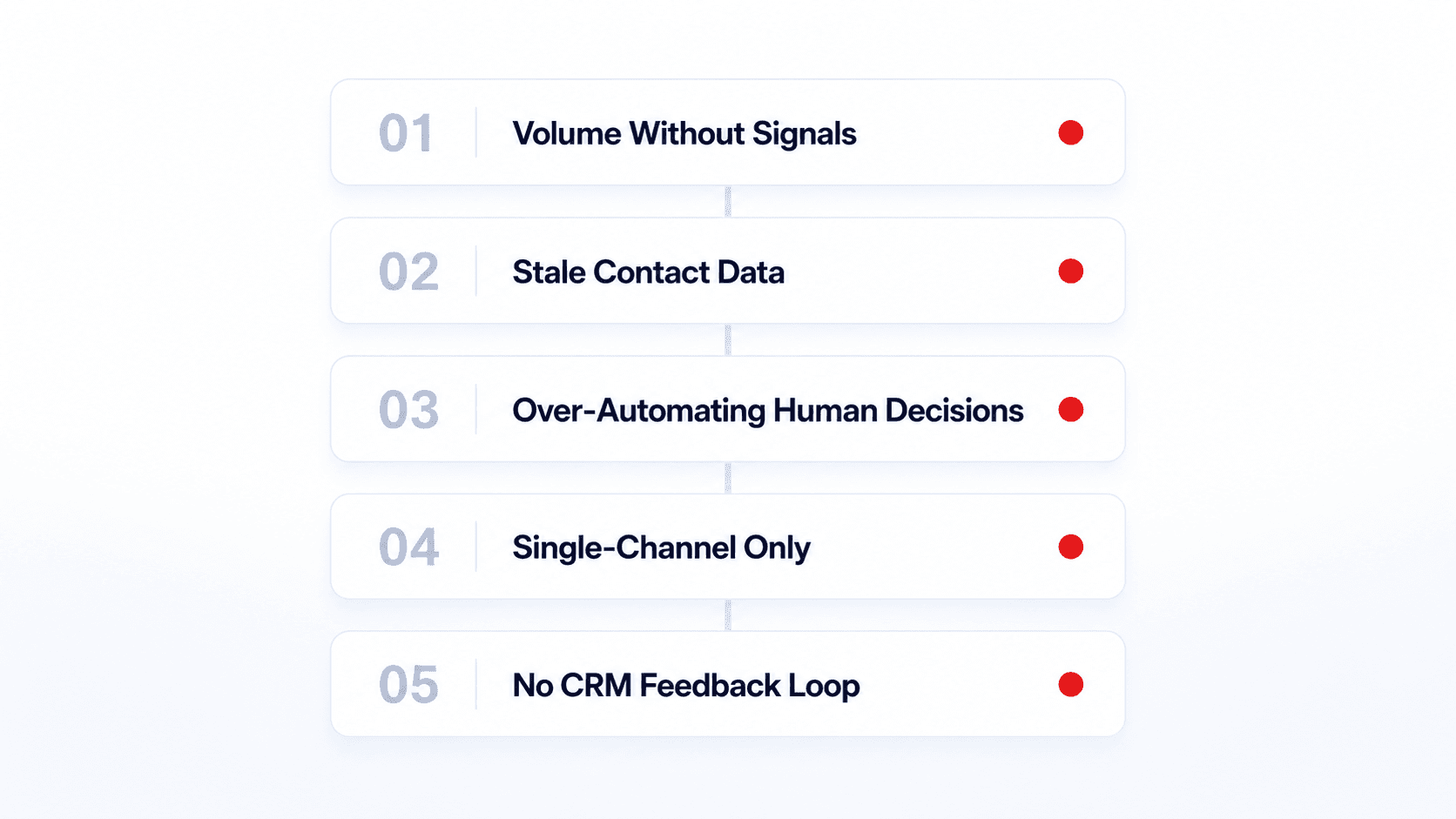
- The five mistakes killing outbound ROI in 2026: wrong signals, stale data, over-automation, single-channel, and no CRM feedback loop.
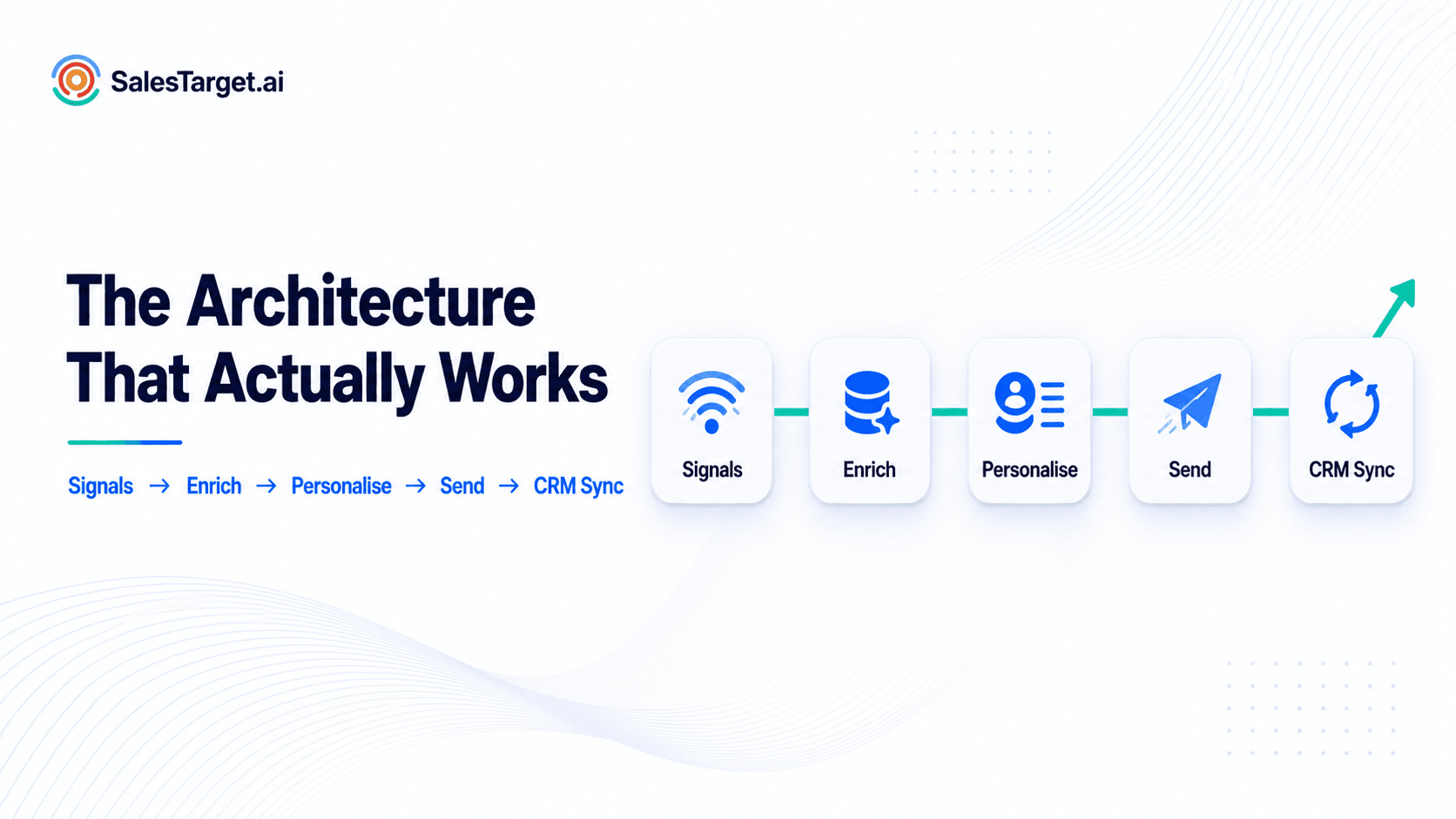
- The architecture that works is a five-stage model: Signals → Enrich → Personalise → Send → CRM Sync.
- Top-quartile outbound teams using this architecture are hitting reply rates of 8–12% — three to four times the industry average.
- SalesTarget connects every stage of that architecture in one platform. See how email outreach works →
What Outbound Automation Actually Means in 2026
Ask ten sales leaders what "outbound sales automation" means and you'll get ten different answers. Most of them are wrong — or at least, incomplete.
The popular definition is narrow: schedule sequences, set delays, fire emails automatically. That's not automation. That's a calendar with a send button.
Real outbound automation in 2026 is a connected system that handles every stage of the outbound motion — from identifying which accounts are likely to buy right now, to enriching contact data, to writing personalised outreach at scale, to routing replies into the right pipeline stage without anyone touching a spreadsheet.
The distinction matters enormously. A sequence tool saves an SDR 20 minutes per day. A full automation architecture can multiply what an SDR can produce by a factor of three or four — without adding headcount.
The teams that have figured this out aren't just using more tools. They've changed the order in which they think about outbound — and that shift in sequence is where most teams are still getting it wrong.
The 5 Mistakes Most Teams Make With Outbound Automation
These aren't edge cases. They show up in nearly every outbound audit — at Series A startups, at 200-person sales teams, at companies that have been doing outbound for a decade.
Mistake 1: Starting With Volume, Not Signals
The most common — and most damaging
The instinct is understandable: automate first, scale fast, figure out quality later. The problem is that without intent signals guiding who gets contacted and when, volume is noise. You're burning domain reputation, exhausting your TAM, and training your prospects to ignore you — all at scale. The right starting point is not "how many emails can we send?" It's "which accounts are showing buying signals right now?"
Mistake 2: Running Sequences on Stale Data
Bad data compounds in automation
B2B contact data decays at roughly 25–30% per year. A list that was solid twelve months ago has one in four contacts who've changed role, company, or email address. Feed that list into an automated sequence and you're not just wasting sends — you're generating bounces that damage your sender reputation and reducing the reach of every campaign that follows. Enrichment isn't a one-time step at list import. It needs to happen continuously, as close to send time as possible.
Mistake 3: Over-Automating the Human Parts
Automation that removes all judgment creates drift
There are things automation should never own: the decision about whether a prospect is actually a fit, the judgment call on reply tone, the relationship once a conversation starts. Teams that try to automate these moments produce outreach that is technically functional and humanly repellent. The best outbound automation keeps humans in the loop for decisions and removes them from tasks — not the other way around. Personalisation is the clearest example: AI can write the first draft at scale, but a rep who reviews and edits before sending will always outperform one who lets automation run without oversight.
Mistake 4: Building a Single-Channel Outbound Motion
Email alone no longer converts at the rates it used to
In 2026, the inbox is genuinely crowded. Email open rates and reply rates have been declining for three years running as the volume of automated outreach has increased. The teams consistently hitting strong reply rates aren't relying on email alone — they're sequencing email and LinkedIn together, so that a connection request reinforces an email, and a follow-up on one channel references a touchpoint on the other. Multichannel isn't a nice-to-have; it's the baseline expectation for professional outbound.
Mistake 5: No Feedback Loop Into the CRM
Outbound without a feedback loop is guesswork
Most teams measure outbound at the sequence level: opens, clicks, replies. Very few close the loop by connecting sequence performance back to pipeline stage and revenue. Without that connection, you can't answer the questions that actually matter: which personas reply but don't convert? Which messages generate the most qualified responses, not just the most responses? Which accounts in your pipeline went cold — and does the outbound motion need to support them with a re-engagement? A CRM that syncs automatically with your outreach motion turns outbound from a broadcast channel into a learning system.
The Architecture That Actually Works: Signals → Enrich → Personalise → Send → CRM Sync
The teams consistently outperforming benchmarks aren't just using better tools. They're operating in a different sequence. Here is the architecture — and what each stage requires to function properly.
Stage 1: Signals — Know Who Is Ready Before You Contact Them
Intent signals are the inputs that tell you which accounts are in an active buying window right now — not six months ago, not theoretically. They include hiring activity (a company posting for a Head of Sales is actively building a sales motion), technology changes (a CRM switch often signals a broader stack evaluation), funding announcements, leadership transitions, and topic-level intent data showing which accounts are researching solutions in your category.
When signals drive your targeting, you're not prospecting at random. You're contacting the right accounts at the moment they're most likely to engage — which is why signal-led outbound consistently outperforms list-based outbound on every metric that matters.
SalesTarget's Real-Time Signal Discovery surfaces these signals automatically — hiring activity, funding rounds, tech stack changes, and topic intent — so your team is always working the highest-probability accounts.
Stage 2: Enrich — Verified, Current Data or Don't Send
Once you've identified signal-qualified accounts, you need accurate contact data for the right people inside them. This means verified email addresses, current job titles, direct phone numbers where relevant, and enough company-level context to make personalisation credible.
Enrichment that happens at import and never updates will decay with the contact data. The standard to aim for: verified contact data refreshed as close to campaign launch as possible, with bounce rate as your quality control metric. If your bounce rate is above 3%, your enrichment layer has a problem.
Stage 3: Personalise — Relevance at Scale, Not Mail Merge at Scale
The personalization bar has risen sharply. "Hi [First Name], I noticed you work at [Company]" is not personalisation — it's a mail merge that your prospect can spot instantly. Real personalisation in 2026 means referencing the specific signal that triggered your outreach, connecting it to a relevant pain point for their role and company size, and framing your value proposition around their situation — not your feature list.
AI makes this achievable at scale. The Instantly 2026 cold email benchmark report found that emails with personalisation beyond first-name substitution — specifically those referencing company context or recent activity — generated reply rates three to four times higher than templated sequences.
SalesTarget's AI Sequences and Content suite generates personalised email copy using prospect and company data, so reps start with a strong draft rather than a blank screen — and can review and send in a fraction of the time.
Stage 4: Send — Infrastructure That Protects Deliverability
The best outreach in the world is worthless if it lands in spam. The send layer of a serious outbound architecture includes warmed sending domains, inbox rotation across multiple accounts to distribute volume safely, sending-time optimisation, and continuous deliverability monitoring.
Teams that ignore the infrastructure layer — because they're focused on sequence copy and cadence — typically hit a deliverability cliff within 60–90 days of scaling. The recovery period, rebuilding domain reputation and re-warming sending accounts, is costly in both time and pipeline.
Stage 5: CRM Sync — Close the Loop or Lose the Learning
Every reply, every booked meeting, every sequence completion should flow automatically into a deal pipeline with full activity context attached. Not as a manual export — as a live sync. The CRM is where outbound strategy gets refined: which personas are converting, which messages are working at which stage, where prospects are going cold. Without this data, your outbound motion is static. With it, it compounds.
What Good Actually Looks Like: 2026 Benchmarks
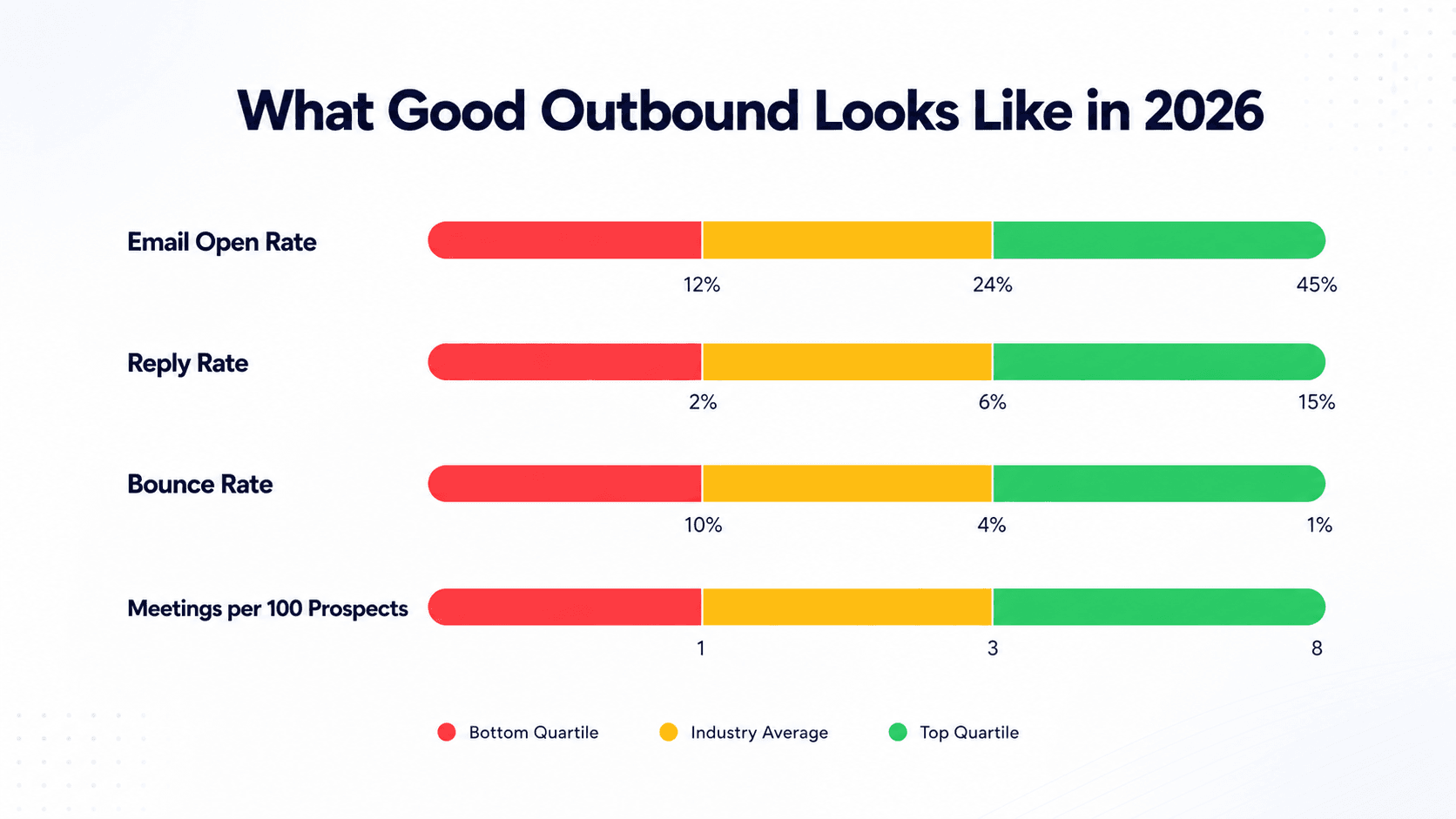
One of the most useful things you can do with benchmark data is audit where your own outbound motion sits. Here is what the current range looks like across key metrics, based on published data from the Instantly 2026 cold email benchmark report.
| Metric | Bottom Quartile | Industry Average | Top Quartile |
|---|---|---|---|
| Cold Email Open Rate | <20% | 35–45% | 55–65% |
| Reply Rate (email) | <2% | 2–4% | 8–12% |
| Bounce Rate | >5% | 3–5% | <2% |
| LinkedIn Acceptance Rate | <15% | 20–30% | 35–45% |
| Meetings Booked per 100 Prospects | <1 | 2–3 | 5–8 |
📊 How to read your own numbers
- Reply rate below 2% — your personalisation layer is broken, or your targeting is too broad
- Bounce rate above 3% — your data enrichment is stale or your validation is absent
- Open rate below 30% — deliverability issue, subject line problem, or sending domain not warmed
- Meetings per 100 below 2 — review the full architecture; the problem is usually at signals or personalisation
How SalesTarget Connects Every Stage in One Platform
The most common version of the architecture described above is a patchwork of tools: one for signals, one for enrichment, one for sequences, one for LinkedIn, one for CRM. Each handoff between tools is a point of friction, a risk of data loss, and a source of reporting gaps.
SalesTarget is built so that each stage of the architecture feeds directly into the next — without exports, without API integrations requiring a developer, and without data living in multiple disconnected places.
| Architecture Stage | What SalesTarget Does | Feature |
|---|---|---|
| Signals | Surfaces real-time buying signals — hiring, funding, tech changes, intent topics | Real-Time Signal Discovery |
| Enrich | Verified contact data with built-in enrichment at prospect level — no third-party tool required | Lead Enrichment |
| Personalise | AI-generated email and LinkedIn copy using real prospect data; reps review and send | AI Sequences & Content |
| Send | Warmed inboxes, inbox rotation, deliverability monitoring — sends that actually arrive | Email Outreach |
| CRM Sync | Replies, meetings, and sequence activity sync automatically to deal pipeline with full context | Activity Tracking & CRM |
The practical impact: an SDR using SalesTarget doesn't need to switch between five tools during their working day. Signals surface automatically, enriched contact data populates into draft outreach, sequences launch with deliverability protections already in place, and every reply appears in a unified inbox with deal context attached. The architecture exists — it's just already built.
How to Audit Your Own Outbound Stack Against This Architecture
If you're not sure where your current outbound motion breaks down, run through these five questions. Be honest. Most teams have a gap in at least two stages.
💡 The Five-Minute Outbound Architecture Audit
- Signals: Can you name the specific buying signal that triggered each active prospect in your sequences right now? If not — you're not using signals.
- Enrichment: When was your contact data last verified? If the answer is "at import" and that was more than 60 days ago — you have a bounce rate problem waiting to happen.
- Personalisation: Open the last 10 emails your team sent. Could each one have been sent to 1,000 other companies without changing a word? If yes — your personalisation is a mail merge.
- Send: What is your average bounce rate across the last 90 days? What is your inbox placement rate? If you don't know — your infrastructure is unmonitored.
- CRM Sync: Can you pull a report showing which outbound sequence generated the most pipeline revenue in the last quarter? If that data doesn't exist — your feedback loop is broken.
If you answered "no" or "I don't know" to two or more of these, the fix isn't a better sequence. It's rebuilding the architecture from Stage 1.
The teams that have done this work — that have connected signals to enrichment to personalisation to a send infrastructure to a CRM that closes the loop — are operating outbound as a compound system rather than a broadcast channel. That's the gap between 2% reply rates and 10%. Not better subject lines. Architecture.
For a deeper look at what's driving outbound failure specifically in cold email, see Why Most Cold Email Outreach Fails — and What the Modern Playbook Looks Like.
Ready to run outbound the way the top quartile does?
SalesTarget connects every stage of the architecture — signals, enrichment, AI personalisation, deliverability, and CRM sync — in one platform built for outbound at scale.
✓ 50 credits ✓ 7-day trial ✓ No credit card required