TL;DR
- The first move after a bad campaign is always to pause sending — continuing to send while reputation is falling makes every subsequent step slower.
- Recovery timelines follow the severity of the damage: mild damage clears in 2-4 weeks, moderate damage in 4-8 weeks, severe or blacklisted domains in 8-16 weeks or longer.
- Domain reputation follows you across ESPs and IP changes — you generally can't outrun damage by simply switching providers.
- A domain is truly unsalvageable only in a narrow set of cases — most damage, even significant damage, is recoverable with patience and discipline.
Your open rates cratered overnight. Bounces spiked. Somewhere between a bad list, an aggressive volume ramp, and one too many spam complaints, your domain's reputation took a real hit — and now every email you send seems to make it worse. The instinct is to either keep pushing through it or panic and buy a new domain. Neither is the right first move. Recovery is a real, well-documented process, and it starts with something much less dramatic than either option.
The Immediate Triage: Pause Sending First
Before anything else: stop sending from the affected domain. This feels counterintuitive when the instinct is to "send your way out of it" with better copy, but continued sending on a domain that's actively losing trust with mailbox providers only compounds the negative signal. Every additional bounce, complaint, or low-engagement send while reputation is actively falling adds to the history that providers use to score you — and that history doesn't reset the moment you fix the underlying problem.
Pausing isn't the same as giving up on the domain. It's creating the clean slate the recovery process actually needs to work from, rather than trying to recover while simultaneously adding fresh damage.
Diagnosing What Went Wrong
Before restarting anything, identify the actual root cause — recovery only works if the thing that caused the damage has genuinely stopped, not just paused.
| Likely cause | What to check |
|---|---|
| Volume spike | Did daily send volume jump sharply without a gradual ramp? Sudden volume increases are a classic trigger for spam filtering, independent of content quality. |
| Bad list quality | Check bounce rate specifically — healthy domains stay under roughly 2%. A rate meaningfully above that points to unverified or purchased contacts. |
| Spam complaints | Complaint rates above roughly 0.1% are a strong signal that content, targeting, or frequency crossed a line recipients didn't expect. |
| Authentication failures | Confirm SPF, DKIM, and DMARC are all correctly configured and passing — a broken authentication record undermines every other recovery step. |
| Blocklist listing | Check whether your domain or IP has landed on a major blocklist — this changes both the severity tier and the recovery timeline significantly. |
The Gradual Re-Warm Timeline (Weeks, Not Days)
The single most consistent finding across recovery guidance is that timelines scale with severity, and none of them are measured in days:
| Damage severity | Typical timeline | Indicators |
|---|---|---|
| Mild | 2-4 weeks | Reputation softening, no blocklist listing, low complaint volume, clean authentication |
| Moderate | 4-8 weeks | Clear spam placement, elevated complaint rate, some bounce rate elevation |
| Severe | 8-16 weeks or more | Active blocklist listing, sustained spam placement, repeated authentication failures, compromised sending credentials |
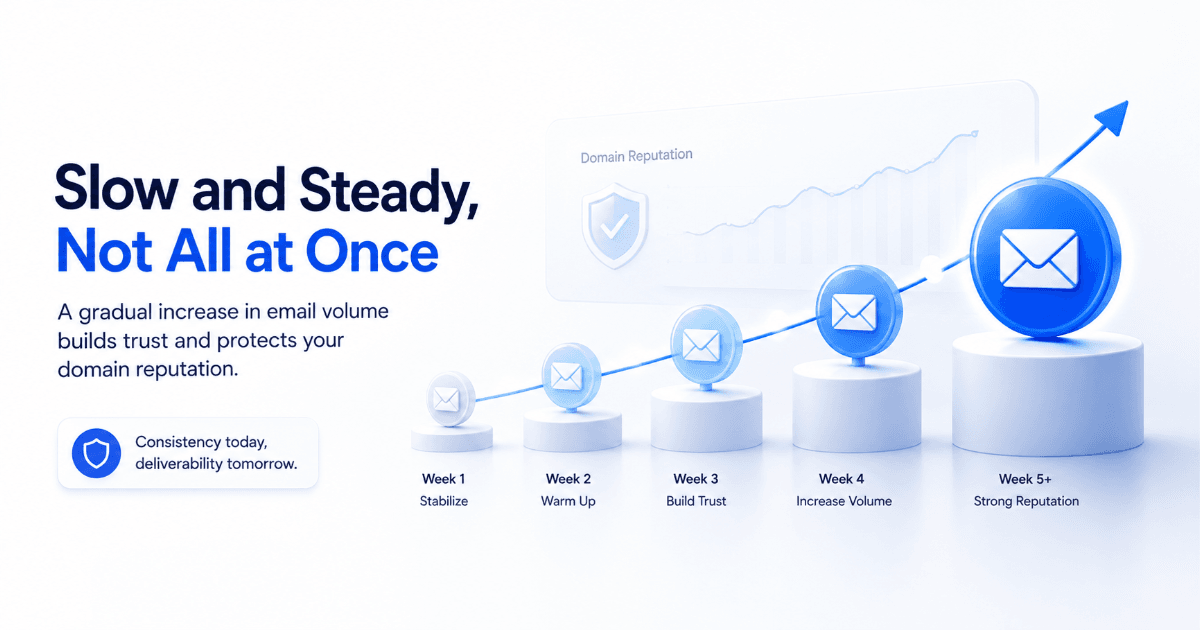
The mechanics of the re-warm itself: resume sending at a small fraction of normal volume — often starting around 25% — targeted specifically at your most engaged contacts (those who opened or clicked in the recent past), and increase volume gradually only as engagement metrics hold steady, rather than on a fixed schedule. Domain reputation specifically tends to run slower to repair than IP reputation, since it follows your sending history across ESPs and IP changes rather than resetting with a server change — which is also why simply switching providers doesn't give you a clean slate the way it might have years ago.
Signs a Domain Is Truly Unsalvageable vs. Recoverable
Most damage, even significant damage, is recoverable with enough patience and discipline. Genuine unsalvageable cases are narrower than the panic reaction usually assumes:
- Recoverable: Volume-spike damage, list-quality issues now fixed, temporary spam placement, moderate blocklist listings that clear once sending practices genuinely change.
- Borderline, requires real patience: Sustained spam placement over months, repeated blocklist relistings even after cleanup, domains that have been essentially inactive for a long stretch and need to be treated as a fresh warm-up as much as a recovery.
- Closest to genuinely unsalvageable: Compromised sending credentials that keep getting re-exploited, a domain permanently associated with abuse across multiple major blocklists with no improvement after repeated, disciplined recovery attempts, or a domain whose core business use has fundamentally changed such that rebuilding trust under the old sending pattern no longer makes sense anyway.
Even in that last category, the honest answer is usually "extremely slow and expensive to recover" rather than "literally impossible" — the decision to abandon a domain is more often a cost-benefit call than a technical dead end.
Mistakes That Slow Down Recovery
Rushing the warm-up to hit normal volume faster
Ramping volume back up before engagement metrics have genuinely stabilized reactivates the same spam-detection patterns that caused the damage in the first place — and effectively resets the recovery clock.
Switching domains without fixing the root cause
A new domain starts neutral, not positive — and if the underlying sending practice (bad lists, no volume control) hasn't changed, the new domain accumulates the same damage on the same timeline.
Treating the first good week as full recovery
Reputation scoring includes recent history, so providers can keep showing degraded status for days or weeks after the underlying behavior has already improved. One clean week is evidence the fix is working, not proof recovery is complete.
Using Deliverability Tools to Support Recovery
The mechanics that matter most during recovery — controlled volume, verified authentication, and gradual scaling — are the same mechanics Deliverability Boost uses for safely scaling any domain, not a separate "recovery mode." Its authentication checks confirm SPF, DKIM, and DMARC are correctly configured (a prerequisite before any re-warm attempt is worth starting), smart throttling and inbox rotation enforce the kind of controlled volume increase that a genuine recovery ramp requires, and ongoing bounce and spam monitoring gives visibility into whether engagement metrics are actually stabilizing before volume increases further.
Applied to a damaged domain specifically, this means the same gradual warm-up pattern used for a brand-new domain via Email Warmup also applies here — the tooling doesn't distinguish between "new domain building trust for the first time" and "damaged domain rebuilding trust after a setback," because the underlying mechanics of safe, gradual sending are the same either way.
Recovery Is Real, But It Isn't Fast
A damaged sender reputation feels like an emergency, but treating it like one — rushing back to full volume, panic-switching domains without fixing the cause — usually makes it worse. Pause, diagnose the actual root cause honestly, and commit to a re-warm timeline measured in weeks rather than days. Most domains recover. The ones that don't usually fail because the recovery process itself got rushed, not because the damage was truly beyond repair.
Protect your domain before it needs recovery.
Automated volume control, authentication checks, and warm-up in one platform.
✓ 50 credits ✓ 7-day trial ✓ No credit card required