TL;DR
- A reported 64% of C-level executives believe AEs own pipeline generation, while only 29% of sales staff agree — a perception gap that shows up directly as broken multichannel coordination.
- There are two workable models for owning a multichannel sequence: one rep end-to-end, or channel specialists coordinated by a shared owner — neither is universally correct.
- The specialist model scales better for larger teams but requires real coordination infrastructure or it silently breaks down between departments.
- Most multichannel failures aren't tactical — they're organizational: nobody actually owns the sequence as a whole.
Your email sequence looks great. Your LinkedIn cadence is dialed in. Your AEs know how to work the phone. And somehow the coordinated multichannel sequence you designed on paper never actually happens the way it's supposed to — because the SDR who owns email has no visibility into what the LinkedIn team sent, and the AE calling on day 12 has no idea the prospect already replied to a LinkedIn message three days ago. This isn't a sequence design problem. It's an org chart problem.
The Coordination Problem When Channels Live in Different Teams
Most multichannel content assumes the sequence design is the hard part — get the timing right, get the messaging right, and the coordination follows. In practice, coordination often fails for a much more mundane reason: the people executing each channel don't report to the same person, don't use the same dashboard, and frequently don't know what the other channel already said.
This isn't a hypothetical misalignment — it shows up in how differently leadership and frontline reps see pipeline ownership in the first place. A reported 64% of C-level executives believe account executives own pipeline generation, while only 29% of sales staff themselves agree. That's not a minor disagreement; it's a structural gap in who thinks they're accountable for the outcome a coordinated sequence is supposed to produce, and it explains why "everyone's job" so often becomes "no one's job" once a sequence crosses team lines.
Model 1: One Rep Owns the Full Sequence Across Channels
In this model, a single rep — usually an SDR or AE depending on team structure — executes the entire sequence themselves: they send the email, they send the LinkedIn connection, they make the call. There's no handoff, which means there's no coordination gap by construction.
| Strength | Weakness |
|---|---|
| Zero coordination overhead — one person always knows the full context | Requires every rep to be competent across email, LinkedIn, and phone, which is a wider skill set to hire and train for |
| Faster to spot when a prospect engaged on one channel and adjust the next touch accordingly | Doesn't scale specialist skill — a rep who's excellent at cold calling but mediocre at LinkedIn copy still has to do both |
| Simple to manage — one person, one metric, one accountability line | Context-switching across channels can reduce total volume a rep can handle compared to a specialist working one channel at scale |
Model 2: Channel Specialists With a Shared Sequence Orchestrator
In this model, an email specialist, a LinkedIn specialist, and a calling specialist (often an AE) each own their channel across many accounts, with a designated owner — sometimes a sequence manager, sometimes the AE ultimately responsible for the deal — responsible for making sure the pieces stay coordinated.
| Strength | Weakness |
|---|---|
| Each channel gets executed by someone genuinely skilled at it, at higher volume | Real risk of exactly the coordination breakdown described above if the "shared orchestrator" role isn't clearly defined and resourced |
| Scales more efficiently for larger teams — specialists handle more accounts per channel than generalists could per full sequence | Requires shared visibility infrastructure so no specialist is executing blind to what another channel already did |
| Easier to hire for — narrower, deeper skill requirements per role | More handoff points means more places for a sequence to silently drift out of sync |
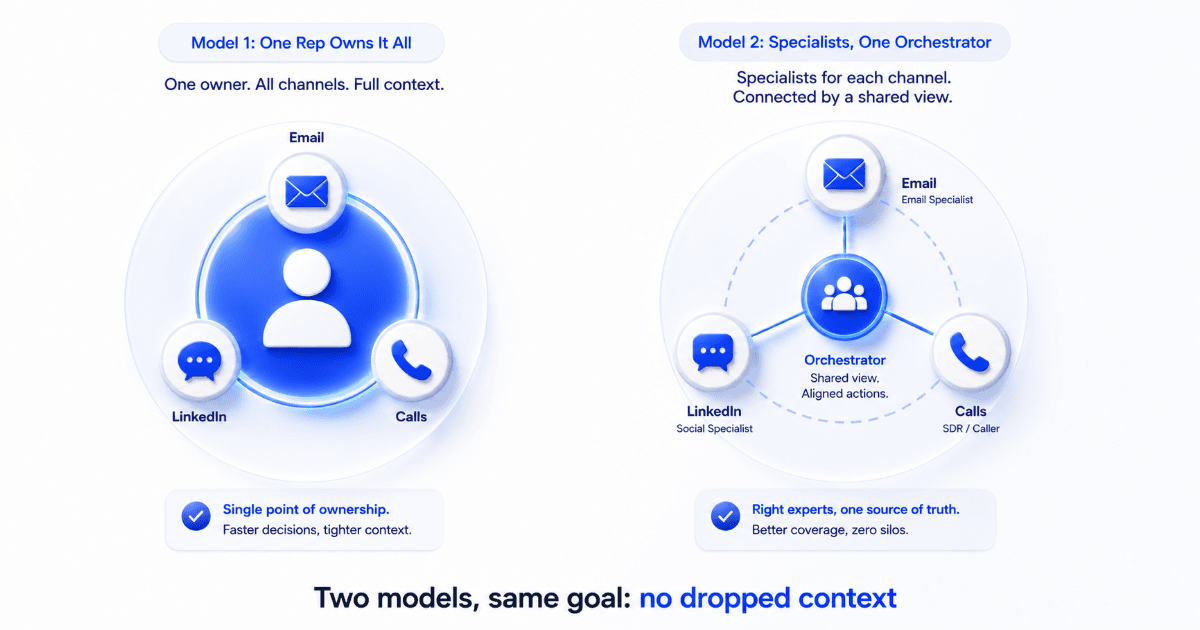
Which Model Fits Which Team Size
Neither model is universally correct — the right choice tracks team size and account complexity more than it tracks any inherent superiority of one structure over the other.
- Small teams (roughly under 10 reps): The single-owner model usually wins. There typically aren't enough accounts to justify true channel specialization, and the coordination overhead of a specialist model outweighs its benefits at this scale.
- Mid-size teams scaling fast: This is the awkward middle where teams often try to specialize before they have the shared-visibility infrastructure to support it — the exact transition point where coordination breakdowns are most common.
- Larger, mature teams: The specialist model becomes worth the coordination cost, since the volume gains from channel-level expertise start to outweigh the handoff risk — provided the shared visibility layer is actually in place.
Mistakes That Break Multichannel Coordination
Specializing before you have shared visibility
Splitting channels across teams without a shared view of activity per account is the single most common cause of the exact coordination breakdown this piece opens with — the org chart changed before the infrastructure did.
Assuming "the orchestrator role" happens by default
In the specialist model, someone has to actually own keeping the sequence coordinated — it's a real responsibility, not something that emerges automatically from three people executing their own channel well.
Ignoring the perception gap on pipeline ownership
When leadership and frontline reps disagree on who owns pipeline generation, multichannel sequences inherit that ambiguity — nobody feels personally accountable for the sequence as a whole, only for their piece of it.
Reducing the Coordination Tax Regardless of Model
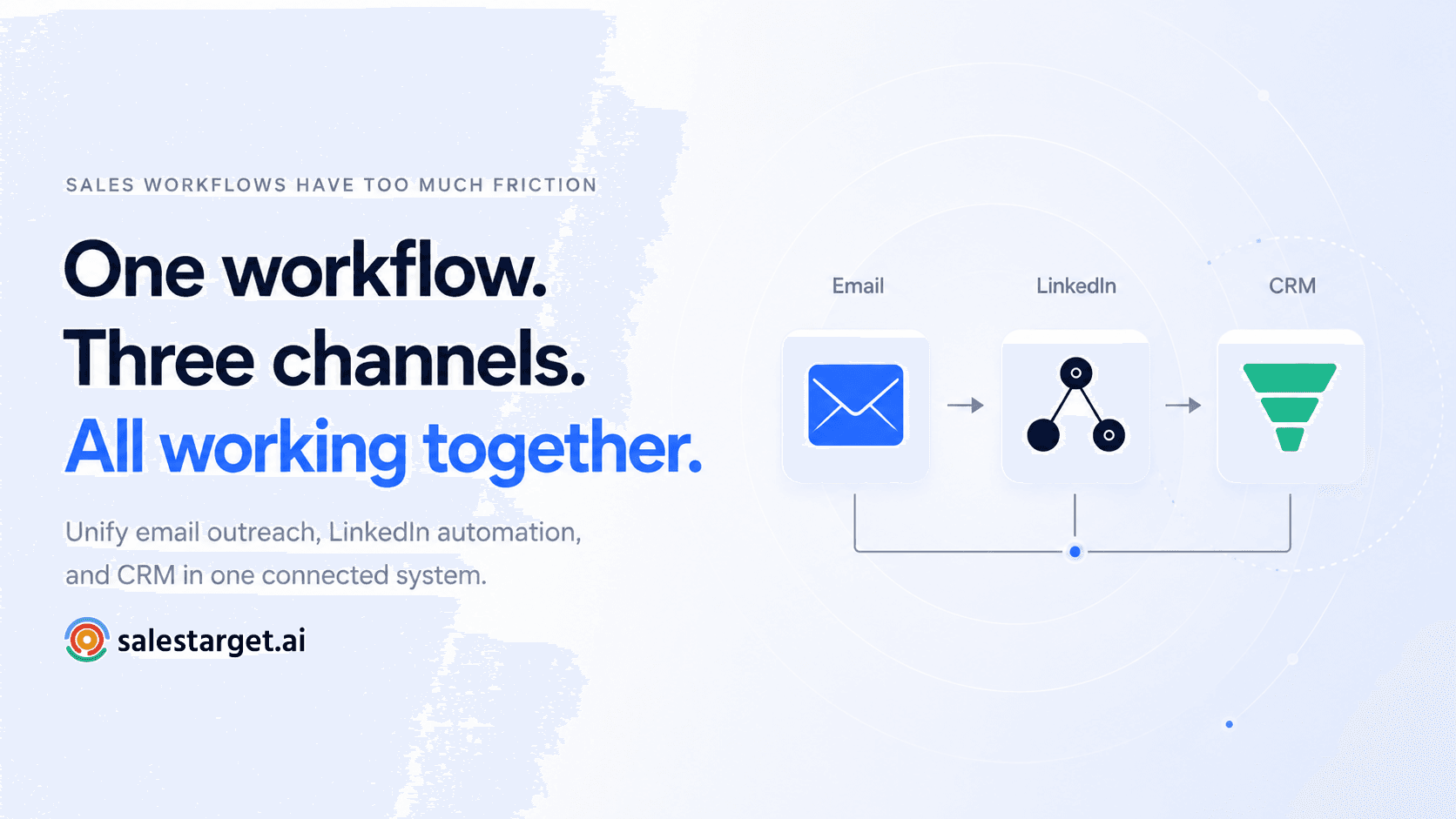
Whichever model a team chooses, the underlying fix is the same: whoever is executing any given touch needs visibility into what happened on every other channel, without having to ask another department or dig through a separate tool. SalesTarget's Multichannel Outreach runs email and LinkedIn sequences in one coordinated workflow rather than as two separately-owned systems, which removes the most common single-owner-vs-specialist failure point — a touch going out with no idea what the other channel already sent.
CRM activity logging and LinkedIn Analytics & CRM Visibility keep email opens, replies, and LinkedIn engagement on a single shared timeline per prospect, so a specialist model doesn't require the orchestrator to manually chase down updates from separate teams before deciding on the next touch. In the single-owner model, that same shared view just means less time spent reconstructing sequence history before a follow-up; in the specialist model, it's what actually makes the handoffs safe. Either way, the org chart decision becomes about hiring and scaling strategy, not about which team happens to have visibility into what.
Design the Org Chart, Not Just the Sequence
A well-designed sequence executed by a poorly coordinated team fails exactly the same way a badly designed sequence does — the prospect experiences disjointed, out-of-sync outreach either way. Before optimizing send times and message copy further, ask the more basic question: does everyone touching this sequence actually know what everyone else touching it has already done? If the honest answer is no, that's the bottleneck worth fixing first.
Coordinate every channel, no matter who owns it.
One shared view of email, LinkedIn, and activity across your whole team.
✓ 50 credits ✓ 7-day trial ✓ No credit card required