Cold email outreach is one of the highest-ROI channels in B2B sales. It's also one of the most misused.
Most teams treat it like a volume game — build a list, fire off a template, hope for the best. The result? Declining reply rates, damaged sender domains, and SDRs stuck doing manual follow-ups instead of closing deals.
According to HubSpot research, the average cold email response rate sits between 1–5%, yet personalized outreach can increase replies by up to 50%. The gap between teams hitting 8–12% reply rates and those stuck below 2% often comes down to one thing: how intelligently they run the campaign, not how many emails they send.
This guide is written for sales leaders, revenue operations teams, and growth-focused SDRs who want a clear-eyed view of what effective cold email outreach actually requires in 2025 — and how AI automation is reshaping the entire motion.
The Uncomfortable Truth About Traditional Cold Outreach
Here's what "traditional" cold email actually looks like inside most B2B teams: a static list exported from a data tool, a generic template pasted into a sequencer, and a follow-up sent on day 3 regardless of any signal. If no one replies, the sequence quietly dies.
The problem isn't that cold email doesn't work. It's that the execution model is broken.
Gartner reports that B2B buyers now complete up to 70% of their purchase journey before engaging a sales rep. They've read reviews, compared tools, and absorbed content — and they can immediately sense a spray-and-pray email when it lands. Generic openers, irrelevant value props, and zero personalization get deleted in seconds, if they clear the spam filter at all.
Meanwhile, sender reputation suffers. Bounce rates climb. Domains get flagged. And SDRs spend their days managing email chaos across five different inboxes.
This isn't a volume problem. It's a systems problem.
The Shift: From Sequences to Intelligent Outreach Systems
The teams consistently outperforming benchmarks aren't sending more emails — they're sending smarter ones inside better-designed systems.
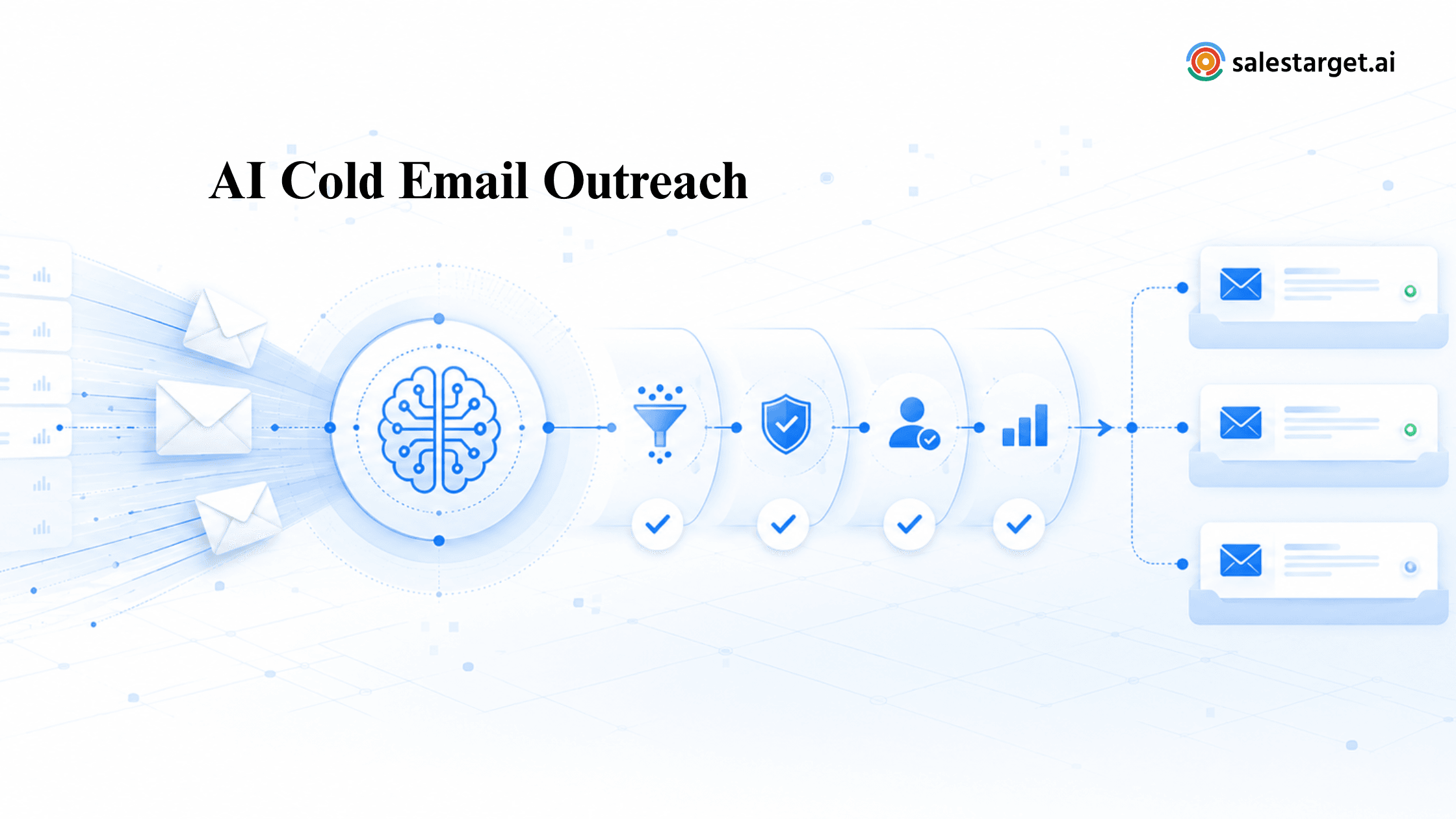
Modern cold email outreach has four distinct pillars:
- Signal-based targeting — reaching prospects based on buying intent or trigger events, not just job title
- AI-driven personalization — generating unique, contextually relevant messaging at scale
- Deliverability infrastructure — protecting sender reputation through warm-up, inbox rotation, and validation
- Unified reply management — handling responses quickly and routing qualified intent into pipeline
When all four work together, outbound email stops feeling like a numbers game and starts functioning as a reliable top-of-funnel engine.
According to McKinsey, companies that personalize outreach at scale see 5–8x higher ROI on their sales and marketing spend than those relying on generic campaigns. That's not a marginal improvement — it's a fundamentally different growth trajectory.
What Modern Cold Email Outreach Must Include
Before looking at tooling, it helps to define what a high-functioning outreach program actually requires. Think of this as the minimum viable infrastructure for cold email in 2025.
Verified, Clean Contact Data
Every campaign starts with list quality. MX record checks, SMTP validation, and disposable email detection aren't optional — they're table stakes. Backlinko data shows that even a 5% bounce rate can damage sender reputation enough to materially reduce inbox placement rates for future campaigns.
Multi-Step Sequences with Intelligent Pacing
A single email is not a campaign. Effective outreach includes a structured first-touch, at least two or three follow-ups, and timing logic that accounts for prospect engagement signals — not just calendar days.
Personalization Beyond First Name
AI-generated personalization pulls in context about the prospect's company, role, or likely pain points to craft openers and value props that don't feel templated. This is where generative AI has genuinely changed what's possible for SDR teams at scale.
Deliverability Protection Built Into the Platform
SPF, DKIM, and DMARC configuration, combined with inbox warm-up and rotation, is what separates campaigns that land in primary inboxes from ones that get routed straight to spam. Salesforce research indicates that deliverability issues account for nearly 20% of all failed outbound email programs.
Centralized Reply Management
Managing replies across multiple inboxes and domains without a unified view is a productivity killer. Fast, qualified response to an interested prospect can mean the difference between booking a meeting and losing them to a competitor.
The Tactical Framework: Running a Campaign That Actually Converts
Here's a simplified framework used by high-performing outbound sales teams:
Step 1 — Define the ICP precisely. Segment by industry, company size, tech stack, or buying signal. Vague targeting is the single biggest reason sequences fail.
Step 2 — Validate your list before importing. Run email validation to eliminate bad addresses, reduce bounce risk, and protect your domain health before a single email goes out.
Step 3 — Build the sequence architecture. Use AI to generate the full sequence structure — first touch, follow-ups, and timing — rather than writing each email manually. Define a clear offer and CTA before starting.
Step 4 — Personalize at the individual level. Use AI content tools to generate unique intros or value statements for each prospect based on their role, industry, or company context. This doesn't mean writing 500 emails — it means using AI to scale what would otherwise be manual.
Step 5 — Monitor and rotate sending infrastructure. Spread sends across multiple warmed inboxes. Keep daily sending volumes conservative per inbox. Monitor deliverability signals in real time.
Step 6 — Manage replies centrally. Route all responses into a unified inbox. Classify by intent (interested, follow-up, not a fit), assign ownership, and move qualified deals directly into CRM without manual data entry.
Six Outreach Mistakes That Kill Reply Rates
| Mistake | Why It Hurts | Fix |
|---|---|---|
| Sending from a cold, unwarmed inbox | Inbox placement tanks immediately | Warm up every new mailbox before sending |
| Using the same email copy for every prospect | Feels impersonal, gets deleted | AI personalization per prospect |
| High bounce rate from unvalidated lists | Damages sender reputation | Validate before every campaign launch |
| Only one follow-up in the sequence | Most replies come after touch 3–4 | Build multi-step sequences with smart pacing |
| Managing replies across multiple inboxes manually | Slow response kills qualified leads | Use a unified inbox to centralize all replies |
| Ignoring SPF/DKIM/DMARC configuration | Emails don't authenticate properly | Validate DNS settings before going live |
How AI Email Automation Changes the Personalization Equation
The biggest shift in outbound over the last two years isn't a new channel — it's what AI has made possible at the content and workflow layer.
Previously, personalization at scale meant one of two things: hire more SDRs, or send generic copy and pretend otherwise. AI changes that calculus entirely.
AI content generation tools can now produce subject lines, email openers, and CTAs tailored to each prospect's role, company stage, and likely pain points — in seconds. AI spintax generators create natural variation in email copy across a large list, improving inbox placement by reducing signal repetition that spam filters flag.
LinkedIn data shows that personalized messages receive 3x higher response rates than non-personalized ones. In cold email, the impact is similar — but only when personalization is contextually relevant, not just cosmetically different.
The other dimension where AI adds real value is sequence building. Instead of manually configuring timing, follow-up triggers, and messaging tone, AI copilot tools can generate a complete campaign architecture from a single audience description — compressing what used to take hours into minutes.
Why Deliverability Is Your Most Important Metric
Most SDR leaders optimize for open rates. The ones consistently hitting top-of-funnel targets optimize for deliverability first.
Here's why: an email that never reaches the primary inbox can never be opened, regardless of how well-written it is. Campaign Monitor data shows that properly authenticated, warmed inboxes with low bounce rates see inbox placement rates above 90%. Unmanaged cold sending infrastructure can drop below 40%.
The mechanics of deliverability protection at scale include:
- Inbox warm-up — gradually increasing send volume over several weeks to build sender reputation
- Inbox rotation — spreading sends across multiple inboxes to prevent any single domain from hitting spam thresholds
- Email validation — removing bad addresses, disposable emails, and high-risk contacts before they ever enter your sequence
- DNS authentication — ensuring SPF, DKIM, and DMARC records are correctly configured for every sending domain
- Content variation — using AI-generated spintax to avoid identical copy patterns that trigger spam filters
Protecting deliverability isn't a one-time setup task. It's an ongoing operational discipline — and it's increasingly where the best cold email platforms differentiate themselves.
How SalesTarget.ai Simplifies Cold Email Outreach
SalesTarget.ai's Email Outreach platform is purpose-built for B2B sales teams who need to move fast without sacrificing deliverability or personalization quality.
The core workflow is designed to remove the friction points that slow down most outbound programs:
AI Copilot turns a single audience description into a complete campaign — first touch, follow-ups, timing, and messaging tone — without manual configuration. Teams report 35% faster campaign creation compared to building sequences manually.
AI Content Generator produces human-sounding subject lines, email openers, and CTAs tailored to each prospect's role and context. AI Spintax Generator creates natural variation across all emails in a campaign, protecting inbox placement without sacrificing message quality.
Unlimited inbox management with built-in warm-up allows teams to connect and manage as many sending inboxes as needed — with AI rotating sending automatically and protecting each domain's sender reputation over time.
Deliverability infrastructure includes automatic SPF/DKIM/DMARC validation, intelligent inbox rotation, and content variation tools — keeping campaigns in the primary inbox as they scale.
Email validation runs MX/SMTP checks, detects disposable addresses, and applies risk scoring to every contact before it enters a sequence — cutting bounce risk and protecting domain health from day one.
Unibox consolidates every campaign reply into a single unified inbox. Replies are categorized by intent (Interested, Follow-Up, Not a Fit), ownership can be assigned per conversation, and qualified leads sync directly to CRM — reducing the time between a positive reply and a booked meeting.
For teams comparing options, SalesTarget.ai's guide to the best AI cold email software provides a detailed breakdown of how modern platforms are reshaping outbound sales workflows in 2025.
What's Next: Outbound Sales Automation Trends in 2025 and Beyond
The trajectory of cold email outreach is moving toward deeper automation with tighter human oversight — not replacing SDRs, but shifting what they spend their time on.
A few trends worth tracking:
AI-native sequence generation will become standard. Teams that still manually configure every email step will fall further behind in speed and campaign quality.
Deliverability as a competitive moat. As inbox providers apply tighter filtering, teams with robust warm-up and rotation infrastructure will consistently outperform those sending from cold or poorly managed domains.
Reply intelligence. The next layer of AI integration will be in reply classification — automatically identifying high-intent responses, flagging objections, and routing conversations to the right rep at the right moment.
Multichannel sequencing. Email outreach is increasingly being run in coordination with LinkedIn touchpoints inside single campaign sequences. Demand Gen Report data shows that multichannel outbound campaigns see 24% higher conversion rates than email-only programs.
The teams building these systems now — not reacting to them later — will own outbound pipeline efficiency as a structural advantage.
Final Takeaway
Cold email outreach still works. What doesn't work is running it the way most teams ran it five years ago.
The modern playbook requires validated contacts, AI-generated sequences, deliverability infrastructure, and centralized reply management — all working together inside a single, well-designed platform. When the system is right, outbound email becomes one of the most efficient and scalable top-of-funnel channels available to a B2B sales team.
If your team is ready to move beyond generic sequences and build a cold email program that actually generates pipeline, start free with SalesTarget.ai — 100 credits, no credit card required.