TL;DR
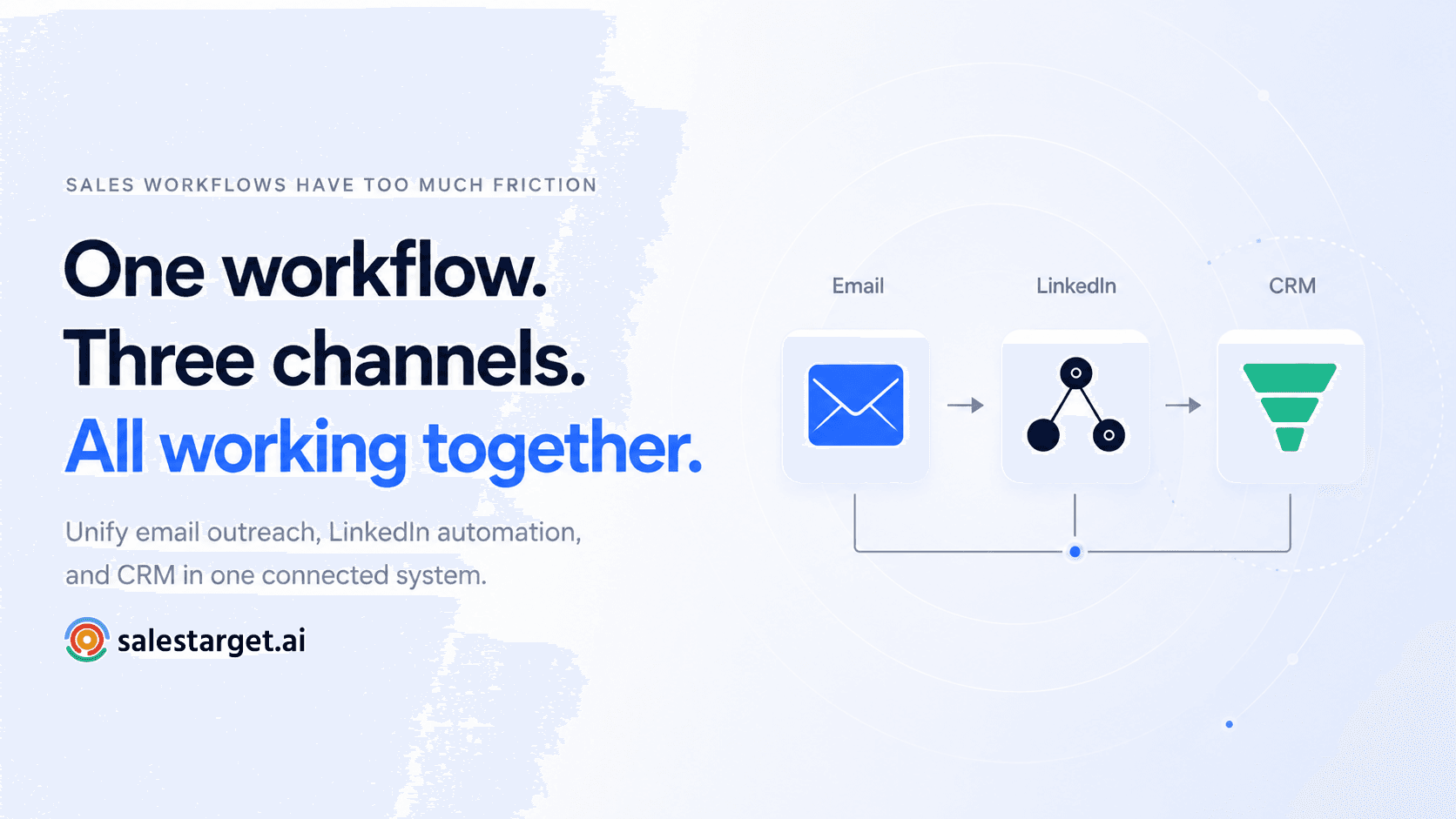
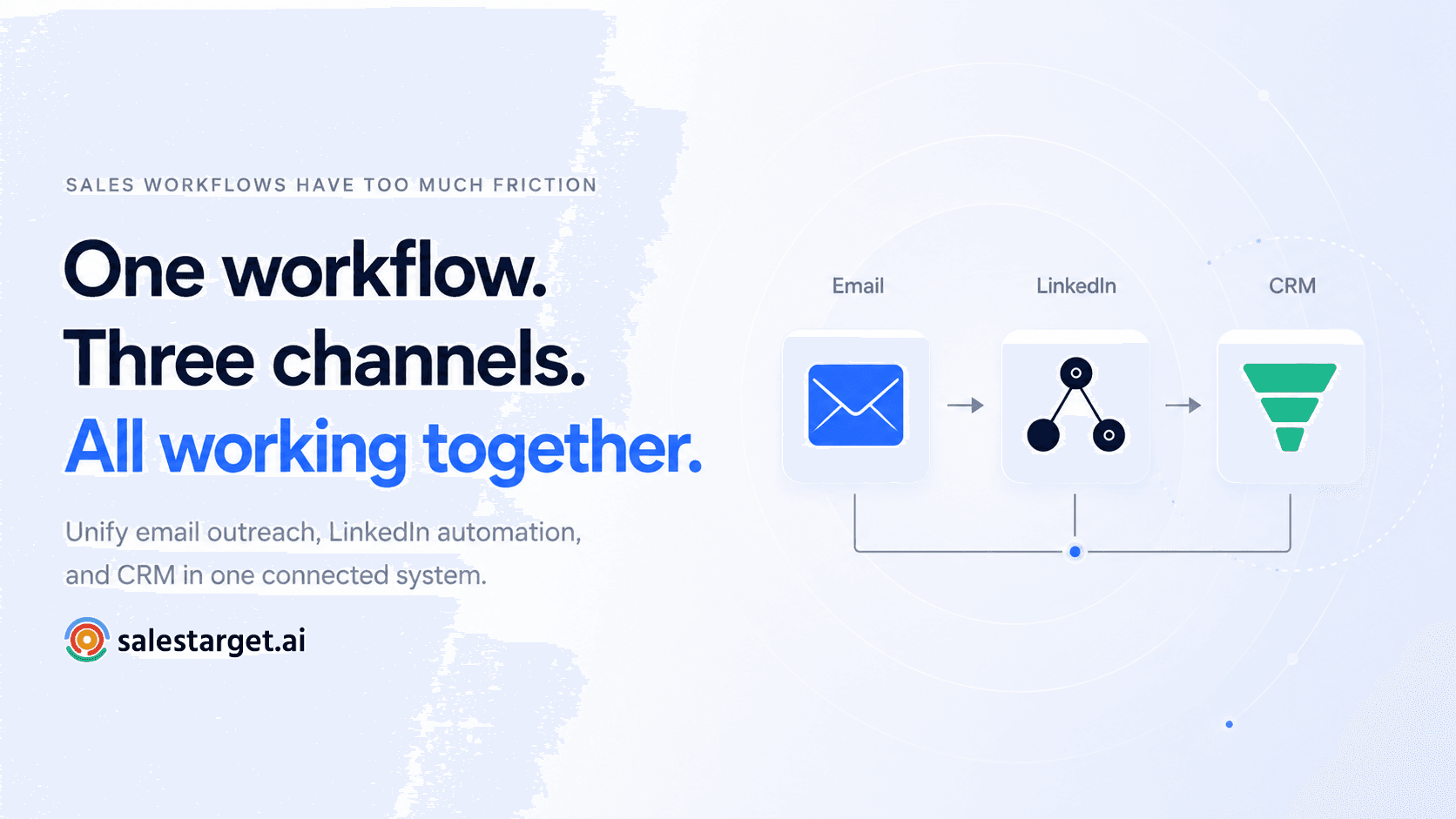
- A multichannel sales outreach strategy means Email, LinkedIn, and CRM operating as one coordinated system — not three separate tools running in parallel
- Multichannel sequences generate 40% higher engagement than single-channel approaches and produce over 20% higher close rates, 20% lower CAC, and 25% shorter sales cycles
- The three failure modes that collapse every multichannel stack: disconnected tools, no unified reply management, and CRM data that never reflects outreach activity
- The winning workflow: ICP-filtered lead discovery → email warmup and deliverability → LinkedIn sequence → coordinated email sequence → CRM pipeline management → AI-driven analytics — all from one platform
- Most B2B teams run a multichannel outreach stack assembled from 4–6 disconnected tools — each handoff between tools is a data quality failure waiting to happen
- SalesTarget runs the full multichannel stack natively — email outreach, LinkedIn automation, and CRM in one platform with unified reply management and AI-driven analytics
Most Teams Are Running Multichannel Outreach. Almost None Are Running It as a System.
Ask any B2B sales leader if they do multichannel outreach and they will say yes. They send cold emails. Their reps are on LinkedIn. They have a CRM. But watch how those three things actually connect and the picture changes fast.
The email tool has no visibility into LinkedIn activity. The LinkedIn tool has no awareness of which prospects already received an email. The CRM reflects what reps manually logged — which is never everything — and has no live view of outreach status. A prospect who replied on LinkedIn is still getting scheduled email follow-ups. A prospect who bounced in email is still getting LinkedIn connection requests. The channels are running. The system is not.
This is the multichannel gap. And it is not a tool problem — it is an architecture problem. Belkins' 2026 outreach research found that multichannel outreach produces over 20% higher close rates, 20% lower CAC, and 25% shorter sales cycles — but only when the channels are coordinated. Uncoordinated multichannel outreach does not underperform coordinated outreach. It often underperforms single-channel outreach because it creates noise and confusion instead of familiarity.
This playbook covers what a real multichannel sales system looks like — Email, LinkedIn, and CRM as one flow — and how to build it without stitching together six different tools.
What a Real Multichannel Outreach Stack Covers
Before mapping the workflow, it helps to be precise about what a complete B2B multichannel stack actually needs to handle. Most playbooks focus on the outreach layer and skip the infrastructure that makes it work at scale.
| Layer | What it covers | What breaks without it |
|---|---|---|
| Lead intelligence | ICP-filtered prospect search, verified contact data, intent and signal data | Outreach volume without targeting precision — high bounce rates, low reply rates |
| Email infrastructure | Domain warmup, inbox rotation, sender reputation management, deliverability | Emails land in spam — all outreach investment wasted before a single open |
| Email outreach | AI-personalized sequences, spintax variation, follow-up automation, A/B testing | Generic templated emails — recognized as automation, ignored or marked spam |
| LinkedIn outreach | Profile views, connection requests, follow-up messages, content engagement, safety compliance | No recognition layer before email — prospects receive cold email from a stranger |
| Unified reply management | Single inbox for LinkedIn and email replies, automatic sequence pause on reply | Prospects who reply get follow-ups anyway — destroys trust and deliverability |
| CRM pipeline | Lead management, deal tracking, follow-up automation, activity logging | Replies fall through cracks — no pipeline visibility, no follow-up accountability |
| Analytics | Campaign performance, reply rates, top performers, sequence optimization signals | No feedback loop — teams keep running campaigns with no data on what is working |
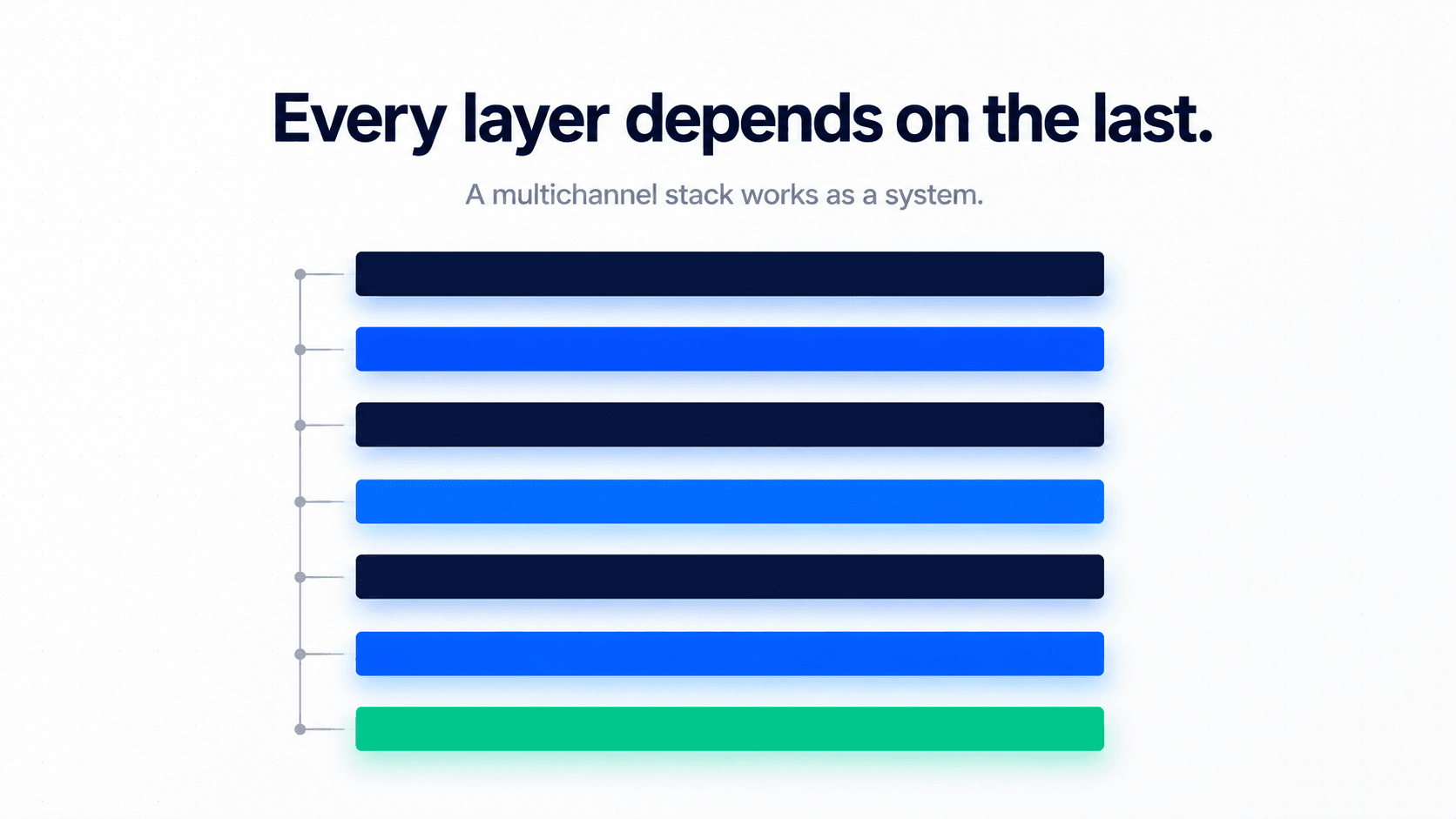
Every layer depends on the ones before it. You can run the world's best LinkedIn sequence and still fail if your email deliverability is broken. You can have perfect deliverability and still lose pipeline if replies are not captured in the CRM. The stack works as a system or it does not work at all.
The 2026 Multichannel Sales Workflow: Step by Step
Here is how the full Email + LinkedIn + CRM flow works in practice when the stack is unified. Each step feeds the next — no manual handoffs, no data exported between tools, no reply management done in three separate inboxes.
Step 1: Build Your ICP-Filtered List Before Touching a Channel
The single biggest mistake in multichannel outreach is launching sequences to a poorly qualified list. At six touchpoints per prospect, a bad list creates six times the noise and six times the deliverability damage. Build the list right first.
ICP filters for B2B outbound that actually move reply rates: industry vertical, company headcount range, job title and seniority, geography, tech stack (what tools they already run), and buying signals (recent funding, hiring surges, leadership changes). The combination of firmographic filters and real-time signals produces a list where every prospect has a reason to be on it — not just a reason to be contacted.
SalesTarget's Lead Explorer applies all of these filters in a single search with built-in enrichment — verified email addresses and contact data appended at the point of discovery, not after export.
Step 2: Warm Your Sending Infrastructure Before Your First Email
This step is invisible when it is done right and catastrophic when it is skipped. New sending domains need 3–4 weeks of warmup before high-volume cold email campaigns. Even established domains need ongoing reputation management — inbox rotation across multiple sending accounts distributes volume so no single domain bears the load.
A common failure mode: teams build a perfect multichannel sequence, launch it at volume on a cold domain, and watch 60–70% of emails land in spam. The LinkedIn touchpoints arrive fine. The emails never do. The sequence produces almost no replies and the team concludes the campaign did not work — when the issue was purely infrastructural.
SalesTarget's email warmup and deliverability infrastructure handle this automatically — warmup, inbox rotation, and sender reputation management built into the platform before any sequence launches.
Step 3: Run LinkedIn First to Create Recognition
The LinkedIn layer is not outreach — it is context-setting. Its job is to make the subsequent email feel warm rather than cold. Done correctly, the prospect has seen your name and profile before the email arrives. The cognitive friction that kills cold email response rates is already partially resolved.
The LinkedIn sequence that creates the strongest recognition effect before the first email:
| Action | Timing | Purpose |
|---|---|---|
| Profile view | Day 1 | Passive first impression — many professionals check who viewed their profile |
| Connection request with brief note | Day 2 | 20–30 words referencing their role — feels natural after a profile view |
| First cold email | Day 3–4 | Arrives from a recognized name — no longer a cold email in the true sense |
SalesTarget's LinkedIn outreach automation handles profile views, connection requests, and follow-up messages with human-like timing and built-in safety compliance — rate limiting and account protection at team scale.
Step 4: Run the Email Sequence as a Continuation of LinkedIn
The email sequence should not be a separate campaign that happens to target the same list. It should feel like a natural continuation of the LinkedIn touchpoints — same value proposition, deeper treatment, different format.
The email that arrives after two LinkedIn touchpoints is not cold. The prospect has seen the name, reviewed the profile, and made a passive judgment about credibility. The email has one job: convert that passive recognition into a reply by being specific, relevant, and short.
📊 What the data says about multichannel sequence performance
- Multi-channel sequences produce 40% higher engagement than single-channel approaches — Salesmotion 2026
- Cold email reply rates for coordinated multichannel sequences: 8–15% vs 2–5% for cold email alone
- LinkedIn generates 80% of B2B social leads — Martal Group LinkedIn Statistics 2026
- Plan for 8–12 touchpoints per prospect across channels — Salesmotion B2B outreach research 2026
SalesTarget's AI sequence and content generator produces personalized email sequences with spintax variation — ensuring each message is unique at the inbox level, reducing spam filter risk and improving deliverability at scale.
Step 5: Manage Replies from Both Channels in One Place
This is the step most multichannel stacks get completely wrong. A prospect replies on LinkedIn on Monday. The scheduled email follow-up fires on Wednesday. The sequence was not paused because the LinkedIn reply was never connected to the email system. The prospect — who was interested enough to respond — now receives an automated follow-up that treats them as if they never replied. That is a deal killed by infrastructure failure.
Unified reply management means: one inbox monitoring both LinkedIn and email replies, automatic sequence pause when a reply arrives on either channel, and CRM activity logging so the reply appears in the deal record without manual input. SalesTarget's Unibox handles all three — cross-channel reply visibility, automatic pause logic, and CRM sync in one place.
Step 6: Move Replies into CRM Pipeline Without Manual Logging
The handoff from outreach to pipeline is where most of the value generated by a multichannel sequence leaks away. A rep gets a reply, intends to log it in the CRM, gets pulled into another conversation, and the lead sits in an email thread with no deal record, no follow-up task, and no visibility for the team.
A connected multichannel stack eliminates this leak. Reply activity flows directly from the Unibox into the CRM. Deal records are created or updated automatically. Follow-up tasks are generated based on the reply type. The rep's job is to execute the follow-up — not to remember to log it first.
SalesTarget's CRM is built for outbound teams — lead management, deal pipeline, follow-up automation, and activity tracking designed to capture outreach activity without requiring reps to manually maintain records.
Step 7: Close the Feedback Loop with Campaign Analytics
A multichannel sequence without analytics is a system with no learning. Teams run campaigns, get results they cannot interpret, and make changes based on gut feel rather than data. The feedback loop is the mechanism that turns a multichannel sequence into a continuously improving system.
The metrics that actually matter for multichannel outreach optimization: reply rate by channel and by sequence step (which touchpoint is generating replies), open rate by subject line variant (what is getting attention in the inbox), connection acceptance rate on LinkedIn (is the profile and note working), and meeting booked rate by campaign (which ICP segments are converting). SalesTarget's campaign analytics surfaces all of these in one view — with AI-driven identification of top-performing campaigns and sequences.
Three Failure Modes That Collapse Multichannel Stacks
Failure mode 1: The disconnected stack
Lead finder → enrichment tool → email validator → email platform → LinkedIn tool → CRM. Six tools. Five handoffs. Each handoff is a CSV export, an API sync that breaks silently, or a Zapier automation that nobody monitors. Data quality degrades at every transfer point. A rep who bounced from one tool is still active in another. A reply logged in one system never appears in the CRM. The stack looks sophisticated and functions like a leaky pipe. The solution is not better integrations — it is fewer tools with deeper native connections.
Failure mode 2: Channels running in parallel rather than sequence
Running LinkedIn and email simultaneously to the same list — both on independent schedules, neither referencing the other — is not multichannel outreach. It is single-channel outreach on two channels at the same time. The prospect receives a LinkedIn message and a cold email on the same day from the same sender with no connection between them. The effect is not doubled reach. It is doubled noise. Multichannel means sequential, coordinated touchpoints that build on each other — not parallel campaigns that happen to target the same list.
Failure mode 3: CRM that does not reflect outreach reality
The CRM is supposed to be the source of truth for pipeline. In most outbound teams, it reflects what reps remembered to log after the fact — which is a fraction of actual activity. LinkedIn touchpoints are rarely logged. Email opens and clicks never make it to the deal record. Follow-up tasks are created manually or not at all. The result is a CRM that shows deals in "contacted" stage that were actually replied to three weeks ago and never followed up. Pipeline forecasting from this CRM is fiction. The fix is a CRM connected directly to the outreach layer — where activity flows in automatically without relying on rep discipline.
What Actually Changes When the Stack Is Unified
The argument for a unified multichannel stack — one platform handling Email, LinkedIn, and CRM — is not primarily about convenience. It is about the compounding effect of having all three layers share the same data in real time.
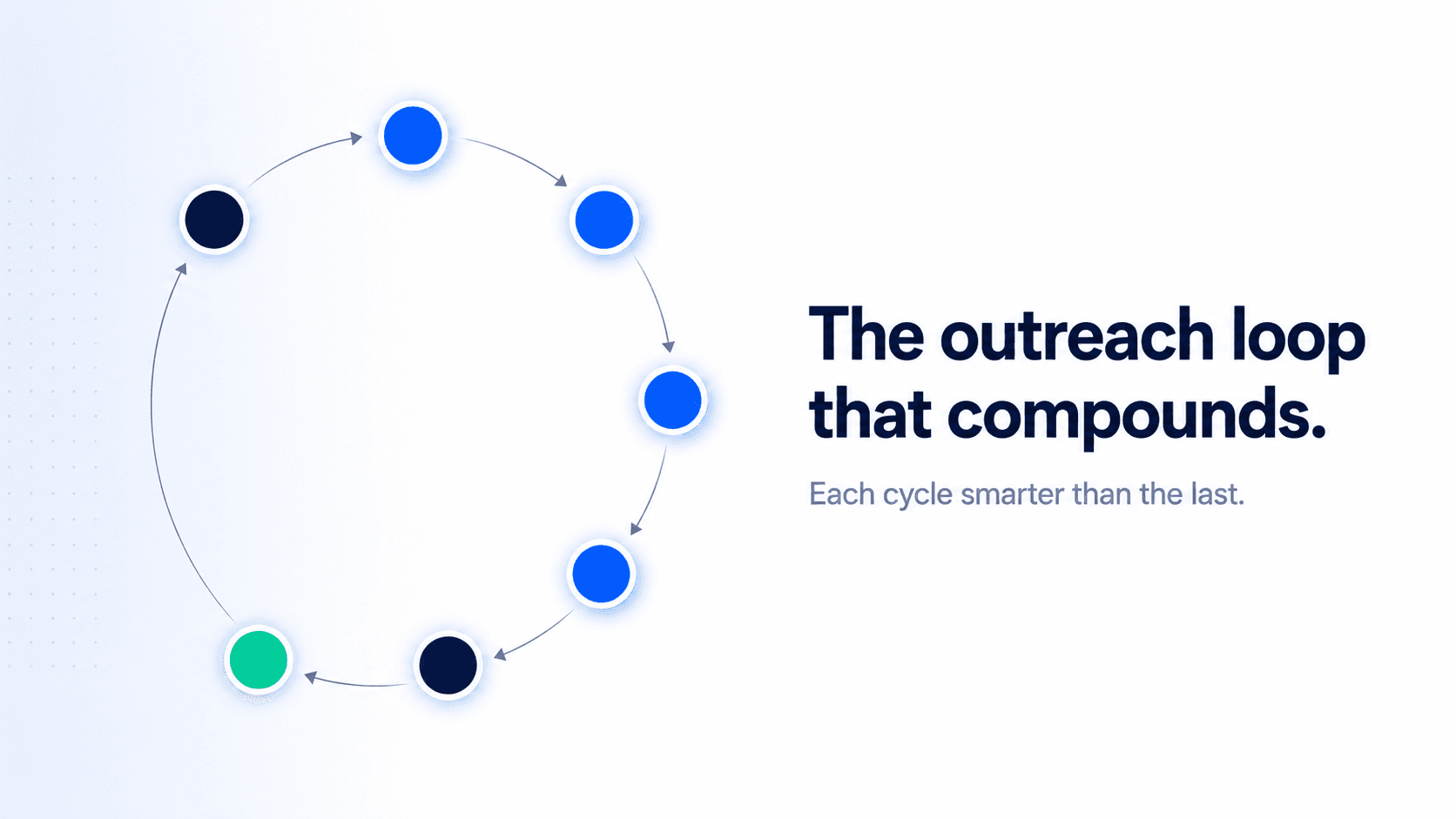
When a prospect replies to a LinkedIn message, the email sequence pauses automatically. When they reply to an email, a deal record is created or updated in the CRM without rep input. When the analytics layer identifies a top-performing sequence, that insight is immediately available for the next campaign without exporting a report and rebuilding it in another tool. The system gets smarter with every interaction because the data from every interaction stays in one place.
This is the structural advantage of SalesTarget's approach — email outreach, multichannel outreach, and CRM pipeline management built as one system rather than three tools with integrations bolted on. No handoff failures. No reply management gaps. No CRM that reflects yesterday's reality instead of today's.
Email. LinkedIn. CRM. One platform. One flow.
Run your entire multichannel sales workflow without stitching together six tools.
✓ 50 credits ✓ 7-day trial ✓ No credit card required
Frequently Asked Questions

See It In Action: Book Your Free Demo
Get a personalized walkthrough and see how it works for your team.
Book My Demo →