Most outbound teams do not have a messaging problem. They have a targeting problem.
Reps are spending hours each week chasing accounts that were never going to buy, working off stale lists pulled from databases that have not been refreshed since the last fiscal year. Reply rates have quietly slipped into the low single digits. Demos are slipping. Pipeline forecasts feel like guesswork.
The uncomfortable truth: spraying personalized-looking emails across 5,000 “maybe-fit” accounts is not prospecting anymore. It is noise. And buyers have learned to filter it out.
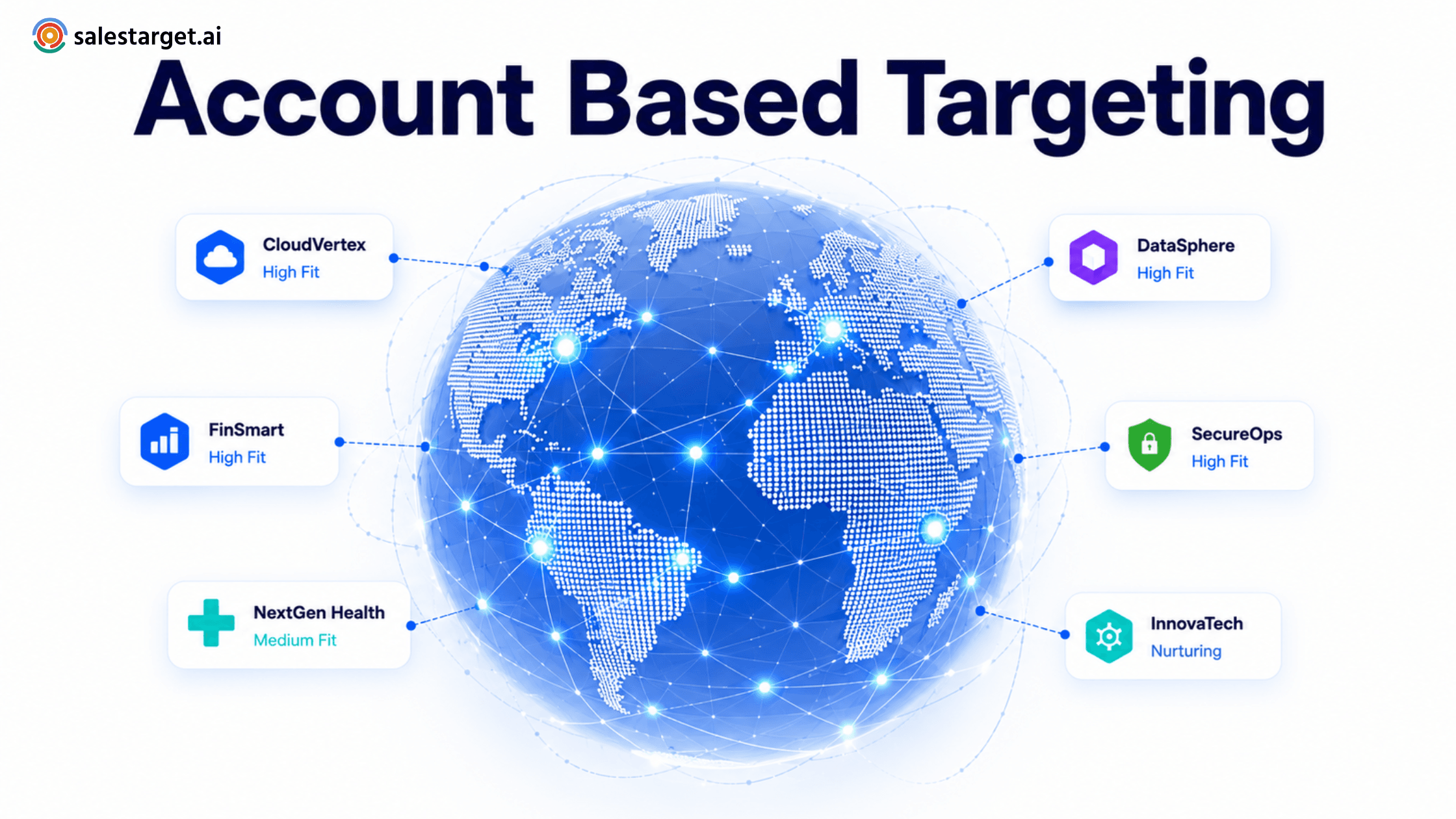
Account Based Targeting flips that pattern. Instead of starting with volume and hoping intent shows up later, it starts with the buyer signal and works backwards to the right person, at the right company, at the right moment.
What Is Account Based Targeting?
Account Based Targeting is the practice of identifying, scoring, and prioritizing a finite set of companies that match your Ideal Customer Profile and show measurable signs of buying interest — before any rep touches them.
It is not the same as traditional lead generation. Lead gen optimizes for lead volume. Account targeting optimizes for account fit and account readiness. One asks “who can I email?” The other asks “who is actually in a buying window right now?”
Quick example: A cybersecurity vendor selling to mid-market fintech does not need a list of 40,000 “finance” companies. They need the 280 fintechs that just hired a Head of Security, opened a SOC 2 page on their site, or posted a job for a compliance engineer in the last 14 days. That is account based targeting in one sentence.
Why Traditional Prospecting Is Failing in 2026?
Sales orgs are not getting worse at outbound. The ground underneath outbound is moving.
- Lead databases age fast. Roughly a third of contact records decay every year, and reps inherit the rot.
- “Broad” targeting punishes deliverability. Sending to wide, low-fit lists trains inbox providers to flag your domain.
- CRM hygiene is patchy. Duplicate accounts, missing firmographics, and orphan contacts hide your best buyers.
- Intent data is missing from most workflows. Reps still rely on title + industry, ignoring what the account is actually doing this week.
- Personalization is performative. Mentioning a prospect’s podcast does not make a generic pitch relevant.
The comparison below is what most VP-Sales conversations boil down to:
| Dimension | Traditional Prospecting | Account Based Targeting |
|---|---|---|
| Audience scope | Broad industry lists | Narrow ICP + intent-fit accounts |
| Data freshness | Static, often months old | Real-time enrichment and signals |
| Signal usage | None or guesswork | Hiring, funding, tech-stack, web intent |
| Personalization | Generic templates | Account-specific context |
| Reply rates | Low and declining | Materially higher on warm accounts |
| CRM hygiene | Duplicates, bounced emails | Verified, deduplicated, scored |
The Core Components of an Effective Account Based Targeting Strategy
Ideal Customer Profile (ICP)
Your ICP is the foundation. It defines firmographics (industry, size, geography, revenue), technographics (tools they use), and trigger criteria (growth stage, regulatory exposure). A sharp ICP eliminates 80% of wasted effort before any rep opens their inbox.
Buyer Intent Signals
Signals are the difference between guessing and knowing. Hiring activity, funding rounds, leadership changes, tech-stack adoption, web research, and category page visits all hint at which accounts are entering a buying window.
If you want a deeper breakdown, this guide on B2B sales signals walks through which signals matter most and how to act on them quickly.
Lead Enrichment
Enrichment fills in the blanks: verified emails, direct dials, job changes, headcount, funding, parent-company links. A clean enriched record is what turns a name into a workable account.
Multi-Channel Prospecting
One channel is a single point of failure. The best-performing motions sequence email, LinkedIn, calls, and ads on the same account, in the same week, with consistent context.
Real-Time Data Updates
Yesterday’s data is a liability. If a prospect changed jobs last Monday and your CRM still has the old email, you are not just wasting a send — you are training Google to distrust your domain.
AI-Based Target Prioritization
AI ranks the queue. It looks at every account, every signal, every enrichment field, and tells the rep which 25 accounts to work today instead of which 2,500 to work “someday.”
How AI Improves Account Based Targeting?
AI is not a replacement for sales judgment. It is a replacement for the four hours a day reps spend doing research.
- Predictive targeting surfaces look-alike accounts of your top closed-won deals.
- Intent analysis blends first-party site visits with third-party research behavior.
- Signal detection scans funding announcements, job posts, and product launches in real time.
- Automated segmentation regroups accounts as their fit and intent change.
- Enrichment automation pulls verified contact data on demand, so reps stop tab-hopping.
The net effect is simple: fewer accounts worked, higher reply rates, shorter cycles.
Building a High-Converting Target Account List
Here is a repeatable seven-step framework any GTM team can run this quarter:
- Define ICP. Anchor it to your last 20 closed-won deals — not a whiteboard fantasy.
- Filter industries. Drop verticals where you have no proof-of-value or weak unit economics.
- Layer buying intent signals. Hiring, funding, tech adoption, and content consumption.
- Enrich company and contact data. Headcount, tech stack, decision-makers, direct dials.
- Validate emails. Anything below 95% deliverability gets quarantined, not sent.
- Prioritize accounts. Score by fit × intent × reachability.
- Launch outbound campaigns. Sequence email, LinkedIn, and calls with account-specific context.
Run this loop every two weeks. A target account list is not a document — it is a living queue.
Common Mistakes Teams Make With Account Based Targeting
- Targeting too broadly to “hit activity numbers.” Activity is not pipeline.
- Ignoring intent signals and treating every account as equally cold.
- Personalization that is cosmetic (a first name) rather than contextual (a trigger event).
- Working off contact data older than 90 days.
- Weak segmentation — one playbook for every persona and every size band.
- Treating LinkedIn as the entire data layer. It is one source, not the source.
- CRM data that no one owns. If nobody is responsible for hygiene, nobody fixes it.
How SalesTarget.ai Helps B2B Teams Target Better Accounts
This is where a purpose-built platform earns its keep. SalesTarget.ai’s Lead Explorer is designed around the workflow above rather than bolted on top of a static database.
Teams use it to filter accounts by deep ICP criteria, layer intent signals on top, and pull verified contact data on the buying committee in a single view. AI-powered prospecting ranks the queue automatically, so reps open their day with the 25 accounts most likely to convert — not a 2,500-row spreadsheet.
Enrichment runs in the background. Verified emails, direct dials, firmographic and technographic data, and recent trigger events surface inline, removing the constant tab-switching that kills outbound throughput. Workflow automation pushes prioritized accounts straight into sequences, so the gap between insight and outreach is measured in minutes, not days.
If you are still in evaluation mode, this breakdown on how to choose the right lead generation platform is a useful checklist to take into vendor demos.
Final Thoughts
Account Based Targeting is not a tactic. It is a discipline — a commitment to working fewer accounts, with better data, at the moment of intent.
AI does the heavy lifting on research and prioritization. Intent signals tell you when to move. Clean, enriched data makes sure your outreach actually lands. The teams who quietly compound on all three are the ones whose pipeline holds up when the market gets noisy.
If your current motion is producing more sends and less pipeline, that is the signal. Tighten the list, lead with intent, and let the data point you at the accounts that are already leaning in.