Most advice about multichannel outreach starts from the same assumption: add a channel, get more replies. Sometimes that holds. Other times a second channel just doubles the writing, the monitoring, and the number of places a prospect can spot a template.
Multichannel outreach is the practice of reaching one prospect through two or more channels, usually LinkedIn and email, as a single coordinated conversation. In practice, that means one prospect record, one sequence, and one rule that stops every channel the moment the prospect replies anywhere.
This guide gives you a fit test for deciding when to use multichannel outreach and where it earns its place: which segments, which accounts, and which teams. It’s written for SDRs, founders, sales managers, and RevOps leads who already run sequences.
Explore Multichannel Outreach →
See how SalesTarget.ai keeps LinkedIn and email outreach in one connected flow, so follow-ups continue the conversation instead of restarting it.
Coordinated multichannel outreach vs. two campaigns that share a list
Before you judge whether multichannel outreach is worth it, be clear about what you’re judging. Plenty of teams believe they’ve tried it when they actually ran two single-channel campaigns against the same people.
| Coordinated outreach | Disconnected campaigns | |
|---|---|---|
| Prospect data | One shared record for both channels | Separate lists in separate tools |
| When the prospect replies | Every channel stops | Only the channel that got the reply stops |
| Next step decided by | What the prospect did last | A fixed date on the calendar |
| Message content | Each touch adds something new | The same pitch, reworded per channel |
| Conversation history | Visible to anyone who opens the record | Split between tools and owners |
If your past results came from the right-hand column, they don’t tell you whether a coordinated approach fits your market. They tell you that uncoordinated outreach irritates buyers. If that sounds familiar, start by diagnosing why LinkedIn and email are working against each other , then come back to the fit test.
A second channel has real costs
Adding LinkedIn to email, or email to LinkedIn, is usually pitched as pure upside. In practice, every channel you add brings costs that never show up on a reply-rate chart.
LinkedIn capacity is limited
LinkedIn limits how many invitations every member can send, Basic and Premium alike, and says accounts may be restricted when many invitations are ignored, left pending, or marked as spam (LinkedIn Help). It doesn’t publish a fixed number, so treat connection requests as a scarce budget. Spending them on poorly matched prospects wastes that budget and raises the risk of a restriction.
Every step needs its own message
A five-step email sequence needs five good emails. A coordinated sequence needs every step written for its channel, plus the logic that connects them. Someone has to find time to write and review all of it.
Replies arrive in more places
Interested buyers may answer in an inbox or in a LinkedIn thread. If LinkedIn replies sit unanswered for two days, you’ve added a channel where warm conversations go cold.
Mistakes become more visible
A clumsy follow-up in one channel is easy to miss. The same clumsiness repeated across two channels starts to look automated, and buyers notice.
None of this is an argument against using two channels. It means the second one belongs where the upside clearly outweighs these costs.
The multichannel outreach fit test
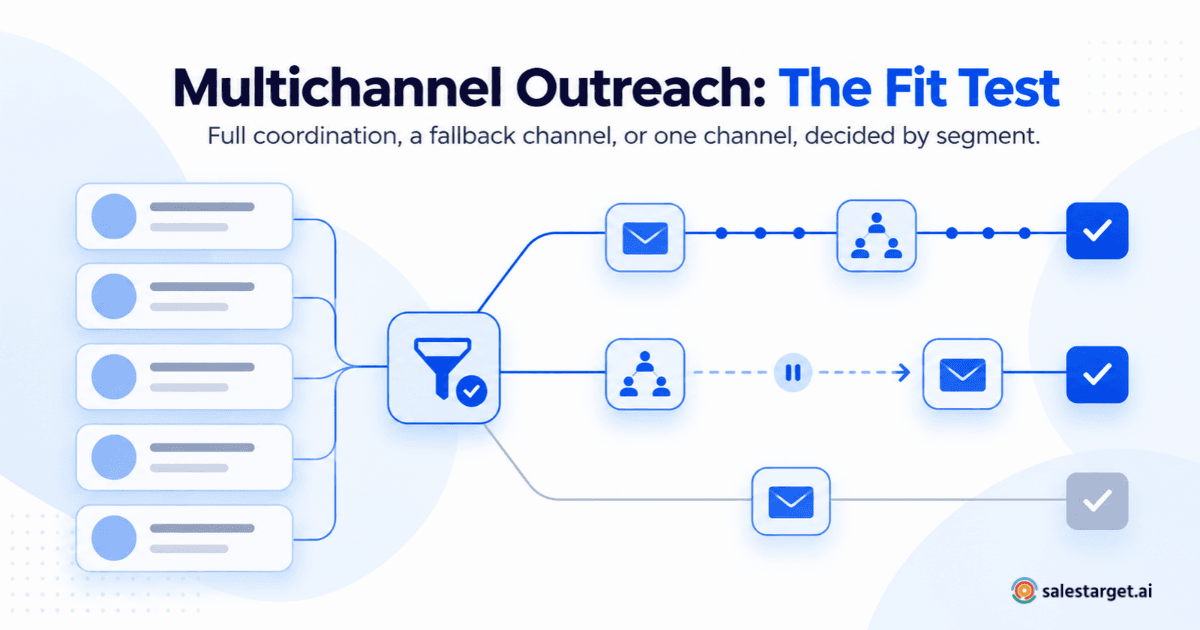
Run this test on a segment (accounts with a similar size, buyer role, and buying situation), not on individual leads. Answer each question yes or no.
- Is each account worth more than one shot at a first impression? If a single win would matter to your quarter, or the list is small and hand-built, a second channel is easy to justify. If you’re testing a message across thousands of low-value accounts, it usually isn’t.
- Can you reach the buyer on both channels? That means a verified work email and a LinkedIn profile with some recent activity. LinkedIn steps aimed at dormant profiles are touches nobody sees.
- Is the buying cycle long enough for one channel to go quiet? In longer cycles, prospects engage, stall, and resurface weeks later, so a second channel gives the conversation somewhere to continue. In fast, transactional sales, one well-timed follow-up often does the job.
- Do you have more than one useful thing to say? Each channel needs its own reason to exist, such as a relevant observation, a sharper question, or a short example. If you only have one message, sending it twice in two formats won’t help.
- Can your team answer on both channels within one business day? If not, fix reply coverage before you add a channel.
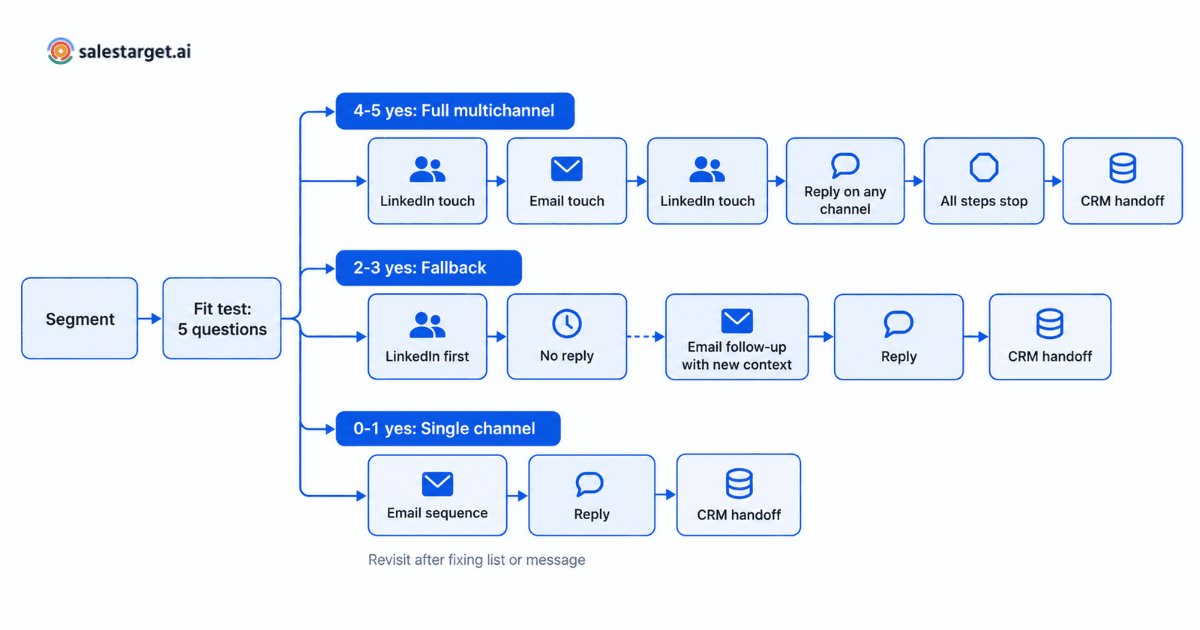
Count the yes answers and place the segment in one of three tiers.
Four or five yes answers: run full multichannel outreach
These segments justify a coordinated sequence that uses both channels from the start. Your next decision is which channel should open the sequence, which depends on intent signals, deal stage, and past engagement.
Two or three yes answers: use the second channel as a fallback
This is the tier most teams skip. Lead on the channel the segment responds to best, and bring in the second channel only when the first goes quiet. For example, a LinkedIn conversation that stalls after the connection is accepted gets an email follow-up that adds new context instead of repeating the opener. You keep the simplicity of one main channel while giving stalled conversations a second path.
Zero or one yes answer: stay single-channel for now
Tighten the list, the message, or the data first. Adding a channel to a segment that fails this test usually spreads the same weak result across two platforms.
Three scenarios, three different answers
Here’s how the fit test plays out in three common situations. They’re illustrative examples, not benchmarks.
An agency targeting 250 named accounts in one niche. Each account is valuable, buyers post on LinkedIn regularly, verified emails are available, the team checks both inboxes daily, and deals take months to close. Five yes answers, so the full multichannel tier makes sense.
An SDR team prospecting thousands of small businesses for a low-touch product. Individual account value is modest, many owners barely use LinkedIn, and decisions happen quickly. One or two yes answers. An email-led sequence fits better, with LinkedIn saved for prospects who reply and need a more personal follow-up.
A founder selling to mid-market teams with a slow buying process. Prospects often accept a LinkedIn connection, exchange a message or two, then go quiet for weeks. Three yes answers. The fallback tier fits: open on LinkedIn and let an email pick up the thread when LinkedIn stalls.
The same company can land in different tiers for different segments. That’s expected: the test sorts segments, it doesn’t label your entire sales motion.
Check operational readiness before you scale
A segment can pass the fit test while your setup still isn’t ready for it. Before you roll it out widely, confirm the basics:
- One prospect record holds the activity from both channels.
- A reply on either channel stops every automated step for that prospect.
- Each segment has an owner who sets its channel plan and reviews the results.
- Email addresses are verified before they enter a sequence.
- Everyone knows who answers LinkedIn replies, and how quickly.
Any gap on this list will surface quickly once two channels are live, usually in front of a prospect.
Pilot it against a single-channel control
The most reliable way to find out whether multichannel outreach is worth it for your team is to test it against what you already do.
- Pick one segment that passed the fit test, ideally one with enough accounts to split in half.
- Split it randomly into two groups. One gets your current single-channel sequence. The other gets the coordinated multichannel version. Keep the targeting and the core message the same.
- Run both through a full sequence cycle. Don’t call a winner while one group still has steps pending.
- Compare outcomes per 100 prospects. Positive replies and meetings booked matter more than opens or connection acceptances.
- Compare the cost side, too. Count rep hours spent writing and replying, plus opt-outs and complaints. A small lift that doubles the workload may not be worth keeping.
Decide in advance what result would justify scaling. If the multichannel group doesn’t clearly beat the control on meetings, without an unacceptable rise in effort or complaints, keep that segment single-channel or move it to the fallback tier. For sample sizes and how to isolate variables, see our guide to A/B testing a multichannel sequence without breaking your data.
After the fit test: choosing how to run it
Once you know which segments warrant a second channel, tooling becomes the practical question. Look for a shared prospect record, a reply on either channel that stops both, and next steps that respond to what the prospect actually did. Our breakdown of multichannel outreach platforms for email and LinkedIn compares how different tools handle those requirements.
Where SalesTarget.ai fits
SalesTarget.ai’s Multi-Channel Outreach feature maps closely to the fallback tier described above. Conversations start on LinkedIn with automated, personalized outreach, and email follow-ups trigger automatically when LinkedIn responses stall. Both channels run in one connected flow, so follow-ups build on earlier messages instead of restarting or repeating them, and lead history stays in one place.
The fit test still applies. Software can keep two channels coordinated; deciding which accounts deserve both is still your call.
Use a second channel where it earns its place
The fit test belongs at the start of any multichannel outreach strategy. Run it segment by segment, give high-value, reachable accounts full coordination, use a fallback channel where conversations tend to stall, and keep everything else simple until a pilot shows otherwise.
Want to see how a LinkedIn-first flow hands off to email when replies stall?