TL;DR
- Applying one fixed channel order to every lead ignores signals you already have sitting in your stack
- ICP fit + intent score, deal stage, and reply history each point toward a different starting channel
- The framework below matches signal combinations to a starting channel, segment by segment — not lead by lead, and not by gut feel
- salestarget.ai surfaces every signal in one workspace, then automatically coordinates the reply-based follow-through once you've set the starting channel
Every outreach guide tells you to lead with LinkedIn. Almost none of them ask whether that's true for the cold enterprise account your AE hasn't touched in eight months, or the SMB lead who just opened your pricing page twice this week. One rule, applied to every segment the same way, is why half your sequences underperform before the first message even sends.
Why One Fixed Rule Breaks Down
"LinkedIn first, always" survives as advice because it's true on average — across a blended population of leads, opening on LinkedIn tends to build more recognition before the ask than a cold email does. But averages hide segment-level failure. A blended win rate can look healthy while quietly underperforming for half your list and overperforming for the other half. Nobody notices, because the aggregate number still looks fine on the dashboard.
The problem shows up in the accounts, not the average. A cold enterprise contact with zero history and a Tier-1 intent signal is a completely different situation from a mid-market lead who replied to a nurture email four months ago and has been sitting in "Nurture" stage since. Treat them the same way — same opener, same channel, same cadence — and you're not running one strategy. You're running no strategy, twice.
Picture two contacts entering your pipeline the same week. The first is a VP at a 400-person company that just posted three open roles matching your ICP and has been showing Tier-1 intent activity for two weeks straight. The second is a director at a 40-person company who matches your firmographic filters but has shown no engagement anywhere. Send both of them the same LinkedIn-first, five-touch cadence, and you'll get two very different outcomes for two very different reasons — one because the approach genuinely fit, the other because it happened to work anyway. That's not a repeatable system. That's two coin flips that happened to land the same way.
Research from RAIN Group has found that landing a first meeting with a net-new B2B prospect takes an average of eight touches — and that number assumes every touch is landing somewhere relevant. A generic sequence applied identically across segments burns through those eight touches without the order, timing, or channel actually matching where each contact is. The fix isn't a better fixed cadence. It's making the starting channel a decision, not a default.
The Three Signals You Already Have
Most teams don't lack the data to make this call — they lack a habit of using it before hitting send. The three signals below already live somewhere in your existing stack, whether that's a scoring dashboard, a CRM stage field, or an activity log nobody checks before launching a sequence. None of them require new data collection. They require a five-minute check before a segment goes live.
ICP Fit and Intent Score
Firmographic fit tells you whether this is the right kind of account. Intent data tells you whether they're actually in-market right now, rather than just matching a filter. Combined, they tell you how much patience an account deserves. A high-fit account showing a real intent signal — an open role, a recent trigger event, a Bombora topic spike — is worth the slower, trust-building approach LinkedIn is good at. A lead that matches your ICP on paper but shows no intent signal yet is better served by a faster, more scalable motion. salestarget.ai's intent-based lead scoring surfaces both in one view inside Lead Explorer, so this isn't a guess — it's a number you can build a rule around.
In practice, this looks like pulling a segment where ICP fit is marked strong and at least one real intent signal is present, versus a segment where fit is present but the intent column is empty. The first group has earned a slower opener. The second group hasn't shown you enough yet to justify anything but a fast, low-cost first touch.
Deal or Pipeline Stage
A contact tied to an active deal record isn't a cold lead, even if nobody's messaged them directly yet. Someone sitting in "Nurture" stage has a relationship history with your company that a brand-new cold-outreach sequence completely ignores. Pipeline stage tells you whether you're opening a new conversation or re-entering one that's already underway — and those two situations should never use the same starting channel or the same opening line.
In practice, this means checking pipeline stage before a rep ever drafts an opening line. A contact marked "Nurture" who replied to a webinar invite six weeks ago should never receive a cold-open LinkedIn connection request that reads like the two of you have never spoken. The record already says otherwise.
Reply and Engagement History
Past behavior is the tiebreaker. A contact who's replied to email before but never accepted a LinkedIn request is telling you something concrete about where they're reachable. Activity history across channels turns "which channel should I try" from a guess into a pattern match — and it's the one signal that updates in real time as a sequence runs, not just at the moment you build the list.
In practice, this shows up as a simple check before a sequence launches: has this contact ever opened, clicked, or replied on either channel before? If email has worked before, don't switch to LinkedIn just because a playbook says LinkedIn goes first. Follow the evidence, not the default.
What Counts as a Strong Enough Signal to Flex the Default
The framework above only works if "high fit" and "real intent signal" mean something specific to your team, not just a feeling. Before rolling this out, get RevOps and sales leadership aligned on three thresholds.
- What ICP fit score or tier qualifies as "high" for this exercise — usually the top band your scoring model already produces, not a new scale invented for this framework.
- Which intent signals count as strong enough to justify the slower, LinkedIn-first approach. A single email open shouldn't count. A hiring signal directly tied to the problem you solve, a funding event, or a sustained topic spike should.
- How much prior engagement earns "existing relationship" status. One unanswered email eight months ago is not the same as an active reply thread from last quarter.
Skip this step and the framework becomes just as arbitrary as the rule it's replacing — reps will each draw their own line for what counts as "high intent," and you're back to guessing, just with extra steps. Set the thresholds once, document them somewhere the whole team can see, and revisit them on the same cadence you already use to review your ICP and scoring model. Most teams land on quarterly.
The Decision Framework
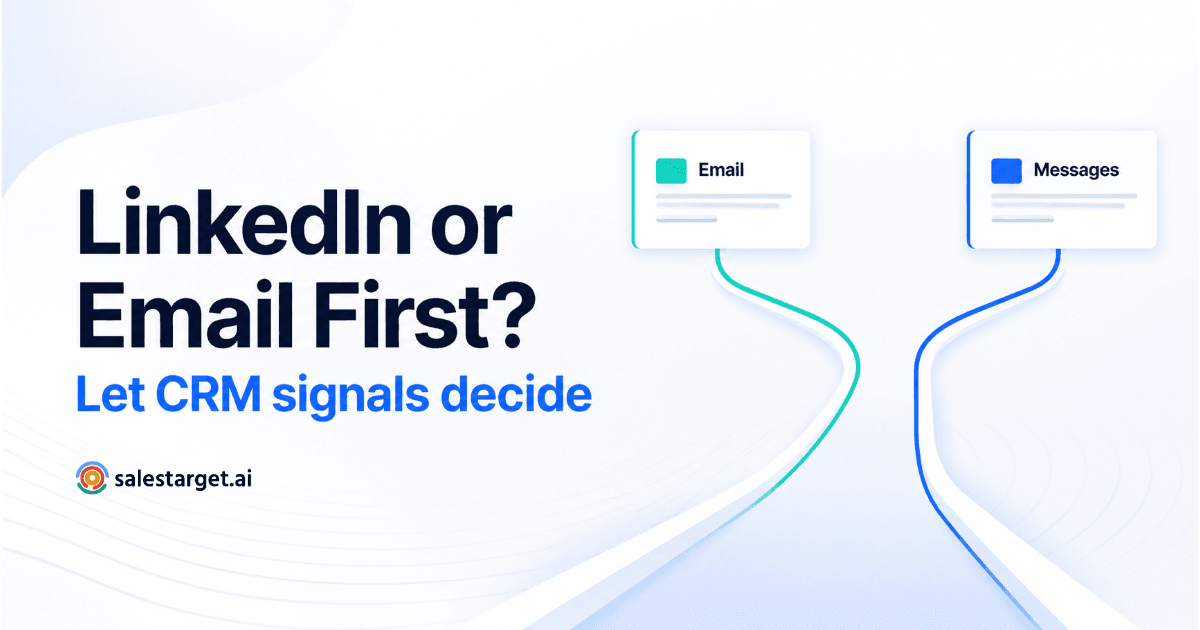
Put the three signals together and a starting-channel rule falls out naturally. It won't cover every edge case, and it isn't meant to — it's meant to replace "always LinkedIn" with a default that actually matches the account in front of you.
- High ICP fit + a real intent signal, no prior history — lead with LinkedIn. This is the account worth the slower, recognition-building approach before a direct ask.
- Broad fit, no scored intent yet, higher-volume segment — lead with email. You need scale and speed to test messaging across a larger list, and LinkedIn's daily action limits weren't built for volume plays.
- Existing engagement on one channel already — lead with that same channel. Continuity reads as familiar. Switching channels on someone who's already engaged reads as starting over.
- Fully cold, no signals at all — default to email first, and only bring in LinkedIn as a second-channel move if the first two email touches go unanswered.
Take a mid-market software company that fits your ICP well but has shown zero intent signals and has no deal history. Under the old rule, that account gets the same LinkedIn-first cadence as your best-fit, highest-intent target account. Under this framework, it gets a faster, lower-cost email sequence instead — freeing up LinkedIn touches, and the daily action limits that come with them, for the accounts that have actually earned the slower approach.
Signals won't always agree, and that's fine. A high-fit account with a strong intent signal that also happens to be sitting in an active "Nurture" deal stage should follow the deal-stage rule, not the fit-and-intent rule — existing relationship context outranks a fresh intent signal every time. As a general order of precedence: prior engagement and deal stage beat ICP fit and intent score, because they describe what's already happened rather than what might happen next.
Notice what this framework doesn't do: it doesn't replace the "LinkedIn builds recognition, email carries the ask" logic that already works — it just stops applying that logic uniformly to accounts it was never meant for. These four rules won't map perfectly onto every CRM setup or every ICP. The point isn't to memorize this exact table — it's to replace "we always start with LinkedIn" with "we start with whichever channel the signals support," documented clearly enough that a new SDR could apply it correctly on day one.
Four Account Profiles, Four Starting Channels
Here's what the framework looks like applied to four common profiles most B2B pipelines contain at any given time. Take the second row as an example: a 35-person logistics company that matches your ICP on paper, but nothing in Lead Explorer shows intent activity yet, and there's no deal record and no prior engagement. That account isn't a bad fit — it's just unproven. Opening on LinkedIn here spends a limited, slow-building channel on an account that hasn't earned the extra patience yet. Opening on email costs less, moves faster, and if a reply comes back, you've just generated your own intent signal.
| Segment | Signal Readout | Starting Channel | Why |
|---|---|---|---|
| Enterprise, high fit | High ICP fit, Tier-1 intent signal, no deal history | Worth the slower trust-building motion before a direct ask | |
| SMB volume segment | Moderate fit, no scored intent yet | Needs scale and speed across a larger list without hitting LinkedIn limits | |
| Mid-funnel, "Nurture" stage | Replied to a marketing email 3+ months ago, active deal record | Continuing the channel they've already responded on reads as familiar | |
| Fully cold, no data | No fit score, no intent, no history | Email, then LinkedIn | Default to the lower-cost channel; add LinkedIn only if email goes unanswered |
The pattern across all four rows is the same: match the channel to what the account has already told you, not to a rule that assumes every account looks the same. High-signal accounts earn patience. Low-signal and volume accounts need speed. Anyone with existing history gets met where that history already lives.
Building This Into Your Actual Workflow
This isn't a per-lead decision your reps make one contact at a time — it's a segment-level rule your whole team follows, set up once and revisited on a schedule. Here's how to build it into a workflow that doesn't depend on any one rep remembering to check three different places before sending.
RevOps typically owns defining the thresholds and the segment-to-channel mapping; sales leadership owns making sure reps actually follow it once it's live. Splitting ownership this way keeps the rule from drifting every time a new rep joins the team.
| Step | What to do |
|---|---|
| 1 | Pull ICP fit and intent score for the segment from Lead Explorer's intent-based scoring |
| 2 | Check whether the contact already has an active record in Deal Pipeline — a new cold-open sequence is wrong for anyone already mid-conversation |
| 3 | Check Activity Tracking for any prior reply or engagement history on either channel |
| 4 | Apply the framework above to assign a starting channel per segment — not per individual lead |
| 5 | Build two sequences in Multi-Channel Outreach — one opening on email, one opening on LinkedIn — and route each segment into the right one |
| 6 | Let the coordination run itself from there — sequences pause on reply and adjust when a connection is accepted, so nobody's manually tracking cross-channel activity once the starting rule is set |
Most teams pilot this on one or two segments before rolling it out everywhere — typically the highest-volume segment and the highest-value segment, since those are the two where getting the starting channel wrong costs the most, either in wasted volume or in a blown first impression on an account that actually mattered.
Once this is running, the manual work is front-loaded. The heavy lifting — assigning segments to a starting channel — happens during setup and during the quarterly review. Day to day, a rep pulling a new segment should be dropping it into an existing sequence, not re-deriving the rule from scratch.
Where Teams Get This Wrong
The failure mode here is rarely the framework itself — it's how loosely teams implement it. Four patterns show up again and again.
Treating it as a one-time decision
A framework built once and never touched again ages the same way a stale lead-scoring model does. ICP shifts, new intent sources get added, and a rule that fit your pipeline six months ago quietly stops matching it. Set a calendar reminder tied to your existing ICP or scoring review — don't rely on someone remembering to revisit it separately.
Applying the rule to individuals instead of segments
Reps eyeballing each contact one at a time reintroduces the guesswork this framework is meant to remove. Set the rule at the segment level so it's consistent across the whole team. If two reps are making different calls on the same segment, that's a sign the rule isn't documented clearly enough yet — not a sign that judgment calls are fine to leave in.
Ignoring what the CRM already knows
Sending a cold-open sequence to a contact who already has deal history is the single fastest way to make a coordinated multichannel motion feel like the opposite — two disconnected people contacting the same person by coincidence. Check pipeline stage before drafting the opener, every time, not just for accounts a rep happens to recognize.
Confusing "we have the data" with "we're using it"
Intent scores and CRM deal stage do nothing on their own. If nobody's segment-mapping process actually pulls them before a sequence launches, the signals sit unused and the team defaults back to habit — usually LinkedIn first, for everyone, regardless of what the data says.
None of this replaces good messaging, proper pacing, or the basic multichannel coordination rules you already follow. It just answers the one question most sequences get wrong before the first word is even written: which channel should go first, for this account, based on what you already know about them. Get that one decision right, consistently, and the rest of your multichannel motion — pacing, messaging, coordination — has something solid to sit on top of.
Stop guessing which channel goes first.
See your intent score, deal stage, and outreach in one workspace with salestarget.ai.
✓ 50 credits ✓ 7-day trial ✓ No credit card required