TL;DR
- Most teams run LinkedIn outreach automation at scale but can't answer a basic question: what pipeline did this actually generate?
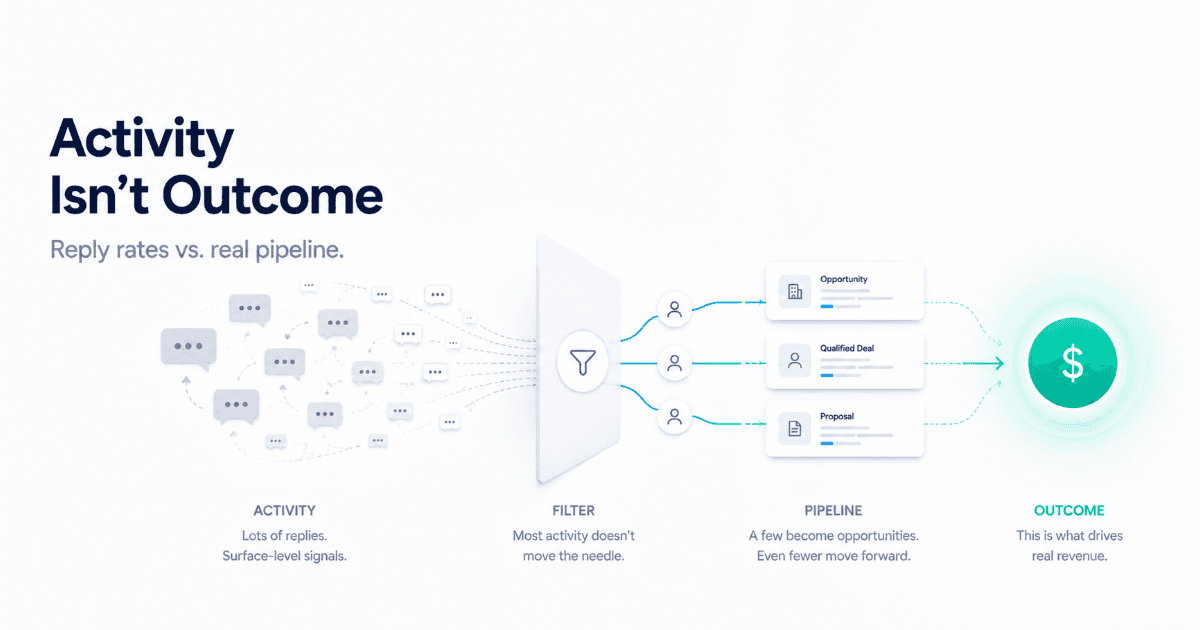
- Reply rate and acceptance rate are activity metrics — not ROI. Pipeline and closed revenue are the only numbers that count.
- Measuring LinkedIn ROI requires a real attribution chain: activity → CRM lead → pipeline stage → closed deal.
- The teams getting this right aren't using better dashboards — they're syncing LinkedIn activity directly into CRM visibility instead of reading two disconnected tools.
Ask most sales leaders what LinkedIn outreach is worth and you'll get a connection-acceptance rate. Ask what it's worth in pipeline and the room goes quiet. That gap — between activity everyone tracks and outcomes nobody connects — is the most expensive blind spot in B2B outbound right now.
Why LinkedIn Pipeline Is the Most Under-Measured Channel in B2B
Cold email has a paper trail almost by default. Opens, clicks, replies, and bounces sit inside the same platform that sent the message, and most teams already tie that data back to CRM. LinkedIn outreach automation doesn't get the same treatment. Connection requests, messages, and replies live inside LinkedIn's own activity feed — separate from the CRM where pipeline actually gets tracked.
The result is a strange industry pattern: teams scale LinkedIn campaign management aggressively, report on sequence-level metrics every week, and still can't tell their CFO how much closed revenue traces back to LinkedIn specifically. Not because the data doesn't exist — because it was never connected to begin with.
That disconnect is becoming harder to justify as LinkedIn sales automation matures into a primary outbound channel rather than a secondary one. A channel generating a meaningful share of pipeline without a meaningful share of attribution is a budget conversation waiting to happen.
The Three Things "ROI" Actually Means for LinkedIn Outreach
Part of why this stays unmeasured is that "ROI" gets used loosely. There are three distinct layers, and most reporting only ever reaches the first one.
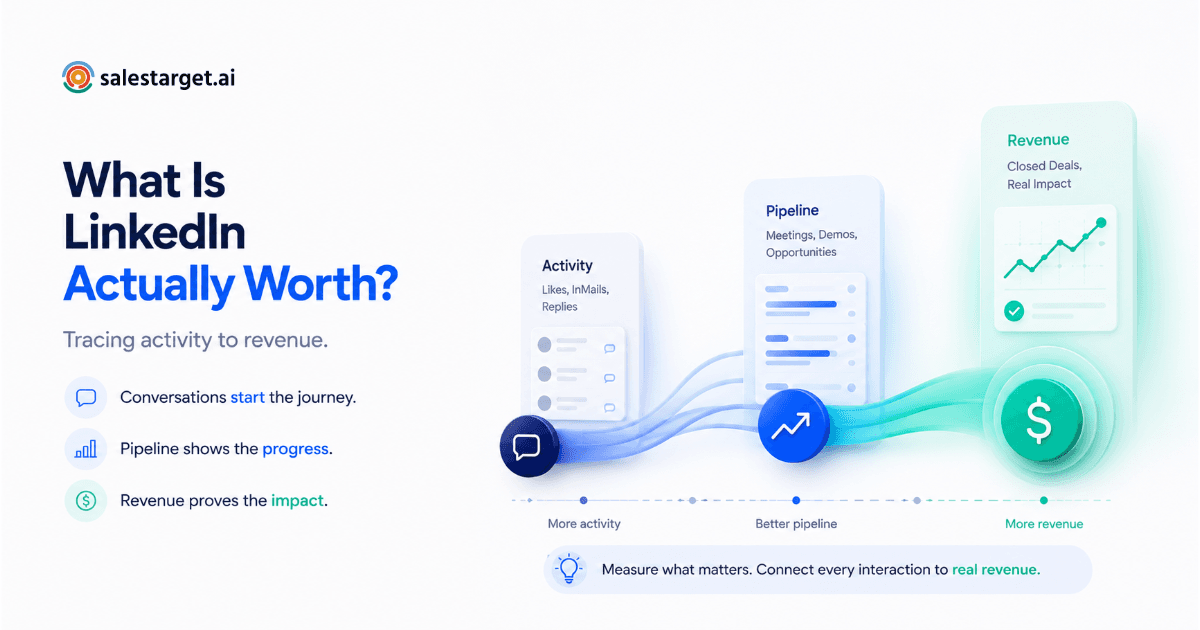
Engagement ROI — acceptance rate, reply rate, conversation rate. Easy to measure, native to every LinkedIn automation tool, and almost entirely disconnected from revenue.
Pipeline ROI — how many of those conversations became a qualified opportunity in the CRM, and how fast. This is where most teams stop measuring, usually because it requires connecting two systems instead of reading one dashboard.
Revenue ROI — closed-won value traced back to a LinkedIn-sourced or LinkedIn-influenced opportunity. The number that actually justifies headcount and tool spend, and the one almost nobody reports on with confidence.
Vanity Metrics vs. Pipeline Metrics
Both columns below come from the same campaign. Only one of them answers the question a CFO actually asks.
| What gets reported | Metric type | Tells you |
|---|---|---|
| Connections sent / accepted | Activity | Volume and outreach reach — not fit or intent |
| Reply / conversation rate | Activity | Message quality — not buying intent |
| Meetings booked from LinkedIn threads | Pipeline | Real conversion from conversation to opportunity |
| Deal value influenced or sourced | Revenue | What the channel is actually worth in dollars |
How to Actually Track LinkedIn Activity Through to Closed Revenue
Real attribution requires a chain, not a snapshot. Each link has to connect to the next one automatically, or the chain breaks the first time someone forgets to log an update.
Activity → CRM lead. Every accepted connection and reply needs to create or update a CRM record the moment it happens — not at end of week, and not manually. This is the step most LinkedIn automation tools skip entirely, which is exactly why LinkedIn Analytics & CRM Visibility exists as a dedicated layer instead of an afterthought feature.
CRM lead → pipeline stage. Once a LinkedIn-sourced lead exists in CRM, it needs a clear source tag that survives every pipeline stage change. Lose the tag at any point and the deal becomes untraceable the moment it's reported on later. CRM Analytics is where that source tag actually gets reported against stage and velocity.
Pipeline stage → closed deal. The final link is patience as much as process — most LinkedIn-sourced deals take longer to close than inbound, so revenue attribution needs to be measured on a longer window than the campaign that started it, or every LinkedIn ROI report will look worse than it actually is.
What Most Teams Get Wrong When They Try to Measure This
Measuring activity instead of outcomes
Mistake
A weekly report full of acceptance and reply rates feels like measurement. It isn't — it's a proxy that stops at the moment a deal actually starts forming.
No CRM sync at the point of activity
Mistake
If a rep has to manually log a LinkedIn reply into CRM, some percentage of replies will never get logged. Manual sync isn't a process — it's a leak.
Attributing too early — or not at all
Mistake
Crediting a deal to LinkedIn the moment a meeting is booked ignores the email follow-ups, calls, and CRM touches that actually closed it. Multichannel deals need multichannel credit, not a single-channel headline.
Ignoring channel overlap entirely
Mistake
Most pipeline today is influenced by more than one channel. Treating LinkedIn ROI as if it operates in isolation — the way cold email ROI often gets measured in isolation too — undercounts every deal that involved both.
Where LinkedIn ROI Measurement Is Headed in 2026
The direction is unmistakable: unified attribution across channels, not channel-by-channel dashboards compared manually after the fact. As LinkedIn outreach automation and email outreach increasingly run through the same platforms, the artificial wall between "LinkedIn metrics" and "CRM metrics" is starting to look like a reporting limitation rather than a real boundary.
The teams that get ahead of this aren't waiting for a perfect attribution model. They're closing the activity-to-CRM gap now, tagging source at the point of first contact, and accepting that revenue attribution takes longer to mature than a sequence does to send. That patience is the actual ROI strategy — not a better dashboard.
Stop guessing what LinkedIn is worth.
See every LinkedIn touch synced to CRM pipeline, automatically.
✓ 50 credits ✓ 7-day trial ✓ No credit card required
Frequently Asked Questions

See It In Action: Book Your Free Demo
Get a personalized walkthrough and see how it works for your team.
Book My Demo →