LinkedIn Outreach Is Getting More Expensive Per Lead
LinkedIn's outreach ceiling keeps dropping while your fixed costs stay flat. Here's the 2026 cost-per-lead math, why spinning up more accounts has limits, and the multichannel response that keeps pipeline predictable.
TL;DR
- LinkedIn's limits have tightened in stages — from no formal weekly cap before 2022 to roughly 100 connection requests a week today, shared across every account tier.
- As the ceiling drops, the same fixed cost spreads over fewer conversations — so cost per booked meeting climbs even when your targeting and copy stay identical.
- Adding more accounts adds volume but also adds subscription cost, warm-up lag, and restriction risk. Returns diminish fast.
- The durable fix is rebalancing: let email carry volume, let buying signals raise conversion, and reserve LinkedIn's expensive touches for your highest-fit prospects.
- A multichannel system sequences LinkedIn and email together, so no single capped channel decides your pipeline.
In 2021, a single LinkedIn account could fire off 250-plus connection requests a week and nobody blinked. In 2026, that same account is capped near 100 — and Free, Premium, and Sales Navigator all pay the same ceiling. Your cost per lead didn't rise because you got worse at outreach. It rose because the runway got shorter.
This is the part of LinkedIn outreach nobody prices in. Everyone tracks reply rates and meetings booked. Far fewer track what a booked meeting actually costs once you account for a shrinking daily allowance. And that number has been quietly moving in the wrong direction for two years. Here's the trend, the math, and what to do before it eats your quarter.
How LinkedIn's limits quietly tightened
The squeeze didn't happen overnight. According to LinkedIn limit trackers that document platform behavior year over year, the platform hardened in distinct phases. Before 2022, most accounts could send 200 to 300 invitations a week before anything throttled, and automation tools openly advertised far higher daily numbers. In early 2022, LinkedIn introduced a weekly hard cap near 100 connection requests as part of an anti-spam push. Since 2024, free accounts have been throttled further — limited to roughly a handful of personalized invite notes per month before they can only send blank requests.
The number itself isn't the whole story. What matters for cost is that the ceiling is now reputation-based, not subscription-based. LinkedIn adjusts your personal limit based on account age, acceptance rate, and how many of your requests get ignored or marked "I don't know this person." Drop below roughly a 30% acceptance rate and the platform tightens your allowance further — sometimes well under the baseline. New accounts under three months old are typically capped near 50 to 80 requests a week until they build trust.
Paying more doesn't buy your way out
This is the trap teams keep falling into. Upgrading tiers doesn't lift the connection cap — that ceiling is the same whether you're on Free or the most expensive Sales Navigator plan. What you buy with a paid tier is messaging headroom around the invitation system: InMail credits, advanced search, Open Profile messaging. And even those are metered. Plan allocations run from roughly 5 InMail credits a month on entry-level Premium up to 50 on Sales Navigator Core — a monthly allowance, not an open tap. For comparison, a single sending mailbox comfortably handles 150 to 200 emails a day at near-zero incremental cost. That gap between channels is the entire thesis of this piece.
The cost-per-lead math as the ceiling drops
Here's the mechanism, in plain terms. Your LinkedIn outreach carries a mostly fixed monthly cost: the Sales Navigator seat, your automation tooling, and the rep's fully loaded time. That cost barely moves whether you send 100 requests a week or 250. What moves is the number of conversations at the bottom of the funnel. When the ceiling drops, the same fixed cost gets divided across fewer meetings — and cost per lead rises with nothing else changing.
📊 The numbers behind the squeeze
- ~100 connection requests/week — the 2026 ceiling, shared across Free, Premium, and Sales Navigator (reputation-based, not subscription-based) — LinkedIn limit trackers, 2026
- 200–300/week — what most accounts could send before the 2022 anti-spam cap — LinkedIn limit trackers
- 5–50 InMail credits/month — typical paid allocations (entry Premium to Sales Navigator Core) — LinkedIn plan documentation
- 150–200 emails/day per mailbox — practical send volume at near-zero incremental cost — deliverability guidance
The table below is an illustrative model, not a benchmark — the percentages are round assumptions so you can see the shape of the problem. Plug in your own acceptance and meeting rates and the direction holds. Notice the fixed cost is held constant on purpose, to isolate what the shrinking ceiling alone does to your cost per meeting.
| Metric (per account, illustrative) | Loose-limit era (~2021) | 2026 (tightened) |
|---|---|---|
| Weekly connection cap | ~250 | ~100 |
| Requests sent per month | ~1,000 | ~430 |
| Accepted (assume ~33%) | ~330 | ~140 |
| Meetings booked (assume ~4% of accepted) | ~13 | ~6 |
| Fixed monthly cost (seat + tool + rep time) | ~$1,400 | ~$1,400 |
| Cost per booked meeting | ~$108 | ~$233 |
Same rep, same targeting, same copy — roughly double the cost per meeting. That's the trend line, and it only bends one way as long as LinkedIn keeps tightening. If your acceptance rate has also slipped (which pushes your personal cap down further), the real curve is steeper than this clean model shows.
Why spinning up more accounts hits diminishing returns
The obvious move is to run more seats. If one account gives you 100 requests a week, three should give you 300. On paper the volume triples. In practice, the economics don't.
Every extra account triples the part of your cost that was supposed to stay fixed — another Sales Navigator subscription, another automation seat, and real management overhead keeping each profile's activity natural and separated. New accounts don't hit full stride immediately, either: profiles under three months old are held to roughly 50 to 80 requests a week until they build a track record, so you're paying full freight during a warm-up window that produces a fraction of the output. And more accounts means more surface area for restrictions — one flagged profile means lost pipeline and recovery time. Multi-account scaling can absolutely help, but it moves your cost-per-lead curve sideways, not down. You're buying more of an increasingly expensive channel instead of changing the mix.
The strategic response: rebalance, don't brute-force
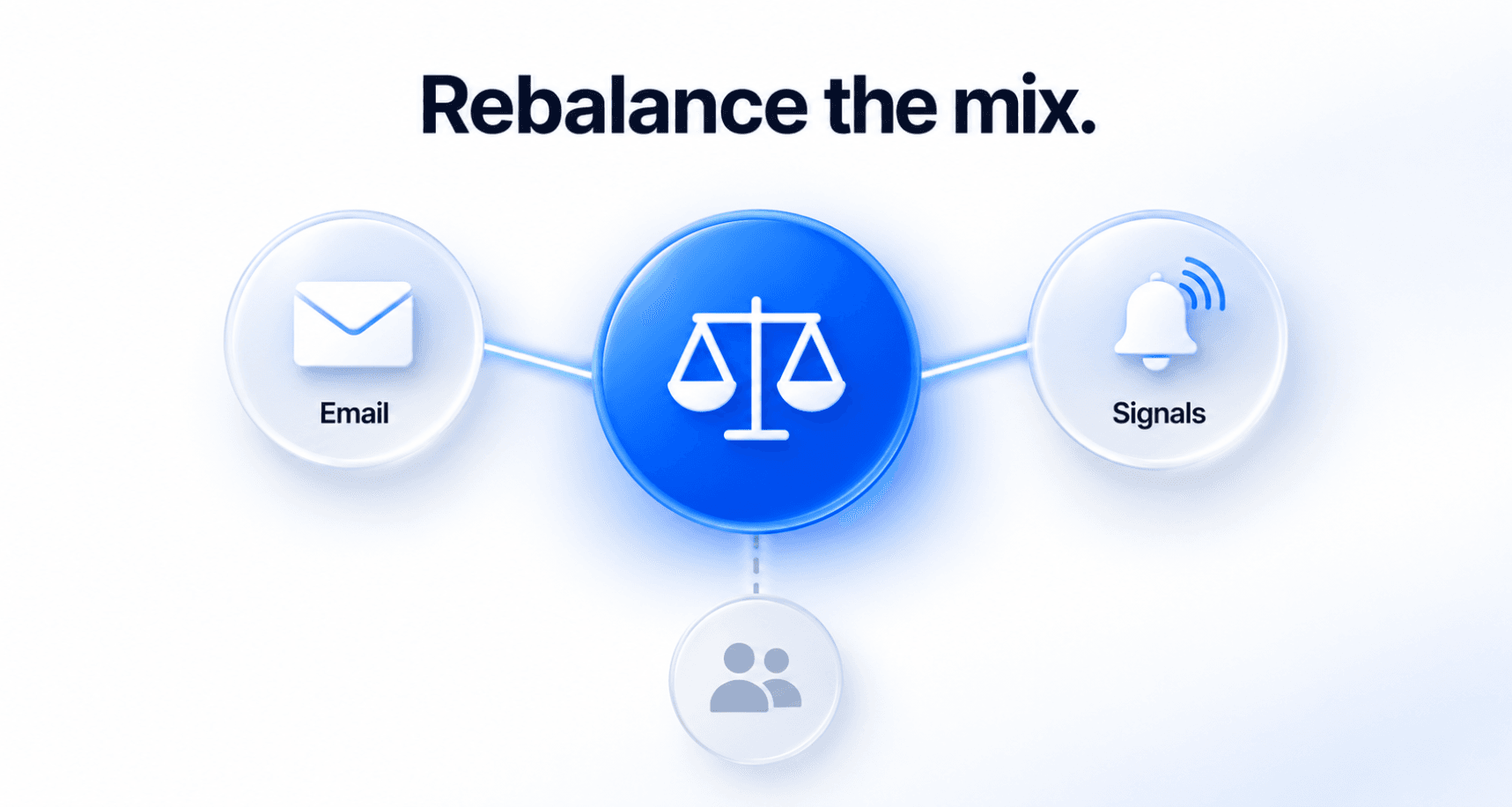
If LinkedIn is becoming a premium, rationed channel, the answer isn't to pour more money into raising its ceiling. It's to stop asking one capped channel to carry your entire number. Three shifts do the heavy lifting.
Let email carry the volume
Email has no equivalent weekly cliff. A single mailbox handles 150 to 200 sends a day, and you scale by adding inboxes rather than begging an algorithm for headroom. The catch is deliverability — volume only works if your domains are warmed, your inboxes rotate, and your list is clean. That's an infrastructure problem, and it's a solvable one. Built correctly on email infrastructure designed to scale, email becomes the channel that absorbs volume at a marginal cost LinkedIn simply can't match.
Let signals raise conversion
The cheapest way to lower cost per lead isn't more touches — it's better-timed ones. When you reach out because a company just raised funding, hired for a relevant role, or showed another buying signal, your reply and acceptance rates jump, which means fewer touches per meeting. On LinkedIn specifically, higher acceptance also protects your account's standing and keeps your cap from shrinking. Signals turn a volume game into a timing game, and timing is far cheaper than volume.
Reserve LinkedIn for precision
Once email owns volume and signals own timing, LinkedIn gets to do the one thing it's still unbeatable at: high-trust, human touches to your best-fit prospects. Spend your ~100 weekly requests and metered InMail credits on the accounts that genuinely warrant them, not on spraying a cold list. A capped channel used with precision is an asset. A capped channel used as a volume firehose is just an expensive one.
How a multichannel system hedges against the trend
Rebalancing only works if your channels actually talk to each other. Running LinkedIn in one tool and email in another leaves you with two disconnected volume problems instead of one coordinated system. The point of a multichannel platform is to make the rebalance operational.
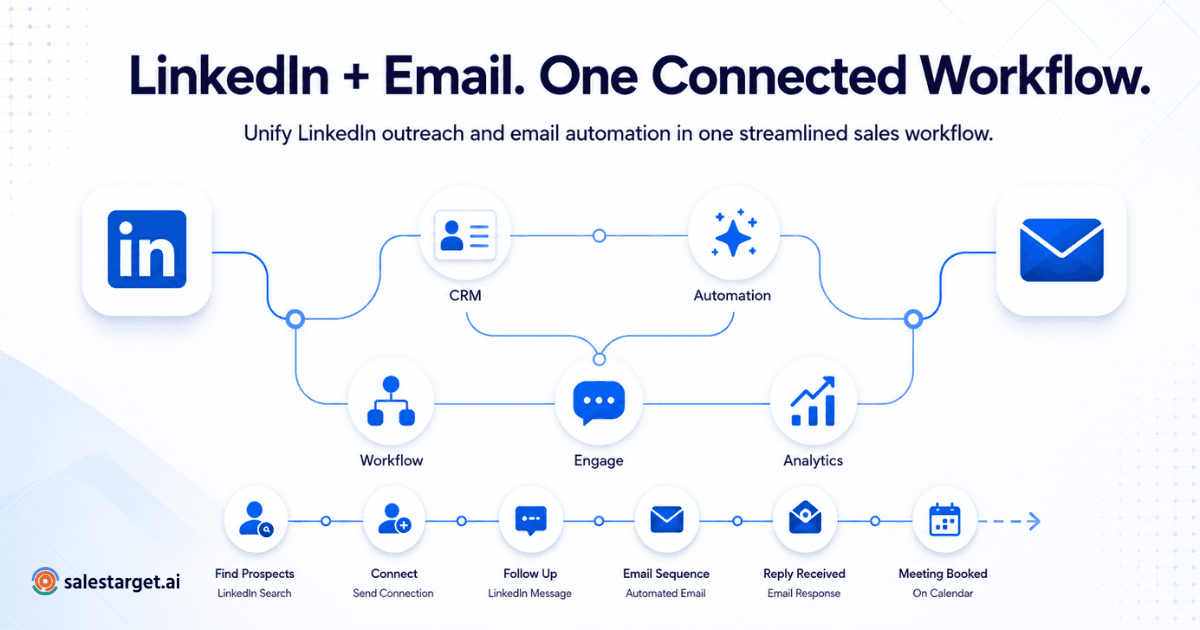
SalesTarget is built around exactly this shift. You can sequence LinkedIn and email in one connected flow — choose whichever channel should lead based on your audience, and the other channel follows up automatically when a thread goes quiet, so every touch builds on the last instead of firing blind. Buying-signal discovery surfaces accounts worth reaching out to now, so your limited LinkedIn touches land when acceptance is highest. Email warm-up, inbox rotation, and deliverability tooling keep the volume channel healthy as it scales. And LinkedIn outreach with built-in pacing and safety controls keeps your sending inside the limits that protect your account's standing — and its cap. The hedge isn't any single feature. It's that no one rationed channel gets to decide your quarter.
Mistakes that quietly inflate your cost per lead
Treating LinkedIn as a volume channel in 2026
The core mindset error
The platform has repriced itself as a precision channel. Pushing more raw volume through a ~100-per-week ceiling doesn't scale pipeline — it just raises your cost per meeting and risks your acceptance rate.
Solving the cap by stacking accounts without a plan
The expensive shortcut
More seats triple your fixed cost and your restriction surface while new profiles crawl through weeks of warm-up. You often pay 3x for far less than 3x the output.
Ignoring acceptance rate
The hidden multiplier
A low acceptance rate doesn't just waste requests — it shrinks your personal cap, compounding the cost problem. Tighter targeting and better-timed outreach protect both your funnel and your ceiling.
Stop letting one capped channel set your cost per lead.
Run LinkedIn and email as one signal-driven system — and keep pipeline predictable as limits tighten.
✓ 7-day trial ✓ No credit card required ✓ Set up in minutes
Frequently Asked Questions

See It In Action: Book Your Free Demo
Get a personalized walkthrough and see how it works for your team.
Book My Demo →