Multi-channel outreach is the practice of coordinating prospect engagement across LinkedIn, email, phone, and other touchpoints inside a single, sequenced workflow. When powered by AI, it replaces the scattered manual prospecting that drains SDR productivity. Modern B2B sales teams use AI-driven multi-channel outreach to personalize messages at scale, time follow-ups based on buyer signals, and consistently fill pipeline without burning out reps.
Here's the uncomfortable truth most sales leaders already sense but haven't acted on: sending the same templated email to 500 prospects each Monday isn't a strategy. It's a habit. And it's costing you pipeline.
Multi-channel outreach flips the script. Instead of hoping a single channel breaks through the noise, you orchestrate touches across LinkedIn, email, and even phone — in a sequence that feels deliberate rather than desperate. The shift from single-thread tactics to a coordinated AI-powered multi-channel outreach strategy is the biggest operational upgrade a revenue team can make right now.
But let's go beyond the buzzwords. What does this actually look like inside a team that's doing it well?
What Multi-Channel Outreach Actually Looks Like in Practice ?
Forget the textbook definition for a second. In practice, multi-channel outreach means a prospect sees a LinkedIn connection request on Tuesday, a value-driven email on Thursday, and a relevant content share the following Monday — all tied together by intent data and CRM activity.
The magic isn't the number of channels. It's the coordination. When channels operate in silos — one SDR blasting emails, another sending LinkedIn invites with no shared context — the buyer experience feels disjointed. They get three messages from the same company that read like they're from three different companies.
Coordinated outreach solves that. Every touch builds on the previous one. The LinkedIn message references the email. The follow-up references the LinkedIn engagement. The prospect feels like they're talking to one informed person, not a machine.
Why Manual Prospecting Can't Keep Up ?
Manual prospecting worked when deal volumes were lower, buyer committees were smaller, and inboxes were quieter. None of those things are true in 2026.
Here's what an SDR's day looks like on a manual workflow: open LinkedIn, scroll through connection requests, copy a prospect's title into a Google Doc, switch to the CRM, log the activity, draft an email, personalize the first line, send it, set a reminder, move to the next prospect. Repeat 40 times. That's an entire day producing maybe 40 semi-personalized touches.
The math simply doesn't scale. And it's exactly why AI sales automation is replacing manual prospecting across high-growth B2B organizations. When you automate the mechanical parts — CRM logging, channel sequencing, follow-up scheduling — reps spend their time on the conversations that actually close deals.
How AI Transforms Outreach Without Making It Sound Robotic ?
The biggest fear with any AI sales tool is that it'll strip the humanity out of your messaging. That's a valid concern — but only if you're using AI as a "set it and forget it" spam engine.
The best implementations use AI for the parts humans are bad at (consistency, timing, data synthesis) and keep humans in the loop for the parts AI is bad at (judgment, empathy, creative problem-solving).
Personalization at Scale
AI can scan a prospect's LinkedIn activity, recent company news, job changes, and CRM history to draft personalized openers in seconds. A human rep reviews and tweaks. The result is a message that references something genuinely relevant to the prospect — written in a fraction of the time.
Based on anonymized outreach campaign observations across growing SaaS teams, sales reps using coordinated LinkedIn + email workflows reduced manual prospecting time by approximately 45% while improving reply consistency. That's not a marginal gain. That's half a workday returned to selling.
Follow-Up Timing and Buyer Intent Signals
Timing matters more than most teams realize. Sending a follow-up three days after a prospect viewed your pricing page is fundamentally different from sending one three weeks later. AI watches for these buying signals — page visits, email opens, LinkedIn profile views — and triggers follow-ups when interest is warm, not when a calendar reminder fires.
Understanding whether to lead with LinkedIn or email based on CRM buying signals is a decision framework every SDR manager should build into their playbook. The channel that works best depends on the prospect's behavior, not your team's preference.
LinkedIn + Email Sequencing: The Combination That Wins
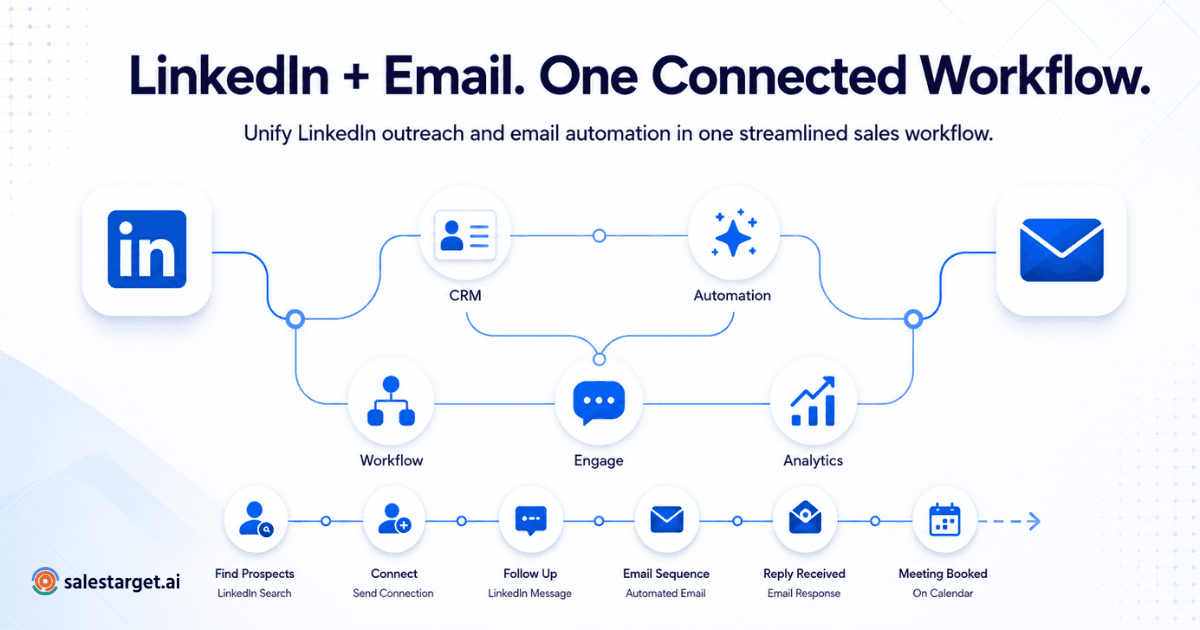
There's a reason LinkedIn sales automation paired with email remains the dominant B2B outreach combination. LinkedIn builds familiarity and social proof. Email delivers depth and specificity. Together, they create a surround-sound effect that single-channel outreach simply can't match.
A practical sequence might look like this:
- Day 1: LinkedIn connection request with a short, relevant note.
- Day 3: Personalized email referencing a shared connection or industry challenge.
- Day 6: LinkedIn comment or reaction on the prospect's recent post.
- Day 9: Follow-up email with a case study or relevant resource.
- Day 14: LinkedIn voice note or brief video message.
Each touchpoint reinforces the last. The prospect doesn't feel ambushed - they feel pursued by someone who actually understands their world.
For teams scaling LinkedIn specifically, a solid LinkedIn automation guide for B2B sales teams covers the compliance guardrails and practical workflows you need to stay effective without risking account restrictions.
Deliverability, CRM Sync, and the Operational Details That Matter
Strategy is only as good as execution. And execution in outreach hinges on a few unsexy but critical operational elements.
Email Deliverability
If your emails land in spam, nothing else matters. Proper domain authentication (SPF, DKIM, DMARC), sending volume warm-up, and inbox rotation are non-negotiable foundations. AI tools that manage sending reputation automatically give teams a meaningful edge here.
CRM Synchronization
Every outreach touch should log back to the CRM without manual effort. When a rep sends a LinkedIn message, it should appear on the contact record. When an email gets a reply, the deal stage should update. This closed-loop system is what separates scalable pipelines from spreadsheet chaos. According to Gartner's research on sales technology trends, organizations that fully integrate their sales tools with CRM systems see measurably higher quota attainment.
Ready to see this in action? Switch from manual prospecting to SalesTarget AI - see a 5-min demo.
Manual Prospecting vs. AI Multi-Channel Outreach
| Dimension | Manual Prospecting | AI Multi-Channel Outreach |
|---|---|---|
| Time per prospect | 15–25 min | 2–4 min |
| Personalization | Limited by rep bandwidth | AI-assisted at scale |
| Daily volume | 30–50 touches | 150–300+ coordinated touches |
| Follow-up consistency | Depends on rep discipline | Automated, signal-based |
| Reply tracking | Manual spreadsheet logging | Real-time dashboards |
| CRM sync | Copy-paste or forgotten | Automatic, bidirectional |
| Channel coordination | Siloed | Sequenced across channels |
| ROI trajectory | Flat, labor-intensive | Compounds over time |
Common Mistakes That Sink Multi-Channel Campaigns
Even with the right tools, teams stumble when they skip the fundamentals:
- Over-automating without review. Sending AI-generated messages without a human glance leads to tone-deaf outreach. Always keep a rep in the loop for quality.
- Ignoring channel-specific norms. LinkedIn messages should be shorter and more conversational than emails. Treating every channel the same flattens your effectiveness.
- No unified reporting. If you can't see LinkedIn and email performance in the same dashboard, you're flying blind on what's actually driving replies.
- Skipping warm-up. Blasting 200 emails from a fresh domain is a fast track to the spam folder.
Signs Your Outreach Process Needs AI
Check every box that applies to your team:
- Reps spend more than 50% of their day on non-selling tasks.
- Follow-up timing is inconsistent across the team.
- LinkedIn and email outreach run on separate, unconnected workflows.
- CRM data is often stale, incomplete, or logged inconsistently.
- You can't attribute pipeline to specific outreach sequences.
- Reply rates have dropped steadily over the past two quarters.
- Scaling outreach means hiring more reps, not improving systems.
- Personalization is limited to first name and company name.
If you checked four or more, your team is leaving pipeline on the table — and an AI-driven workflow would make a material difference.
How to Evaluate an AI Sales Tool for Multi-Channel Outreach?
Not all tools are built the same. When evaluating any AI sales tool for multi-channel outreach, LinkedIn's business solutions offer a useful baseline for understanding how professional networking integrates into sales workflows. Beyond that, here's what to look for:
- Native LinkedIn + email sequencing in a single platform (no Zapier glue required).
- AI-generated message drafts with human review capability.
- CRM integration that's bidirectional and real-time.
- Built-in deliverability management (domain warm-up, rotation, reputation monitoring).
- Intent signal tracking — who's engaging, when, and on which channel.
- Transparent analytics that tie outreach activity to pipeline and revenue.
Where Multi-Channel Outreach Is Heading?
The trajectory is clear: outreach is becoming more intelligent, more personalized, and more automated — without becoming less human. Expect to see AI that can adapt message tone based on a prospect's communication style, predict the best channel and time for each individual contact, and integrate real-time competitive intelligence into outreach sequences.
Teams that adopt multi-channel outreach now won't just keep up. They'll build a compounding advantage in pipeline velocity, rep efficiency, and buyer experience that's very difficult for laggards to close.