TL;DR
- Funding signals decay fast — most of the real window closes within days, not weeks
- By the time a round hits TechCrunch, you're already behind — the SEC Form D filing goes public up to 15 days earlier
- Outreach within 30 days of a funding announcement produces meaningfully higher response rates than cold outreach to non-funded companies
- Every "congrats on the raise" email reads identical — the message framework matters as much as the speed
- A saved funding filter beats manually checking Crunchbase every morning
Every sales team sees the same alert. A funding round hits TechCrunch, and by lunch, fifty reps have already sent "Congrats on the raise!" to the same inbox. The deal doesn't go to whoever noticed first — it goes to whoever reached out before the flood, with a message that didn't read like the other forty-nine.
The 48-Hour Funding Window: Why Speed Matters This Much
A funding announcement isn't the moment a company starts being worth reaching out to — it's the moment everyone else finds out at the same time. The press release, the TechCrunch writeup, the LinkedIn congratulations post: those all land on the same day, which means every sales team using the same signal source starts their outreach clock at the exact same second.
That's the actual problem. It's not that funding signals aren't valuable — our Signal Stack breakdown covers why they convert 3-5x better than cold outreach. It's that the moment a signal becomes visible to you is usually the same moment it becomes visible to everyone else chasing the same account. Whoever built the fastest pipeline from "signal appears" to "message sent" wins the inbox, not whoever has the best copy.
Research tracking outreach to recently funded companies shows response rates run roughly 2.3x higher within the first 30 days of a funding announcement compared to cold outreach to non-funded companies. But that multiplier isn't flat across the whole window — it's front-loaded. A message sent on day one lands in a mostly empty inbox. A message sent on day five lands underneath forty other "congrats" openers, and the multiplier collapses toward zero.
Think about what actually happens inside a newly funded company in the first week. The founder is fielding investor calls, doing press interviews, posting the announcement themselves, and replying to a flood of LinkedIn congratulations — on top of running the business. By day three or four, most of that inbound gets triaged into "read later," and "read later" is where most sales outreach quietly dies. The teams that get an actual reply are almost always the ones who showed up before the triage folder existed.
Where Funding Signals Actually Come From
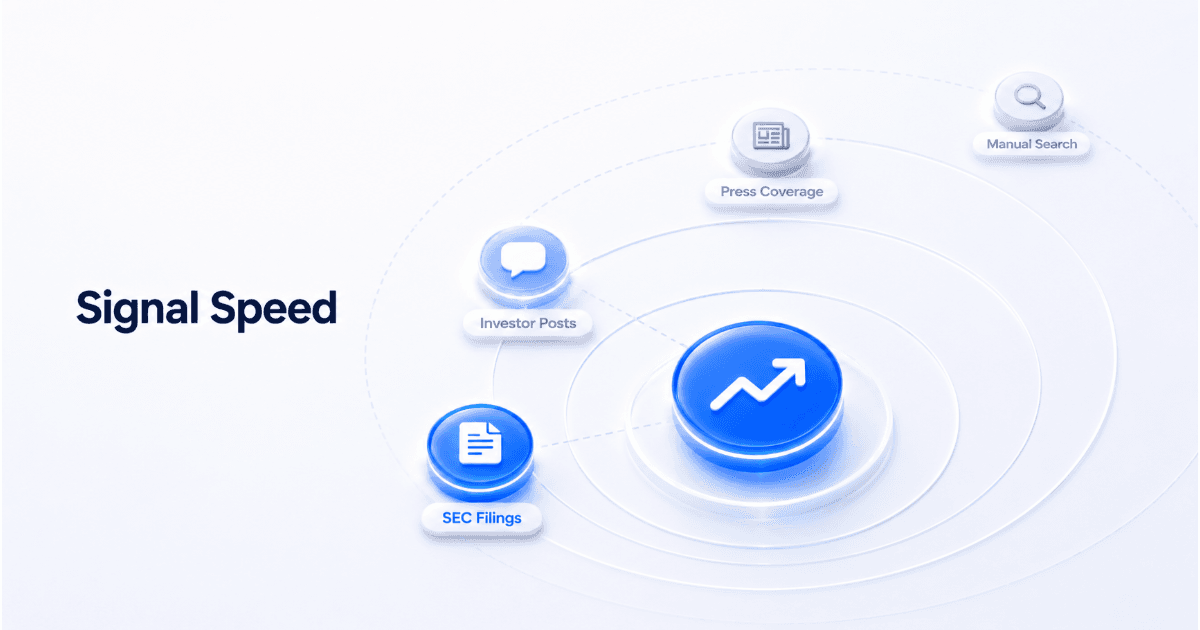
Not all sources surface a signal at the same speed. Ranked roughly fastest to slowest:
SEC Form D filings
U.S.-based companies raising private capital are required to file a Form D with the SEC within 15 days of closing the round. That filing is public the moment it's submitted — often well before the press release goes out. Most sales teams never think to check it, which makes it one of the fastest legitimate sources available, if you know to look.
Investor and founder social posts
Lead investors frequently post about a deal on LinkedIn or X before the embargo on press coverage lifts — they're not bound by the same publication timing as journalists. Following a handful of active VCs in your category surfaces some rounds a day or two before they hit TechCrunch.
Press coverage and funding databases
TechCrunch, Crunchbase, and PitchBook are reliable but structurally slower — most of them are reporting on a press release that already went out, which means you're reading the same signal at the same time as every competitor doing the same search. Useful for volume and backfill, not for being first.
Google Alerts and manual search
Setting an alert for phrases like "raises $" alongside your target industry is free and genuinely works — but it depends on the same press coverage as everything else, arrives at the same time as every other alert-based search, and returns a lot of noise you have to manually qualify against your ICP before it's useful. It's a reasonable backstop, not a speed advantage.
A saved signal filter inside your prospecting tool
Manually checking four or five sources every morning doesn't scale, and it's the first habit that slips when the week gets busy. A saved filter that surfaces funding events within a recent lookback window turns this into a five-minute daily check instead of an open-ended research task, and it doesn't depend on you remembering to do it — more on how that filter actually works further down.
The practical takeaway: treat SEC filings and investor social posts as your early-warning layer for the handful of accounts you'd chase manually anyway, and let a saved filter cover the rest of your target list so nothing falls through simply because nobody had time to check Crunchbase that day.
The Funding-Signal Message Framework That's Actually Different
Speed gets your message into the inbox first. It doesn't make the message worth answering. Here's the sequence that separates a reply from a delete:
| Step | What to do |
|---|---|
| 1. Skip the word "congrats" | It's the first word in every other email they've received today — open with something else entirely |
| 2. Reference what the round signals, not the round itself | A Series B usually means a hiring plan or a new market push — name that, not the dollar amount |
| 3. Tie it to a real, specific trigger | Connect the signal to a problem your product actually solves at that exact stage — not a generic pitch |
| 4. Keep the ask small | Ask a question, not for a demo — a low-friction ask gets answered faster in a full inbox |
| 5. Send before the press cycle peaks | Day one or two, not day five — by then you're competing with a full inbox instead of an empty one |
Put together, a working opener sounds closer to: noticing the round signals a specific kind of scaling push, naming the operational bottleneck that tends to show up at that stage, and asking one direct question about whether it's already on their radar — no dollar figure, no "congrats," no demo link.
Compare that to the version everyone else is sending: an opener that leads with congratulations, restates the round size back to the founder, pivots straight into a feature list, and closes with a calendar link. It's not that this version is rude — it's that it's completely interchangeable with the other forty-nine messages sitting above it in the same inbox. The version that gets a reply is the one a founder couldn't have received from anyone else, because it required actually noticing something specific about their situation.
Where "Congrats on the Raise" Emails Go Wrong
Founders at newly funded companies see the same pattern of outreach within hours of the announcement. Here's what makes yours indistinguishable from the other forty-nine:
"Congrats on the raise!" as the entire opener
Mistake
It's not that the sentiment is wrong — it's that it's the first line of nearly every message the founder receives that day. It signals template, not attention.
Pitching the product in the first line
Mistake
A founder juggling investor calls and press interviews on announcement day has no bandwidth for a full pitch. Lead with the observation, not the ask.
Naming the round size instead of what it signals
Mistake
Restating the dollar figure back to them adds nothing — they know how much they raised. Naming what usually happens next at that stage shows you understand their situation, not just their headline.
Sending after everyone else already has
Mistake
By day five, the inbox is full and the founder has stopped reading past the first line of anything that starts with "congrats." Speed isn't optional here — it's half the strategy.
Treating every newly funded company the same
Mistake
A seed round and a Series C signal completely different priorities. Sending the same message regardless of round type reads as a mail-merge, not a message written for that company's actual stage.
Manual Monitoring vs. a Saved Signal Filter
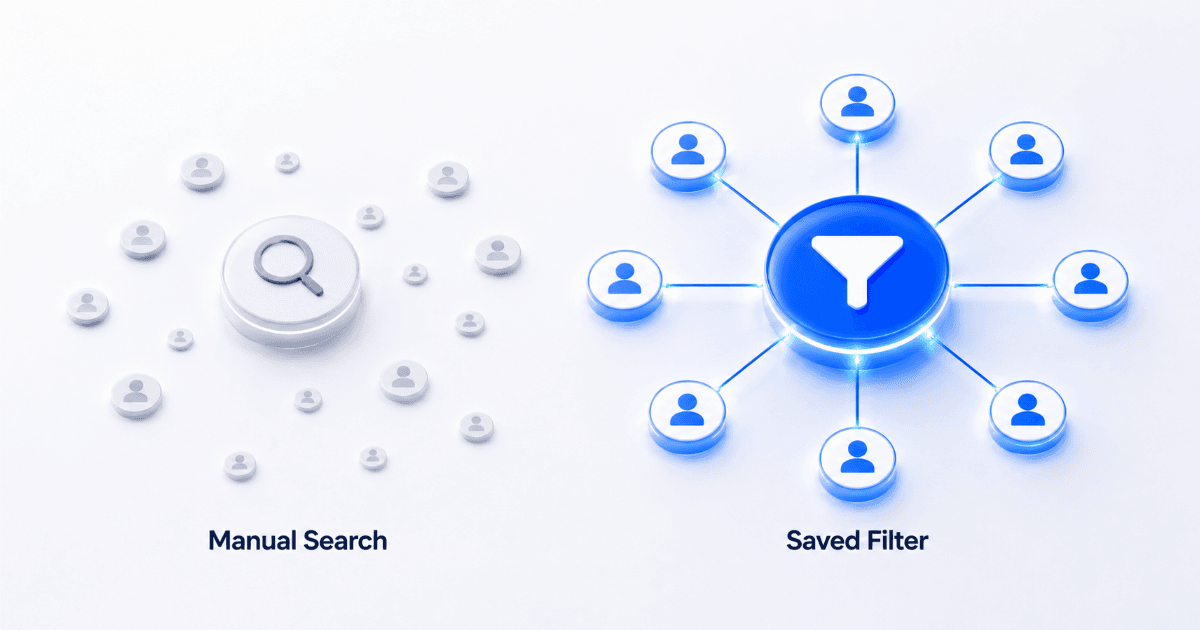
Picture two reps chasing the same list of Series A/B companies in their vertical. Rep A checks Crunchbase and TechCrunch manually most mornings, when the schedule allows — some days it happens before 9am, other days it gets pushed to the afternoon or skipped entirely when a forecast call runs long. Rep B set up a saved filter once, checks it for five minutes at the start of the day as a fixed habit, and moves straight into outreach.
Over a month, Rep A catches most of the obvious, high-profile rounds — the ones that made TechCrunch's front page — and misses a chunk of the smaller raises that didn't get major press but still match their ICP perfectly. Rep B catches both, consistently, because the filter doesn't have a busy Tuesday. The gap isn't about who works harder. It's that one workflow depends on remembering to do something extra every single day, and the other doesn't.
| Dimension | Manual daily search | Saved signal filter |
|---|---|---|
| Time cost | 20-40 minutes daily, if it happens | Under 5 minutes daily |
| Consistency | Skipped on busy days — signals get missed | Runs every time, no manual step to forget |
| ICP fit | Every result needs manual qualifying | Pre-filtered to ICP before you see the list |
| Coverage | Limited to the two or three sources you check | Pulls from a broader dataset in one search |
📊 Why the first 30 days matter most
- Outreach to funded companies within the first 30 days sees response rates roughly 2.3x higher than cold outreach to non-funded companies
- Most of that lift is front-loaded into the first several days — the multiplier shrinks fast as the inbox fills up
How SalesTarget Surfaces Funding Signals
This is where the "saved filter" idea above becomes concrete. SalesTarget's Real-Time Signal Discovery lets you filter Lead Explorer by funding stage, round size, recency, and investor — layered on top of your existing ICP filters (industry, company size, job title). You set a lookback window of 30 to 90 days; the 30-day setting surfaces the freshest signals available.
In practice, that means running the filter each morning as part of your routine — not waiting for a headline to catch your attention — and getting back a pre-qualified account list where the funding event happened recently and the company already matches your ICP. When an account surfaces, contact data is unlocked in one click, so there's no separate step between finding the signal and having someone to email. Funding results also feed into intent-based lead scoring, so accounts that are both freshly funded and matching your ICP automatically rise to the top of your list instead of getting buried under everything else in your pipeline.
It won't replace watching a specific investor's LinkedIn feed for the handful of rounds that leak a day early — nothing beats that for pure speed on a small number of accounts. What it replaces is the daily grind of manually cross-referencing multiple sources for the other 95% of your target list, so your first message goes out while the inbox is still empty instead of on day five.
None of this works without the message framework above. Speed gets you to the front of the line; a message that sounds like every other "congrats" email still gets deleted from the front of the line. Combine both, and you're one of the first messages a founder reads that actually sounds like it was written for them.
Funding signals aren't a secret — every sales team targeting growth-stage companies already knows to watch for them. What separates the reps who convert them from the reps sending message number fifty is simply this: a repeatable way to see the signal early, and a message that doesn't read like everyone else's.
Catch the Signal Before the Flood.
Set a saved funding filter in SalesTarget and reach newly funded accounts while the inbox is still empty.
✓ 50 credits ✓ 7-day trial ✓ No credit card required