If you have ever imported a contact list into your CRM and watched half the records bounce, you already know the cost of bad data. Missing titles, stale company info, and unverified emails turn a promising outbound push into wasted SDR hours. A lead enrichment tool solves exactly that — and building a reliable data enrichment workflow around one separates pipelines that convert from those that stall.
A lead enrichment tool is B2B data enrichment software that appends missing or outdated information — verified emails, job titles, firmographic enrichment attributes, technographic data, and buying intent signals — to raw contact records, making them complete enough for targeted outbound campaigns.
Why Raw Contact Lists Fail?
Most outbound teams inherit or purchase lists that look complete at first glance. Dig deeper and the cracks show. A verified contact data approach reveals just how much is typically wrong.
Emails go unverified and bounce rates spike. Company records reference organizations that were acquired or rebranded. Titles sit blank or reflect roles from two promotions ago. Without firmographic enrichment, segmentation becomes guesswork. Duplicates clog CRM queues, personalization suffers, reply rates drop, and sender reputation erodes.
According to Salesforce's State of Data report, sales teams consistently rank incomplete records as a top barrier to quota attainment (source: Salesforce, "State of Data and Analytics").
What Is a Lead Enrichment Tool?
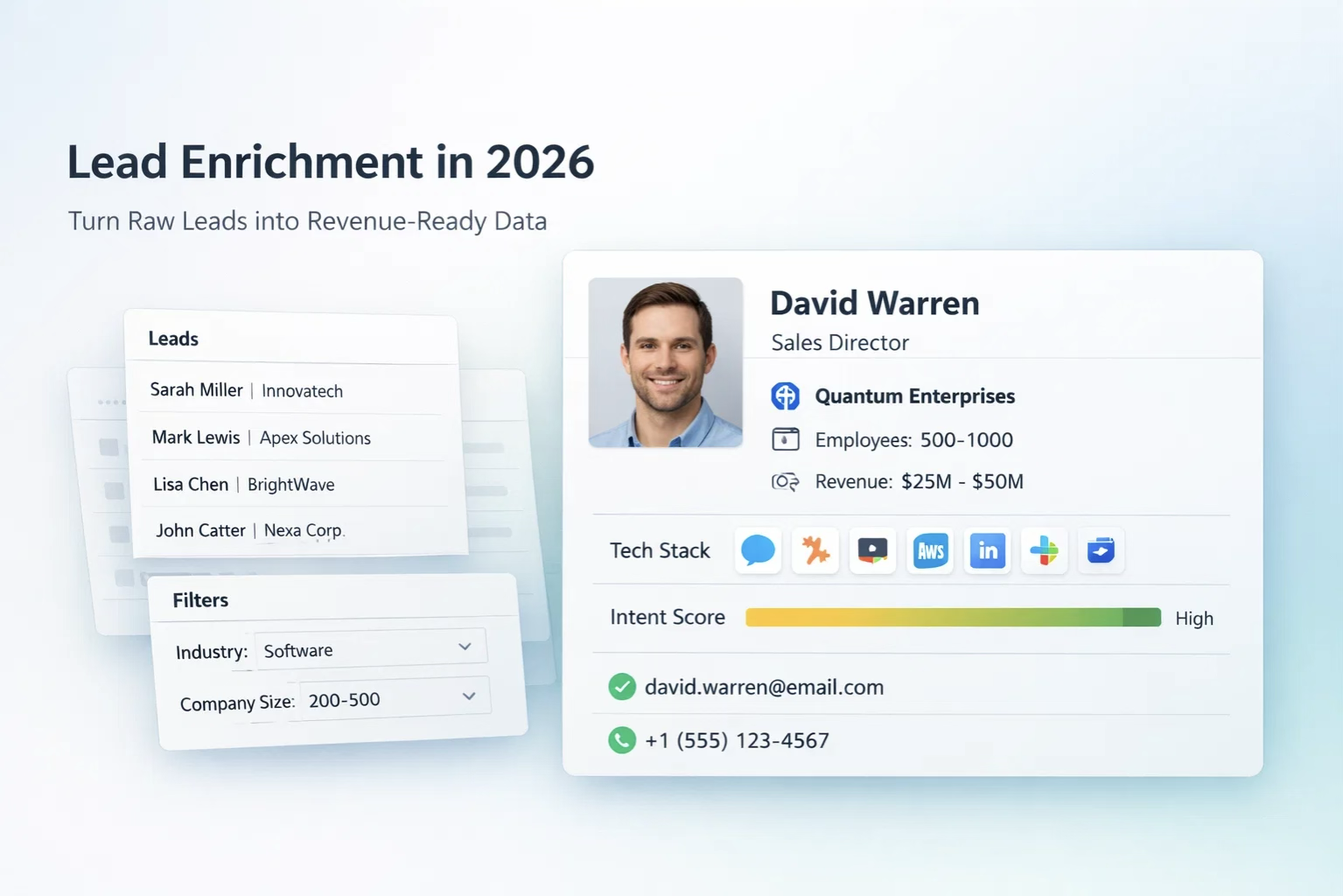
A lead enrichment tool connects to multiple data sources and layers missing attributes onto existing records across four dimensions:
- Contact Enrichment: Verified emails, direct-dial phones, current titles, seniority levels, and LinkedIn URLs.
- Company Enrichment: Firmographic enrichment fields — industry, employee count, revenue, headquarters, funding history.
- Intent Enrichment: Buying signals, technology adoption patterns, and engagement indicators suggesting active research.
- CRM Enrichment: Syncing enriched fields directly into Salesforce, HubSpot, or your CRM so reps work from a single source of truth.
You might start with a name and company domain. After enrichment, that record includes a verified email, the company's tech stack, and a flag showing competitor website visits — the leap from a cold name to an actionable lead.
How a Modern Data Enrichment Workflow Works?
A repeatable data enrichment workflow does not require a massive tech stack. It requires clarity at each stage:
Step 1: Collect raw leads. Pull contacts from event registrations, inbound forms, or a what is a lead generation platform that sources net-new prospects.
Step 2: Verify contacts. Run email verification and phone validation before enriching. No point decorating a dead email address.
Step 3: Add firmographic enrichment. Append industry, size, revenue, and location to enable proper segmentation.
Step 4: Layer in technographic data. Identify tools and platforms the prospect already uses — this shapes competitive positioning.
Step 5: Identify buying signals. Look for intent indicators like job postings, technology evaluations, or content consumption patterns.
Step 6: Sync into CRM. Push enriched records with mapped fields. CRM enrichment should be automated, not a manual CSV upload.
Step 7: Launch campaigns. Route enriched, segmented leads into sequences or ABM plays with confidence.
The Three Layers of Prospect Intelligence
A framework I have used with dozens of RevOps teams to audit enrichment maturity:
- Layer 1 — Identity: Name, title, verified email, phone. Table stakes.
- Layer 2 — Context: Company size, industry, tech stack, funding, org structure. Where firmographic enrichment and technographic data live.
- Layer 3 — Timing: Intent data, hiring patterns, competitive evaluations. This separates good prospecting from great.
Teams at Layer 1 can send emails. Teams across all three have relevant conversations — and that distinction drives conversion gaps.
What Data Should You Enrich?
| Field | Why It Matters | Example |
|---|---|---|
| Name | Basic identity for personalization | Jane Patel |
| Title | Determines seniority and relevance | VP of Revenue Operations |
| Company | Firmographic foundation | Acme SaaS Inc. |
| Industry | Enables vertical segmentation | Financial Services |
| Employee Count | Qualifies company size tier | 1,200 employees |
| Revenue | Prioritizes enterprise vs. SMB | $85M ARR |
| Technologies Used | Powers technographic messaging | Uses Salesforce, Marketo |
| Buying Intent | Flags active evaluation cycles | Researching CRM alternatives |
| Enables social selling | linkedin.com/in/janepatel | |
| Verified Email | Ensures deliverability | jane.patel@acmesaas.com |
| Phone | Supports multi-channel outreach | +1 (555) 234-5678 |
| Location | Territory routing and compliance | Austin, TX, USA |
Observational Insight: Based on aggregated outbound workflow analysis, teams enriching both firmographic and technographic attributes before outreach typically see 35–50% higher personalization efficiency and stronger reply rates compared with teams relying on basic contact data alone. This benchmark is observational, not independently verified.
Benefits of Better Prospect Data Quality
Better prospect data quality compounds across every funnel stage. If you want to understand the foundational work feeding enrichment, how to find B2B leads is a strong starting point.
- Sharper Personalization: Enriched titles, tech stacks, and context let reps write messages referencing something real.
- Stronger Deliverability: Verified emails keep bounce rates low and protect sender reputation.
- Higher Response Rates: Enriching cold lists with industry context and buying signals outperforms raw blasts.
- Cleaner CRM: Deduplication and standardized fields improve forecasting accuracy.
- Improved SDR Productivity: Reps sell instead of researching. Ramp time shrinks, activity volume rises.
- Stronger Segmentation: Slice by industry, tech stack, intent, size, or geography with accuracy.
Lead Enrichment Best Practices
- Verify before you enrich. Validation first, enrichment second — always.
- Standardize field formats across sources before syncing. Inconsistent naming silently creates duplicates.
- Refresh records quarterly at minimum. Contact data decays at roughly 30% per year according to HubSpot research (source: HubSpot, "Database Decay").
- Map enriched fields to your CRM schema before importing. Unmapped data sits unused.
- Prioritize enrichment for high-value segments. Not every record needs the same depth.
- Use technographic data as a conversation starter, not just a filter.
- Audit enrichment accuracy monthly with random spot-checks.
- Build feedback loops between SDRs and ops to flag and fix bad data.
- Document your data enrichment workflow to avoid single points of failure.
Common Mistakes to Avoid
- Enriching outdated lists: Clean first, enrich second.
- Skipping verification: Enrichment without validation decorates bad records with fields that lead nowhere.
- Ignoring technographic data: Firmographics alone miss competitive context that transforms messaging.
- Overloading your CRM: Import only the fields your team will actually use.
- Not refreshing records: Data decays. Treat enrichment as ongoing maintenance.
How SalesTarget.ai Lead Explorer Helps ?
If you are assembling a data enrichment workflow from scratch, tooling matters. SalesTarget.ai Lead Explorer consolidates several steps into one workspace — verified contact data alongside company intelligence, firmographics, technographic data, and buyer intent signals — so you are not toggling between platforms to build a complete prospect record.
The practical workflow orientation stands out. Filter by industry, company size, technology usage, and intent indicators, then export CRM-ready lists that map directly into your sales process. Instead of enriching cold lists manually, you start with records already enriched and verified.
If you want to compress the time between identifying a target account and launching a sequence, Build Your Prospect List with Lead Explorer and see how much cleaner the workflow becomes when enrichment is built in from the start.
Raw contact data is a starting point, not a pipeline. Teams that outperform in outbound treat enrichment as infrastructure. Build a repeatable data enrichment workflow, insist on prospect data quality at every stage, layer firmographic enrichment and technographic data on verified contacts, and use tooling that makes the process sustainable.