What Is Lead Enrichment and Why It Matters More Than Lead Generation in 2026
TL;DR
- Lead enrichment adds firmographics, tech stack, intent signals, and verified contacts to a prospect record
- Lead generation finds leads. Lead enrichment makes them actionable. They are not the same thing
- Most enrichment tools use a batch model — export, wait, clean, import — introducing delay and stale data
- The better architecture: enrichment at point of discovery — same tool, same click, live verification
- B2B contact data decays at ~30% annually. Batch enrichment ignores this. Point-of-discovery does not
- Lead enrichment feeds directly into lead scoring — ICP fit + intent signal = highest-priority accounts
The Problem No One Is Talking About
Sales teams are not failing because they have too few leads. They are failing because the leads they have are not ready to work.
A name and a company domain is not a lead. It is the starting point of a lead. Everything between that starting point and a qualified, reachable, actionable contact — that gap is what lead enrichment closes.
Most B2B content treats lead enrichment like a feature. A bolt-on. Something you add after the fact. That framing is exactly why SDR teams are still losing hours to manual research, watching cold email bounce rates climb, and chasing volume when the actual problem is data quality.
This article makes a different argument: lead enrichment is not a feature. It is an architecture decision. And the teams getting it right are not just enriching more leads — they are enriching them at the right moment, in the right workflow.
📊 Industry benchmark: According to Gartner, poor data quality costs organisations an average of $12.9 million per year. In B2B sales, that cost lands most heavily on the SDR team — in manual research time, bounced outreach, and missed pipeline.
What Is Lead Enrichment?
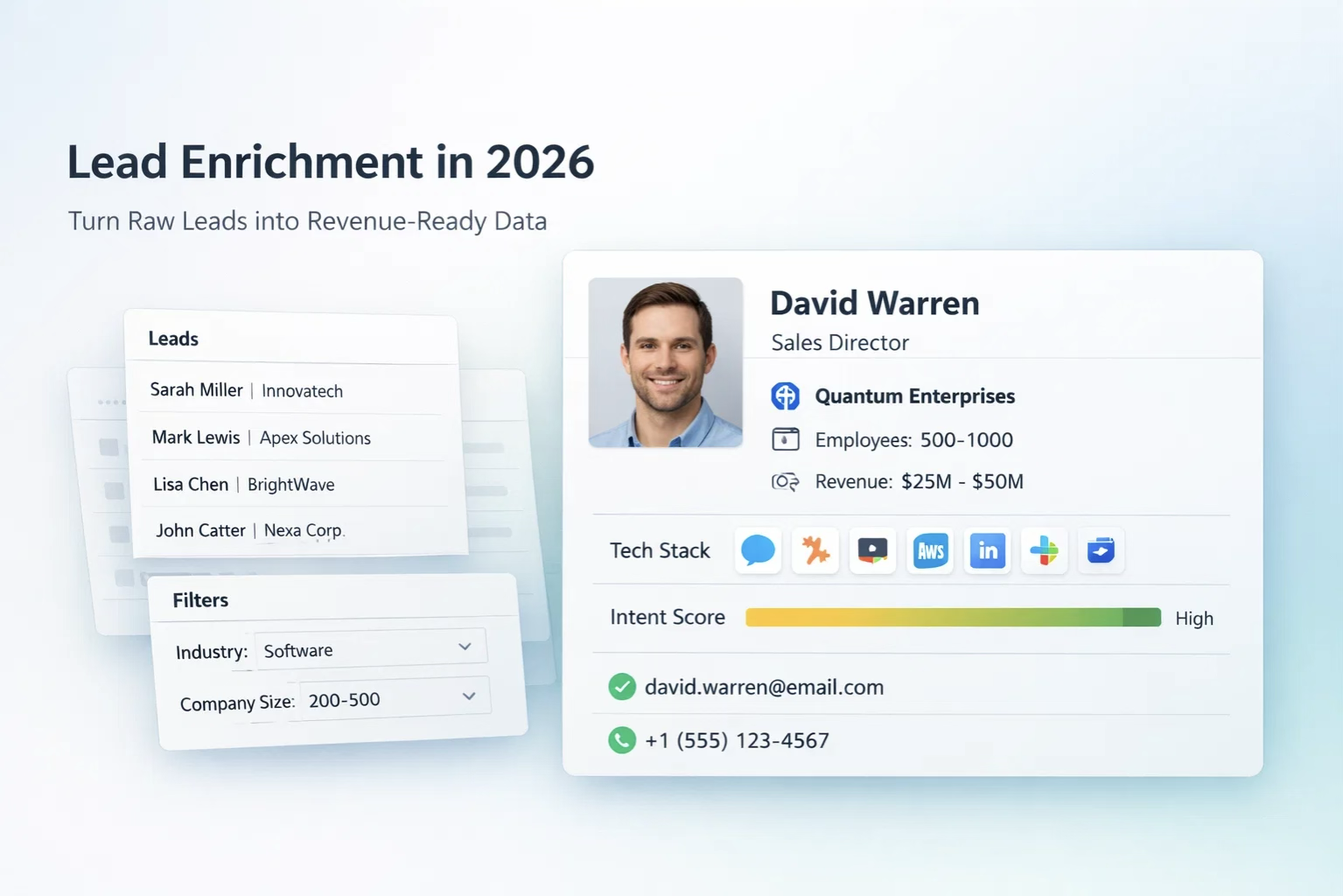
Lead enrichment is the process of adding structured data to a prospect record — taking a partial contact and turning it into a complete, actionable one. When a lead surfaces through search, an inbound form, or a database lookup, you typically start with the basics: name, job title, company name.
Lead enrichment fills in everything your team actually needs before outreach can begin — across thousands of data signals, covering hundreds of millions of professional profiles and business entities.
| Category | What it includes | Why it matters |
|---|---|---|
| Firmographic data | Company size, revenue, HQ location, industry, founded year, no. of locations | Confirms ICP fit before any SDR time is spent |
| Technographic data | CRM, marketing stack, devops tools, BI software, HR systems | Shows whether the company is a realistic buyer or displacement opportunity |
| Intent signals | Bombora intent topics, in-market research activity, 30–90 day lookback | Tells you if a company is actively researching a solution like yours right now |
| Verified contacts | Professional email, personal email, direct dial, mobile | Ensures outreach actually reaches a real, current person |
What lead enrichment is not: it does not find new leads. That is what lead generation does. Lead enrichment takes the leads that already exist and makes them worth working.
Lead Enrichment vs. Lead Generation: The Actual Difference
Lead generation and lead enrichment are often bundled together in tool marketing. They are not the same capability and they solve different problems.
| Aspect | Lead Generation | Lead Enrichment |
|---|---|---|
| What it does | Finds new prospects | Makes existing prospects actionable |
| Output | Names, titles, companies | Complete, verified, scored record |
| When it happens | First step in prospecting | During or immediately after discovery |
| Problem it solves | Not enough prospects to contact | Prospects exist but are unworkable |
| Without it | Empty pipeline | Full pipeline that doesn't convert |
Both are necessary. But in 2026, the underinvestment is overwhelmingly in lead enrichment — not generation.
What the difference looks like for an SDR
Without lead enrichment built into discovery:
- Receive a list of 200 prospects
- Open LinkedIn to verify role manually
- Check a separate tool for revenue / headcount
- Try 2–3 email permutations, hope one works
- Manually look up tech stack per company
- By noon: 40 contacts ready, 160 in a spreadsheet
With lead enrichment built into discovery:
- Receive 200 prospects with firmographics attached
- Tech stack already mapped
- Intent scores already calculated
- Verified emails + phones already unlocked
- Sort by intent score in one click
- Full list ready before 9am
📈 Forrester benchmark: B2B organisations with high-quality, enriched data generate 70% more revenue than those with poor data quality. The gap is not in lead volume. It is in data completeness.
Why Batch Enrichment Is the Wrong Architecture in 2026
Most lead enrichment tools operate on a batch model: export your prospect list as a CSV, upload to the enrichment platform, wait for data to be appended, download and clean inconsistencies, then re-import into your CRM or outreach tool.
When this workflow was introduced, it was a genuine improvement over fully manual research. But it has a structural flaw no amount of process optimisation can solve.
Batch lead enrichment separates enrichment from discovery. There is always a gap — measured in hours or days — between when a lead is found and when it is ready to work. In B2B sales, that gap has a real cost.
| Risk | Impact |
|---|---|
| Prospect changes roles | Contact data is stale before it reaches the SDR |
| Intent signal peaks and fades | The window that made this lead valuable closes |
| Funding round news ages | Timing that made outreach relevant has passed |
| Hiring spike normalises | The buying signal is no longer visible |
| Contact data decays | Email bounces, domain reputation suffers |
⚠️ Data point: B2B contact data decays at approximately 25–30% annually. That is one in four contacts becoming inaccurate every year. A batch enrichment cycle that takes 48 hours adds two full days of decay risk on top of a dataset that may already be months old.
The alternative is lead enrichment built into discovery. The lead is found and enriched in the same workflow, using the same tool, in a single action. Firmographics, tech stack, intent signals, and verified contact details — all checked against live records at the exact moment of discovery.
No export. No queue. No import cycle. No copy-pasting. No tab switching.
The Real Cost of Unenriched or Stale Lead Data
Incomplete lead data does not just slow down SDRs. It creates compounding problems across the whole revenue function.
| Problem | Root cause | Business impact |
|---|---|---|
| High cold email bounce rate | Stale contact data | Domain reputation damaged, deliverability degrades |
| Wasted sequence capacity | Unverified contacts fill active slots | Qualified leads get deprioritised |
| ICP misalignment | No firmographic data at discovery | SDR effort spent on wrong-fit accounts |
| Long ramp time | Manual research fills SDR hours | Quota attainment drops in first 90 days |
| Poor sender reputation | Bounce rates exceed 10% threshold | Email provider flags the sending domain |
📬 Deliverability benchmark: Cold email campaigns built on point-of-discovery enrichment consistently produce bounce rates below 5%. Campaigns built on batch-enriched historical data typically run at 15–20%. At typical outbound volumes, that gap is enough to get a sending domain flagged within weeks.
The fix is not better copywriting. It is not more subject line A/B testing. It is cleaner, fresher data — verified at the moment it is accessed, not months before.
Conclusion: The Architecture Question
Lead generation has been a largely solved problem for years. Big databases. Smart filters. AI-assisted search. That space is commoditised.
The unsolved problem — the one most B2B sales teams are still paying for in lost SDR hours, damaged sending domains, and under-converted pipeline — is lead enrichment architecture. Specifically: enrichment happening in the wrong tool, in a separate step, against data verified months ago.
The teams closing that gap are not buying a better enrichment tool to sit next to their prospecting tool. They are using platforms where enrichment is built into the discovery workflow — where finding a lead and making it actionable are one action, not two steps across two products.
SalesTarget.ai's Lead Explorer is built exactly this way — searching across 840M+ professional profiles and 146M+ business entities, with built-in lead enrichment unlocked in a single click the moment you find the prospect. Firmographics, tech stack, intent signals, and verified contact details — all in one action, no separate tool, no CSV export, no tab switching.
Not more leads. Better-enriched ones, faster.
Your next customer is already in there. Go find them.