So how do you actually find B2B leads that turn into revenue? The short answer: combine a clear ideal customer profile with the right mix of data sources, intent signals, and systematic outreach. Forget buying stale contact lists and hoping for the best. Modern B2B prospecting demands sharper targeting, better data, and a process that connects you with the people who are genuinely in-market.
This guide breaks down how to find B2B leads effectively—from defining your target accounts, to choosing the right lead generation sources, to building prospect lists that your sales team will actually want to work. Whether you're an SDR hunting for net-new pipeline, a founder doing your own outreach, or a demand gen leader scaling your team's efforts, you'll walk away with tactics you can apply this week.
The Importance of Defining a B2B Lead
Before diving into tactics, it's worth asking: what makes a contact a "lead" rather than just a name in a spreadsheet? In B2B, a lead is a person at a company that matches your target criteria who has shown some signal of potential interest or fit. That signal can be explicit (they filled out a form) or implicit (their company just raised a Series B and is hiring for roles your product supports).
The distinction matters because chasing every company in a given industry wastes time. Effective B2B contact discovery starts with narrowing the field. You're looking for the overlap between firmographic fit (right size, right industry, right tech stack) and timing (budget cycle, hiring patterns, recent trigger events).
The Growing Challenges of Sourcing B2B Leads
If you've ever pulled a list of 500 companies, spent a week emailing, and gotten three replies—you already know the problem. Most B2B prospecting tactics fail not because of effort, but because of targeting.
Here's what typically goes wrong:
- The ICP is too broad. Targeting "mid-market SaaS companies" isn't a profile—it's a category. Without specifics around tech stack, headcount, growth stage, or buying triggers, your list will be bloated with poor-fit accounts.
- Data is outdated. People change roles every 18 to 24 months on average. A list that's even six months old will have significant bounce rates.
- No intent layer. Firmographics tell you who could buy. Buying signals tell you who's likely buying right now. Skipping the intent layer means you're always guessing.
- Manual research doesn't scale. Scrolling through LinkedIn profiles one by one works when you have five target accounts. It breaks down at fifty.
This is exactly where tools like Lead Explorer change the equation. Instead of assembling data from five different tabs, you can run targeted searches with firmographic and intent filters in a single workspace.
The Step-by-Step Process for Finding B2B Leads
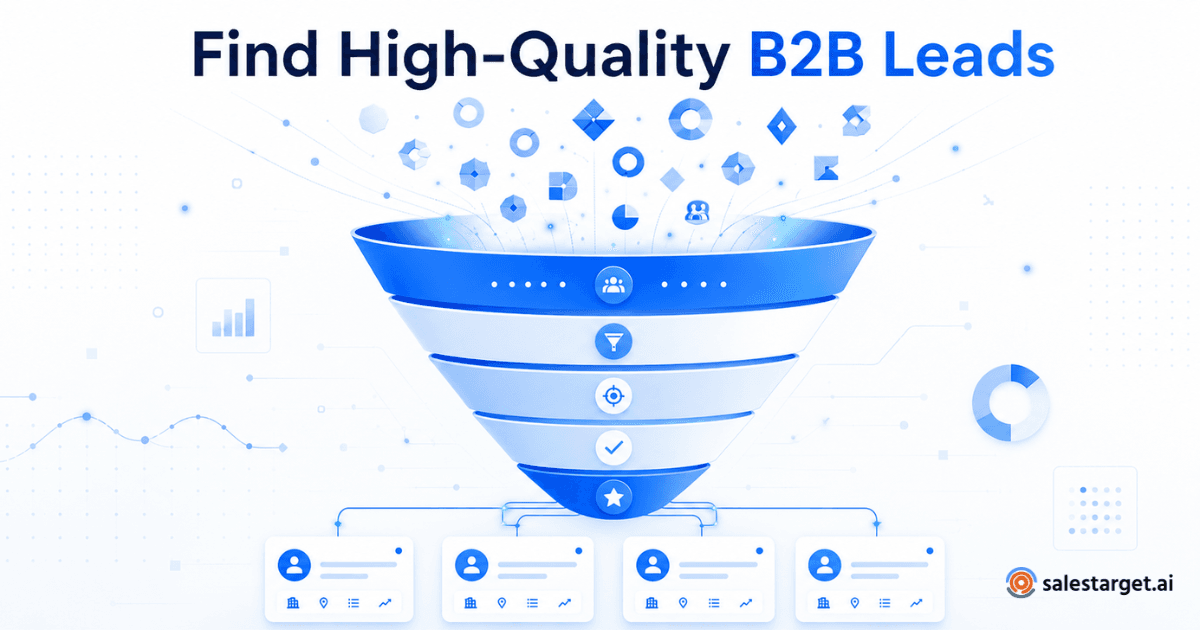
Let's get into the actual mechanics. Think of finding qualified leads as a three-stage process: define, discover, and validate.
Stage 1: Define Your Ideal Customer Profile
You've probably heard this advice before, but here's the nuance most teams miss: your ICP should be built from your best closed-won deals, not from who you think your customer is. Pull your last 20 wins and look for patterns. What industries? What company sizes? What roles were the economic buyers versus the champions?
Once you've mapped those patterns, codify them. Tools like the ICP Builder let you build your ideal customer profile with structured criteria so your entire team prospects against the same standard—not individual guesswork.
Stage 2: Discover Accounts and Contacts
With your ICP locked in, it's time for the actual prospect research. Here's where most reps default to LinkedIn and stop. LinkedIn is valuable, but it's only one source. A modern B2B lead finder approach layers multiple data sources:
- Company databases for firmographic filtering (industry, revenue, employee count)
- Technographic data to see what tools prospects already use
- Intent data to identify companies actively researching topics related to your solution
- Hiring signals that suggest budget allocation and team growth
- Trigger events like funding rounds, leadership changes, or product launches
The goal of this stage is building a working list of accounts and decision-makers. AI-powered smart prospect search can compress hours of manual research into minutes by cross-referencing these data layers automatically.
Stage 3: Validate Before You Reach Out
This is the step most teams skip—and it's the one that separates good pipelines from bloated ones. Before loading a list into your sequencer, verify three things:
- Is the contact still at the company and in the right role?
- Does the account genuinely match your ICP, or did it sneak through a loose filter?
- Is there any signal that suggests this is the right time to reach out?
A validated list of 100 prospects will outperform an unvalidated list of 1,000 every time. This is the practical heart of list building strategies that actually drive pipeline.
Best Lead Generation Sources for B2B Teams
Where should you actually source your prospects? Here's a practical breakdown, ranked by signal quality rather than volume:
- Your own CRM. Closed-lost deals from 12 months ago, churned accounts with new decision-makers, and inbound leads that went cold are goldmines. They already know your name.
- Review sites and community forums. Prospects evaluating your competitors on G2 or Capterra are actively in-market. These are high-intent contacts worth prioritizing.
- AI-powered prospecting platforms. Platforms that combine contact data with intent signals—like a B2B lead finder that identifies buying-ready prospects—let you skip the manual assembly work.
- Industry events and webinars. Attendees have self-selected into your topic. Post-event follow-up, done within 48 hours, consistently outperforms cold outreach.
- LinkedIn and social selling. Still powerful for relationship-building, especially when combined with content engagement tracking.
According to HubSpot's State of Marketing report, companies that align their sales and marketing teams around shared lead definitions see significantly higher close rates. The source matters less than the process you wrap around it.
A Practical Benchmark Worth Noting
Based on industry observations across mid-market SaaS teams, sales organizations that combine firmographic filters with real-time buying signals typically reduce manual prospecting time by up to 40%. This isn't from a published study—it's a pattern I've seen consistently across teams making the shift from spreadsheet-based research to structured, signal-driven workflows. Your mileage will vary, but the direction is clear.
Mistakes That Tank Your Prospecting Results
Even experienced teams fall into patterns that erode results over time. Here are the ones I see most often:
- Treating list building as a one-time project. Your prospect list should be a living asset. Revisit it monthly. Remove bounced contacts, update titles, and add new accounts that hit your ICP criteria.
- Over-indexing on volume. Sending 500 generic emails a week isn't a strategy—it's spam with extra steps. Smaller, well-researched batches convert at multiples of high-volume blasts.
- Ignoring negative signals. If a company just went through layoffs or a leadership shake-up, that's usually a "not right now" signal. Respect it.
- No feedback loop with sales. If your SDRs are passing leads that AEs consistently disqualify, your ICP or your sourcing criteria need adjustment. Build that feedback mechanism into your weekly cadence.
Finding B2B leads isn't a mystery. It's a system. Define your ICP from real data, source from high-signal channels, validate before outreach, and build a feedback loop that sharpens your targeting over time.
The teams that consistently build strong pipeline aren't doing anything magical. They've just stopped guessing and started using structured, signal-driven workflows. If you're ready to move beyond spreadsheet prospecting, build your prospect list with Lead Explorer and see how quickly a focused approach changes your numbers.