You built the list. Fifty, a hundred, maybe five hundred contacts that fit your ICP. Your sequences are loaded, the copy is tight, and you hit send. Then the bounce notifications start rolling in. Three percent. Five percent. Eight. Your sender reputation tanks, half the list never sees your email, and every hour you spent building that campaign just evaporated.
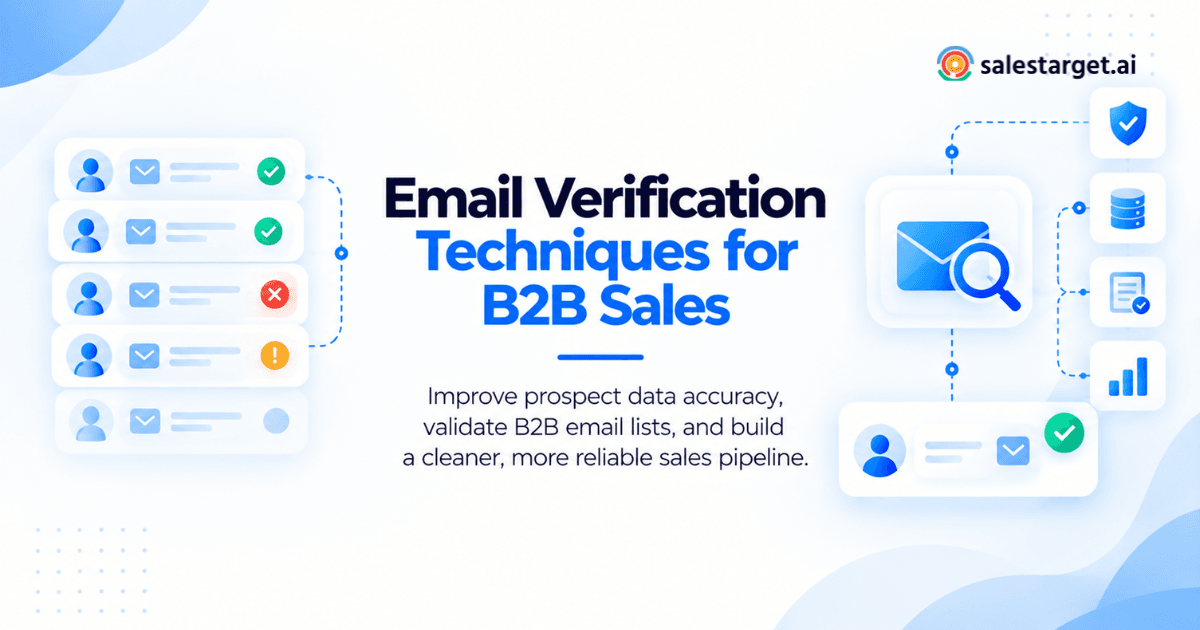
Email verification techniques fix this before it happens. They check whether an email address is real, active, and safe to send to, using a stack of validation methods: syntax checks, domain and MX record lookups, SMTP mailbox pings, catch-all detection, and disposable address filtering. When you verify before you send, you protect your deliverability, reduce wasted outreach, and put your reps in front of real buyers instead of dead inboxes.
B2B contact data decays at roughly 22.5% per year, according to HubSpot. That means nearly a quarter of your prospect list goes stale every twelve months. Without regular verification, you are always prospecting on bad data. This post breaks down each verification technique, shows you how to build a reliable prospecting database with verified emails, and explains how SalesTarget.ai keeps every step inside one platform.
The Role of Email Verification in B2B Sales Prospecting
The Impact of Inaccurate Contact Data on Sales Prospecting
Bad contact data doesn't announce itself. It costs you silently: bounced emails that ding your domain reputation, wasted sequences sent to people who left their company two quarters ago, and reps spending time on leads who will never receive the message. Gartner estimates that poor data quality costs organizations an average of $12.9 million per year in lost productivity and missed opportunities. For an outbound team, even a fraction of that number means deals that never start.
The damage compounds. ISPs now flag senders who consistently exceed a 2% bounce rate. Once your domain lands on a blocklist, every email you send (including replies to warm prospects) gets filtered. That single list of unverified contacts can undermine months of warm-up and deliverability work.
Why Verified Email Addresses Matter for B2B Lead Generation
A verified email address means the mailbox exists, accepts mail, and belongs to an active recipient. That's the baseline for any outreach that's going to reach a human. When your team sends to verified addresses, open rates climb because messages actually land in primary inboxes. Reply rates follow because you're reaching real people in the right roles.
Verification also saves your ops team from chasing phantom metrics. If 10% of your list is invalid, your campaign analytics are built on noise. You can't A/B test copy, optimize send times, or measure sequence performance when a chunk of your audience never existed.
Connecting Email Verification With Prospect Data Quality
Email verification is one layer in a broader data quality stack. It answers a narrow but high-stakes question: "Can I reach this person?" It does not tell you whether they're in-market, whether they match your ICP, or whether they have budget. But if the answer to that first question is no, nothing else matters.
That's why the best prospecting workflows verify at the point of enrichment, not as an afterthought. In SalesTarget.ai's Lead Explorer, contacts are enriched and verified in the same action. You never export a list wondering which half is deliverable.
Email Verification Techniques for Accurate B2B Lead Data
Email Syntax and Format Validation
This is the first filter. Syntax validation checks whether an email follows the correct structure: a local part, the @ symbol, and a valid domain. It catches typos (missing dots, double @@ signs, illegal characters) before any network-level check runs. It's fast, and it eliminates the obvious junk.
Domain Verification and MX Record Checks
Once syntax passes, domain verification confirms the domain itself is real and configured to receive email. An MX (Mail Exchange) record lookup queries DNS to see if the domain has active mail servers. If there's no MX record, no email will be delivered to that domain, period. This step weeds out made-up domains and domains that have let their email infrastructure lapse.
SMTP Verification and Mailbox Validation
SMTP verification goes a level deeper. It connects to the recipient's mail server and simulates the delivery process without actually sending a message. The server responds with whether the specific mailbox exists. This is where you catch addresses like john.smith@realcompany.com when John left six months ago and his mailbox was deactivated.
Catch-All and Disposable Email Detection
Catch-all domains accept mail sent to any address at that domain, whether the specific mailbox exists or not. Sending to catch-all addresses is a gamble: some will reach a real person, many won't, and you can't tell which is which from the verification result alone. Disposable email addresses (from services like Guerrilla Mail or Temp Mail) are designed to be used once and abandoned. Both categories need to be flagged and handled differently from your confirmed-valid contacts.
Here's an insight most verification guides skip: catch-all domains are disproportionately common among enterprise prospects. Large companies with strict IT policies often configure catch-all to route unknown addresses to a central inbox or to silently drop them. If you're prospecting into enterprise accounts, you'll see a higher percentage of catch-all results, and you need a strategy for them beyond just "skip."
Role-Based Email Identification and Risk Assessment
Role-based addresses (info@, support@, sales@, admin@) belong to a function, not a person. Sending cold outreach to these addresses almost never produces a conversation. Worse, they're monitored by teams who are more likely to mark you as spam. A good verification process flags role-based addresses so your reps aren't wasting a sequence step on a shared inbox that nobody checks for cold outreach.
Building a Reliable B2B Prospecting Database With Verified Emails
Identifying the Right Business Contacts
Verification quality starts with sourcing quality. If your initial search pulls the wrong titles, wrong companies, or wrong geographies, no amount of verification saves the list. Start with tight ICP filters: industry, company size, role, seniority, department, and (when available) buying signals like recent funding rounds or hiring spikes. SalesTarget.ai's Lead Explorer lets you search across 840M+ verified professional profiles using plain-English queries or stacked filters, including 4,000+ intent signals powered by Bombora data.
Collecting Accurate Email Addresses Through Lead Enrichment
Lead enrichment fills in the gaps that basic searches leave behind: direct email, phone number, company data. The timing of enrichment matters more than most teams realize. Data that was enriched six months ago is already decaying. SalesTarget.ai enriches at the moment you find the lead, and contacts are verified at the point of enrichment, not whenever the data was first scraped. That distinction is the difference between a fresh contact and a stale record.
Removing Invalid, Duplicate, and Outdated Contact Records
Deduplication is the step that most teams skip until their CRM is already polluted. Multiple list imports, rep-entered contacts, and marketing syncs create overlapping records. Duplicates inflate your prospect count, split activity history across records, and sometimes result in the same person getting two competing sequences from the same team. Clean before you campaign.
Organizing Verified Prospects for Targeted Sales Outreach
Once your contacts are verified and deduplicated, segment them. Group by verification status (valid, risky, unknown), then layer in ICP attributes. Valid contacts with strong intent signals go straight into active sequences. Risky contacts (catch-all addresses, for instance) go into a separate, lower-volume cadence where a single bounce won't damage your domain. This kind of segmentation is straightforward when your data, verification, and outreach live in one platform, and fragmented when you're stitching together three or four tools.
A Step-by-Step Email Verification Process for B2B Sales Teams
Preparing Prospect Lists for Email Verification
Before running verification, remove obvious junk: personal email domains (gmail.com, yahoo.com) unless you're targeting solopreneurs, duplicate rows, and contacts missing a company name or title. A clean input means faster, cheaper verification with more actionable results.
Running Bulk Email Verification Across Contact Lists
Bulk verification lets you process thousands of contacts in a single pass. SalesTarget.ai's Email Validator runs MX/SMTP checks, disposable-email detection, and risk scoring across your full list. It connects with 60+ platforms, so you can validate contacts sitting in your CRM, ESP, or website builder without exporting CSVs back and forth.
Reviewing Valid, Invalid, Risky, and Unknown Email Results
Verification doesn't return a simple yes/no. Expect four buckets:
- Valid: Mailbox confirmed active. Safe to send.
- Invalid: Mailbox does not exist. Remove immediately.
- Risky: Catch-all domains, full inboxes, or new domains with limited history. Send with caution, lower volume.
- Unknown: Server didn't respond or timed out. Re-verify later or check manually.
Treat risky and unknown addresses with the same discipline you'd apply to an unqualified lead. They deserve a different cadence, not the same aggressive sequence you run on confirmed-valid contacts.
Updating Prospect Records With Verified Contact Information
Push verification results back into your source of truth. If you're using a CRM, tag each record with its verification status and the date it was last verified. This gives your ops team a filterable field to audit data quality at any point and prevents reps from accidentally emailing a contact that was flagged invalid three weeks ago.
Adding Verified Leads to Sales Outreach Campaigns
Only verified-valid contacts should go into your primary outreach sequences. In SalesTarget.ai, you can push enriched and verified leads straight into email and LinkedIn sequences without exporting a file. That means zero lag between "this lead is real" and "this lead is being contacted."
If you're running multichannel outreach, verification becomes even more valuable. A verified email paired with a LinkedIn profile gives you two confirmed paths to the same buyer. SalesTarget.ai coordinates both channels in one sequence so context carries across email and LinkedIn touches.
Improving B2B Contact Data Accuracy Through Email Verification
Maintaining Accurate Prospect Information Across Sales Tools
Most outbound teams use at least three tools: a data provider, an outreach platform, and a CRM. Every integration point is a place where data can drift. A contact gets updated in the CRM but not in the outreach tool. A new enrichment overwrites a manually corrected email. SalesTarget.ai keeps prospecting, verification, outreach, and CRM in one workspace, so there's one record, updated once, visible everywhere.
Combining Email Verification With B2B Lead Enrichment
Verification tells you whether you can reach someone. Enrichment tells you whether you should. The two should run together. When you enrich a lead and verify the email in the same step, you avoid the common trap of enriching a batch of contacts, exporting them, uploading them to a separate verification tool, downloading the results, and re-importing the clean list. That five-step process takes hours. A unified workflow takes seconds.
Keeping CRM Contact Records Clean and Updated
CRM hygiene isn't a quarterly project. It's a continuous process. Every new contact that enters your CRM should be verified on entry. Every existing contact should be re-verified on a 90-day cycle at minimum. SalesTarget.ai's built-in CRM auto-logs every email and call to the lead timeline, and campaign leads land automatically without manual imports, so your records stay current without extra admin work.
Creating a Consistent Process for Prospect Data Verification
Document your verification workflow. Specify when verification happens (on import, before campaign launch, on a schedule), who owns the process, and what happens to each result category. A written SOP turns email verification from something one rep does when they remember into a team-wide standard.
Choosing the Right Email Verification Tools for Sales Prospecting
Email Verification Accuracy and Validation Methods
Look for tools that run multi-layer checks: syntax, domain, MX, SMTP, and risk scoring. Single-layer tools miss too much. A tool that only checks syntax will pass a perfectly formatted address to a domain that doesn't exist.
Bulk Verification and Real-Time Email Checking
You need both. Bulk verification cleans existing lists. Real-time verification catches bad addresses at the point of entry, whether that's a web form, a CRM import, or a manual add by a rep. SalesTarget.ai's Email Validator offers both: a real-time verification API and bulk list cleaning.
CRM Integration and Prospect Data Management
If your verification tool doesn't write results back to your CRM automatically, your team will skip the step. The tool should sync verification status, timestamps, and risk flags directly to the contact record.
Lead Enrichment and Sales Automation Capabilities
The most efficient setup combines verification with enrichment and outreach in one platform. That eliminates the export-import cycles that slow teams down and introduce data errors. SalesTarget.ai handles all three: find the lead, enrich and verify it, push it into a sequence.
Pricing, Verification Limits, and Data Security
Evaluate verification tools on per-record cost at your expected volume, rate limits (some tools throttle bulk jobs), and how they handle your data. Your prospect list is a competitive asset. Make sure the verification provider doesn't retain, resell, or expose it.
Why Choose SalesTarget.ai
Discover and Enrich B2B Leads With Lead Explorer
Lead Explorer gives you access to 840M+ professional profiles and 146M+ business entities, searchable by plain-English AI queries or 50+ filters. Enrichment pulls verified professional email, personal email, phone, and mobile in one click. Intent data from Bombora covers 4,000+ topics so you can target companies actively researching solutions in your category.
Validate Prospect Emails With the Email Validator
The Email Validator runs MX/SMTP checks, disposable-email detection, and risk scoring before a single email leaves your outbox. SalesTarget.ai validates 90% of emails before sending, and the platform delivers 99% verified contact data. The result: fewer bounces, a protected sender reputation, and better inbox placement.
Connect Verified Leads to Email and LinkedIn Outreach
Verified leads flow directly into Email Outreach and LinkedIn Outreach sequences. AI builds multi-step campaigns from a plain-English audience description. Unlimited inboxes with automatic warm-up, intelligent rotation, and SPF/DKIM/DMARC checks keep your deliverability intact.
Manage Prospect Data and Sales Activities in the Built-In CRM
The built-in CRM is built for outbound, not enterprise bloat. Campaign leads land automatically, every touchpoint is logged, and follow-up tasks are created when a lead replies or a meeting ends. Teams using SalesTarget.ai's CRM report 3.2X faster deal cycles and about 6 hours saved per rep per week.
Simplify Prospecting Workflows With the AI Copilot
The AI Copilot lets you find leads, generate personalized sequences, query CRM data, and assign tasks, all through a chat interface. It flags at-risk deals, recommends next moves, and personalizes by role, industry, and company size. Strategy stays human. The grunt work doesn't.
Common Email Verification Mistakes in B2B Sales Prospecting
Relying on Unverified or Outdated Prospect Lists
A list that was accurate six months ago has lost roughly 11% of its valid contacts (based on the 22.5% annual decay rate). Treating old lists as current is one of the fastest ways to spike your bounce rate and damage your domain.
Ignoring Catch-All and Risky Email Addresses
Most teams either send to catch-all addresses at full volume or discard them entirely. Both approaches are wrong. Catch-all contacts should be segmented into a lower-volume, monitored cadence. Watch for bounces per domain, and pull the plug on domains that bounce consistently.
Treating Email Validity as Proof of Lead Qualification
A valid email doesn't mean a qualified lead. It means the mailbox exists. You still need to confirm ICP fit, buying intent, and timing. Verification is a data quality step, not a qualification step.
Overlooking Data Changes After Initial Verification
People change jobs. Companies get acquired. Domains expire. A contact that was verified-valid in Q1 may be invalid by Q3. Build re-verification into your workflow, not as a one-time cleanup, but as a recurring process.
Failing to Sync Verified Contact Data Across Sales Platforms
If verification results live only in your verification tool and never make it back to your CRM or outreach platform, your reps are still sending to bad addresses. Every tool in your stack should reflect the same verification status for the same contact. This is trivial when your tools are one platform, and a constant maintenance headache when they're not.
Best Practices for Maintaining Accurate B2B Prospect Lists
Verify New Contact Records Before Adding Them to Campaigns
No contact enters an active sequence without passing verification first. This is non-negotiable. One invalid batch can undo weeks of sender warm-up.
Schedule Periodic Email List Verification
Set a 90-day re-verification cadence at minimum. For high-volume senders or teams targeting fast-turnover industries (tech, SaaS, startups), monthly is safer. Automate the schedule so it runs whether anyone remembers to trigger it or not.
Combine Email Validation With Contact Data Enrichment
Run both at the same time. Enrichment fills missing fields. Verification confirms the email is deliverable. Together, they give you a complete, accurate record ready for outreach. In SalesTarget.ai, this happens in one step with built-in lead enrichment.
Maintain Consistent CRM Data Hygiene
Assign ownership of CRM data quality. Define what a "complete" record looks like. Set required fields on contact creation. Run duplicate detection monthly. Archive contacts that have bounced on two consecutive verifications.
Track Email Verification Results and Prospect Data Quality
Measure your verification pass rate over time. If it's declining, your sourcing methods or data providers may be degrading. Track bounce rates by campaign, by list source, and by domain. These metrics tell you where your data quality problems are concentrated.
Conclusion: Strengthening B2B Sales Prospecting With Accurate Email Data
Every outbound motion starts with a bet: "This person will see my message." Email verification is how you stack that bet in your favor. Without it, you're burning sequences on dead inboxes, damaging the sender reputation you spent weeks building, and making decisions on analytics that don't reflect reality.
The techniques are straightforward: validate syntax, check the domain and MX records, ping the SMTP server, flag catch-all and disposable addresses, and separate role-based emails from individual contacts. The hard part is doing all of this consistently, at scale, and in sync with the rest of your prospecting workflow.
That's what SalesTarget.ai is built for. Find leads across 840M+ profiles. Enrich and verify in the same click. Push verified contacts straight into email and LinkedIn sequences. Track every deal in a CRM that stays clean because the data was accurate from the start. One platform, one workflow, no duct tape.
Start your free demo and see how verified data changes your outbound results.