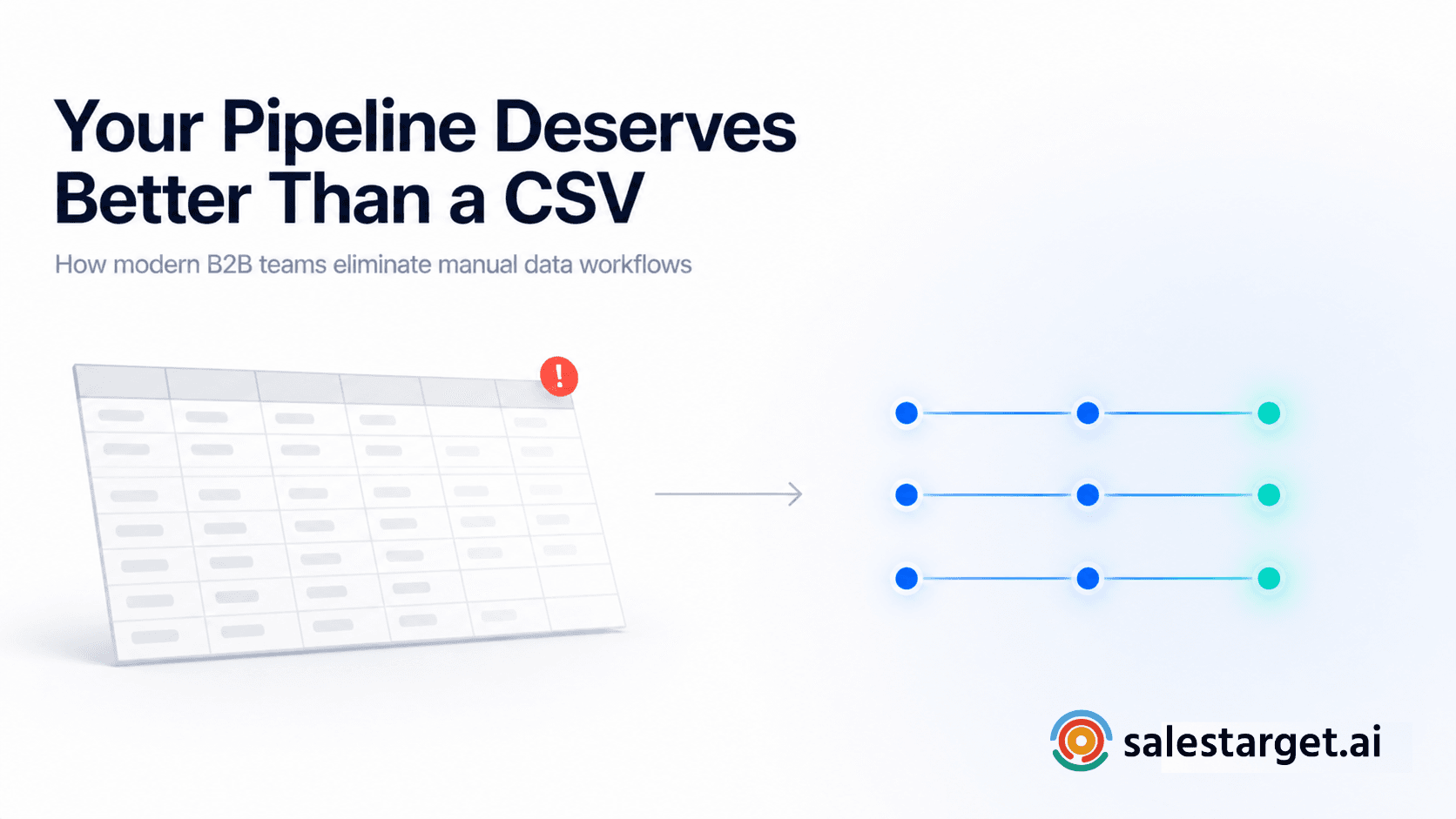
Most sales teams have accepted a broken workflow as normal. A rep finds a promising prospect, enriches the record, exports a CSV, reformats the columns, imports it into the CRM, deduplicates the entries, and manually fills in the fields the import missed. By the time the lead is ready to contact, the data is already hours old — and in B2B sales, hours matter.
This guide is for founders, sales teams, and outbound marketers who are tired of treating spreadsheets as the connective tissue between their prospecting tools and their CRM. We will walk through exactly why CSV-based workflows fail, what a cleaner alternative looks like, and how to build a B2B lead pipeline that does not depend on manual data entry at any stage.
The Real Cost of CSV-Based Lead Management
The CSV export habit is so embedded in sales operations that most teams never question it. But the costs are real and they compound over time.
Data Goes Stale in Transit
B2B contact data has a short shelf life. Job titles change. People leave companies. Phone numbers get reassigned. When a lead sits in a spreadsheet waiting to be imported, every hour increases the chance that at least one field is no longer accurate. A B2B prospecting tool that enriches data in real time but routes it through a CSV loses much of that freshness before the record ever lands in the CRM.
Field Mapping Errors Are Inevitable
CSV imports require manual column mapping. Even with templates, mismatches happen — company names land in the wrong field, phone numbers overwrite emails, custom properties get ignored entirely. These are not one-time mistakes. They happen every import cycle, and they quietly corrupt the data quality of your entire CRM over time.
Duplicate Records Accumulate
Without a direct sync, there is no deduplication logic running during import. The same contact can appear three times under slightly different names across different CSV batches. Cleaning duplicates is low-value work that takes time sales reps should be spending on outreach.
The Audit Trail Disappears
When a lead moves through a spreadsheet, there is no record of when it was enriched, what signals triggered its inclusion, or which rep pulled it. Pipeline visibility depends on data provenance — and CSVs erase it.
What CRM Data Enrichment Actually Means
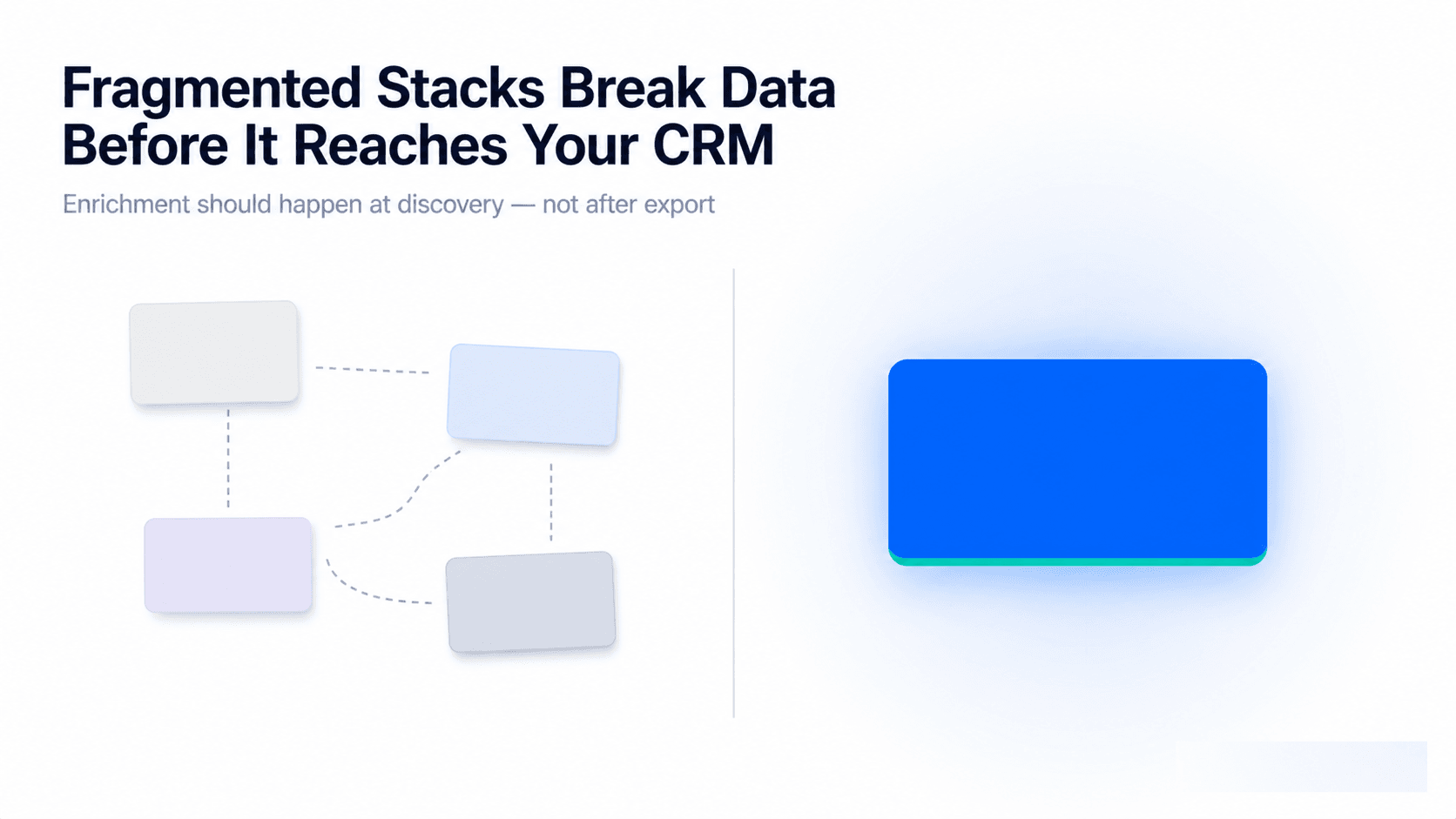
CRM data enrichment is the process of automatically appending additional, verified information to a contact or company record — without manual input. Instead of a rep typing in a job title or copy-pasting a LinkedIn URL, enrichment pulls that data from a verified source and populates the fields directly.
In practice, enrichment adds depth to records that would otherwise be shallow. A lead that enters your pipeline as just a name and email address can be enriched with job title, company size, industry, tech stack, funding status, and buying signals — all without anyone opening a browser tab.
The critical distinction is where enrichment happens. In a disconnected stack, enrichment occurs in one tool and the data is then manually transferred to another. In an integrated lead generation platform, enrichment and storage happen in the same system. The record is created already enriched. Nothing gets lost in transit.
The Workflow That Actually Works: Enrich Inside the Platform, Store in a Built-In CRM
The cleanest B2B lead pipeline eliminates the handoff problem entirely. Instead of enriching data in one place and storing it in another, the prospecting tool and the CRM are the same system — or at minimum, deeply integrated within the same product.
Here is what that workflow looks like in practice:
Step 1: Search and Filter with Intent
Rather than building a broad list and cleaning it later, the rep starts with precise filters — industry, company size, job title, tech stack, and geography. A well-designed B2B lead generation tool with advanced targeting filters surfaces only the accounts that match a defined ideal customer profile. The result is a smaller, higher-quality list rather than a large, noisy one.
Step 2: Enrich Automatically at the Point of Discovery
As each record is identified, enrichment runs in the background. Verified contact data — email addresses, direct dials, LinkedIn profiles — is appended automatically. Data enrichment tools embedded in the prospecting workflow mean the rep never has to leave the platform to fill in missing fields.
Step 3: Apply Intent and Signal Data Before Prioritization
Not every enriched lead deserves equal attention. B2B sales signals — hiring activity, funding rounds, technology changes, job postings — indicate which accounts are actively in a buying motion. Applying signal data before prioritization means the rep is calling on accounts that are ready to engage, not just accounts that match a firmographic profile.
Step 4: Store Directly in the Built-In CRM
Once a lead is enriched and prioritized, it moves into the CRM — not via export, not via import, but directly. Fields are pre-mapped. Duplicates are checked. The record arrives clean, complete, and tagged with the context of how and why it was added. This is the core advantage of a sales intelligence platform with an integrated CRM: the data never leaves the system that created it.
The Problem with Disconnected Stacks
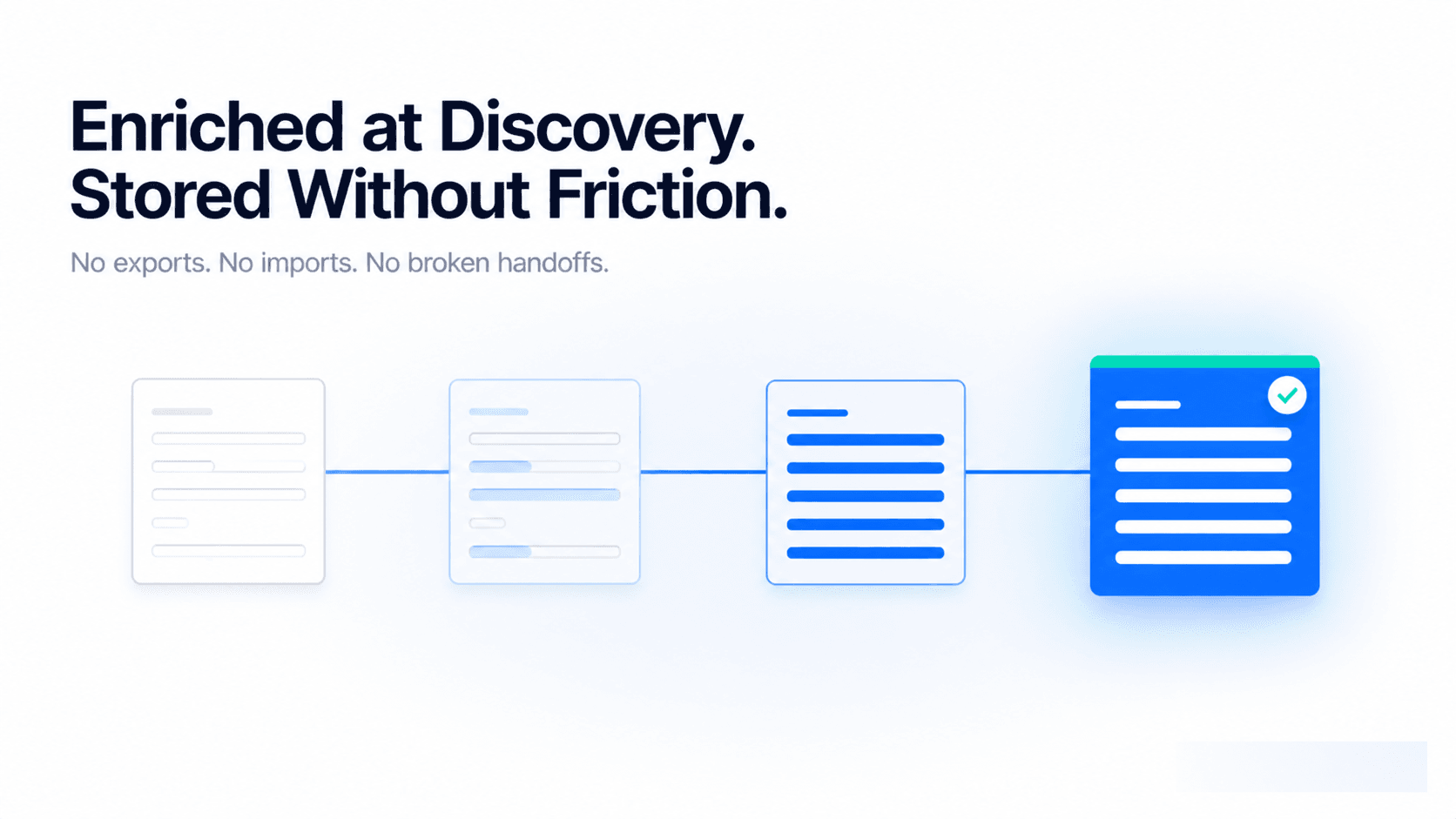
Many sales teams run a stack that looks like this: a prospecting tool for discovery, a separate enrichment provider for data quality, a verification service for email validation, and a CRM for storage. Each of these tools does its job well in isolation. But the connections between them — the exports, imports, API calls, and Zaps — are where data quality and time get lost.
Every handoff between tools is a potential point of failure. A Zapier automation that breaks silently. A field that does not exist in the destination CRM. A rate limit that causes incomplete syncs. Teams that rely on these connections spend significant time maintaining integrations that exist solely to move data from one place to another — work that produces no pipeline value.
The alternative is consolidation. A single B2B lead generation platform that handles prospecting, enrichment, signal detection, verification, and CRM storage eliminates the maintenance burden and reduces the failure surface. There are fewer moving parts, fewer things to break, and a single source of truth for every lead record.
What Clean Lead Data Actually Enables
The goal of eliminating CSV workflows is not just operational efficiency. Clean, enriched, directly-stored lead data changes what is possible at every stage of the sales process.
Faster Outreach Cycles
When a rep does not need to clean, import, and deduplicate before reaching out, the time from lead discovery to first contact compresses significantly. In competitive deals, this matters. The first credible outreach often sets the frame for the entire conversation.
Better Segmentation for Campaigns
Enriched records with consistent field values enable reliable segmentation. A campaign targeting SaaS companies with more than 100 employees that recently raised a Series B requires accurate, structured data across every record. That level of segmentation is only possible when enrichment happens at the source, not after import.
Accurate Pipeline Forecasting
CRM data that is clean and complete from the moment a record is created gives revenue operations teams accurate inputs for forecasting models. Garbage in, garbage out applies directly here — and the garbage usually enters the system during the CSV import step.
Scalable Prospecting Without Proportional Headcount
Manual CSV workflows do not scale. As list volume grows, the time required to manage exports and imports grows with it. A pipeline built on direct enrichment and built-in CRM storage can handle significantly higher lead volumes without requiring additional operations resources.
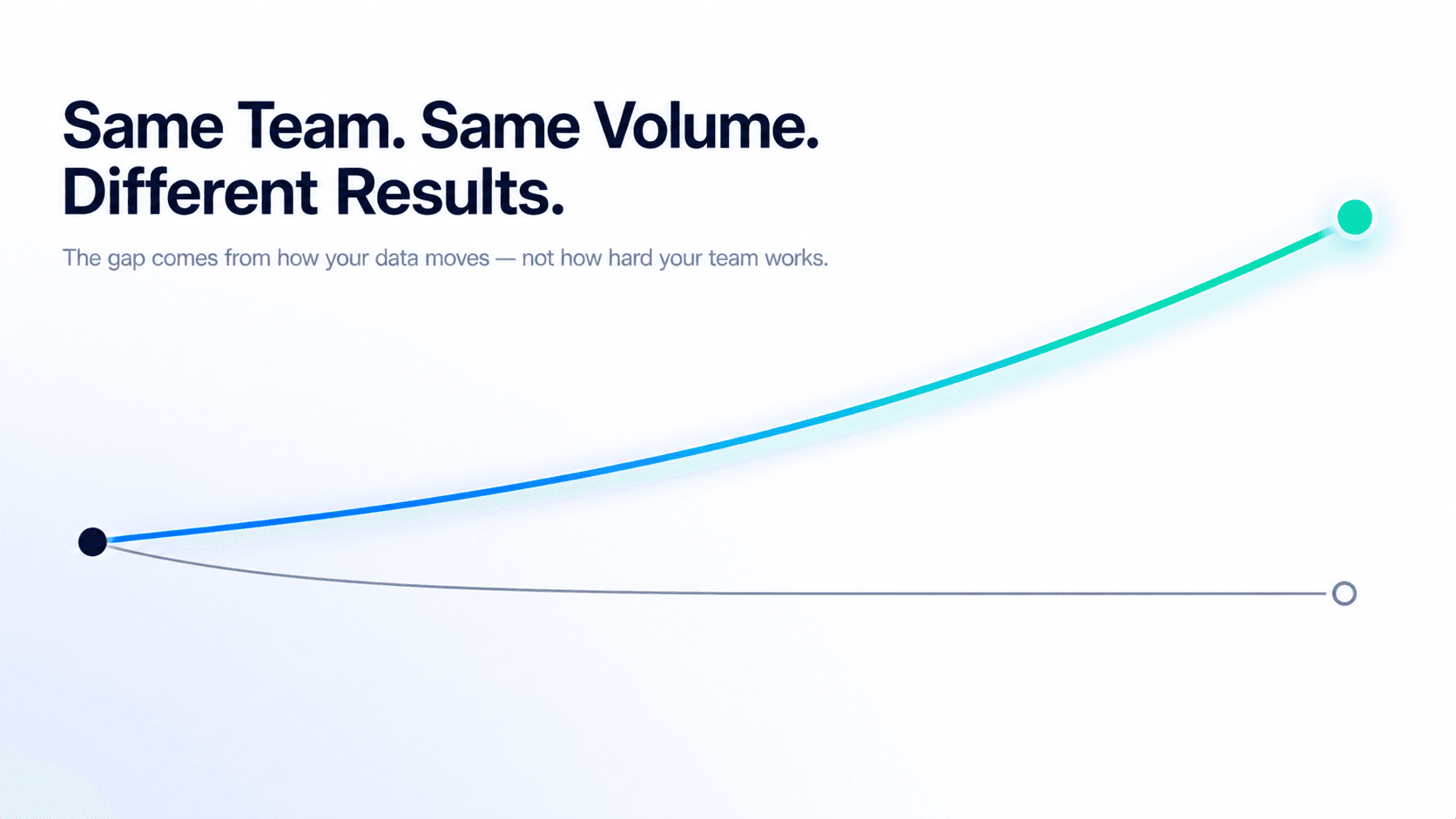
A Practical Scenario: Two Outbound Teams, Same Volume, Different Results
Consider two sales teams, each targeting 500 net-new accounts per month.
Team A uses a prospecting tool that exports to CSV. A rep spends roughly 4 hours per week managing exports, cleaning data, and importing records into the CRM. Fields are often incomplete. Duplicates appear regularly. By the time outreach begins, roughly 15 percent of email addresses have already bounced or gone cold.
Team B uses a lead generation platform with built-in enrichment and a native CRM. Records are enriched at the point of discovery, stored directly, and ready for outreach without any manual intervention. The same rep spends those 4 hours on actual outreach instead. Email verification runs automatically, reducing bounce rates to under 3 percent. Segmentation is reliable because every field is populated consistently.
Same headcount, same lead volume. The difference is entirely in how data moves through the system.
What to Look for in a B2B Lead Generation Platform with CRM Capabilities
If you are evaluating a move away from CSV-based workflows, these are the capabilities that matter most:
Enrichment at the Point of Search
Enrichment should not be a separate step. The platform should append verified contact data — job title, email, phone, company information — automatically as leads are identified, not after they have been exported.
Verified Contact Data
A built-in B2B email finder with real-time verification ensures that email addresses are valid before they reach the CRM. This reduces bounce rates and protects sender reputation for outbound campaigns.
Signal-Based Prioritization
The platform should surface buying signals — funding rounds, hiring surges, technology changes — and use them to score or rank leads before they enter the pipeline. This ensures the CRM is populated with prioritized leads, not just enriched ones.
A Native CRM, Not Just an Export Button
The difference between a platform with an export function and a platform with a built-in CRM is significant. A native CRM means leads are stored, tracked, and managed within the same system where they were discovered and enriched. No handoffs, no field mapping errors, no integration maintenance.
Consistent Field Structure
Every record should arrive in the CRM with the same fields populated in the same format. Consistency is what enables reliable segmentation, accurate reporting, and scalable outreach.
Conclusion
CSV exports are not a workflow problem. They are a symptom of a stack that was never designed to move data cleanly from discovery to pipeline. Every export is a gap — a moment where data can degrade, fields can misalign, and time gets spent on logistics instead of selling.
The solution is not a better import template. It is a prospecting and enrichment workflow where data does not need to leave the system in the first place. A B2B lead generation platform with built-in CRM data enrichment and a native CRM does not eliminate the need for outreach — it eliminates the friction between finding a good lead and being ready to reach out to them.
For sales teams that are serious about pipeline quality and outbound efficiency, that friction is not a minor inconvenience. It is the difference between a team that spends its time selling and a team that spends its time managing spreadsheets.