Your reps are spending hours each week building prospect lists by hand, copy-pasting email templates, and chasing unresponsive contacts with zero system behind the follow-up. Meanwhile, the leads that actually match your ICP sit buried in a spreadsheet nobody has touched since last quarter. That is not a cold email problem. That is a workflow problem, and most teams are one bad quarter away from feeling it in the pipeline.
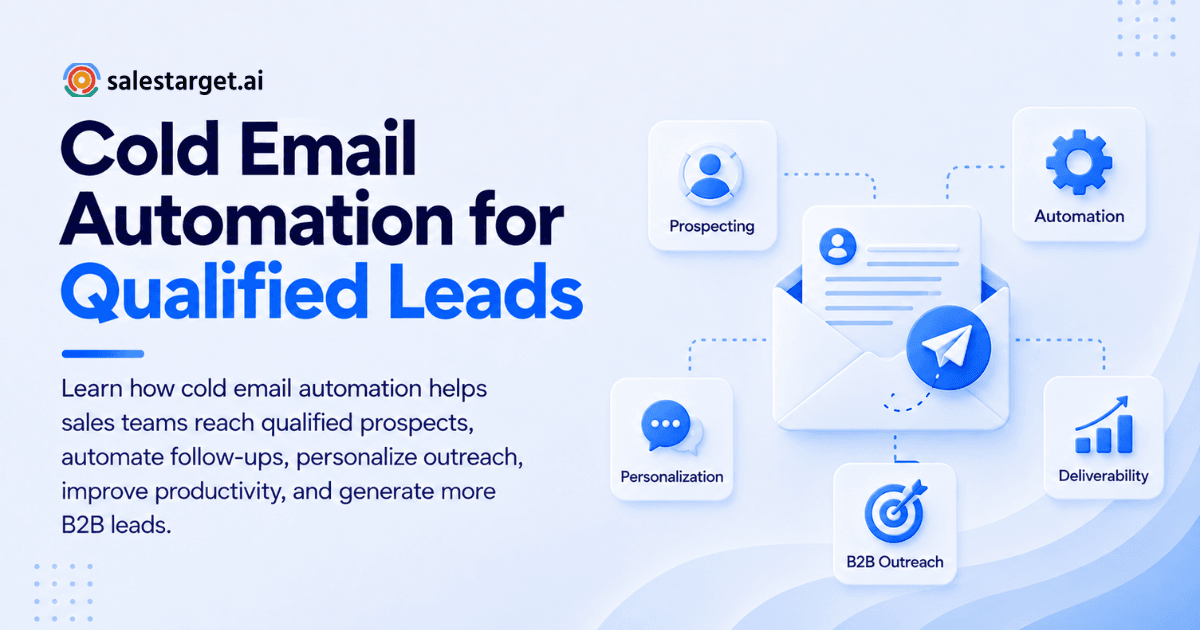
Cold email automation fixes the part of outbound most sales teams are getting wrong: the repetitive, manual work that eats rep time without improving output. When a sales team automates prospect selection, contact enrichment, email sequencing, follow-up scheduling, and reply tracking, reps stop being operators of disconnected tasks and start spending their time where it actually moves deals forward.
According to Salesforce's 2026 State of Sales report, reps spend 60% of their work hours on non-selling tasks, including writing emails, doing prospect research, and manually entering data. Cold email automation directly cuts into that number by handling the mechanics of outreach at scale. The teams that combine automation with precise targeting and clean contact data consistently generate more qualified replies, more meetings, and a predictable pipeline instead of one built on hope.
The Role of Cold Email Automation in B2B Lead Generation
In B2B outbound, the pipeline only exists if the outreach volume exists. Manual prospecting cannot sustain both volume and quality. A rep writing every email from scratch and tracking follow-ups in a spreadsheet will eventually drop the ball, and the contacts who never got a third touch will never know your product existed.
Cold email automation creates a repeatable system. Targeting decisions and messaging are set once per campaign, and the platform handles delivery, pacing, follow-up timing, and reply sorting. The result is consistent outreach across every prospect segment, not just the ones a rep happened to contact this week.
How Cold Email Automation Works
Prospect Selection and Contact Enrichment
Automation starts before the first email. The platform pulls prospects from a B2B database based on filters like industry, company size, job function, seniority, and tech stack. Enrichment then layers in verified email addresses, direct dials, and firmographic context for each contact.
SalesTarget.ai's Lead Explorer searches across 840 million verified professional profiles and 146 million business entities. A plain-English AI query or stacked filters deliver a targeted prospect list with enriched, verified contact data in one click, with no CSV export or third-party enrichment tool required.
Email Personalization and Sequence Creation
A cold email automation platform builds a multi-touch sequence for each prospect segment. The first touch, follow-ups, and final breakup email are written and scheduled ahead of time. AI personalization adjusts subject lines, openers, and body copy based on role, industry, and company context.
Automated Scheduling and Follow-Ups
The platform sends each email at the right time and waits for a reply window before triggering the next step. If a prospect replies, the sequence stops. If they do not, the next follow-up fires automatically. Timing rules, working-hour limits, and send-rate controls prevent the sequence from looking like a mass blast.
Reply Tracking and Campaign Monitoring
Every reply is captured and categorized by intent. The platform surfaces which contacts are interested, which need follow-up, and which have opted out. Campaign-level data shows delivery rates, reply rates, and sequence performance in real time so teams can course-correct without waiting until a campaign ends.
Key Benefits of Cold Email Automation for Sales Teams
Increase Outreach Volume Without Increasing Manual Work
A single rep running automated sequences can contact far more qualified prospects per week than one doing everything manually. Manual prospect research averages 7.5 minutes per lead; automated enrichment brings that down to 45 seconds (Overton Automation, 2025). That difference multiplied across a hundred leads per week adds up to dozens of recovered selling hours.
Maintain Consistent Prospect Follow-Ups
80% of successful sales require at least five follow-up attempts, yet nearly half of reps stop after one (Invesp). Automation removes the variable of rep memory from the follow-up equation. Every prospect in the sequence gets the full run of touches, not just the ones a rep remembered on a Friday.
Personalize Communication at Scale
Automation does not mean generic. AI copy generation and Spintax variation let teams send different messaging to different buyer segments with different hooks and proof points, all within the same campaign, while keeping each email looking individually written.
Improve Sales Team Productivity
When automation handles sequence execution, reps focus on handling replies, running discovery calls, and closing. SalesTarget.ai CRM data shows reps save around 6 hours per week, with 91% follow-up completion across active campaigns.
Generate and Manage More Qualified Opportunities
More outreach with better targeting produces more replies, and more replies filtered by intent produce more qualified conversations. SalesTarget.ai data shows teams using automated multichannel outreach with CRM integration close deals at 3.2X the speed of teams managing outreach manually.
Building a Cold Email Automation Strategy
Define the Target Audience and Ideal Customer Profile
Start with a clear ICP before you touch a sequence template. Define the company size, industry, geography, revenue range, and tech stack that your best customers share. The ICP determines who enters your campaigns, and a weak ICP will waste automation on the wrong contacts just as fast as manual outreach does.
Segment Prospects by Industry, Role, and Intent
Segment before you sequence. A founder at a 20-person SaaS startup reads differently than a VP of Sales at a 500-person logistics company. Different segments need different email hooks, different proof points, and different CTAs. One campaign trying to speak to both will speak to neither.
Pair demographic segmentation with intent signals. Contacts who recently received funding, are actively hiring for sales roles, or just changed their tech stack are more likely to be in an active buying window. Including intent data in your targeting rules significantly lifts the qualified reply rate from the same volume of outreach.
Create Relevant Cold Email Sequences
Write each sequence for one specific segment and one specific pain point. The first email should open with a problem the prospect recognizes, not a product description. Follow-up touches should add new value, not just say "just checking in." Three to five touches is enough for most B2B campaigns; more rarely lifts reply rates and risks damaging sender reputation.
Set Follow-Up Timing and Campaign Conditions
Build timing rules into the sequence: two to four days between touches, sends limited to business hours, and reply detection that stops the sequence the moment a prospect engages. Conditional branches let you route contacts who click a link but do not reply into a different follow-up track than contacts who opened but took no action.
Review Results and Refine the Strategy
A cold email strategy is not a one-time setup. Review reply rates, positive reply rates, and meeting conversion weekly. Replace underperforming subject lines, test new openers, and cut segments that are not converting. The teams hitting 10%+ reply rates in 2026 run constant iteration, not set-and-forget campaigns.
Essential Features of Cold Email Automation Software
B2B Prospect Data and Enrichment
The platform should have a built-in database with verified contact data, not a connection to a third-party vendor that syncs weekly. Real-time enrichment at the point of prospecting means your contact data is current when the email goes out, not when it was first scraped.
Personalized Email Sequences
AI sequence builders that generate multi-touch campaigns from a brief audience description save campaign setup time and eliminate blank-page syndrome. Look for platforms that generate variations and adapt copy to different roles and industries automatically.
Automated Cold Email Follow-Up
Follow-up automation should operate on reply detection, not a fixed schedule. A sequence that continues sending after a prospect replies is a deliverability risk and a reputation problem.
Email Verification and Deliverability Controls
Every campaign needs email verification baked in before send, not as a separate step. SPF, DKIM, and DMARC authentication, inbox warm-up, and rotation across multiple sending domains are non-negotiable for sustained deliverability. The 2026 Instantly Benchmark Report found that average cold email reply rates have declined to 3.43%, largely because of inbox saturation and spam filter improvements. Deliverability hygiene is now a prerequisite for getting into the inbox at all.
Campaign Analytics and Reply Tracking
Track reply rate and positive reply rate, not just opens. In 2026, open rate tracking is unreliable; Apple Mail Privacy Protection pre-loads tracking pixels for 49% of all email opens, making the metric directionally meaningless (Cleverly, 2026). Build your performance view around replies and pipeline outcomes.
CRM and Lead Management
Replies that never reach a CRM are pipeline that gets lost. The email automation platform should route qualified replies directly into a deal pipeline, log activity automatically, and create follow-up tasks without rep intervention.
Best Practices for Automated Cold Email Outreach
Start With Accurate and Verified Contact Data
Bad contact data costs B2B businesses an average of $9.7 million per year (Sales So, 2026). Every bounce, every email sent to a departed employee, and every message that hits a spam trap erodes your sending reputation. Verify contacts before a sequence starts, not after bounce rates spike.
SalesTarget.ai's Lead/Email Validator runs MX/SMTP checks, disposable-email detection, and risk scoring on every contact before it enters a sequence. With 90% of contacts validated before the first send, bounce rates stay low and sender domains stay off blacklists.
Keep Messaging Relevant to Each Prospect Segment
A generic message might clear the spam filter and still get ignored. Relevance is what drives replies. Write sequences that speak to the specific role, company stage, and industry challenges of each segment. Generic messaging is the fastest way to waste a good deliverability setup.
Use Personalization Across the Sequence
Personalization is not just a first-name merge field. The opening line should reference something specific about the prospect's company, their role, or a recent business event. AI tools that pull real-time context from a prospect's LinkedIn profile, company news, or hiring signals and fold it into the opener consistently outperform generic templates.
Balance Automated Outreach With Human Conversations
The goal of cold email automation is to start conversations, not replace them. Once a prospect replies with genuine interest, the rep takes over. The handoff should be clean, fast, and visible in the inbox so no interested reply sits unanswered for 48 hours.
Track Qualified Replies and Pipeline Results
Count the meetings, not the emails. Volume metrics like emails sent and open rate tell you about your activity. Qualified replies, meetings booked, and pipeline created tell you about your results. Build your weekly review around the latter, and you will optimize toward outcomes rather than activity.
Why Choose SalesTarget.ai
Most cold email automation platforms make you bring your own data. You buy a list from one provider, run it through an enrichment tool, verify it with another, then load it into a sequencing platform. By the time the email goes out, the data might be weeks old. SalesTarget.ai removes that chain entirely. For a direct look at how the platform stacks up against point solutions, the SalesTarget.ai vs. Lemlist cold email automation comparison lays out the differences in detail.
Find and Enrich Prospects With Lead Explorer
Lead Explorer combines AI-powered prospecting with built-in enrichment across 840 million verified profiles and 4,000+ buyer intent signals from 50+ data sources. Enrichment happens at the moment you find the lead, and contact data is verified in the same click, not days later. Bombora intent topics and business events like funding rounds and hiring spikes let you filter for prospects in an active buying window before the first email goes out.
Combine Email and LinkedIn Outreach
Email Outreach builds multi-step sequences automatically from a plain-English audience description. AI Spintax and content generation vary copy across inboxes. Unlimited sending accounts with built-in warm-up and intelligent inbox rotation keep deliverability strong across high-volume campaigns. Pair it with LinkedIn Outreach to run coordinated email and LinkedIn sequences simultaneously, so context carries across channels and each touchpoint reinforces the last.
Verify Contacts and Support Email Deliverability
SalesTarget.ai verifies contact data at the point of enrichment and runs SPF, DKIM, and DMARC checks on every sending domain. The result is 90% of contacts validated before campaigns launch, which keeps bounce rates low and sender reputation intact across long-running outreach programs.
Manage Leads in a Built-In CRM
Replies land directly in the CRM with no manual import. Every email, call, and LinkedIn touch is logged to the lead timeline automatically. Follow-up tasks are created when a lead replies or a meeting ends. The AI dialer captures and saves call notes to the lead record during the call, so reps never lose conversation context between touches.
Use AI Copilot for Sales Research and Daily Tasks
AI Copilot is a conversational sales teammate built into the platform. Reps can ask it to find leads, generate a full sequence, track which campaigns are driving revenue, or surface at-risk deals in plain English. It personalizes by role, industry, and company size, runs A/B variations automatically, and flags what to do next so reps spend time on relationships, not admin.
Common Cold Email Automation Mistakes
Automating Campaigns With Inaccurate Contact Data
Running automation on a dirty list accelerates the damage. High bounce rates burn sender reputation faster at scale. Verify data before the campaign starts, not after the domain gets flagged.
Sending Generic Messages to Every Prospect
Segmentation and personalization are not optional add-ons. A 500-email blast with one template is not outreach automation; it is spam at scale.
Overloading Prospects With Follow-Ups
More touches are not always better. Sending seven follow-ups to a non-responsive contact risks spam complaints that hurt every campaign on that domain. Four or five is the ceiling for most B2B sequences.
Ignoring Deliverability Signals
A rising bounce rate is a deliverability warning, not a copy problem. Act on it early: check domain reputation, rotate sending inboxes, and reduce daily volume while the domain recovers.
Measuring Email Activity Instead of Sales Outcomes
Emails sent and open rates are activity metrics. Build your weekly review around qualified replies, meetings booked, and pipeline generated. Everything else is a leading indicator, not a result.
Measuring Cold Email Automation Performance
Delivery and Bounce Rates
Aim for a bounce rate below 3%. Above 5% signals a data or deliverability problem that compounds fast across a large campaign.
Reply and Positive Reply Rates
A reply rate above 5% puts you ahead of most B2B senders in 2026 (Cleverly, 2026). Track total replies and positive replies separately; the latter connects directly to pipeline.
Qualified Leads Generated
Count the replies that pass a qualification check, not every reply. Build a clear definition of a qualified reply into your weekly review.
Meetings and Sales Opportunities
Every meeting booked from outbound should trace back to a campaign, a sequence, and a prospect segment. Attribution tells you which ICP definitions and which messaging setups are actually generating pipeline.
Pipeline Contribution and Conversion
Track the percentage of outbound pipeline that closes. If outbound-sourced deals close slower than inbound, the problem is usually lead quality. Adjust targeting before increasing volume.
Scaling B2B Lead Generation With Cold Email Automation
Combine Prospecting, Outreach, and CRM Workflows
The biggest efficiency gain in cold email automation comes from eliminating handoffs between tools. When prospecting, enrichment, sequencing, and CRM live in one platform, a qualified reply can be in a rep's pipeline within minutes with full context attached. Start with SalesTarget.ai to see that workflow in practice.
Expand Campaigns Across Targeted Buyer Segments
Once a campaign works in one segment, the playbook is replicable. Take the best-performing subject line, sequence structure, and ICP definition, and roll it into the next segment. Build on what worked instead of starting from scratch.
Use Performance Data to Improve Future Campaigns
Each campaign generates data that makes the next one better: which roles responded to which framing, which follow-up timing worked best. Teams that review this weekly compound improvement across every outbound motion.
Create a Repeatable Outbound Lead Generation Process
The goal is a system that generates consistent pipeline without depending on individual rep effort. When prospecting, outreach, follow-up, and CRM are all connected, the team scales output by refining the system, not by hiring more people to do manual work.
Building a Scalable B2B Outreach Strategy With Cold Email Automation
Cold email automation does not generate leads by sending more emails. It generates leads by running a better system: cleaner data, more precise targeting, consistent follow-up, and real-time reply routing that gets interested prospects in front of a rep before they move on.
The teams running outbound at scale in 2026 are not sending more volume than everyone else. They are running tighter workflows with better data, and they are measuring the outcomes that actually matter: qualified replies, meetings, and pipeline contribution.
SalesTarget.ai is built for exactly that workflow. From the moment you find a prospect in Lead Explorer to the moment a deal closes in the CRM, every step is connected in one platform, on one bill, with no manual handoffs between tools. If your current outbound setup requires too many tools and too much rep time to produce too few qualified conversations, explore SalesTarget.ai and see what a consolidated outbound system actually looks like.