Buying a B2B lead generation platform rarely fixes a pipeline problem on its own. The teams that get real returns from one are the teams who treated the purchase as the midpoint of the project, not the finish line - they already knew who they were selling to, which signals mattered, and who owned a lead by Tuesday morning. Everyone else ends up with a very expensive contact database and a reporting tab nobody opens.
This piece is for sales leaders, founders, and SDR managers who are either evaluating a platform or already paying for one that is quietly underperforming. The frame is practical: four operating decisions decide whether a platform compounds into pipeline, and this article walks through each of them, how to translate them into platform configuration, and the weekly rhythm that keeps the whole thing honest.
Primary CTA - placement: directly after the intro, before the first H2.
What a B2B Lead Generation Platform Actually Does - And What It Can't
Short answer: a B2B lead generation platform is a system that discovers accounts and contacts that look like your buyers, enriches them with contact and firmographic data, filters by behavioural or intent signals, and pushes the shortlist into outreach or a CRM. It replaces the manual stitch between a data provider, an email finder, a verification tool, and a list-management spreadsheet.
What a platform does not do: decide who your buyer is, judge whether a lead is actually qualified, write the first touch, or hold a rep accountable for responding to a replying prospect within the hour. Those are human and operational decisions. If they are vague or missing, a better platform will just surface vague or missing leads faster.
That split is the central argument of this article. Everything below assumes you understand the platform is leverage, not a strategy.
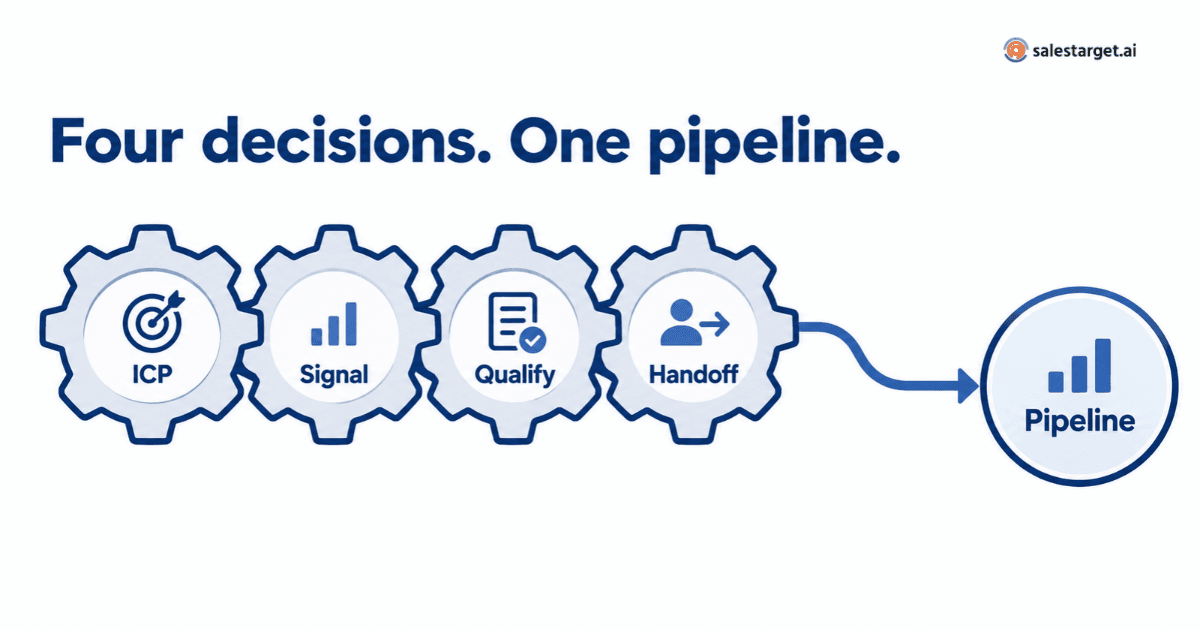
The Four Operating Decisions That Decide Platform ROI
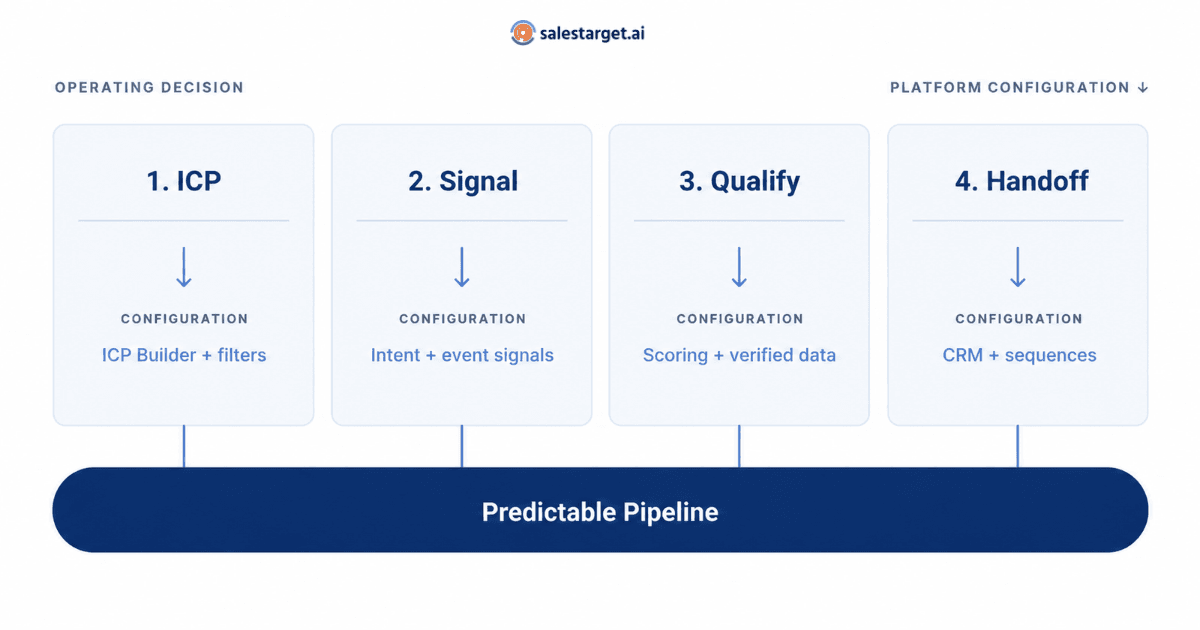
Before evaluating a B2B lead generation platform - or re-evaluating the one you already pay for - nail down four decisions. Teams who treat these as paperwork tend to spend 18 months blaming vendors; teams who treat them as the real work tend to see pipeline movement inside a quarter.
Decision 1: Who are you actually selling to this quarter?
Not your TAM. Not a persona deck from last year. The specific accounts that are a good fit for the offer in market right now. For most teams the answer narrows quickly once you add constraints: an industry sliver, a company-size band, a specific tech stack, a region where you can support the sale, and the one to three job titles who sign. The output is a short, written ideal customer profile a new SDR could read in a minute and act on. If your ICP is a paragraph of hedged qualifiers, the platform cannot save you — it will faithfully retrieve the fuzziness.
Decision 2: What signal justifies an outreach attempt?
Static lists go stale within weeks. The teams building the most consistent pipeline work from triggers: a hiring spike for a role your product supports, a funding round that unlocks budget, a leadership change at an account you've been tracking, a new technology appearing in the stack, or an in-market intent spike against a topic your category owns. Pick two or three triggers you can act on this quarter. More than that and nothing gets prioritised; fewer and your pipeline becomes brittle when a signal source dries up.
Decision 3: What does "qualified" mean to your sales team?
Written down, in one short paragraph, and signed off by whoever carries the number. Fit (ICP match) and intent (observable behaviour) both have to appear. Vague qualification is what produces the familiar fight where marketing hands over 400 "leads" and sales works 40 of them and ignores the rest. If an SDR cannot look at a record and say inside ten seconds whether to work it or disqualify it, qualification is still unresolved.
Decision 4: Who owns a lead, within what SLA?
The best enrichment in the world is wasted if a qualified contact sits unassigned for two days. Decide ownership rules (round-robin, named owner by territory, pod ownership) and a response SLA that reflects the lead's intent level — minutes for a demo request, hours for a signal-driven outbound touch, days for a nurture add. The SLA is the metric the team actually watches on Monday morning; make it visible or it does not exist.
If any of the four is unresolved
Resolve it before you expand the platform spend. A sharper ICP or a documented SLA will do more for pipeline this quarter than a bigger database will.
Translating Those Decisions Into Platform Configuration
A good B2B lead generation platform is the place where these four decisions become executable. SalesTarget.ai's Lead Explorer is a useful reference point because its surface maps cleanly onto each one - the same mapping applies conceptually to most modern B2B prospecting platforms, so the mental model carries even if you end up on a different tool.
ICP → ICP Builder and advanced targeting filters
The written ICP becomes a saved filter set in the platform. In Lead Explorer, this is handled through the ICP Builder and the firmographic / technographic filters across Business and People views — industry, company size, revenue, seniority, tech stack, and location. The practical discipline here is to save the ICP as a reusable segment rather than reconstructing filters each week; drift is what quietly produces off-ICP leads over time. For teams still working this layer out, our guide to lead generation tools and platforms walks through the broader category context around platform selection and tool fit.
Signals → Intent Topics and business event filters
The chosen triggers become live filters. Lead Explorer surfaces this through Intent Topics (powered by Bombora) and a set of business event filters covering funding rounds, hiring spikes, leadership changes, and company awards, with a 30–90 day lookback window. The key operating rule: only track signals you have an outreach motion for. A funding-round trigger with no corresponding message framework is noise.
Qualification → intent-based lead scoring and verified contact data
Fit filters narrow the universe; intent scoring prioritises inside it. The platform's job is to surface the overlap — accounts that match the ICP and show a buying signal in the same week. Verified contact data (email, phone, mobile, verified at the point of enrichment) is what makes that shortlist actionable; a scored lead with a bouncing email is a tracking artifact, not a prospect.
Handoff → CRM push, sequences, and multichannel outreach
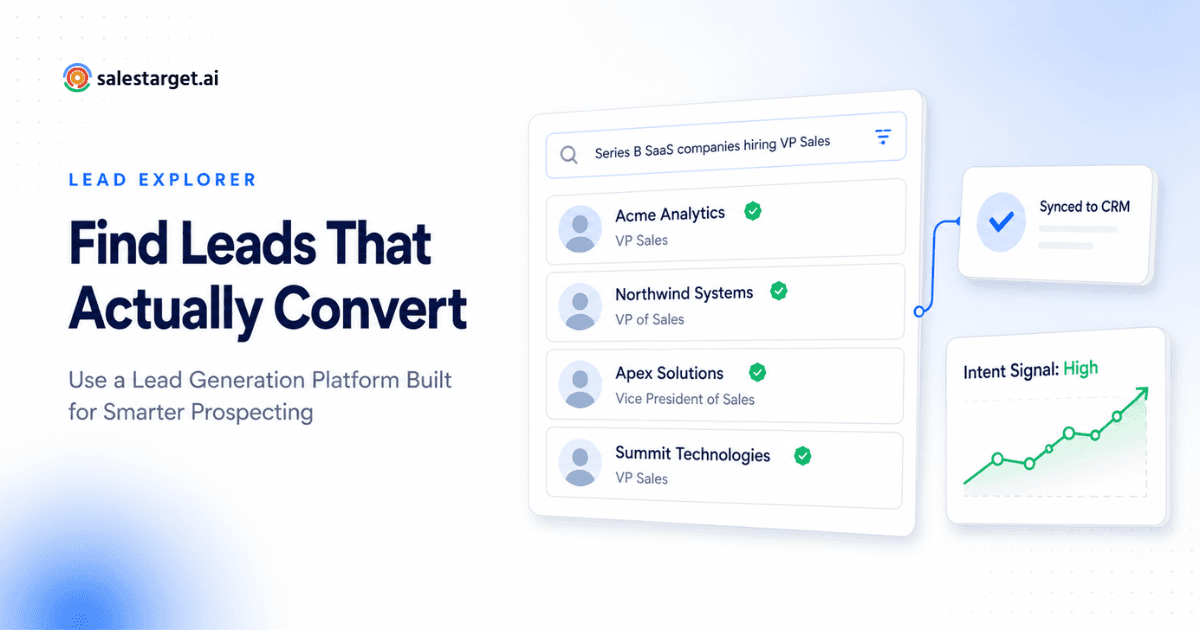
Once the lead is scored and verified, the handoff is the step that still breaks most often. The design goal is zero manual steps between "this is qualified" and "the first touch is scheduled." Lead Explorer syncs directly into SalesTarget.ai's built-in CRM and connects with HubSpot, Salesforce, Pipedrive and Zoho, and enriched leads can be pushed into coordinated email and LinkedIn sequences from the same workspace. The architectural question is simpler than it looks: how many tool boundaries does a lead cross before a human talks to the prospect? Fewer is almost always better.
The Operating Rhythm That Keeps a Platform Productive
A platform does not run itself, however good the automation. The teams that get the most out of a B2B lead generation platform run a short weekly and monthly rhythm around it.
Weekly
- Monday — segment refresh. Pull the week's new matches against your two or three primary signals; triage into working lists.
- Mid-week — reply triage. Review responders against the qualification definition; disqualify fast, prioritise the yes-adjacent.
- Friday — list hygiene. Pull anything that has gone 14 days without a touch into either a re-sequence or a hold queue; archive dead records.
Monthly
- ICP review. Compare won deals to the saved ICP filter and update the filter where reality has diverged.
- Signal audit. Which trigger actually produced meetings? Which produced noise? Cut and replace rather than accumulating.
- Enrichment latency check. Measure the gap between "lead qualifies" and "first touch leaves outbound" — if it is drifting past the SLA, the handoff is the bottleneck, not the platform.
Three Failure Modes a Platform Won't Fix on Its Own
Even an excellent B2B lead generation platform cannot rescue a workflow with these cracks in it. Recognising them early is cheaper than diagnosing them from a QBR.
1. The ICP is really three ICPs in a trench coat
If your "ideal" customer secretly spans three unrelated segments, the platform will dutifully surface all three, and the SDR team will context-switch itself into mediocre reply rates. Fix: pick the segment with the fastest sales cycle and highest average contract value, run it alone for a quarter, then expand.
2. Signal volume outpaces outreach capacity
Intent and event filters are generous by design. If your team can comfortably work 40 new conversations a week and the platform is surfacing 400, either narrow the signal thresholds or stop blaming reps for low conversion. A smaller, better-matched list almost always outperforms a larger generic one.
3. Qualified leads stall between tools
A lead moves from the data layer to the enrichment layer to the sequencer to the CRM, and somewhere along that chain the context thins out. By the time a closer picks it up, nobody remembers why it was qualified in the first place. Collapsing the chain — fewer tool boundaries, one shared record - is usually a bigger pipeline unlock than any single tool upgrade.
A Realistic 30 / 60 / 90-Day Rollout
For teams rolling out - or re-rolling out - a B2B lead generation platform, these are the checkpoints worth setting. They are deliberately modest; most of the real work in month one is operational, not technical.
| Window | What the team ships | What good looks like |
|---|---|---|
| First 30 days | Written ICP, two or three chosen signals, qualification paragraph signed off, SLA agreed. Platform configured against those; two saved segments live. | A short list of qualified leads is being worked by at least one rep daily. |
| Days 31–60 | Weekly rhythm running; monthly ICP review happens on time; CRM and outreach push working without manual export. | First signal-driven meetings on the calendar; disqualify rate stabilising below 50%. |
| Days 61–90 | Monthly signal audit cycle complete; at least one trigger retired or replaced; handoff latency measured. | Pipeline from signal-driven outbound is visible as a distinct source in reporting. |
The Takeaway
Choosing a B2B lead generation platform is the easy half of the project. The harder half is the operating model wrapped around it: a sharp ICP, a short list of signals you can actually act on, a shared definition of qualified, and an owner for every lead inside a defined SLA. Platforms that look identical in a demo produce very different pipeline outcomes depending on how disciplined the team is about those four things.
If you want to see how this operating model lands on an actual platform, SalesTarget.ai Lead Explorer is built around the four-decision workflow described above - ICP Builder for Decision 1, Intent Topics and event filters for Decision 2, intent-based lead scoring and verified contacts for Decision 3, and native CRM plus multichannel sequences for Decision 4.