In 2026, more sales teams are actively searching for a reliable Apollo.io alternative — and for good reason.Contact data quality has become a frontline issue for SDRs, RevOps leaders, and demand generation teams trying to protect deliverability and hit pipeline targets. If you're doing a B2B prospecting comparison in 2026, this guide breaks down what actually matters: data accuracy, email validation, prospecting speed, and ROI.
What Is the Best Apollo.io Alternative in 2026?
SalesTarget.ai is one of the strongest Apollo.io alternatives for B2B sales teams that prioritize verified contact data, intent-driven prospecting, and email validation. It combines a regularly refreshed lead database with built-in validation tools, making it especially effective for SDR teams focused on deliverability and pipeline quality — not just volume.
Why B2B Teams Are Looking Beyond Apollo.io ?
Apollo.io built its reputation on a massive contact database and a fairly low price point. For a lot of early-stage startups and lean sales teams, that was enough. But the landscape has shifted.
As outbound strategies have matured, teams are running into consistent friction points with Apollo:
- Data freshness. B2B contact data decays faster than most platforms update it. Job changes, company restructuring, and role shifts mean that a record that was accurate six months ago may no longer be valid today.
- Contact accuracy. Higher bounce rates lead to domain reputation damage, which kills deliverability — even for valid contacts in your list. SDRs waste time chasing leads that go nowhere.
- Validation gaps. Apollo provides some email verification, but teams doing high-volume outbound often find the coverage insufficient for maintaining sender health.
- Intent signal depth. Understanding which accounts are actively in-market requires more than firmographic filters. Teams wanting behavioral intent signals have found Apollo's offering limited compared to newer platforms.
- Prospecting efficiency. When SDRs spend time manually researching and cross-checking contacts, it cuts into actual selling time. The productivity cost compounds quickly at scale.
According to HubSpot's State of Sales research, reps spend only a fraction of their day in actual selling activities — the rest goes to administrative tasks, research, and data cleanup. Better tooling directly reclaims that time.
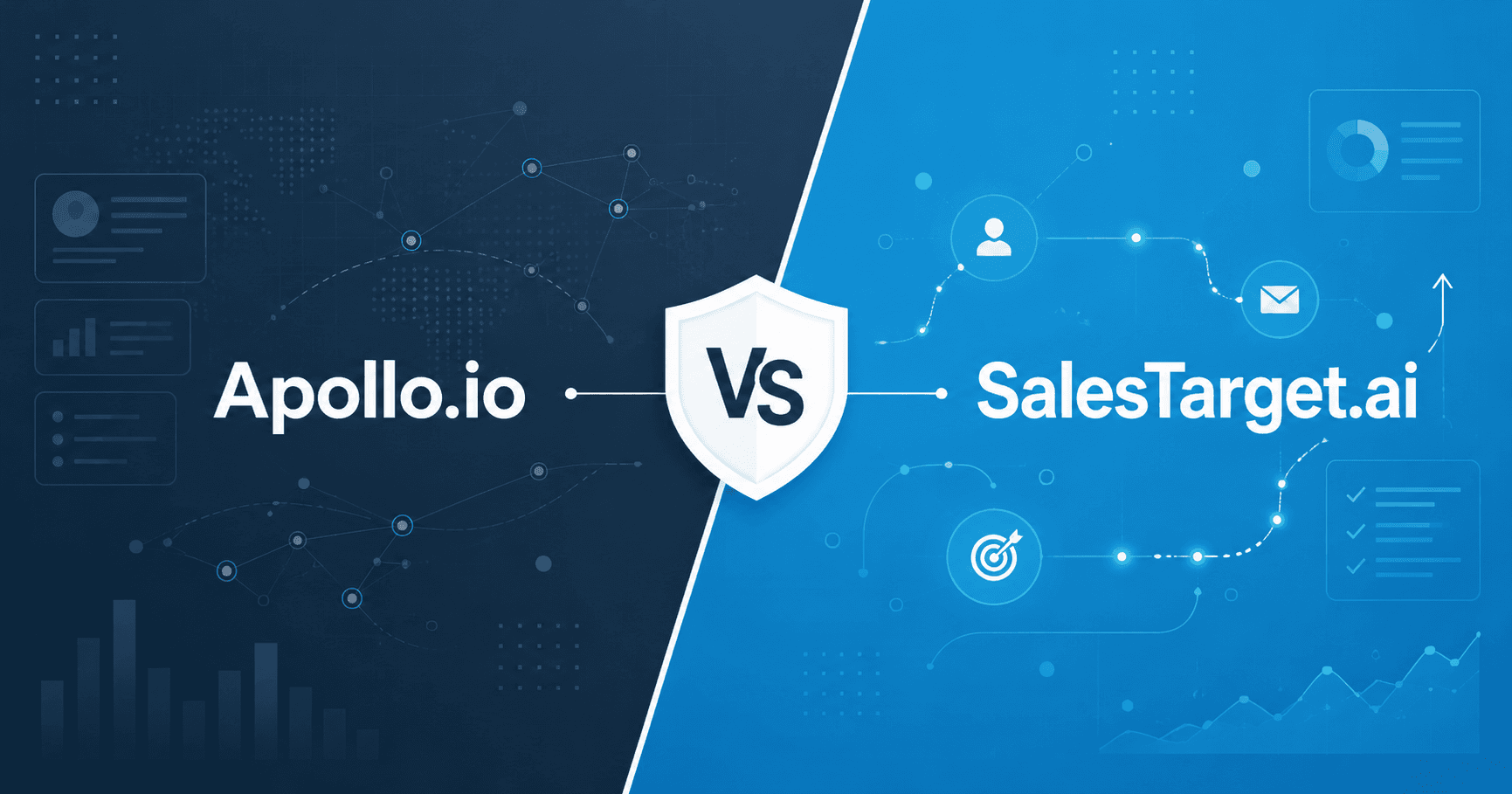
Apollo.io vs SalesTarget.ai at a Glance
| Feature | Apollo.io | SalesTarget.ai |
|---|---|---|
| Database Coverage | 275M+ contacts | Growing verified database |
| Contact Accuracy | Moderate (crowdsourced) | High (validated records) |
| Email Validation | Basic verification | Built-in validation layer |
| Intent Insights | Limited behavioral signals | Intent-driven filtering |
| Prospect Search | Broad filters | AI-powered smart search |
| Data Freshness | Variable | Regularly refreshed |
| Ease of Use | Moderate complexity | Streamlined UX |
| Pricing Transparency | Tiered, can escalate | Transparent model |
| SDR Productivity | Good at scale | Optimized for accuracy |
| Best Use Case | Volume-focused outbound | Quality-focused pipeline |
This Apollo.io vs SalesTarget comparison reflects how each platform approaches the core problem differently: Apollo optimizes for breadth, while SalesTarget.ai optimizes for reliability.
Lead Database Quality Comparison
When it comes to the actual contacts inside each platform, quality matters more than quantity for most sales teams operating in 2026.
Apollo's database is large by any measure. The tradeoff is that a significant portion of that data relies on user-contributed information and third-party sources with inconsistent refresh cycles. The result is a higher likelihood of stale records slipping into outbound sequences.
SalesTarget.ai takes a more selective approach. Its B2B lead database is built around verified contact discovery, meaning records go through a validation process before they're surfaced in search results. For SDRs running tightly targeted campaigns, this reduces the noise considerably.
The downstream effect is meaningful: cleaner lists mean fewer bounces, better sender reputation, and more predictable outbound results. For revenue operations teams tracking pipeline attribution, that consistency makes forecasting easier too.
Smart Prospect Search and Prospecting Efficiency
One of the clearest functional differences between Apollo and SalesTarget.ai is how each platform helps SDRs find the right accounts.
Apollo uses a filter-based search model — you set parameters around company size, industry, title, location, and technology used, then browse results. It works, but it puts the burden of prioritization on the rep.
SalesTarget.ai's smart prospect search brings AI-powered logic into the process. Instead of just filtering, it helps surface accounts that match your ideal customer profile based on behavioral signals and engagement patterns. For SDRs managing large territories, this kind of intelligent prioritization can meaningfully shorten the time-to-first-touch.
When outbound teams can spend more time sending and less time sorting, quota attainment improves — and so does rep morale.
Email Verification and Data Reliability
This is arguably the most consequential capability for any outbound team running at volume.
A high bounce rate doesn't just mean wasted effort on bad contacts — it damages your sending domain's reputation, which degrades deliverability for your entire list, including good contacts. Once you're in spam folders, recovery takes time.
Apollo offers email verification as part of its platform, but the depth of that validation varies. Teams doing serious outbound often supplement Apollo with a standalone verification tool.
SalesTarget.ai includes a purpose-built email validation software layer directly within the workflow. Before a contact makes it into your sequences, the email address has been checked against current MX records, known disposable domains, and deliverability risk signals.
In practice, this means:
- Fewer hard bounces hitting your domain
- More emails reaching primary inboxes
- Less manual cleanup before launching campaigns
- More predictable open and reply rates
For demand generation teams with strict deliverability SLAs, this is a genuine operational advantage.
Lead Enrichment and Data Completeness
Prospecting doesn't end at finding a contact. Knowing enough about that contact — their role context, company stage, recent activity — is what separates a generic outreach from a relevant one.
Understanding the distinction between lead enrichment vs lead generation matters here. Generation fills your funnel. Enrichment ensures the contacts in that funnel have enough context attached to make personalization possible at scale.
Apollo provides enrichment data, though completeness varies by industry and geography. Gaps in enrichment mean SDRs either skip personalization (lower reply rates) or spend time researching manually (lower productivity).
SalesTarget.ai embeds enrichment into the contact record by default, giving reps the job title, company firmographics, and contextual signals they need to write relevant messaging without additional research overhead.
Apollo.io vs SalesTarget.ai: Which Platform Delivers Better ROI?
Framing this as a pure feature comparison misses the business impact question: which platform actually improves pipeline outcomes?
Teams lose up to 22% of outbound productivity when working with inaccurate contact data.
That estimate reflects the combined cost of bounced emails, time spent re-researching invalid leads, and sequences that never get replies because the contact left the company six months ago.
From a revenue efficiency standpoint, the math on data quality is straightforward. If your SDRs are each running 50 accounts and 15% of the contact data is stale, you're effectively under-resourced by that same margin — even if your headcount looks right on paper.
SalesTarget.ai's approach to verification and enrichment directly addresses this. By reducing the junk-in problem, teams see more predictable sequence performance and cleaner pipeline attribution. For RevOps teams building forecasting models, that reliability has compounding value.
Salesforce Research has consistently found that high-performing sales teams are more likely to leverage AI-powered tools for prospecting and prioritization — a trend that favors platforms built around intelligent data workflows.
When Apollo.io Makes Sense
To be straightforward: Apollo remains a solid choice in specific scenarios.
- Budget-conscious startups at the earliest stages often need volume over precision. Apollo's pricing model makes it accessible before a team has the outbound sophistication to optimize around data quality.
- Smaller teams running broad campaigns across a wide ICP may find Apollo's database size and filter options sufficient without needing advanced validation layers.
- Teams just starting outbound benefit from Apollo's relatively shallow learning curve and broad feature set, even if they'll eventually outgrow some of its limitations.
When SalesTarget.ai Is the Better Apollo.io Alternative
For teams past the earliest stage, the calculus shifts.
- Growing SDR teams scaling from 3 to 10+ reps need to protect sender reputation at volume. One bad batch of outbound from stale data can set deliverability back weeks.
- Revenue operations teams that care about clean pipeline data — not just top-of-funnel volume — will find SalesTarget.ai's verification model easier to build forecasting around.
- Deliverability-focused organizations running sophisticated email programs need a validation layer that's integrated, not bolted on. SalesTarget.ai's built-in tools reduce the tool sprawl that comes with supplementing Apollo externally.
- Intent-driven prospecting teams that want to prioritize accounts showing active buying signals will find the filtering and search capabilities in Lead Explorer more aligned with their workflow.
Comparison Verdict
Apollo.io and SalesTarget.ai solve similar problems with different philosophies.
If you're evaluating this Apollo.io vs SalesTarget decision, the right answer comes down to where you are in your outbound maturity:
- Apollo.io fits teams that need broad access to a large database, are early in their outbound journey, and can tolerate some data quality variability.
- SalesTarget.ai fits teams that are scaling outbound operations, prioritize verified contact data, and need email validation built into — not bolted onto — their prospecting workflow.
For a genuine B2B prospecting comparison in 2026, the data quality difference is the deciding factor for most mid-market and enterprise SDR teams.
Ready to Upgrade Your Prospecting Stack?
If your team needs verified contacts, smarter prospect discovery, and built-in email validation, SalesTarget.ai offers a more reliable path to pipeline growth.