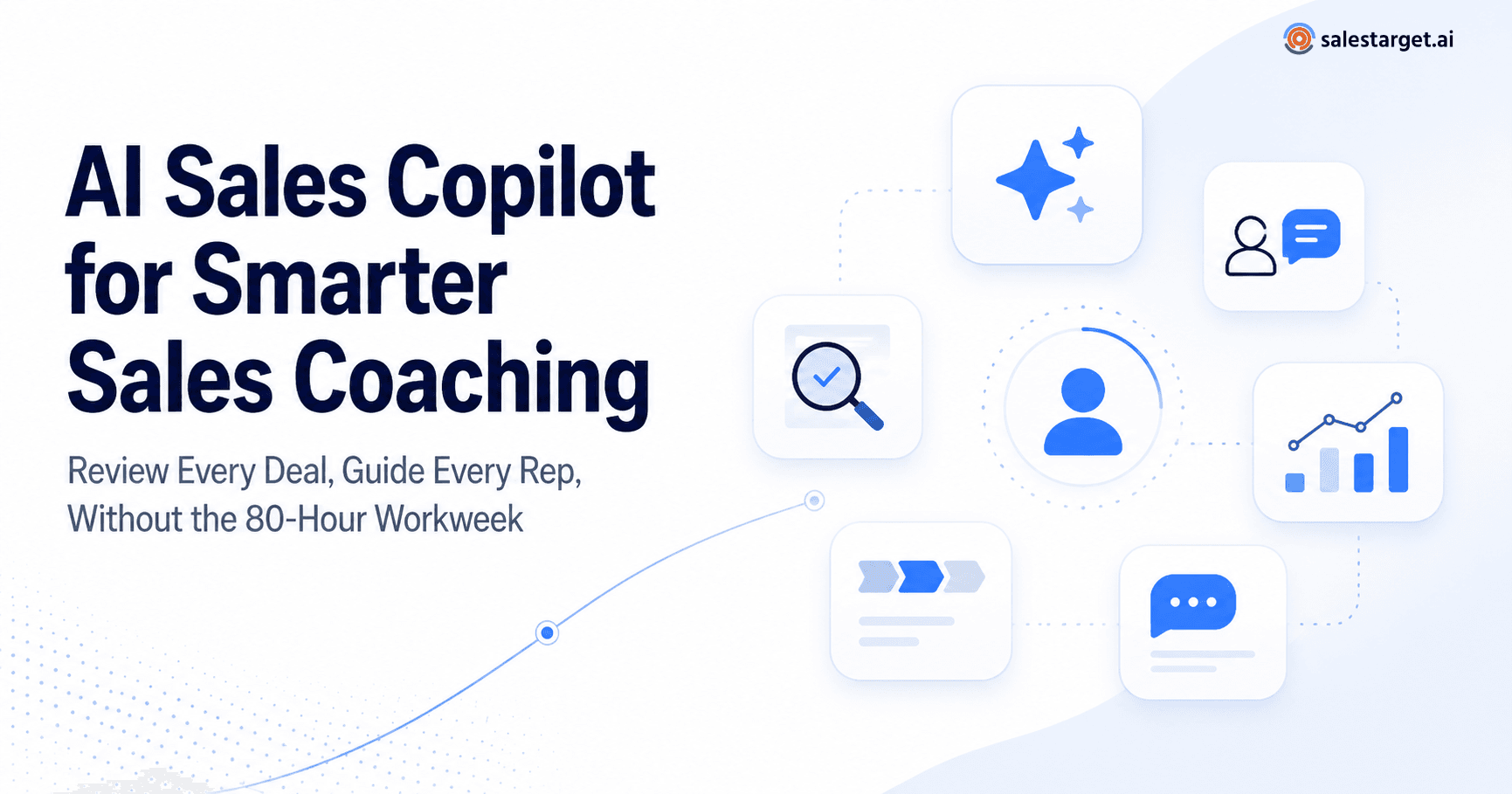
Sales managers are expected to know every deal across every rep's pipeline, catch risks early, and deliver coaching that moves the needle. The problem? There aren't enough hours. An AI Sales Copilot gives managers an intelligent layer that reviews deal data, flags risks, and surfaces coaching opportunities so they can focus where it matters most.
Quick Answer: AI sales coaching uses artificial intelligence to analyze deal activity, CRM data, and conversations, then delivers actionable insights to managers. An AI Sales Copilot automates deal review and risk detection, allowing managers to coach more reps on more deals without manually combing through every opportunity record.
What Is AI Sales Coaching?
Traditional sales coaching depends on a manager's ability to review deals one at a time. That means opening CRM records, reading notes, listening to call recordings, checking activity timelines, and cross-referencing pipeline reports before every coaching conversation. When it works, it works well. The problem is that it rarely scales.
AI sales coaching shifts the analysis burden. Instead of the manager doing all the investigative work, AI tools process deal data, sales activity, and communication signals continuously. The output isn't a replacement for human judgment. It's a prepared briefing that helps the manager walk into every coaching conversation already informed.
This matters because coaching has an outsized impact on performance. According to data compiled by Salesforce from the Gartner Sales Survey, seventy-five percent of sales reps say they are more likely to hit their targets with a coach or mentor. The issue has never been whether coaching works. It's whether managers have the bandwidth to deliver it consistently.
Why Managers Can't Manually Review Every Deal ?
Consider the math. If a frontline manager has eight reps and each rep carries fifteen active opportunities, that's one hundred twenty deals to monitor. If each review takes just five minutes of CRM inspection, the manager is spending ten hours per week on deal review alone. That's before coaching conversations, forecast calls, hiring, cross-functional meetings, and their own pipeline work.
Illustrative calculation: 8 reps × 15 opportunities = 120 deals. At 5 minutes per review, that's 600 minutes, or 10 hours weekly. Based on common B2B team structures; actual time will vary by organization and deal complexity.
The result is predictable. Managers default to reviewing only the largest deals or the ones reps surface in meetings. Smaller opportunities stall quietly. CRM records go stale because reps know nobody is checking. Coaching becomes reactive, triggered by a lost deal or missed quarter rather than real-time signals.
Teams that rely on B2B email outreach segmentation strategies to fill the top of the funnel often discover that more pipeline without better deal management just compounds the problem. More opportunities in the pipe means even less manager time per deal.
7 AI Sales Coaching Use Cases That Save Managers Hours
Here is where AI sales tools earn their value—not by replacing the manager, but by doing the prep work that consumes most of their day.
1. Deal Health and Risk Detection
Manually, the manager reviews activity logs, email timestamps, and meeting history to decide if a deal is progressing. With AI, the copilot monitors engagement patterns and flags deals showing signs of stalling, single-threaded contacts, or extended silence. The manager gets a prioritized risk list instead of digging through records.
2. Automatic Opportunity Review
Managers typically open each opportunity, read notes, check stages, and verify next steps. An AI-powered sales assistant summarizes each deal's status, recent activities, and gaps. Managers review summaries instead of raw data, cutting review time significantly.
3. Rep-Specific Coaching Recommendations
Without AI, the manager tracks rep patterns by memory or spreadsheet. A sales AI assistant identifies trends across a rep's entire book—deals stalling at the proposal stage, skipped discovery steps, or reliance on a single contact per account. Managers receive targeted coaching prompts per rep, making one-on-ones more productive. For practical examples, see these AI Sales Copilot prompt templates.
4. Pipeline Gap Identification
Manually, a manager compares pipeline coverage to quota targets using spreadsheets. The AI copilot highlights coverage gaps by stage, flagging when early-stage pipeline is thin relative to upcoming targets. Managers can redirect prospecting before it's too late.
5. Follow-Up and Next-Step Analysis
Managers often rely on asking reps whether follow-ups have been sent. AI tracks whether scheduled next steps actually happened and flags overdue follow-ups. This catches drops that reps may not self-report.
6. Coaching Based on Sales Activity and Conversations
Reviewing call recordings or reading email threads to assess communication quality takes significant time. AI analyzes activity data and conversation signals to highlight patterns in messaging, objection handling, and engagement. Managers get a concise view of how reps interact with buyers without reviewing every thread.
7. Manager-Ready Deal Summaries and Prioritization
Forecast prep normally requires building a personal view of which deals matter most this week. The AI copilot generates prioritized deal summaries ranked by risk, size, and required action. Forecast meetings become decision-making sessions instead of data-gathering exercises.
How an AI Sales Copilot Changes the Manager's Workflow
The shift isn't about removing steps. It's about changing who does the analysis.
Traditional: Open CRM. Inspect each opportunity. Check activity history. Review notes. Compare pipeline to targets. Identify risks. Prepare coaching topics. Meet with rep.
AI-assisted: AI reviews pipeline data and activity signals. Priority deals and risks surface automatically. Coaching opportunities are highlighted per rep. Manager validates, adds context, and coaches.
The manager still makes every decision and runs the coaching conversation. What changes is that they arrive prepared, rather than spending half their day getting there. This is the core of how modern sales teams use AI Sales Copilots to scale their coaching without scaling their headcount.
What to Look for in the Best AI Sales Assistant Software
Not every AI sales tool delivers the same coaching value. When evaluating the best AI Sales Assistant software, prioritize these criteria:
- Deal intelligence depth. Can the tool assess deal health based on actual activity, not just stage labels?
- CRM context. Does it pull from your existing CRM data, or require a separate data silo?
- Rep-level insights. Can it identify patterns and coaching opportunities per rep, not just per deal?
- Actionable recommendations. Does it tell you what to focus on, or just display more dashboards?
- Manager control. Can managers adjust thresholds, priorities, and focus areas?
- Ease of adoption. Will reps and managers actually use it without a multi-week onboarding process?
- Integration with existing workflows. Does it fit into how your team already sells?
The right sales enablement software should reduce time spent on analysis and increase time spent on high-value activities like coaching, deal strategy, and rep development.
How SalesTarget's AI Sales Copilot Supports Sales Managers
SalesTarget.ai built its AI Sales Copilot as a conversational assistant embedded directly inside the platform. Managers and reps interact with it through a chat-based interface, asking questions about deals, pipelines, and tasks in plain language.
The Copilot flags at-risk deals and recommends next actions, keeping managers informed without requiring manual CRM reviews. It generates personalized outreach sequences, tracks deal progress, and surfaces pipeline insights—all within a single workspace that includes lead discovery, email outreach, and CRM.
For sales managers who spend too much of their week on manual pipeline review, the Copilot is designed to shift that time back toward coaching and deal strategy.
The Future of Sales Coaching Is Manager + AI, Not Manager vs. AI
The goal was never for managers to spend zero time on deals. The goal is for every minute to count. AI handles the pattern recognition, data processing, and summary work that consumes a manager's morning. The manager handles the judgment, empathy, and strategic thinking no algorithm can replicate.
Sales teams that figure out this partnership early will coach more consistently, catch risks sooner, and develop reps faster than teams where the manager is still the bottleneck in every review cycle.
Spend less time digging through deals. Spend more time coaching the reps who need you.