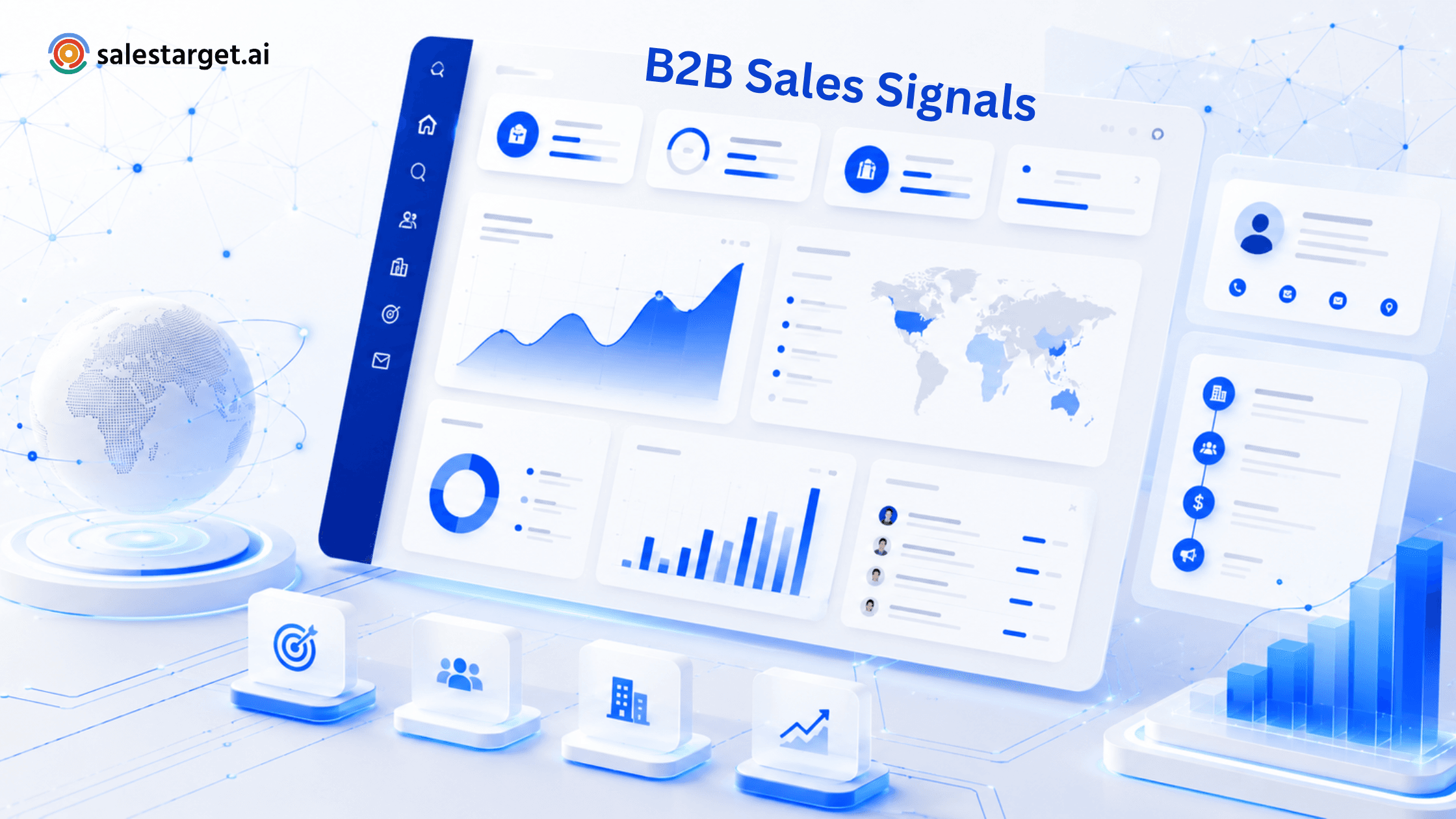

B2B Sales Signals: How AI-Powered Intelligence Drives Predictable Revenue
Most outbound sales teams are working blind. They're cold-calling companies based on firmographic filters — industry, company size, geography — without any real indication of whether those companies are actually in the market for a solution right now.
That's exactly where B2B sales signals change everything.
Rather than blasting the same sequence to a static list, signal-based selling lets your team reach out to the right company at the right moment — when a real buying trigger has already occurred. The result is higher reply rates, shorter sales cycles, and a pipeline that's built on actual buyer intent rather than hope.
This guide breaks down what B2B sales signals are, the types that matter most, and how AI-powered sales intelligence platforms are turning these signals into predictable revenue.
What Are B2B Sales Signals?
B2B sales signals are behavioral, contextual, or event-based indicators that suggest a company or decision-maker may be entering a buying journey.
They're not guesses. They're data points — sourced from job boards, funding announcements, web research activity, technographic changes, CRM behavior, and more — that tell you a company is either actively evaluating solutions or approaching a moment when they'll need one soon.
Think of them as the digital footprints buyers leave before they ever fill out a demo form.
A company posting five new SDR roles on LinkedIn. A startup closing a Series B round. A firm replacing their legacy CRM. A VP of Revenue spending time on review sites researching your category. Each of these is a signal. Alone, any one of them is interesting. Together, they paint a picture of an account that's worth calling today.
Types of B2B Sales Signals
Not all signals carry the same weight. Understanding the categories helps teams allocate attention where it counts.
Intent Signals
The most widely discussed — these track which topics companies are researching online, derived from third-party content networks and review site behavior. If a company's employees are repeatedly consuming content about sales automation or revenue intelligence, it's a reasonable indicator they're evaluating solutions in that space.
Hiring Signals
Often fly under the radar but are remarkably predictive. A company aggressively hiring for a Head of Revenue Operations or a team of BDRs tells you something about where their growth priorities are and what tools they'll likely need.
Funding and Growth Triggers
Series A, B, or C announcements; mergers and acquisitions; new market entries — these signal budget availability and organizational change, two conditions that historically precede new software purchases.
Technographic Signals
Reveal what a company currently uses. Knowing a prospect runs a specific CRM or marketing automation tool tells you what integrations matter, what gaps might exist, and how your product fits their existing stack.
Engagement Signals
From your own ecosystem — website visits, email opens, content downloads, webinar attendance — these indicate accounts that are already aware of you and warming toward a conversation.
Why B2B Sales Signals Improve Outbound Conversion Rates
Timing is arguably the most underrated variable in outbound sales. A message that lands during active evaluation converts at a completely different rate than the same message sent six months too early or six months too late.
Sales signals solve the timing problem.
When your outreach is triggered by an event — a funding round, a job posting, a spike in intent activity — you're no longer interrupting someone randomly. You have a reason to reach out that's relevant to what's happening in their business right now. That context changes the entire dynamic of the conversation.
Signal-led prospecting also improves ICP targeting precision. Instead of applying broad filters and hoping for the best, teams can layer signals on top of ideal customer profile criteria to build lists of accounts that match both the right profile and the right moment. The overlap is where your highest-converting pipeline lives.
How AI-Powered Sales Intelligence Platforms Use Sales Signals
Manually monitoring every possible signal source — job boards, news feeds, intent platforms, CRM activity logs, funding trackers — isn't realistic at scale. That's where AI sales intelligence changes the game.
Modern AI-powered platforms ingest and correlate data from dozens of sources simultaneously. Machine learning models analyze patterns across signal types and account attributes to score and rank accounts by likelihood to buy, right now. A single account might trigger five separate signals in the same week — that kind of correlation is nearly impossible to catch manually, but trivial for an AI model watching all those streams in parallel.
If you're still building prospect lists from scratch, it's worth reading about AI-powered B2B leads databases and how they surface verified prospects at scale. The infrastructure behind those databases is what makes real-time signal matching possible.
The output of a well-tuned AI prospecting system isn't just a list of contacts. It's a prioritized, dynamic view of which accounts to engage today, why, and with what message.
Best Ways to Identify High-Intent Prospects
If you want to build a signal-based prospecting workflow, start with these approaches:
- Layer intent data with firmographics. Intent data alone isn't enough — lots of companies research a category without ever buying. But when you combine intent topic spikes with the right company size, tech stack, and growth stage, you're isolating accounts that fit and are actively looking.
- Watch for organizational change. New C-suite hires, department expansions, and leadership transitions create windows of opportunity. New leaders often audit existing tools and rebuild their tech stacks within the first 90 days.
- Monitor your own engagement data. Accounts that visit your pricing page, return multiple times to your site, or engage with your email sequences without converting are raising their hand quietly. These are warm signals hiding in plain sight.
- Track competitive displacement events. When a competitor is acquired, raises prices, or makes a product change that generates negative reviews, the window to reach their customers widens. Technographic platforms can help identify those accounts.
Role of Sales Prospecting Tools in Signal-Based Selling
Signal-based selling only works if your underlying data infrastructure is solid. That means having access to a reliable sales prospecting tool that combines verified contact data with real-time account intelligence.
The gap between enriched data and basic list-building is significant. It's worth understanding what distinguishes lead enrichment from lead generation — because enrichment is what turns a company name into a fully contextualized account profile with signals attached.
The best sales prospecting tools today don't just store data — they surface it in context. They show you which accounts are spiking on relevant intent topics, which ones have had recent trigger events, and which contacts within those accounts are most likely to be relevant decision-makers. That combination of signal plus verified contact dramatically compresses the research phase of prospecting.
How SalesTarget Lead Explorer Helps Teams Use B2B Sales Signals
SalesTarget Lead Explorer is built for exactly this kind of signal-led prospecting workflow.
Instead of toggling between a contact database, an intent platform, and a news aggregator, your team gets a unified interface that layers verified B2B data with real-time account intelligence signals. You can filter by ICP criteria, narrow by buying trigger events, and identify high-intent decision-makers — all in one place.
For SDRs, that means starting every morning with a prioritized list of accounts that showed buying signals overnight. For RevOps, it means building outbound sequences that are triggered by events rather than arbitrary cadence schedules. For sales leaders, it means your team is spending time on accounts that are actually ready to engage, not burning cycles on cold, unqualified lists.
The platform is designed to compress the time between signal detection and first outreach — which is where the conversion advantage lives.
Common Mistakes Sales Teams Make with Intent Signals
Even teams with access to good signal data routinely underperform because of avoidable mistakes.
- Treating signals as a list, not a context. A list of 'high-intent accounts' without understanding why they're high-intent leads to generic outreach that wastes the opportunity. The signal should inform the message, not just the target.
- Waiting too long to act. Intent signals decay fast. An account researching a solution category today may have made a decision in two weeks. Speed-to-outreach matters enormously once a signal fires.
- Ignoring signal recency. Stale signals are misleading. Many teams are still using intent data that's 30–60 days old as if it reflects current behavior. Recency and freshness of data should be explicit criteria when evaluating any sales intelligence platform.
- Over-indexing on a single signal type. No single signal is definitive. The most reliable signal picture is a composite — multiple data points converging on the same account around the same time.
Future of AI-Driven Sales Intelligence
The gap between sales teams using AI-powered signal intelligence and those who aren't is widening quickly. We're entering a phase where generic outbound is effectively dead — the noise is too high, the barriers to ignoring it are too low.
The next wave of AI sales intelligence will deliver predictive account scoring that doesn't just describe current behavior but anticipates buying windows before they fully open. Models trained on historical deal data will correlate specific signal combinations with conversion outcomes, giving teams a statistical basis for prioritization rather than intuition.
Real-time revenue intelligence — where signals flow directly into CRM workflows and trigger automated next-best-action recommendations — will become standard infrastructure for any competitive B2B sales organization.
B2B sales signals are the clearest path from spray-and-pray outbound to a precision prospecting machine. When your team knows which accounts are actively evaluating, which have hit a trigger event, and which decision-makers are showing engagement — outreach stops being a numbers game and starts being a conversation at the right moment.
The technology to operationalize this exists today. With the right sales intelligence platform, the right prospecting tools, and a clear framework for acting on signals quickly, your team can build a pipeline that's filled with companies genuinely ready to talk.
Start building signal-led workflows into your process now — before your competitors do.
Ready to put B2B sales signals to work? Explore SalesTarget Lead Explorer and see how AI-powered account intelligence can fill your pipeline with high-intent prospects — verified, enriched, and ready to convert.
Frequently Asked Questions

See It In Action: Book Your Free Demo
Get a personalized walkthrough and see how it works for your team.
Book My Demo →