Your reps built a list of 200 prospects this week. Half the emails bounced. The LinkedIn messages sat unanswered in a separate tab. Nobody logged the three replies that actually came in, so a warm lead is sitting untouched in someone's inbox right now.
A sales engagement platform fixes this by putting prospecting, outreach, follow-up, and pipeline tracking in one connected system instead of five disconnected tabs. In plain terms: it finds the right people, reaches them across email and LinkedIn on autopilot, keeps their contact data clean, and logs every touch so nothing falls through. Reps spend their hours talking to prospects instead of hunting for them or copying data between tools. That shift, moving hours from admin work to selling work, is where most of the productivity gain comes from.
According to Salesforce's State of Sales research, reps now give roughly 28% of their week to actual selling, down from 34% in 2018, with the rest lost to record keeping, tool management, and data entry. A sales engagement platform is built to claw that time back.
The Productivity Challenges Slowing Down B2B Sales Teams
Most sales teams aren't short on effort. They're short on connected systems. A rep might use one tool to find leads, another to send emails, a spreadsheet to track LinkedIn outreach, and a CRM that only gets updated once a week.
That fragmentation shows up everywhere: stale or unverified contact data that tanks deliverability, manual follow-ups that get forgotten the moment a rep gets busy, and pipeline reports that never match what's actually happening in outreach. Salesforce reports that two-thirds of sales reps say they feel buried under too many tools, with the average team juggling around ten separate systems just to close one deal. Each handoff between tools is a place where a lead, a reply, or a follow-up task quietly disappears.
How a Sales Engagement Platform Supports B2B Sales Productivity
Connecting prospecting, outreach, and pipeline activities
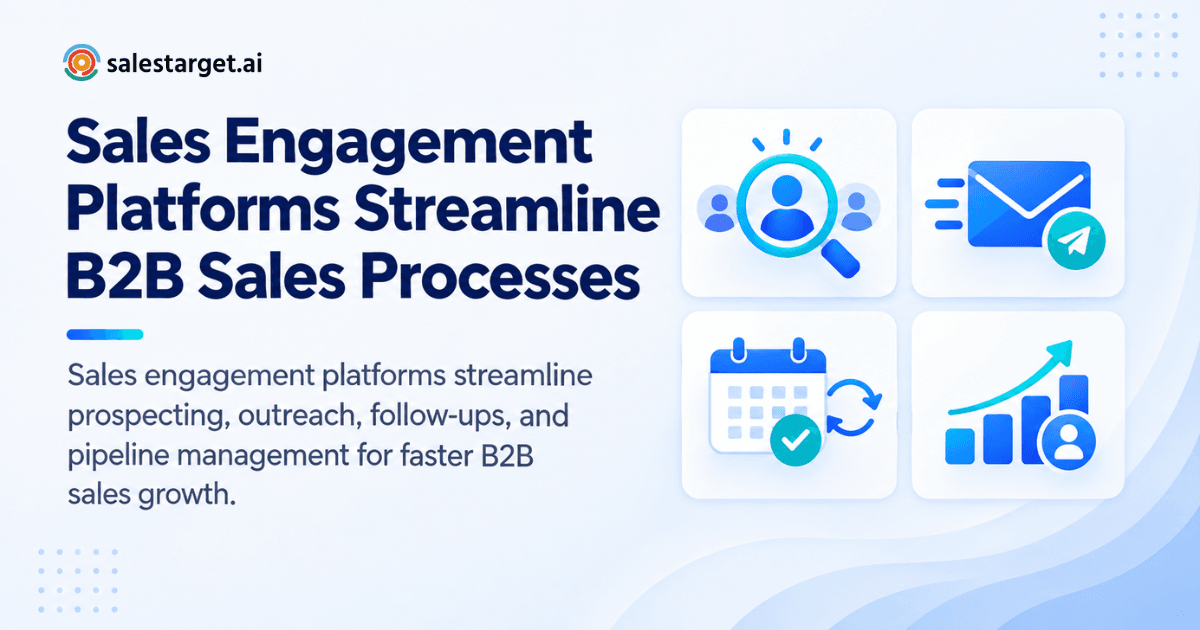
A sales engagement platform links the steps that used to live in separate tools. A lead found today can be enriched, added to a sequence, and tracked in the pipeline without a single CSV export. That connection turns a list of names into booked meetings.
Centralizing sales engagement across multiple channels
Email and LinkedIn outreach run from the same workspace, sharing context so a prospect who opens an email and views a LinkedIn profile gets a coordinated next step instead of two unrelated messages. Reps stop guessing which channel a lead responded on last.
Automating repetitive sales tasks and follow-ups
Sequence steps, follow-up reminders, and task creation happen on their own, triggered by prospect behavior. A reply creates a task. A no-show triggers a re-engagement step. Reps don't need to remember to check back in three days.
Giving sales teams more time for revenue-focused activities
Every hour not spent building lists by hand or updating records manually is an hour available for calls, demos, and negotiation. This is the direct line between platform automation and the sales productivity numbers leadership actually tracks.
Core Capabilities of a Sales Engagement Platform
B2B prospecting and lead enrichment
A strong platform searches a large database of verified companies and contacts, then enriches each record with a working email, phone number, and firmographic detail the moment a rep finds it. SalesTarget.ai's Lead Explorer does this against 840M+ profiles and 146M+ business entities, with enrichment happening at the point of discovery rather than days later.
Personalized email and LinkedIn outreach
Outreach that references a prospect's role, industry, or recent company news gets read. Templates that don't change per prospect get ignored or reported as spam. The platform should generate that personalization at scale, not force reps to hand-write every line.
Automated sales sequences and follow-ups
Multi-step sequences handle the first touch, the follow-ups, and the pacing between them, adjusting based on opens, replies, and clicks. This is where most of the manual admin work in outbound sales quietly disappears.
Contact validation and email deliverability
Bad data is the fastest way to land in spam. Verifying an email before it's sent, not just when it enters the database, keeps bounce rates low and sender reputations intact.
CRM and sales activity management
Every call, email, and reply needs a home. A built-in CRM that logs activity on its own, rather than relying on reps to type it in later, is what keeps pipeline reporting accurate.
AI assistance for daily sales workflows
An AI layer that can pull a lead list, draft a sequence, or summarize a deal's status on request removes the busywork sitting between a rep and their next call.
Key Benefits of Sales Engagement Software for B2B Teams
Faster lead qualification and prospect research
Filtering by role, seniority, company size, and buying intent turns hours of manual research into a search that takes minutes.
Higher sales rep efficiency through task automation
When sequencing, logging, and follow-up reminders run on their own, reps reclaim hours each week for direct selling. SalesTarget.ai's Email Outreach module reports campaigns built 35% faster once sequence creation is automated.
More consistent multichannel sales engagement
Coordinated email and LinkedIn touches keep a prospect's experience consistent, instead of a polished email followed by a generic, unrelated connection request.
Better follow-up management across the sales pipeline
Research from RAIN Group on top sales performers found it takes around 8 touchpoints on average to land a first meeting with a new prospect, while top performers get there in roughly 5. Automated follow-up sequencing is what makes hitting that number realistic at scale, rather than relying on a rep's memory.
Greater visibility into sales team performance
A shared, live pipeline view shows leadership exactly where deals stand, without waiting on a rep to update a spreadsheet before Friday's forecast call.
A Practical Framework for Improving B2B Sales Productivity With Automation
Define ideal customer and prospect qualification criteria
Set the firmographic and behavioral filters, industry, company size, role, and buying signals, that actually predict a closed deal, not just a filled pipeline.
Build targeted prospect lists with enriched data
Pull verified contact data at the moment a list is built, so outreach starts on clean data instead of records that will bounce or go stale within weeks.
Create personalized email and LinkedIn sequences
Write sequences around the prospect's role and context, not a single generic template stretched across every industry a company sells into.
Validate contact data before launching outreach
Run every list through validation before the first send. This single step prevents most of the deliverability damage teams spend months trying to repair.
Automate follow-ups based on prospect activity
Let opens, clicks, and replies trigger the next step automatically, so a rep's follow-up discipline doesn't depend on memory or a sticky note.
Connect engagement activity with CRM and pipeline management
Route every reply and meeting straight into the CRM, so pipeline stages update from real activity instead of a rep's end-of-week guesswork.
Measure results and refine the sales workflow
Watch reply rates, meetings booked, and cycle length by sequence, then cut what isn't working instead of running the same underperforming template for another quarter.
Sales Engagement Features That Matter for Team Efficiency
Lead data quality and enrichment capabilities
Coverage matters less than freshness. A huge database with stale emails wastes more time than it saves.
Email and LinkedIn multichannel outreach
Look for sequences that run across both channels from one workflow, with actions on one channel able to trigger a step on the other.
Sales sequence automation and personalization
Automation should still read like it was written by a person who did their homework, not a template with a first name dropped in.
Deliverability monitoring and email validation
SPF, DKIM, and DMARC checks, plus inbox warm-up, protect the sender reputation that every other feature depends on.
CRM integration and pipeline visibility
A CRM that auto-populates from campaign activity removes the manual data entry that eats a rep's afternoon.
Sales productivity metrics and activity tracking
Dashboards should show open deals, meetings booked, and pending tasks at a glance, without requiring a separate reporting tool to interpret them.
AI-powered sales workflow support
An assistant that can answer "which deals are stalling" or "draft a follow-up for this lead" in plain language saves reps a context switch every time they need an answer.
Choosing the Right Sales Engagement Platform for B2B Sales
Data coverage and lead enrichment quality
Check how many verified profiles and business entities the platform actually covers, and whether enrichment happens live or from an outdated snapshot.
Outreach channels and sequence flexibility
Confirm whether email and LinkedIn run in one coordinated sequence or as separate, disconnected tools bolted together.
Automation and personalization controls
Automation should have guardrails: pacing limits, conditional branches, and the ability to pause a sequence the moment a prospect replies.
Deliverability and contact verification features
Ask whether validation happens at the point of enrichment or only as a bulk cleanup step run occasionally.
CRM capabilities and workflow integration
A platform without a working CRM means outreach data and pipeline data live in different systems, which defeats the point of consolidation.
Pricing, scalability, and overall tool consolidation
Weigh the platform against how many separate tools it actually replaces. Consolidation is often the bigger productivity win than any single feature. For a deeper breakdown, see how to choose the best sales engagement platform.
Why Choose SalesTarget.ai
SalesTarget.ai combines B2B lead data, multichannel outreach, email validation, a built-in CRM, and an AI Copilot in one workspace, so outbound teams stop stitching point tools together to get a lead from discovery to closed deal.
AI-powered prospecting and lead enrichment with Lead Explorer
Search in plain English or stack filters across industry, seniority, and buying intent, then enrich a lead with verified email and phone data in the same click, drawing on 4,000+ intent signals from 50+ data sources.
Email and LinkedIn outreach in one connected workflow
LinkedIn Outreach and email sequences run together, so a prospect's activity on one channel shapes the next step on the other, with timezone-aware scheduling and built-in rate limits to keep accounts safe.
Email validation and deliverability checks before sending
Every enriched contact is verified at the point of discovery, and the platform reports 90% of emails validated before send, which keeps bounce rates and sender reputation in check.
Built-in CRM for managing sales activity and pipeline
The CRM logs every email and call to a lead's timeline automatically and creates follow-up tasks the moment a lead replies, no manual entry required. Teams report 91% follow-up completion and roughly 6 hours saved per rep each week.
AI Copilot for prospecting, sequences, and sales insights
Chat with the AI Copilot to pull a lead list, draft a full sequence, or check which deals are at risk, all in plain language, while strategy and final decisions stay with the rep.
If your team is still stitching together a data tool, an email sender, and a spreadsheet CRM, seeing SalesTarget.ai in action is worth twenty minutes.
Common Sales Engagement Mistakes That Reduce Productivity
Automating outreach without clear prospect qualification
Automation aimed at the wrong audience just sends bad-fit messages faster. Qualification criteria come first, automation second.
Using unverified contact data for sales campaigns
Sending to unverified lists is the single fastest way to tank a sender's domain reputation, sometimes for months.
Focusing on activity volume instead of pipeline outcomes
Emails sent and calls dialed look productive on a dashboard but mean nothing if meetings and deals aren't moving with them.
Managing sales engagement across too many disconnected tools
Every extra tool is another place data goes stale and another login a rep has to remember to check.
Using the same sequence for every prospect
A single generic sequence run across every industry and title reads as mass outreach, and prospects treat it that way.
Failing to connect outreach activity with CRM records
When engagement data doesn't flow into the CRM, forecasts get built on guesswork instead of what's actually happening in outreach.
Measuring the Impact of Sales Engagement on Sales Productivity
Sales rep time saved through automation
Track hours reclaimed from manual list-building, data entry, and follow-up scheduling. This is usually the fastest number to show leadership.
Qualified leads and meetings generated
Volume matters less than fit. Track how many enriched, qualified leads actually convert into booked meetings.
Reply and engagement rates across sales sequences
Compare reply rates by sequence and channel to see which messaging and cadence combinations are actually working.
Follow-up completion and pipeline movement
A high follow-up completion rate is one of the clearest signs that automation is doing its job instead of quietly failing in the background.
Sales cycle and conversion performance
Track how quickly enriched, validated leads move from first touch to closed deal, and compare that against the old manual process.
Building a More Productive B2B Sales Workflow With Sales Engagement
The problem at the start of this article, bounced emails, missed replies, a rep's morning lost to manual list-building, comes down to running outbound across too many disconnected tools. A sales engagement platform fixes that by connecting prospecting, outreach, validation, and pipeline tracking into one workflow.
SalesTarget.ai builds that workflow around verified data, coordinated email and LinkedIn sequences, and a CRM that updates itself, so reps spend their week talking to prospects instead of chasing them across five tabs. For a closer look at what separates a genuinely connected platform from a bundle of point tools, see what makes the best sales engagement platform. Or start with SalesTarget.ai and see the difference in your own pipeline.