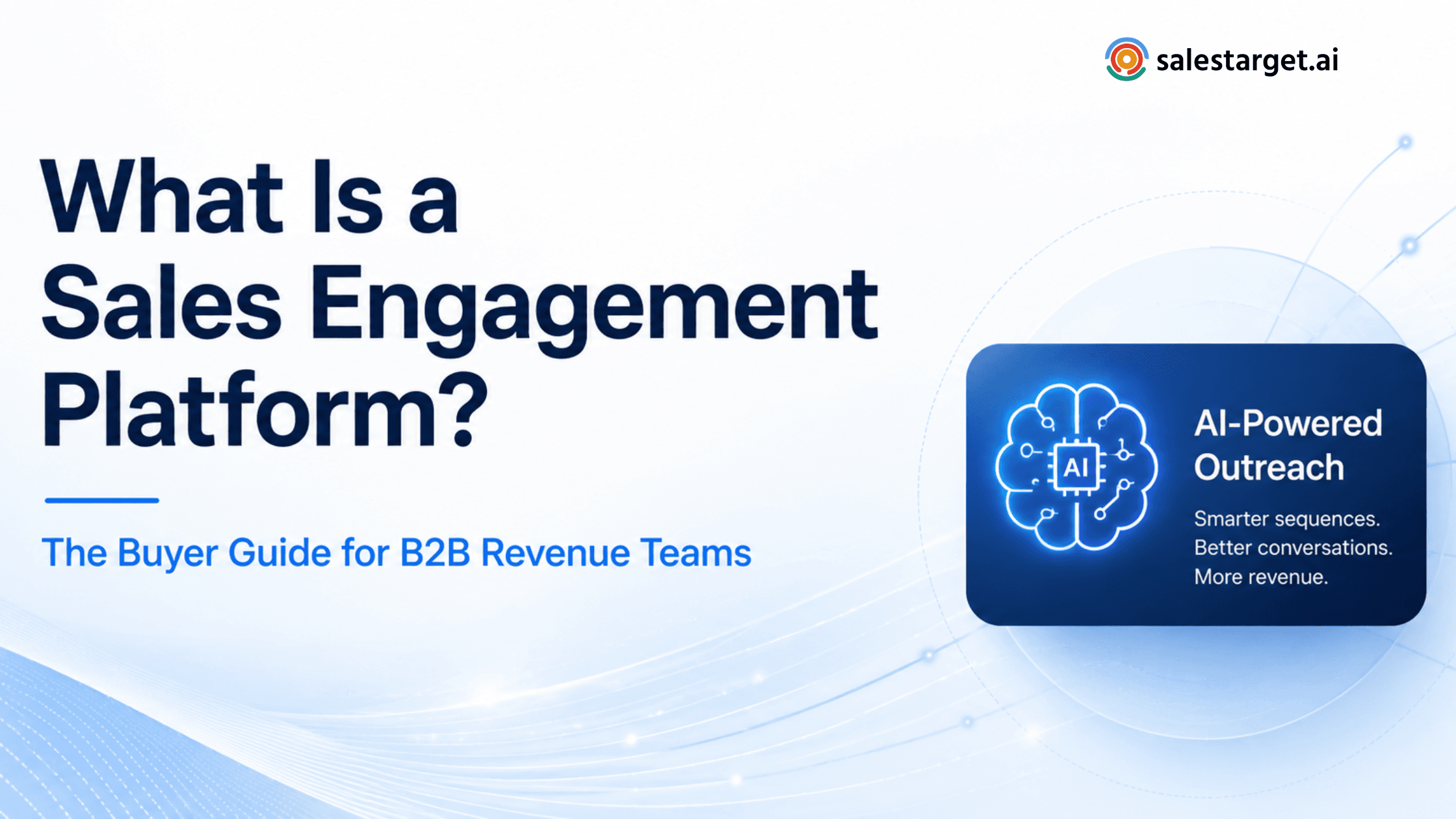
What Is a Sales Engagement Platform?
The Buyer Guide for B2B Revenue Teams
Modern B2B sales teams face a paradox: more tools, yet fewer responses. Inboxes are noisier, buying cycles are longer, and reps spend more time on admin than on actual conversations. A sales engagement platform exists to close that gap — giving revenue teams the automation, intelligence, and visibility to turn outreach into pipeline.
This guide breaks down everything you need to know before choosing one.
A sales engagement platform is software that helps B2B sales teams automate, personalize, and track multi-channel outreach across email, phone, and LinkedIn. It combines email sequencing, cadence automation, contact management, and analytics into one workflow — so reps spend less time on manual tasks and more time closing deals.
Why Sales Engagement Changed in the AI Era
Buyer behavior shifted quietly, then all at once. Prospects now receive hundreds of automated messages weekly. Open rates that hovered above 30% a few years ago have compressed in many industries. Decision-makers ignore generic pitches on sight.
At the same time, outbound teams grew. More SDRs sending more sequences created more noise, not more pipeline. HubSpot's research on sales productivity consistently highlights that reps spend a disproportionate share of their day on non-selling activities — updating CRMs, writing follow-ups, logging calls.
Declining response rates forced a structural rethink. Spray-and-pray sequencing stopped working. Teams that held on to legacy approaches saw their reply rates fall toward single digits. The teams that adapted moved toward relevance, timing, and context — and they needed tools that could deliver those things at scale.
That is where modern sales engagement platforms stepped in. They do not just automate volume. They help reps send the right message, to the right prospect, at the right moment — consistently, and without burning out the team in the process. For a side-by-side look at how today's options stack up, this comparison of modern cold email platforms is a useful starting point.
What Is a Sales Engagement Platform?
A sales engagement platform is a category of sales software built specifically to manage, automate, and measure every touchpoint between a rep and a prospect. It sits between the CRM (which stores data) and the rep (who needs to act on it), turning static contact lists into active outreach workflows.
Four core capabilities define the category:
- Email sequencing organizes follow-up messages into pre-built, logic-driven chains. A prospect who opens an email but does not reply can automatically receive a different follow-up than one who never opened it at all. The sequence adapts based on engagement signals rather than a fixed timer.
- Cadence automation coordinates outreach across channels — email, phone, LinkedIn, direct mail — in a structured, repeatable rhythm. A cadence might start with an email on day one, a LinkedIn connection on day three, and a call on day seven. Each step is triggered automatically, removing the mental overhead from the rep.
- Activity tracking captures every touchpoint — sends, opens, clicks, replies, calls, and meetings — and surfaces this data in dashboards. Managers can see which reps are on track, which sequences convert, and where prospects drop off.
- Task orchestration queues up manual tasks (calls, LinkedIn messages, personalized notes) alongside automated steps so reps work from a single prioritized list rather than juggling multiple tabs and spreadsheets.
The Five Core Components Every Platform Should Have
Not every tool that calls itself a sales engagement platform delivers equally on all fronts. Here are the five capabilities worth evaluating carefully.
1. Intelligent Email Sequencing
Sequencing should do more than send a timed series of templates. Look for branching logic (different paths based on opens, clicks, or replies), the ability to pause sequences when a prospect replies, and smart send-time optimization that learns when each contact is most likely to engage.
2. Multi-Channel Cadence Automation
Email alone no longer moves the needle. The best platforms blend email, phone prompts, LinkedIn tasks, and — increasingly — SMS and direct mail into cohesive cadences. Multi-channel reach typically outperforms single-channel outreach, though the exact lift varies by industry and persona.
3. Contact Data Quality
Outreach only works if the underlying data is clean. Platforms that include built-in verification, bounce detection, and enrichment reduce wasted sends and protect domain reputation. This is especially critical at scale, where a single bad data batch can damage deliverability for an entire sending domain.
4. Analytics and Pipeline Visibility
Revenue operations teams need more than open-rate dashboards. Look for sequence-level conversion data, step-by-step drop-off analysis, meeting booking attribution, and rep activity reports that connect outreach effort to pipeline created. Gartner's research on sales technology adoption consistently identifies reporting depth as one of the top factors separating high-performing sales organizations from the rest.
5. AI-Assisted Personalization
Personalization at scale used to be a contradiction. AI writing assistants, prospect research summarizers, and dynamic content blocks now make it possible to tailor messaging without requiring an hour of research per contact. Platforms vary widely on how much of this is native versus bolted on through integrations.
How Revenue Teams Use Sales Engagement Tools Across the Funnel
Consider a realistic scenario: a 12-person SaaS company targeting mid-market operations directors.
The demand gen team uses LinkedIn and third-party intent data to build a list of 400 accounts showing buying signals. The list is imported into the sales engagement platform, where each contact is automatically verified and enriched with job title, company size, and recent funding data.
The SDR team runs a five-step cadence: a personalized first email referencing a recent trigger (a new hire, a funding round), a LinkedIn connection request on day two, a follow-up email on day five referencing a relevant case study, a call task on day eight, and a final "breakup" email on day twelve. To see exactly how this type of workflow is structured end-to-end, how campaigns work inside SalesTarget provides a clear walkthrough.
Prospects who reply at any stage are immediately pulled out of the automated sequence. The rep takes over with a manual, context-aware conversation. Meeting invites are sent directly from the platform, and when booked, the opportunity is automatically created in the CRM.
Within four weeks, the team has 22 discovery calls booked from 400 contacts — a 5.5% meeting rate — compared to a previous average of under 2% with unstructured outreach.
Buying Checklist for Evaluating a Sales Engagement Platform
Use this framework when comparing options:
- CRM integration: Does it sync bidirectionally with your CRM in real time, or does it require manual exports?
- Email deliverability: Does the platform include domain warm-up, sending limits, inbox rotation, and bounce management?
- Cadence flexibility: Can you build multi-channel sequences with conditional branching, or are you limited to linear email chains?
- Reporting depth: Can you attribute meetings and pipeline to specific sequences and steps?
- Scalability: Will it handle your projected contact volume and team size in 12 months without a major price jump?
- AI functionality: Is personalization assistance, send-time optimization, or intent scoring built in natively?
- Ease of onboarding: How long does it realistically take for a new SDR to run their first campaign without IT support?
Common Mistakes Teams Make When Choosing Sales Engagement Tools
The most common mistake is evaluating platforms on feature lists rather than workflows. A tool with 60 features rarely outperforms one with 20 if those 20 match how your team actually works.
Teams also underestimate deliverability. A platform might offer beautiful sequence builders, but if its shared infrastructure has been flagged by spam filters, your open rates will tank regardless of copy quality. Ask vendors specifically about deliverability architecture, dedicated IP options, and how they handle abuse.
Another frequent error: buying for the SDR team without involving revenue operations. Without RevOps alignment on data flow, attribution logic, and CRM hygiene, you end up with a powerful tool generating data that nobody trusts.
Finally, many teams skip pilot testing. Running a 30-day pilot with a small segment of your list — before committing to an annual contract — reveals workflow gaps that no demo ever will.
The Future of Sales Engagement
The category is moving fast. Based on analysis of modern B2B outbound workflows, sales teams often spend nearly 35–40% of their prospecting time on manual follow-ups and administrative activities rather than active selling. That is an industry observation, not third-party research — but it reflects a pattern visible across early-stage and mid-market teams alike.
AI agents are beginning to address this directly. Rather than a rep managing a sequence, an AI agent can monitor prospect behavior, interpret intent signals, adjust messaging in real time, and decide autonomously when to escalate a thread to a human. Predictive outreach — where the system identifies which prospects to contact before the rep even sees the list — is already appearing in next-generation platforms.
Autonomous workflows, where an entire segment of outreach runs without human initiation, are closer than most teams expect. The platforms making meaningful progress here are the ones investing heavily in native AI rather than layering it on as an afterthought. SalesTarget's AI-powered outreach capabilities offer a practical example of what this looks like in a product built around AI from the ground up.
Final Thoughts
A sales engagement platform is not a magic number generator. It is infrastructure — the layer between your team's effort and the market's attention. The right one removes friction, enforces consistency, and gives leadership the visibility to improve what is not working.
The wrong one creates busy work in a new interface.
Evaluate based on your actual workflow, not a vendor's roadmap. Run a real pilot. Involve RevOps from day one. And prioritize deliverability and data quality above UI aesthetics — because no sequence converts if it never reaches the inbox.
Explore Sales Engagement
Modern revenue teams are automating outreach, streamlining follow-ups, and scaling engagement using AI-powered sales workflows — without adding headcount. Whether you're building your first outbound motion or optimizing an existing one, the right platform makes the difference between a full calendar and an empty pipeline.