Most revenue leaders can recite their win rates, pipeline velocity, and average deal size from memory. But very few can tell you what percentage of their outbound emails never reach a human inbox. That blind spot is more expensive than it looks.
When sales teams operate on unreliable contact data, reducing bounce rates becomes more than a deliverability chore. It becomes a direct lever on revenue efficiency. Every email that bounces is a prospecting touch that never happened, an impression that was never made, and a conversation that was never started. Scale that across thousands of sends per month and the cost compounds quickly.
Why Reducing Bounce Rates Is a Revenue Issue ?
Bounce rates tend to sit in the territory of marketing operations or email deliverability teams. Revenue leaders rarely examine them. That is a mistake.
A bounced email is not simply a failed delivery. It is wasted capacity. Your SDR researched the account, personalized the message, and triggered a send. If that email hits an invalid address, every minute and every dollar spent acquiring that contact produced zero return. Multiply that across a team of ten or twenty reps sending hundreds of emails a day, and you begin to see the real financial footprint.
Strong messaging, sharp targeting, compelling offers, and talented reps cannot overcome a foundation of poor contact data. A sales team can do everything right and still underperform if a meaningful share of their outreach never arrives.
Teams that follow a structured B2B email verification playbook consistently outperform peers who treat data hygiene as an afterthought. The difference shows up not just in deliverability metrics, but in pipeline generated per rep.
The Real Cost of Poor Email Data Quality
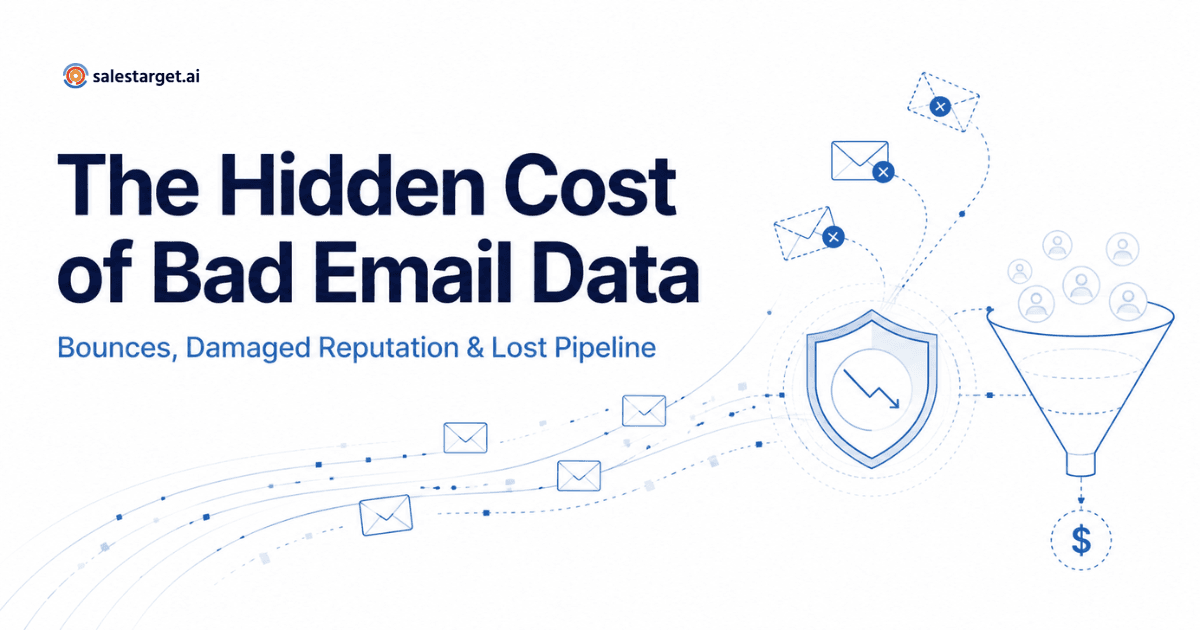
Bad email data creates a chain reaction that most organizations never fully trace. It starts with invalid addresses and cascades into weakened sender reputation, lower inbox placement, fewer prospect replies, and ultimately, lost pipeline.
Consider what happens behind the scenes. When an email bounces, your sending domain accumulates a negative signal. Internet service providers and mailbox providers track bounce patterns. A domain that consistently sends to non-existent addresses gets flagged as a potential spam source. Once that reputation damage takes hold, even your valid, well-crafted emails begin landing in junk folders.
The downstream cost is hard to overstate. Reduced inbox placement means fewer opens. Fewer opens mean fewer replies. Fewer replies mean fewer meetings booked. And fewer meetings mean less pipeline.
Illustrative example:
Suppose a mid-market sales organization sends 30,000 prospecting emails per month. If their bounce rate sits at 5%, that is 1,500 emails that never reach anyone. Assume the fully loaded cost of sourcing, enriching, and preparing each contact is roughly $1.50 when you factor in data vendor fees, SDR time, and tooling. Those 1,500 failed sends represent approximately $2,250 in wasted spend every month, or $27,000 annually, before accounting for the reputational damage and the lost conversations those sends were supposed to generate.
Understanding lead validation as a revenue lever helps revenue leaders see these costs clearly and make data quality a budget priority rather than an afterthought.
How Bounce Rates Affect Domain Reputation ?
What Happens When Invalid Emails Keep Getting Sent
Mailbox providers like Google and Microsoft use sender reputation as a core signal when deciding whether to deliver, filter, or block incoming mail. According to Google's Email Sender Guidelines, senders should keep their spam complaint rate below 0.3% and maintain clean sending practices to preserve deliverability. Bounce patterns contribute to the overall reputation signals these providers evaluate.
When a domain repeatedly sends messages to addresses that do not exist, those hard bounces tell receiving servers that the sender does not maintain its lists. Over time, the domain's reputation score drops. Once it drops past a certain threshold, even legitimate emails to real, engaged contacts may start getting filtered.
Rebuilding a damaged domain reputation is slow and difficult. Prevention, specifically by validating data before it enters your outreach workflow, is significantly more efficient than remediation. This is where email validation for sales teams fits into the broader revenue process. It is not a nice-to-have. For teams doing any volume of outbound, it is infrastructure.
Bounce Rate Benchmarks: What Revenue Leaders Should Watch
There is no single universal bounce rate that qualifies as "good" across every situation. Acceptable levels depend on your list source, data freshness, acquisition method, campaign type, sending frequency, and industry.
That said, widely referenced industry guidance suggests that keeping total bounce rates below 2% is a reasonable operational target for most B2B outbound programs. Mailchimp's benchmark data, drawn from billions of sends, places average hard bounce rates for most industries between 0.3% and 0.7%. Anything consistently above 2% warrants investigation, and rates above 5% signal a data quality problem that is actively degrading sender reputation.
Revenue leaders should distinguish between three benchmarks. First, your industry benchmark, which provides general context. Second, your campaign benchmark, which reflects the quality of a specific list or segment. Third, your sender-specific baseline, which is the rolling average your domain maintains over time. Tracking all three gives a clearer picture than relying on any single number.
The Deliverability ROI Most Sales Teams Overlook
Deliverability is rarely discussed in revenue reviews. It should be.
The logic is straightforward. Better data quality leads to fewer invalid sends. Fewer invalid sends protect sender reputation. A stronger reputation means higher inbox placement. Higher inbox placement creates more opportunities for prospects to see, open, and respond to outreach. More responses mean more conversations, more pipeline, and ultimately, more revenue.
Here is a simple way to frame it. If improving data quality moves your inbox placement rate from 82% to 92% on 30,000 monthly sends, that is an additional 3,000 emails actually reaching a human inbox. Even at a modest 3% reply rate, that is 90 more conversations per month. If 20% of those conversations convert to a qualified meeting, that is 18 additional opportunities your team was previously leaving on the table. That math adds up over quarters.
How Better Email Data Supports Pipeline Growth ?
Clean data does not just prevent bad outcomes. It actively enables better ones. When SDRs trust their contact lists, they spend less time chasing dead addresses and more time on high-value activities: personalizing outreach, multi-threading into accounts, and following up with engaged prospects.
Sales operations leaders who invest in data quality see compounding benefits. Sequences run more efficiently. A/B tests produce cleaner results because variations are not muddied by non-deliveries. Reporting becomes more accurate because open and reply rates reflect actual prospect behavior rather than being diluted by emails that never arrived.
A Practical Framework for Reducing Bounce Rates
Revenue leaders do not need to become email deliverability experts. But they do need a framework that keeps data quality from quietly eroding pipeline. Here is a concise, actionable approach.
Audit your existing database
Start with what you have. Run your current prospect and lead database through a verification process to identify invalid, risky, or outdated addresses. Most teams are surprised by how much of their data has decayed.
Validate emails before outreach
Build verification into your workflow so that no email enters a sequence or campaign without being checked first. This single step eliminates the majority of preventable bounces. When evaluating solutions, understanding how to choose the right email verifier can save significant time and prevent investing in a tool that does not fit your team's volume or workflow.
Remove or suppress risky addresses
Not every address that passes a basic check is safe to send to. Catch-all domains, role-based addresses, and disposable emails carry higher risk. Suppress them from active outreach or route them to lower-priority cadences.
Monitor bounce and deliverability trends
Track bounce rates at the campaign, domain, and list-source level. Establish a sender-specific baseline and investigate any deviation. Monthly reporting on deliverability health should be as routine as reviewing pipeline numbers.
Why Email Validation Should Be Part of the Revenue Process ?
Email validation is often categorized as a marketing operations function. In practice, it is a revenue efficiency tool. When validation runs before every outbound sequence, sales teams protect their sending reputation, maximize the reach of every campaign, and ensure that the pipeline they report is built on real conversations with real prospects, not inflated by sends that went nowhere.
For revenue leaders who want to treat their outbound engine with the same rigor they apply to forecasting and pipeline management, data quality is not optional. It is foundational.
Final Takeaway for Revenue Leaders
Poor email data does not announce itself. It does not show up as a line item in your budget or a red flag in your CRM dashboard. It works quietly, eroding deliverability, wasting sending capacity, damaging domain reputation, and shrinking the pool of prospects your team can actually reach.
Reducing bounce rates is not an email marketing task. It is a revenue-efficiency discipline. The organizations that treat it that way will generate more pipeline from the same resources, protect their sending infrastructure, and give their sales teams a genuine advantage in crowded inboxes.
Stop Letting Bad Data Eat Into Your Pipeline
Find accurate prospect email addresses before your sales team spends time reaching out. Build cleaner lists, reduce unnecessary bounces, and give your outbound team better data to work with.