TL;DR
- AI personalisation sounds robotic when teams feed it surface data only — name and company — and call it done. Real personalisation runs on three layers simultaneously.
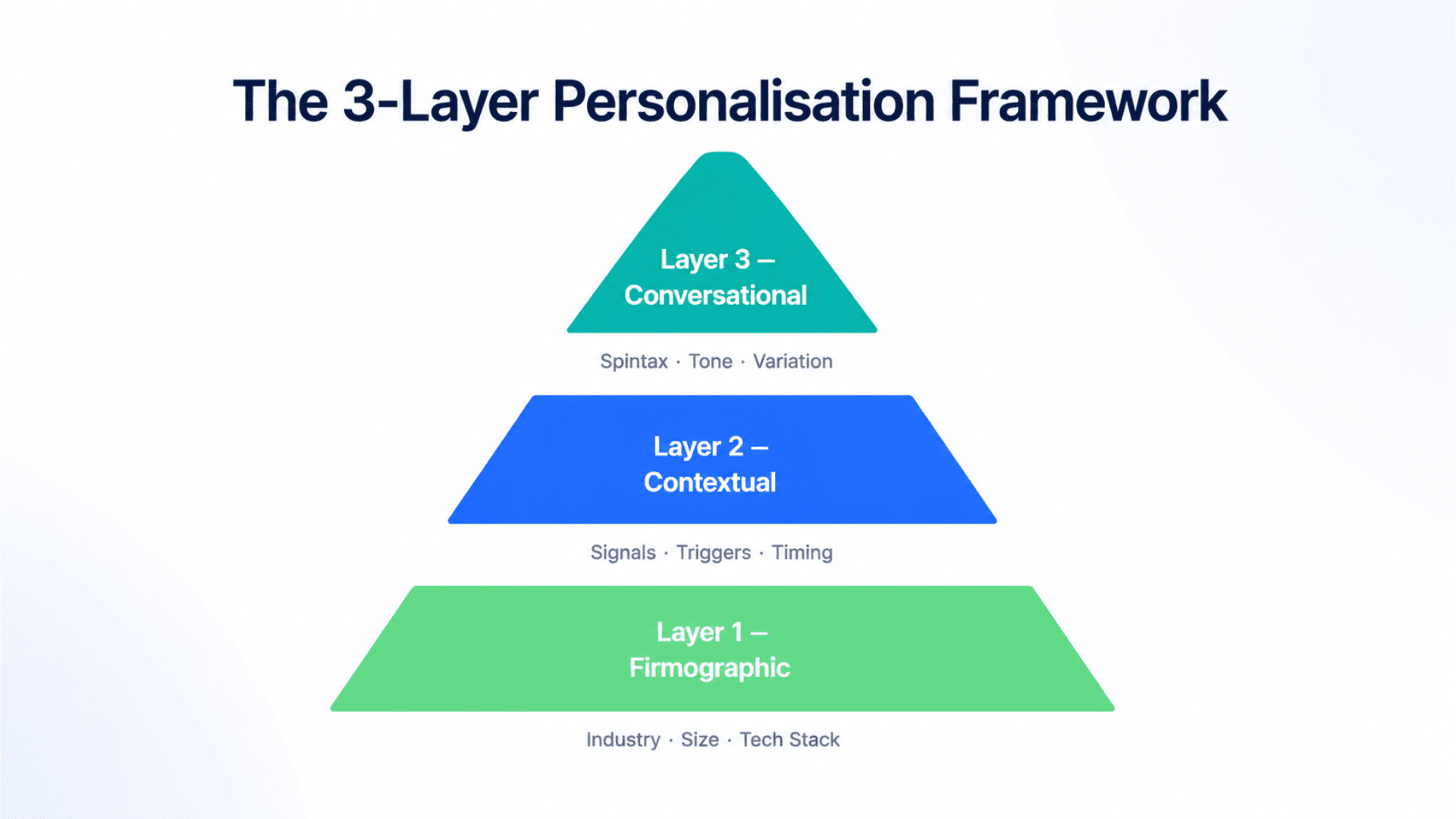
- The 3-layer framework: Firmographic (what their company is) + Contextual (what is happening there right now) + Conversational (how the email sounds to a human).
- Salesforce research shows 73% of B2B buyers expect outreach that reflects their specific situation — yet most cold email still opens with a generic product pitch.
- Spintax is the structural variation layer that prevents 500 similar emails from triggering spam filters — it is not a personalisation hack, it is a deliverability tool.
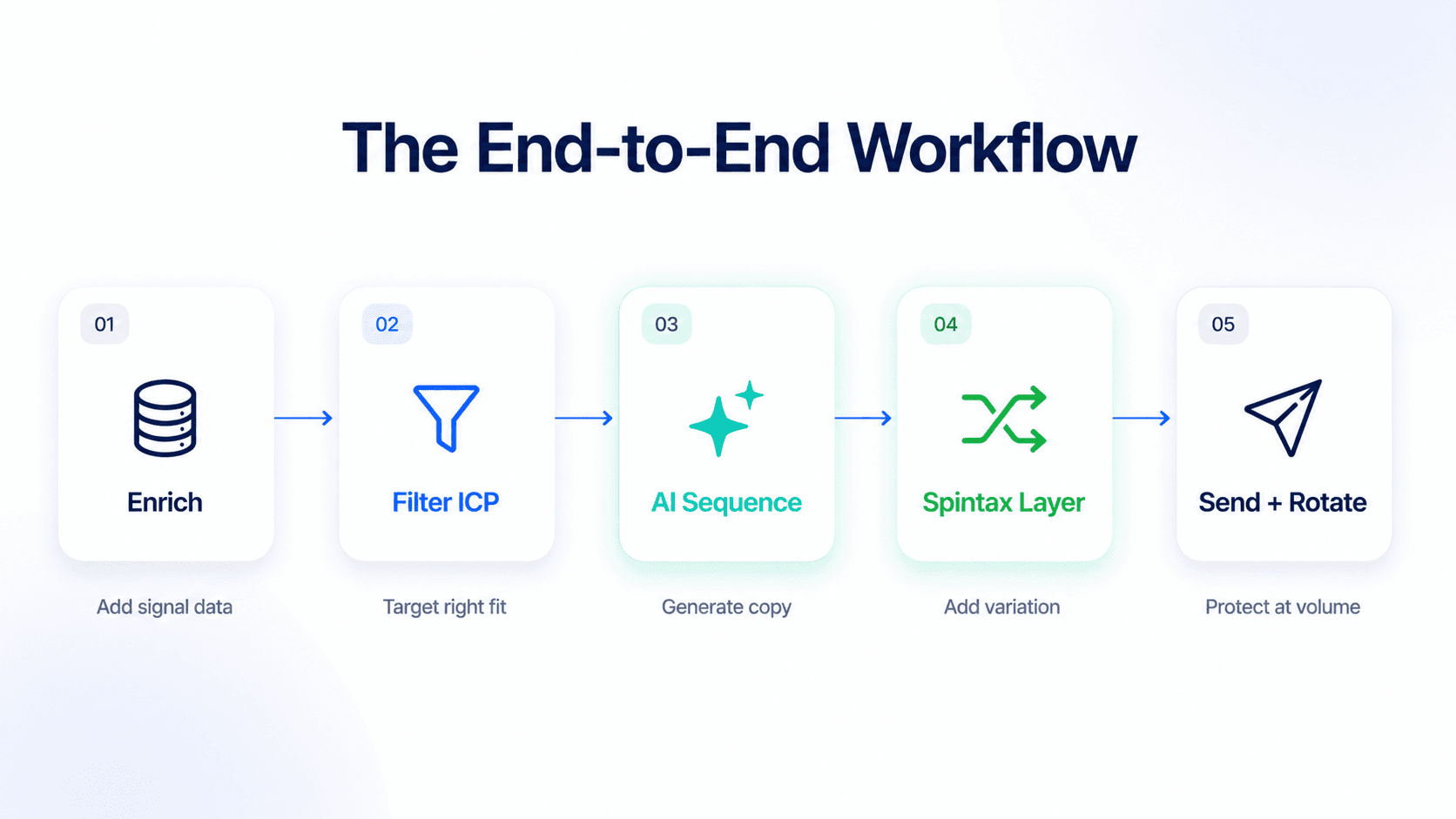
- The full workflow — enrichment, ICP filter, AI sequence, spintax, send — runs inside SalesTarget's AI Outreach Suite without switching tools.
Salesforce's State of the Connected Customer research finds that 73% of B2B buyers expect companies to understand their unique needs and circumstances before reaching out. Most cold email ignores this entirely — opening with a company name, a feature list, and a calendar link that could have been sent to anyone on the list. The problem is not that AI-generated email is bad. The problem is that most teams use AI to write faster without changing what they feed it. First name and company name is not personalisation. It is a mail merge with a better interface. Here is the workflow that actually changes what the AI knows before it writes.
Why AI Personalisation Sounds Robotic (The Input Problem, Not the Output Problem)
There is a consistent pattern in AI-generated cold email that experienced SDRs recognise immediately: the email mentions the company name in the first line, makes a generic claim about their industry, and pivots to a product pitch by line two. It reads like a robot read the company's LinkedIn page and summarised it back. Which is exactly what happened.
The output is robotic because the input is generic. AI models are pattern-completion engines — they produce the most probable continuation of whatever you give them. Feed them a name and a company, and they produce the most probable opening for an email to someone at that company. That opening exists in thousands of other emails. It sounds like every other AI-generated cold email in the prospect's inbox because it was generated from the same type of prompt.
The fix is not a better prompt. It is better data going into the prompt. Specifically: data that the AI cannot generate from general knowledge — a signal, a trigger, a specific behavioural or contextual detail about this company at this moment. That is what makes an email feel like it was written for one person rather than processed for a list.
The diagnostic: what is your AI actually using?
Before running any AI personalisation at scale, answer three questions:
- What data fields is the AI referencing? If the answer is only first name, company name, and job title — you are doing mail merge, not personalisation.
- Is any of that data time-sensitive? A trigger event from three weeks ago is more valuable than a company description that has not changed in two years.
- Does the email reference something the prospect could verify? Real personalisation contains a detail the prospect recognises — a job posting, a product launch, a funding round. Generic personalisation contains only things they already know about themselves.
The 3-Layer Personalisation Framework
Effective AI personalisation at scale operates on three layers simultaneously. Each layer adds something the previous one cannot provide alone. Skipping any layer produces email that feels either impersonal, irrelevant, or inhuman — sometimes all three.
| Layer | What it covers | Data inputs | What it adds to the email |
|---|---|---|---|
| 1 — Firmographic | What their company is | Industry, company size, revenue band, tech stack, location, growth stage | Relevance — the email clearly applies to their type of company |
| 2 — Contextual | What is happening at their company right now | Recent funding, new hire in a relevant role, job postings, product launches, news mentions, tech stack changes | Timing — the email arrives at the right moment, not just to the right company |
| 3 — Conversational | How the email sounds to a human | Tone variation, sentence structure variation, spintax alternatives, subject line variants | Humanity — the email reads like a person wrote it for this reader, not a system generated it for a segment |
Layer 1 — Firmographic Personalisation: What the AI Knows from Data
Firmographic data is the baseline. It is the information that makes your email relevant to a category of companies rather than just a list of names. At this layer, AI handles the heavy lifting — taking structured data fields and weaving them into copy that acknowledges the prospect's specific context without requiring manual research per contact.
The data fields that do the most work at this layer are industry vertical, company size band, and tech stack. A cold email to a 50-person SaaS company should read differently from one to a 400-person professional services firm even if the product being offered is the same. AI handles that differentiation automatically when the data fields are populated correctly during enrichment.
💡 The firmographic personalisation rule
Firmographic data tells the AI what type of problem to reference. It does not tell the AI why this prospect has that problem right now. Layer 1 alone produces emails that feel relevant to a segment but not to a person. You need Layer 2 for that.
Layer 2 — Contextual Personalisation: What the AI Knows from Signals
Contextual personalisation is the layer that separates AI-personalised email from AI-generated email. It requires real-time or near-real-time signal data — something that happened at this company recently that creates a hook the AI can reference in the opening line.
According to the Instantly 2026 Cold Email Benchmark Report, signal-personalised emails achieve an average reply rate of 18% compared to 3.4% for generic outreach. The gap is not marginal. It reflects a fundamental difference in how the prospect experiences the email — one feels researched, the other feels processed.
| Signal type | Example | How the AI uses it | Reply rate impact |
|---|---|---|---|
| Funding round | Company raised Series B 3 weeks ago | Opens with the growth implication — what problems scaling companies hit at this stage | Very high |
| Key hire | New VP of Sales joined last month | References what new sales leadership typically prioritises in their first 90 days | Very high |
| Job posting | Hiring 3 SDRs right now | Connects the hire to the problem your product solves — scaling outreach, managing volume, tooling | High |
| Product launch | Launched new feature or product tier last quarter | References the outreach challenge that comes with launching into a new segment or market | Medium-high |
| Tech stack change | Recently adopted a new CRM or sales tool | Opens with the integration or workflow gap that typically follows a tool switch | Medium-high |
Layer 3 — Conversational Personalisation: Spintax and Tone Variation
The first two layers make an email relevant and timely. Layer 3 makes it sound human. At 500 emails per day, even perfectly crafted personalised content starts to create a pattern — similar sentence structures, similar phrasing, similar rhythm. Inbox providers recognise this pattern. So do recipients who receive multiple touches from the same campaign.
Spintax solves this at the structural level. It creates multiple equivalent versions of each sentence, phrase, or section — and the email system selects randomly from these alternatives for each send. The message stays consistent; the surface expression of it varies enough to break the pattern that triggers spam filters and reader fatigue.
Spintax in practice — what it looks like
Spintax input
{Worth a quick call|Happy to show you how this works|Would it make sense to connect} to see if it's relevant for {Company}?
What three different recipients receive
→ "Worth a quick call to see if it's relevant for Acme?"
→ "Happy to show you how this works to see if it's relevant for Ridgeline?"
→ "Would it make sense to connect to see if it's relevant for Northstar Labs?"
Spintax is not a substitute for Layer 1 and 2 personalisation — it is an addition to them. The personalised first line handles relevance and timing. Spintax handles structural variation throughout the body and CTA so the email pattern never becomes fingerprint-able at scale. For a deeper technical walkthrough of spintax implementation, the SalesTarget spintax guide covers the specific syntax and use cases in detail.
The SalesTarget Workflow End-to-End: Enrichment to Send
Here is the complete workflow that applies all three personalisation layers at 500 emails per day — no manual research, no switching between tools, no copy-pasting between spreadsheets and email platforms.
📋 The 5-step AI personalisation workflow
- Step 1 — Enrichment. Import your contact list. SalesTarget enriches each contact with firmographic data — industry, company size, tech stack, growth stage — and overlays available signal data: recent funding, new hires, job postings. This populates the Layer 1 and Layer 2 data fields that the AI will reference when generating copy.
- Step 2 — ICP filter. Apply filters to surface only contacts that match your current campaign's ICP definition. Industry, company size, role seniority, and signal presence (e.g. only companies with an active SDR hire in the last 30 days). The AI personalisation is only as good as the targeting — sending personalised emails to off-ICP contacts wastes the framework.
- Step 3 — AI sequence generation. Define your sequence structure in SalesTarget's AI Outreach Suite: number of touches, timing intervals, and the personalisation variables each touch should reference. The AI generates the copy for each touch using the enriched data — Layer 1 firmographic context in the body, Layer 2 signal data in the opening line.
- Step 4 — Spintax layer. Apply spintax variants to body copy and CTAs to create structural variation across sends. This is configured once per campaign — the system handles the random selection per send automatically. Layer 3 is now active across the entire sequence.
- Step 5 — Send via inbox rotation. Launch the campaign with inbox rotation active — daily volume distributed across multiple warmed inboxes so no single domain takes sustained high-volume load. At 500 emails per day, inbox rotation is not optional. It is the mechanism that keeps deliverability intact while all three personalisation layers do their work in the inbox.
Before and After: Generic vs. AI-Personalised
The difference between a generic AI email and a properly personalised one is visible in the first two lines. Here is the same product, the same target, the same ask — before and after the 3-layer framework is applied.
Before — Generic AI email (Layer 1 only)
Subject: Improve your cold email outreach
Hi Sarah,
I noticed you work at Ridgeline, a SaaS company in the B2B space. We help sales teams like yours improve their outreach performance with AI-powered tools.
Would you be open to a 30-minute demo to see how we can help?
After — 3-layer AI personalisation (Firmographic + Signal + Spintax)
Subject: Ridgeline + the SDR scaling problem
Hi Sarah,
Saw that Ridgeline is hiring three SDRs right now — companies at that growth stage usually hit the same wall: outreach volume increases but reply rates don't keep up because sequences are still generic.
We built the AI personalisation layer that fixes that — [named company at similar stage] used it to take reply rates from 1.4% to 3.1% in 30 days.
Worth a 10-minute call to see if it's relevant for Ridgeline?
The "after" version uses a real signal (SDR hiring), references a felt consequence of that signal (volume without reply rate improvement), provides a specific proof point, and makes a low-friction ask. The AI wrote it — but it wrote it from three layers of input data, not one.
How Personalisation Protects Deliverability at 500 Emails per Day
There is a deliverability argument for personalisation that most outreach guides miss. Inbox providers score outbound email not just on technical signals (SPF, DKIM, bounce rate) but on engagement signals — do recipients open, reply, and engage, or do they ignore and mark as spam?
Personalised emails that reference a real signal generate higher open rates and positive reply rates. According to Salesforge research, AI-personalised outreach generates 57% higher open rates than generic templates. Higher engagement signals tell inbox providers that your domain sends content recipients want — which in turn improves inbox placement for every subsequent send.
At 500 emails per day, this virtuous cycle matters significantly. Generic outreach at that volume accumulates negative engagement signals (low opens, high ignore rates, occasional spam flags) that compound into domain reputation damage over weeks. Personalised outreach at the same volume generates positive signals that protect and reinforce sender reputation. The personalisation framework is not just a reply rate strategy — it is a long-term deliverability strategy for high-volume senders.
💡 The high-volume sender rule
At 500 emails per day, inbox rotation is non-negotiable — distribute volume across multiple warmed inboxes via SalesTarget's inbox rotation to protect per-domain sending reputation. Personalisation improves engagement signals. Rotation prevents volume from overwhelming any single domain. Both are required at scale — neither works as a substitute for the other.
500 emails a day. Zero that sound the same.
SalesTarget's AI Outreach Suite runs all three personalisation layers — firmographic, contextual, and conversational — in one workflow, at scale.
✓ 50 credits ✓ 7-day trial ✓ No credit card required