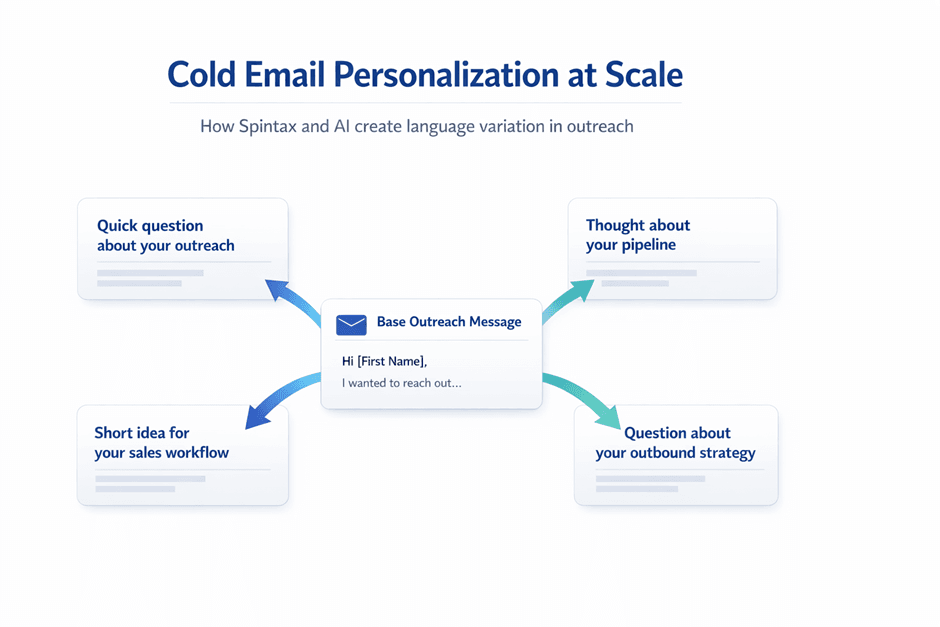
Personalization Breaks When Scale Begins
Cold email personalization works well when volume is low. A salesperson can review a company website, scan a LinkedIn profile, and write a message that reflects some level of awareness. At small scale, this approach is manageable and often effective.
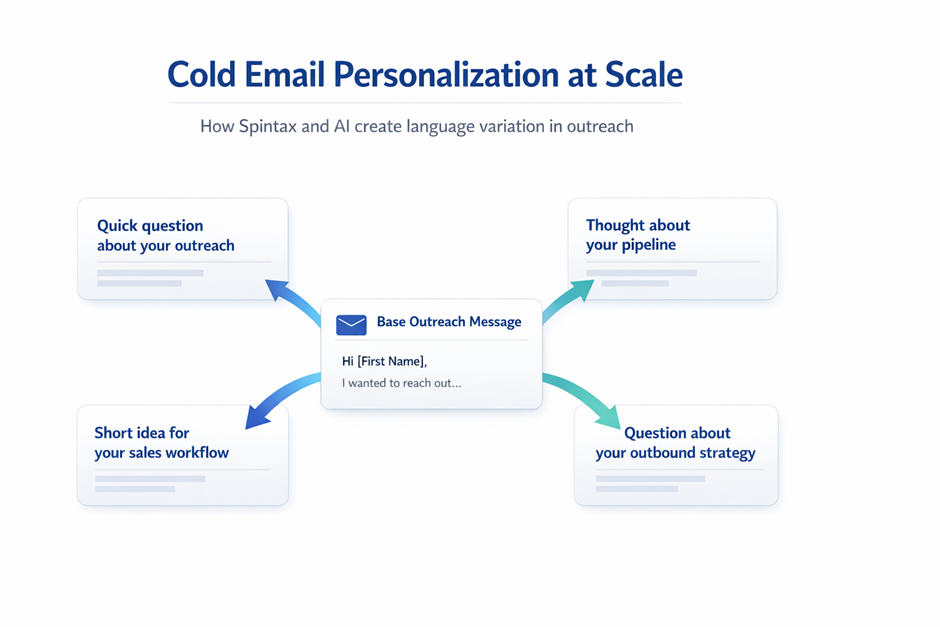
The problem begins when volume increases.
As soon as teams move from dozens of emails per week to hundreds or thousands, personalization changes form. It becomes template-driven. Instead of writing messages, teams design one or two strong templates and insert basic variables such as first name, company name, and job title. Technically, the emails remain personalized. Functionally, they begin to look identical.
This shift matters because buyers have become highly sensitive to pattern-based outreach. Decision-makers receive many sales emails every week and learn quickly how to recognize automation. When several messages follow the same structure and language, they are treated as system output rather than intentional communication.
By 2026, the challenge is no longer whether personalization matters. It is whether personalization can survive at scale. Spintax generators exist specifically to address this tension between volume and relevance. They allow teams to preserve diversity in language while still operating inside automated outreach systems.
Spintax does not replace strategy. It replaces repetition.
Why Language Variation Has Become Important
Modern outbound performance data consistently shows that engagement declines as messages become more uniform. While no single industry report isolates spintax as a variable, multiple outbound benchmarks from 2024 and 2025 point to the same pattern: static templates lose effectiveness over time as recipients recognize familiar structures and phrasing.
Reply rate benchmarks in cold email typically sit in the low single digits for broad campaigns, and only improve meaningfully when segmentation and message differentiation are introduced. This suggests that it is not just relevance that matters, but how that relevance is expressed.
This is also reflected in how engagement improves when messaging adapts over time, as shown in How to Increase Your Email Conversion Rates with AI.
Language plays a role in perception. When emails appear mass-produced, they are treated as such. When phrasing varies naturally, automation becomes less visible. This does not guarantee higher replies, but it reduces the fatigue effect that static templates create.
The same behavior is visible in reply patterns analyzed in Cold Email Reply Rates Explained: Why Prospects Respond (or Don't).
Spintax generators operate at this level. They do not change targeting or intent. They change how language behaves at scale.
Outreach at Scale Creates a Language Problem
Modern cold email struggles less with identifying the right accounts and more with how messages are delivered. Most teams can now build accurate lead lists. What often fails is the message format.
Scaled outreach relies on static templates. These templates may be well written, but they become predictable. Opening lines repeat the same structure. Value propositions follow the same rhythm. Calls to action sound the same across campaigns.
From the sender's perspective, this feels efficient. From the recipient's perspective, it feels automated.
This is not primarily a data or deliverability problem. It is a language problem. When language stops varying, it stops feeling deliberate. Even a relevant message loses credibility if it appears mass-produced.
Cold email personalization depends on two conditions: relevance and variation. Relevance ensures the message applies to the reader. Variation ensures it feels written rather than generated. Most outreach systems solve for relevance. Few preserve variation.
Spintax generators are designed to reintroduce variation without abandoning automation.
What a Spintax Generator Actually Does
A spintax generator allows multiple versions of the same sentence to exist within a single line of text. Instead of committing to one phrasing, the sender defines several acceptable alternatives.
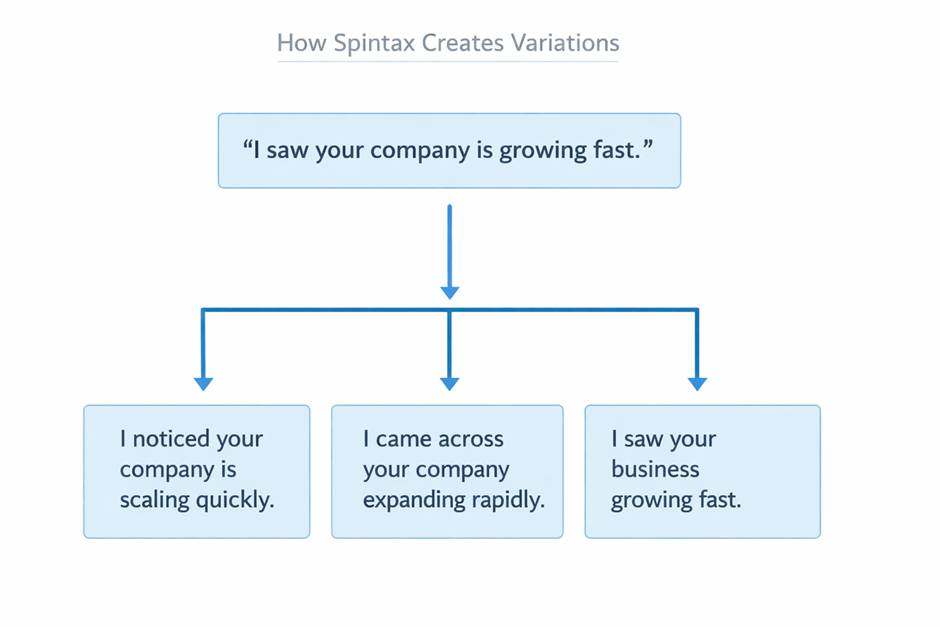
For example, instead of writing "I saw your company is growing fast," the sender can write:
I {saw|noticed|came across} your company is {growing fast|scaling quickly|expanding rapidly}. Each time the email is sent, the system selects one of the possible combinations.
The meaning remains stable. Only the wording changes.
This approach allows one message to exist in many surface forms. It does not create new ideas. It reshapes existing ones. At small scale, this may appear unnecessary. At large scale, it becomes structural.
Without variation, automation becomes visible. With variation, automation becomes less obvious.
This is why spintax is particularly relevant in cold email outreach, where first impressions form quickly and repeated language is easily detected.
Why Traditional Personalization Stops Working
For years, personalization was treated as a formatting problem. If the first name and company name were inserted correctly, the email was considered personalized. That approach worked when inboxes were less crowded and automation was less common.
By 2026, this logic no longer holds.
Buyers do not judge personalization by whether their name appears. They judge it by whether the language feels specific. A sentence that could apply to any company feels generic, even if the variables are correct.
As volume increases, creative effort decreases. Writing hundreds of messages manually is unsustainable. Templates become default. Over time, templates harden into fixed patterns.
This is where personalization collapses into structure.
Spintax introduces controlled variation into that structure. Instead of relying on one phrasing, teams rely on a family of phrasings that serve the same purpose.
This changes how personalization behaves at scale. Instead of becoming narrower, it becomes more flexible.
How Spintax Changes Template Behavior
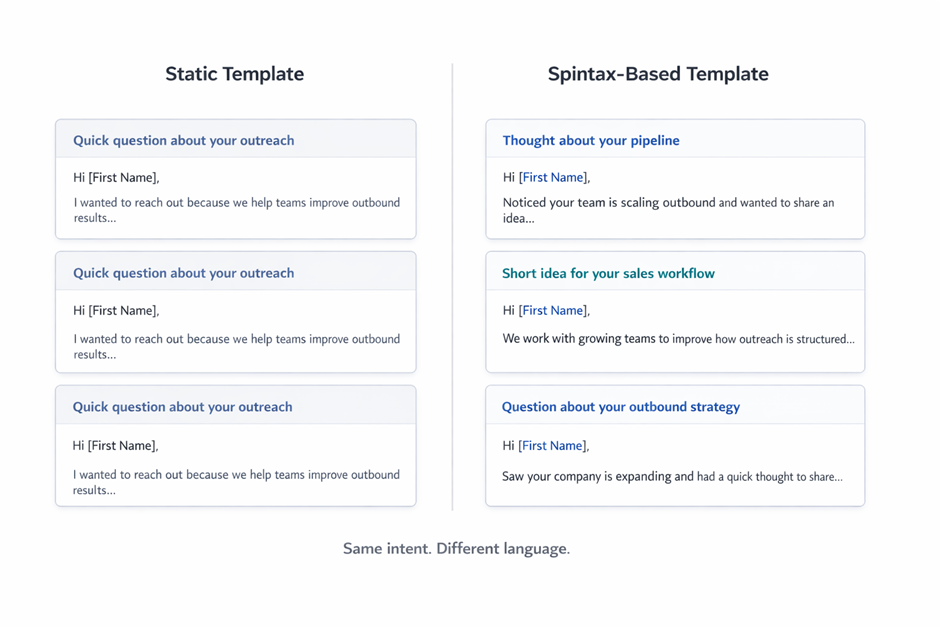
A normal template is static. It contains one version of every sentence. A spintax-based template is dynamic. It contains multiple acceptable versions of each key sentence.
This changes how templates age. Static templates degrade as they are reused. Dynamic templates preserve freshness because they never appear exactly the same twice.
For example, a fixed call to action might say, "Let me know if you're interested." A spintax-based version might say:
Would you be {open to a quick chat|interested in a short call|up for a brief discussion}? The intent remains identical, but the surface language changes.
This reduces pattern recognition and helps maintain a consistent tone without repeating identical phrasing.
The Role of AI in Modern Spintax Usage
Early spintax required users to manually write every variation. This limited adoption because producing multiple versions of each sentence still required time.
With AI email personalization, this barrier has weakened. An AI content generator can now produce alternative phrasings based on role, industry, and campaign goal.
Instead of asking, "How many ways can I say this sentence?" teams can ask, "How should this sentence sound for this type of buyer?"
A message to a founder can emphasize outcomes and efficiency. A message to a marketing leader can emphasize experimentation and growth. Both messages can exist within the same campaign while using different language structures.
When combined with AI outreach automation, spintax becomes part of an adaptive system. Messaging no longer freezes at launch. It evolves with audience response.
This evolution mirrors broader trends in intelligent messaging, which we covered in AI-Powered Cold Emails That Convert in 2026: Trends + Tips.
Spintax provides the mechanism. AI provides the direction.
Where Spintax Creates the Most Value
Spintax is most effective in the parts of an email that tend to become repetitive.
- Subject lines benefit because repeating the same phrasing reduces attention.
- Opening lines benefit because predictable beginnings signal automation.
- Value propositions benefit because the same benefit can be described using different wording.
- Calls to action benefit because requests can be phrased without becoming formulaic.
When these elements vary together, the email reads less like a campaign and more like an individual message.
Practical Example
A fixed sentence might say:
"I wanted to reach out because we help teams book more meetings."
A spintax-based version could say:
I wanted to {reach out|get in touch} because we help teams {book more meetings|generate qualified leads|improve outbound results}. This does not change the offer. It changes the expression. Across large sends, this prevents repetition from dominating the message.
This is how spintax supports cold email personalization without removing automation.
Best Practices for Controlled Variation
Spintax works best when it is used deliberately. The goal is not randomness. The goal is controlled diversity.
A strong approach is to write a normal email first, then rewrite key sentences in two or three different ways and place those variations into spintax format. This preserves clarity while introducing flexibility.
Phrase-level variation is safer than word-level variation because it maintains grammar and meaning. Tone should remain consistent across all versions to avoid instability in voice.
Testing is essential. Every possible combination should be reviewed before launch to ensure it still sounds natural.
When used properly, spintax does not make emails feel generated. It makes them feel rewritten.
How Modern Outreach Tools Apply Spintax
Most modern outreach platforms support some form of phrase variation. Entry-level tools such as Mailchimp or HubSpot allow simple text rotation. Open-source scripts and spreadsheet logic can also generate spintax-style outputs for teams with technical resources.
More advanced platforms integrate spintax into AI-generated sequences. These systems generate variations automatically based on audience and campaign logic rather than requiring users to write them manually.
One example is SalesTarget, which embeds spintax generation into its AI-powered outreach system. Users define their audience and message strategy, and the platform applies controlled variation inside AI-written messages so that each email remains aligned with the same intent while differing in surface language.
The important shift is not the tool itself. It is the movement from manual rewriting to system-driven variation.
Where Spintax Should Not Be Used
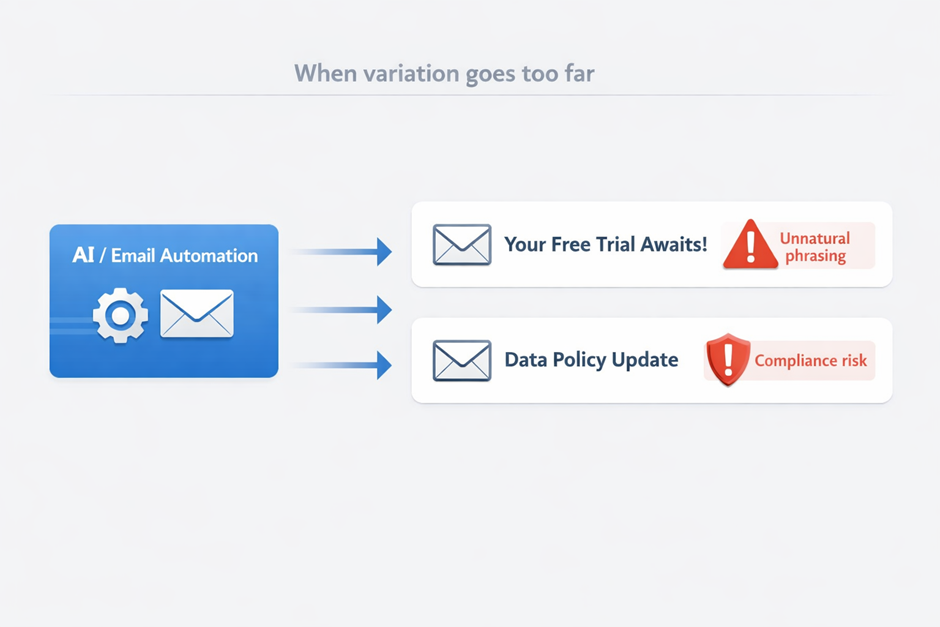
Spintax is not universally safe.
It should not be used in legal communication, compliance notices, or brand announcements where wording must remain exact.
It also introduces technical risks if applied poorly. Overuse can create unnatural sentence combinations that reduce readability or subtly change meaning. In extreme cases, poorly structured variation can increase spam filtering risk if messages appear inconsistent or artificial.
Mailbox providers evaluate message consistency and sender behavior closely, as explained in Google's official guidance on bulk email senders.
There is also an operational risk. Email filtering systems also assess content patterns and engagement signals, as detailed in Microsoft's anti-spam protection guidelines. Testing becomes harder when variation is uncontrolled. If every recipient sees a different version, isolating which phrasing performs best becomes difficult unless variation is structured and tracked.
Finally, there is an ethical dimension. AI-driven personalization should avoid deceptive variation. Spintax should not imply false familiarity, fabricate context, or simulate human behavior in misleading ways. Variation should improve clarity and relevance, not manipulate perception.
Spintax works best when it supports honesty, not when it hides automation.
Conclusion: Language Must Scale With Data
Cold email personalization does not fail because it is unimportant. It fails because language does not scale as easily as data.
Spintax generators address this imbalance by allowing language to vary while structure remains stable. When combined with AI email personalization and AI outreach automation, they allow teams to scale without turning communication into output.
The future of cold email is not defined by how many messages can be sent. It is defined by how natural those messages remain as volume increases.
Spintax does not solve outreach.
It prevents it from becoming mechanical.